-
-
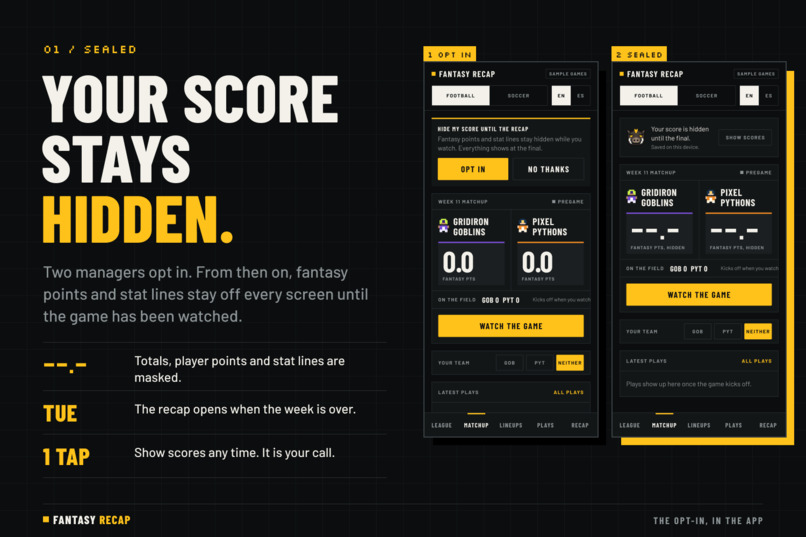
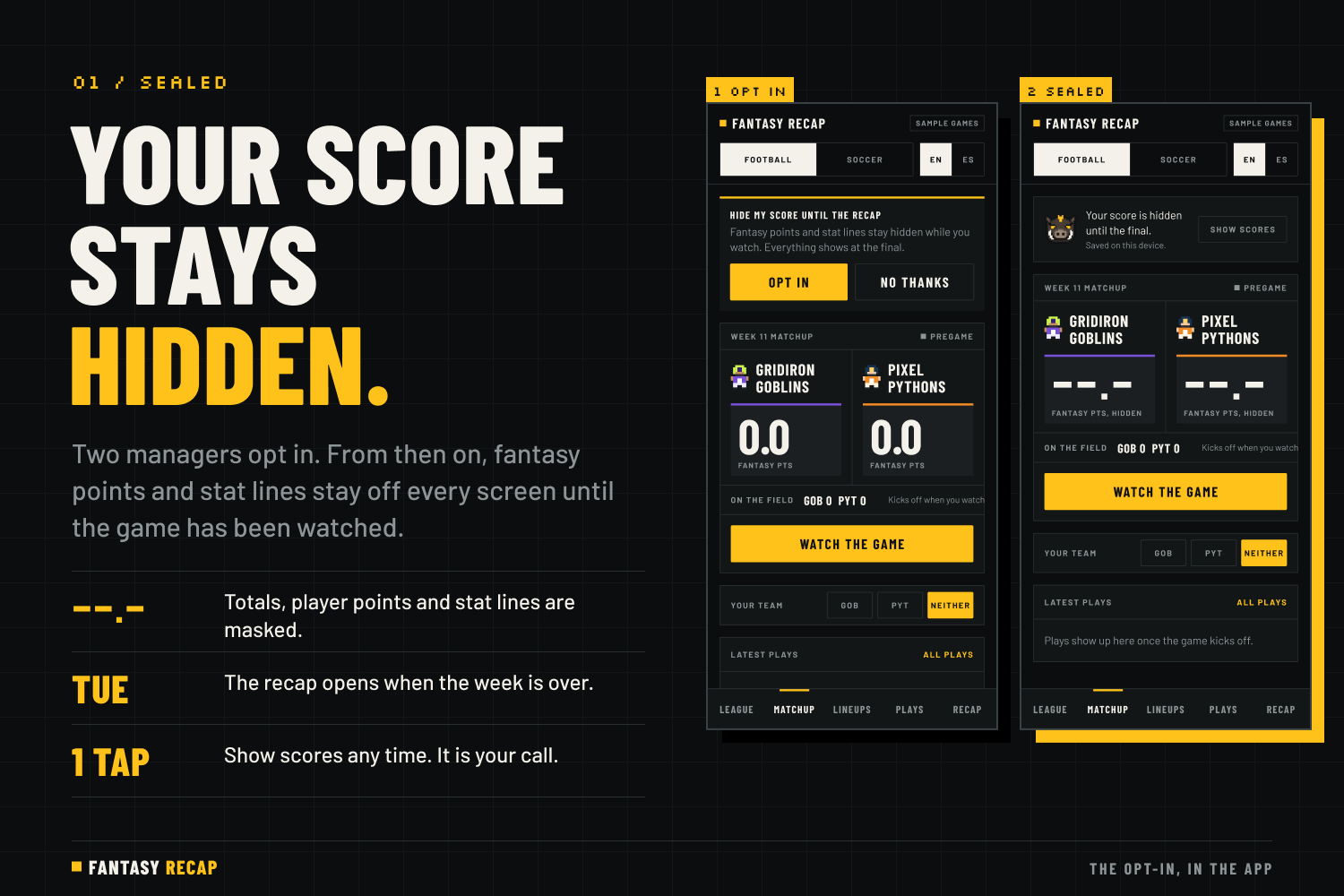
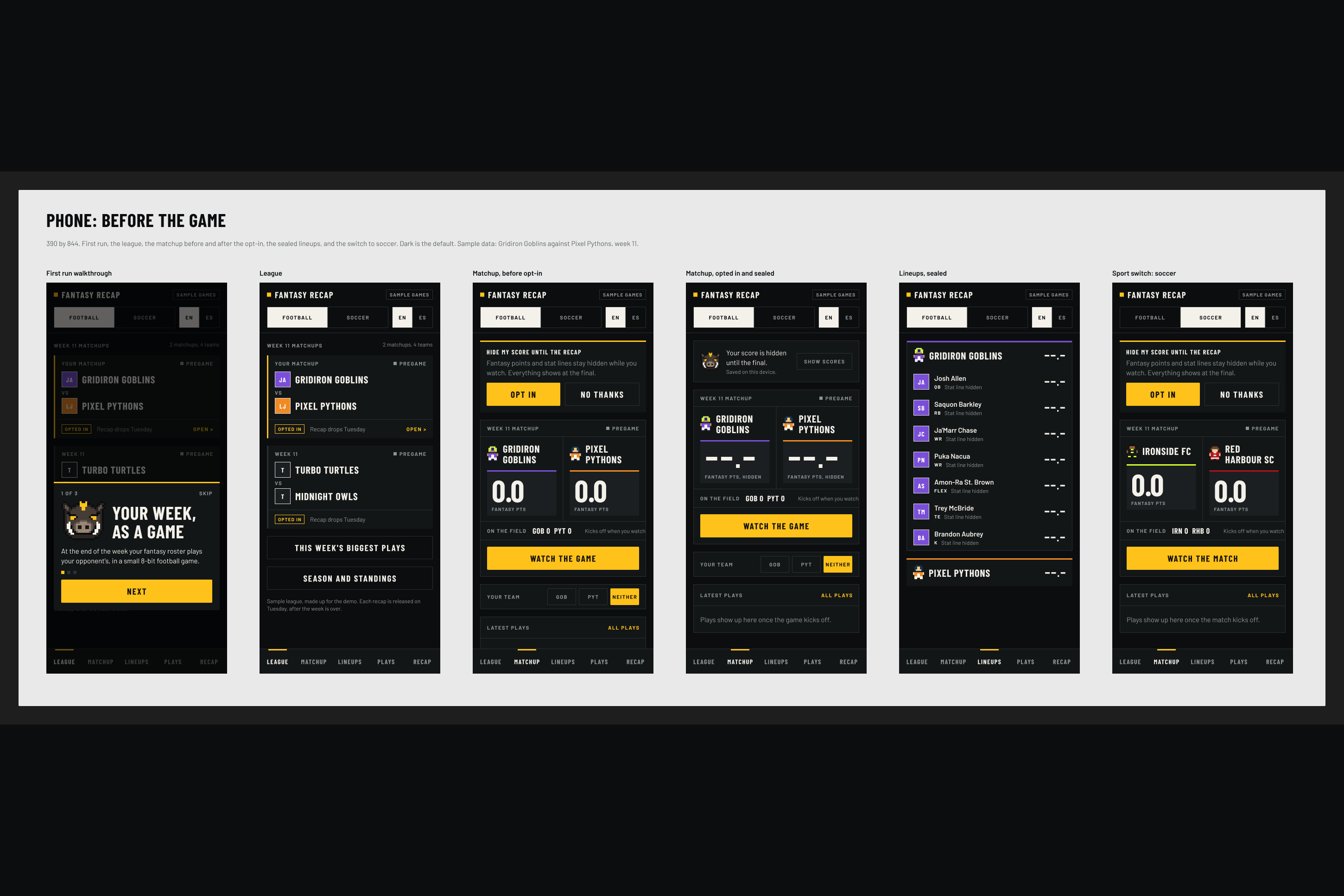
Opt in and your score stays hidden until the final whistle
-
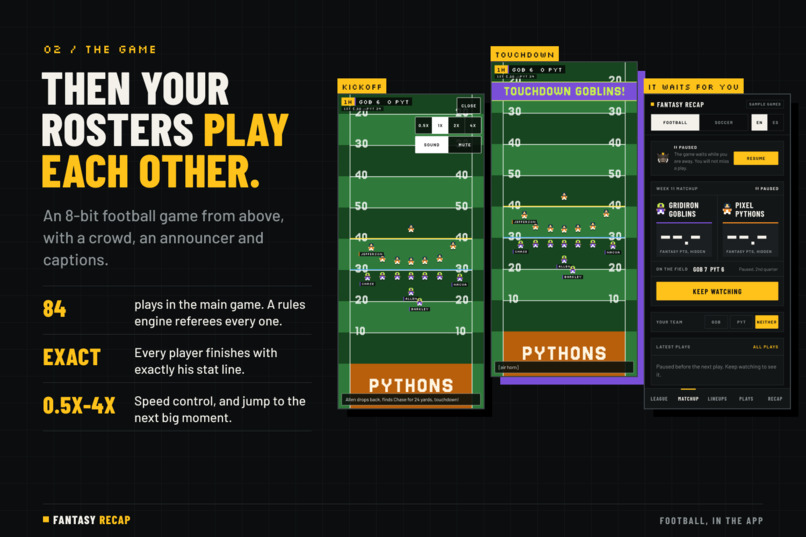
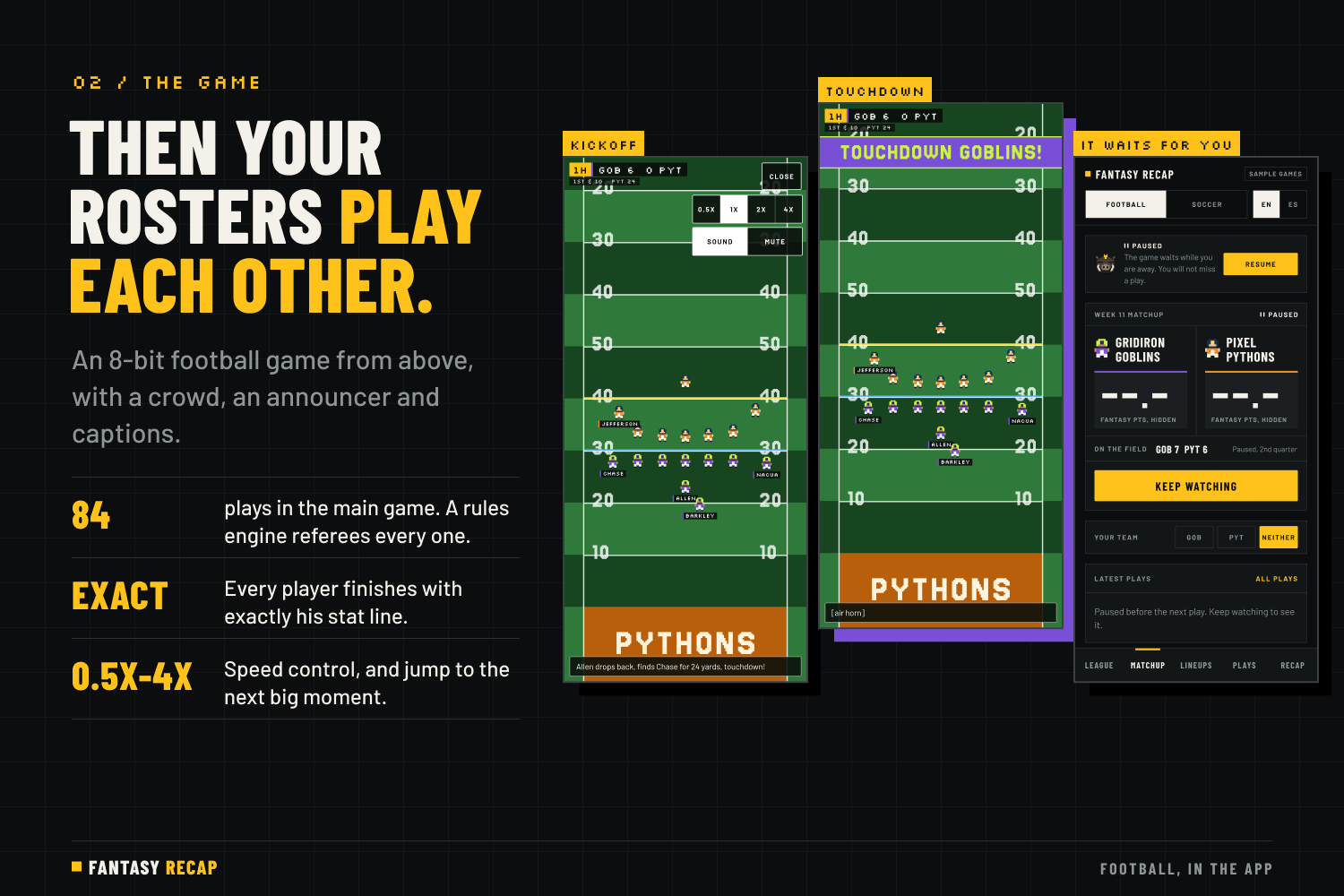
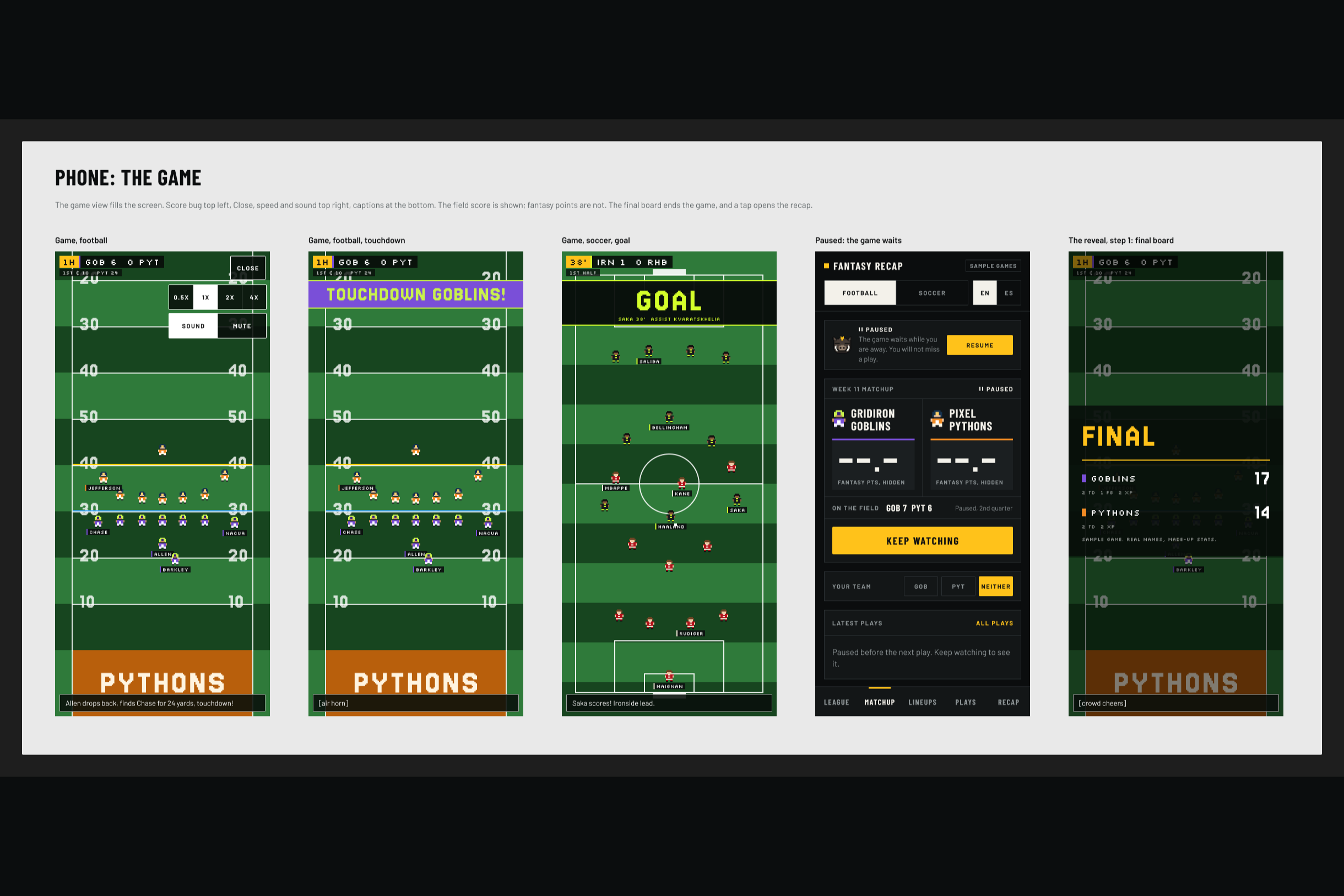
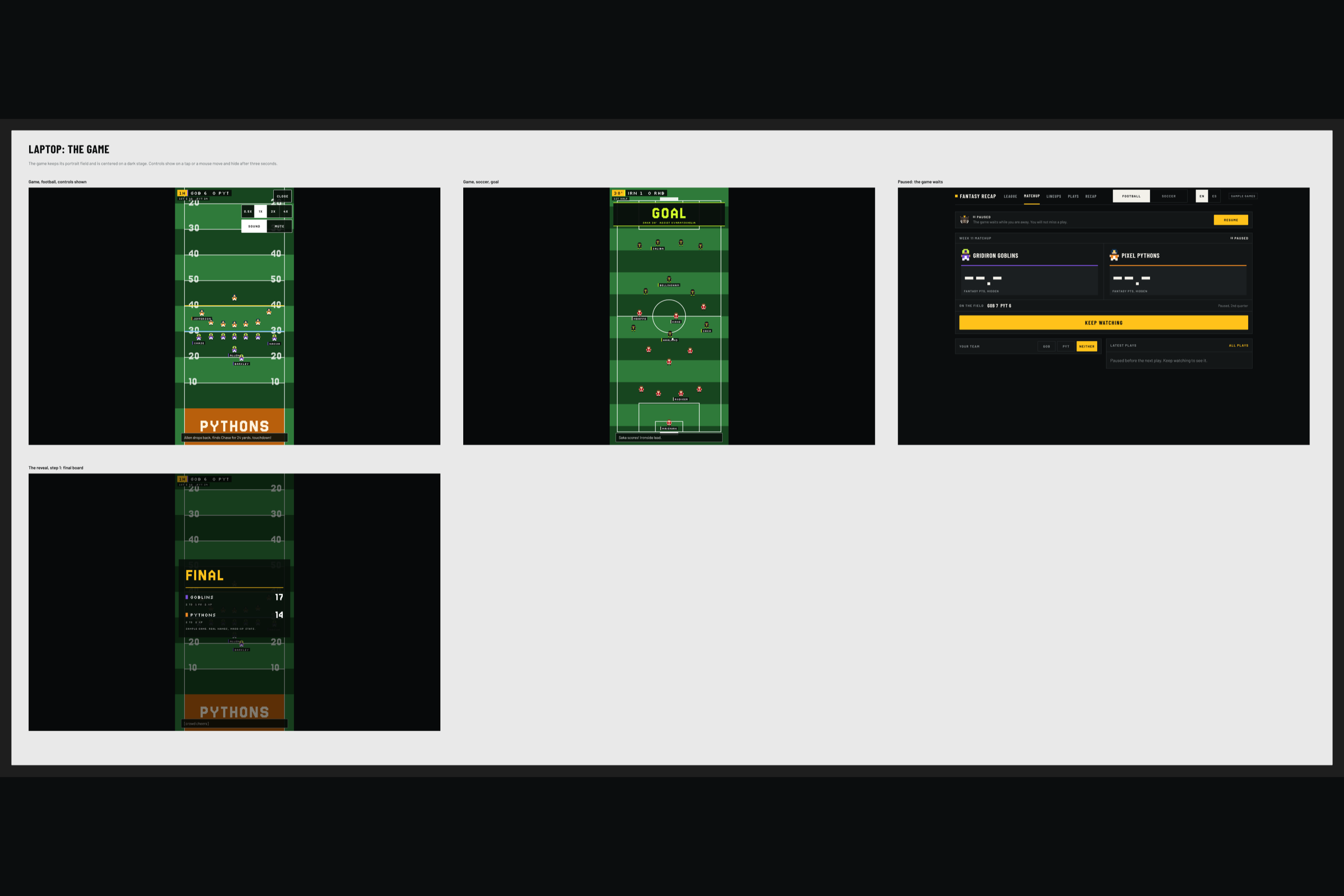
The game: every fantasy point shown as the play that earned it
-
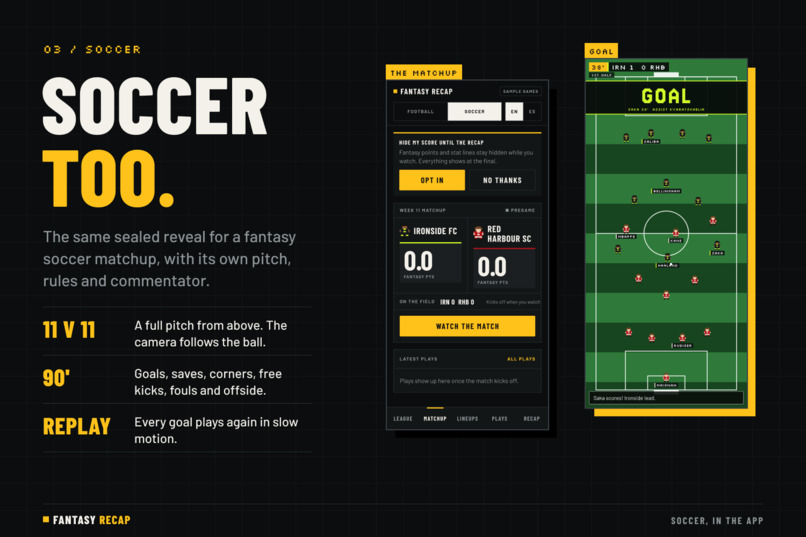
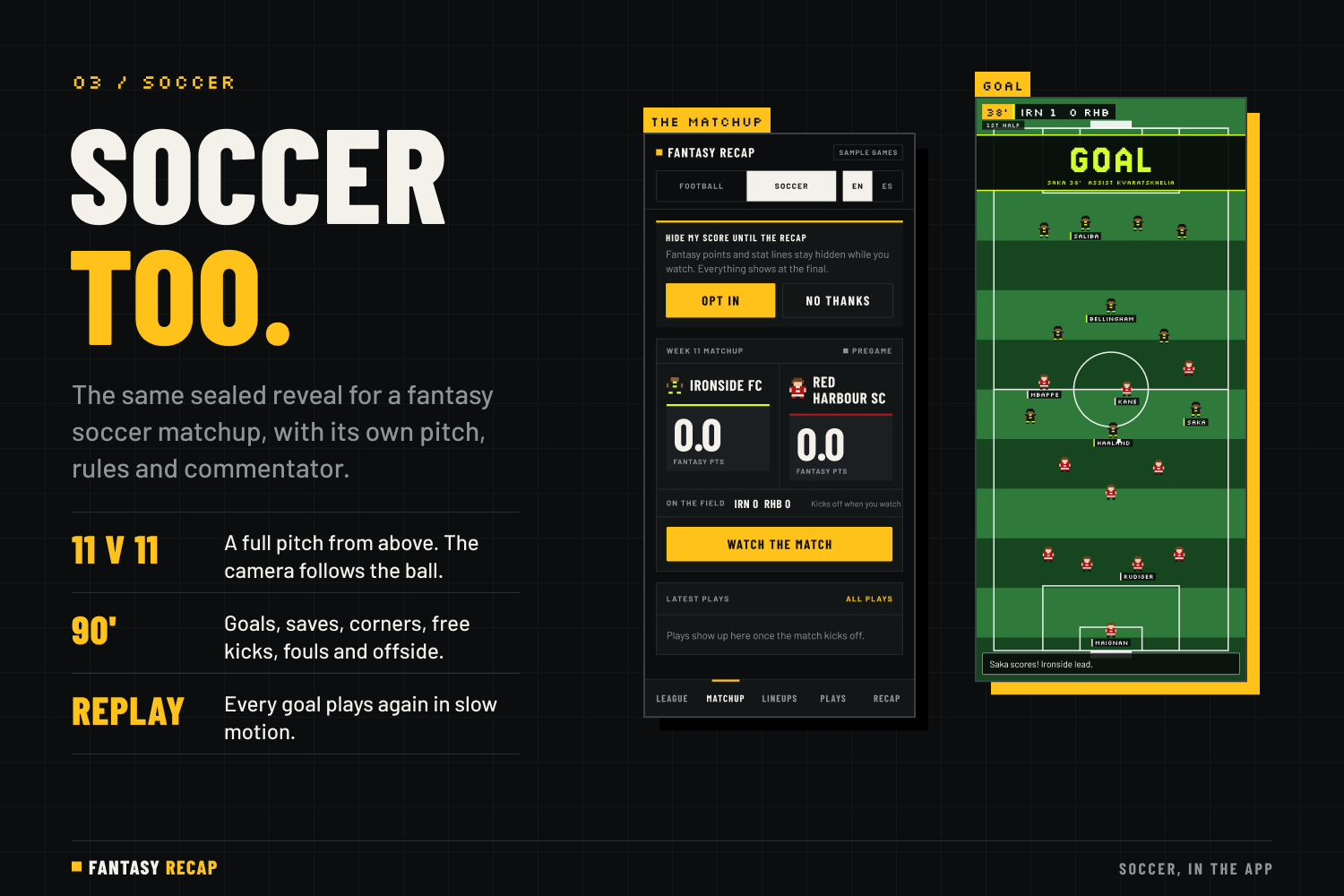
Soccer, in the same app
-
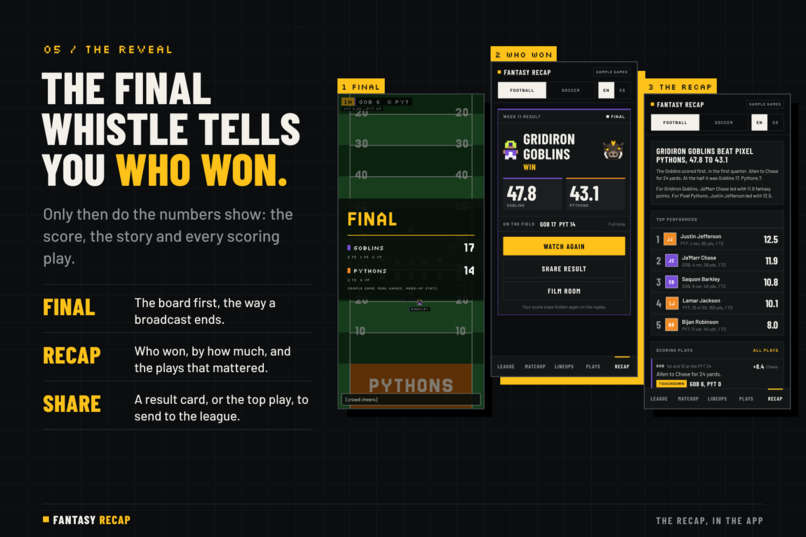
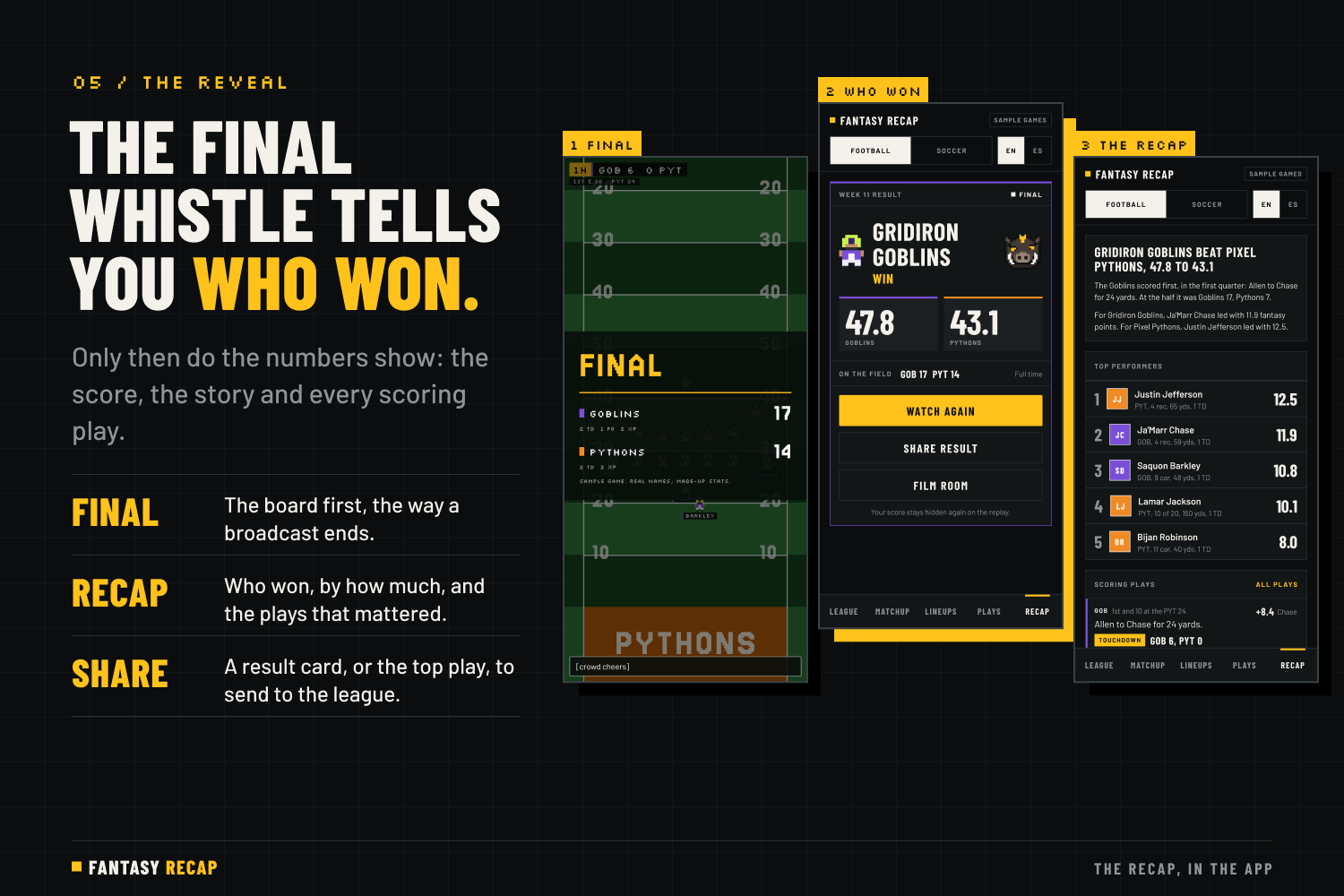
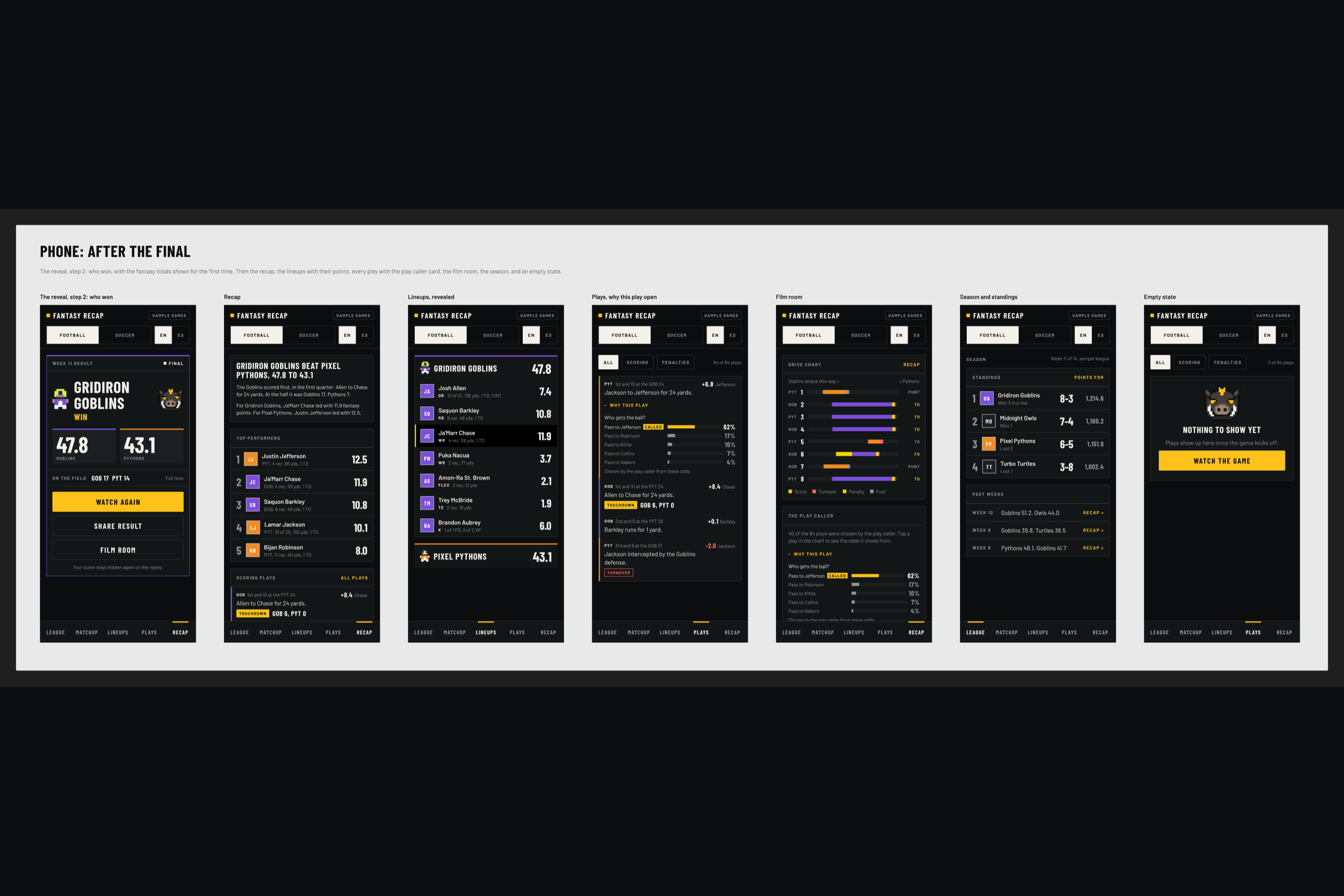
The reveal: the final board and the recap
-
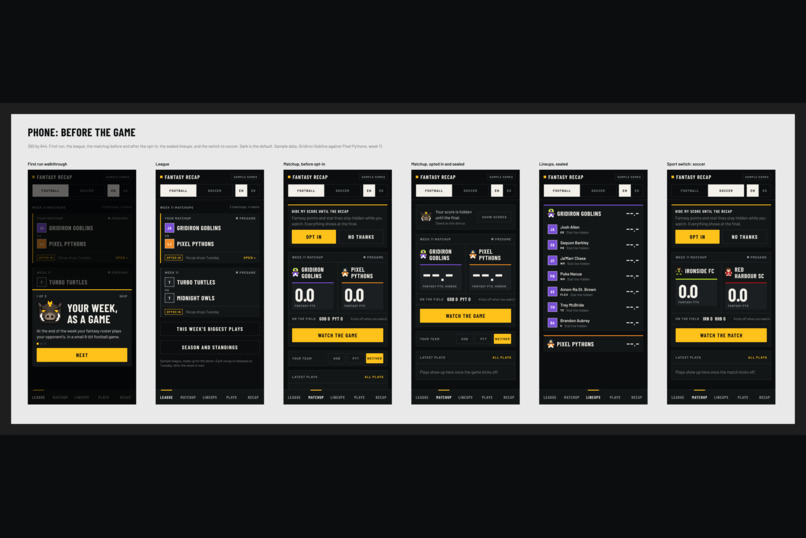
Phone screens: before the game
-
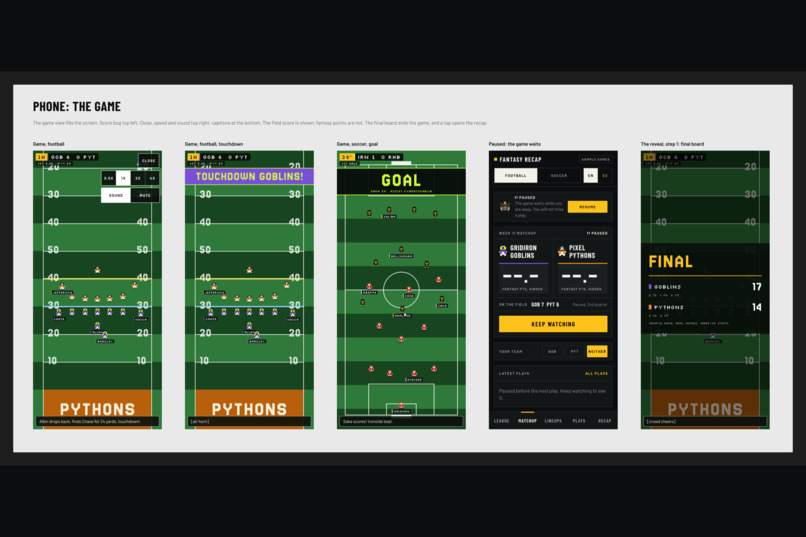
Phone screens: the game
-
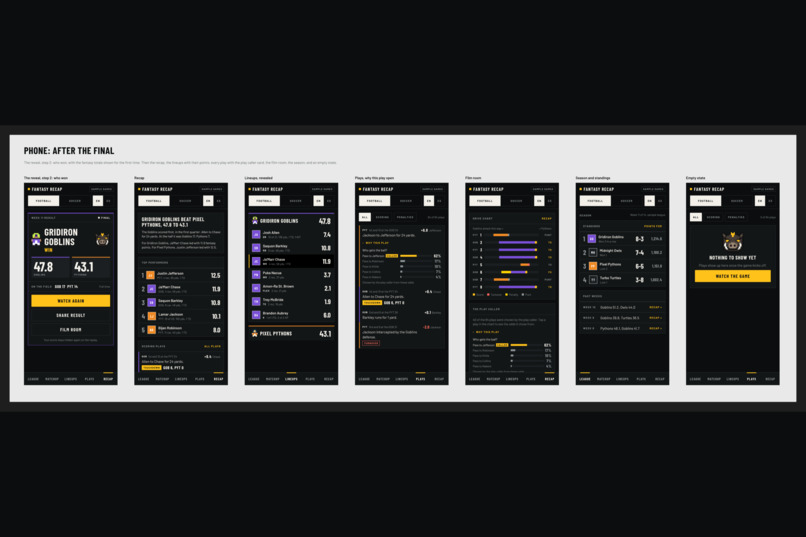
Phone screens: after the final
-
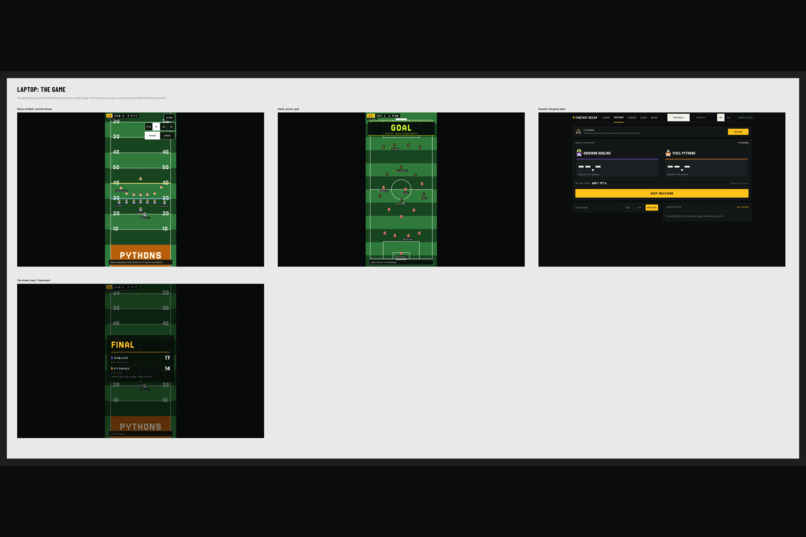
The game on a laptop
-
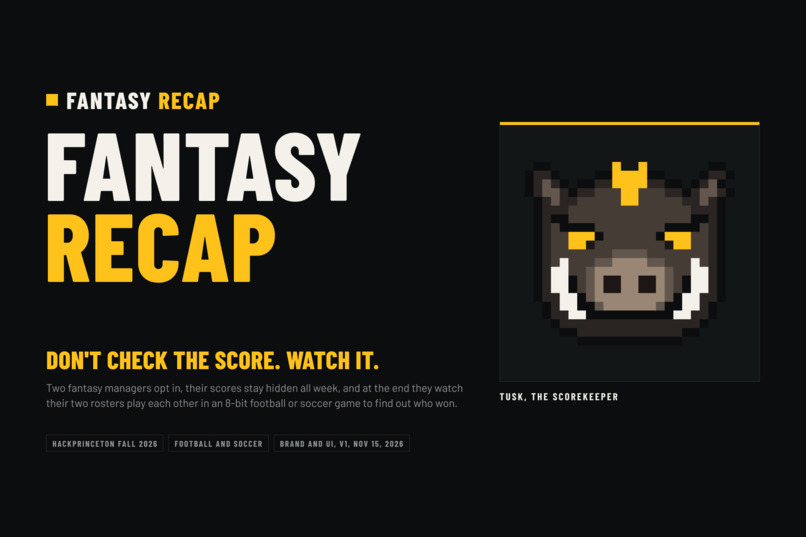
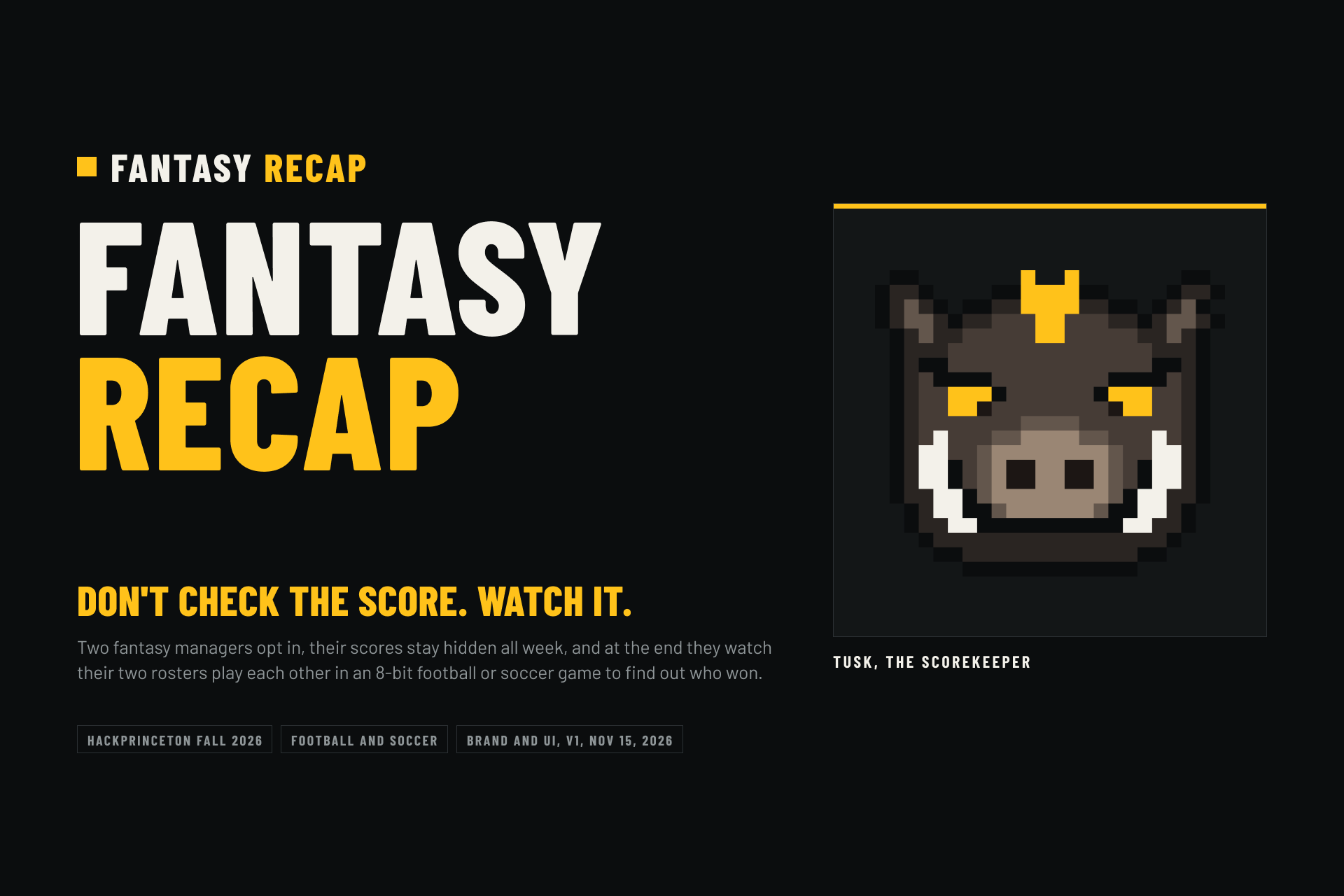
Fantasy Recap: the design file cover
-
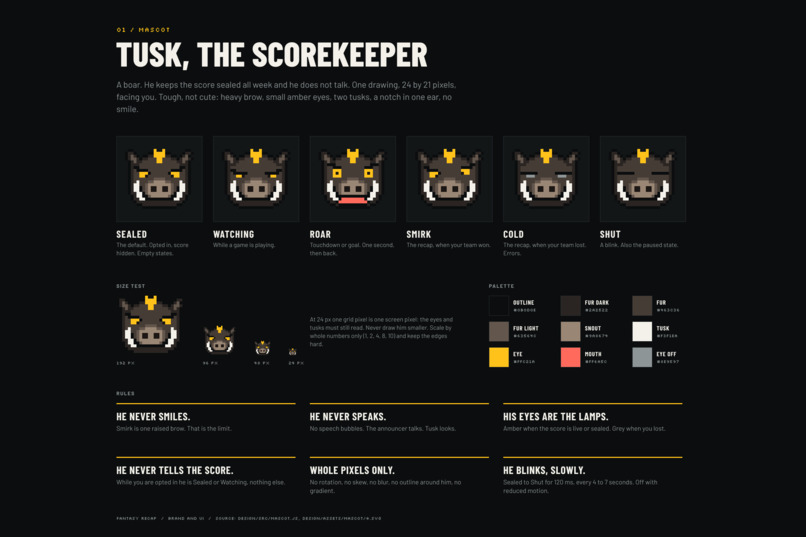
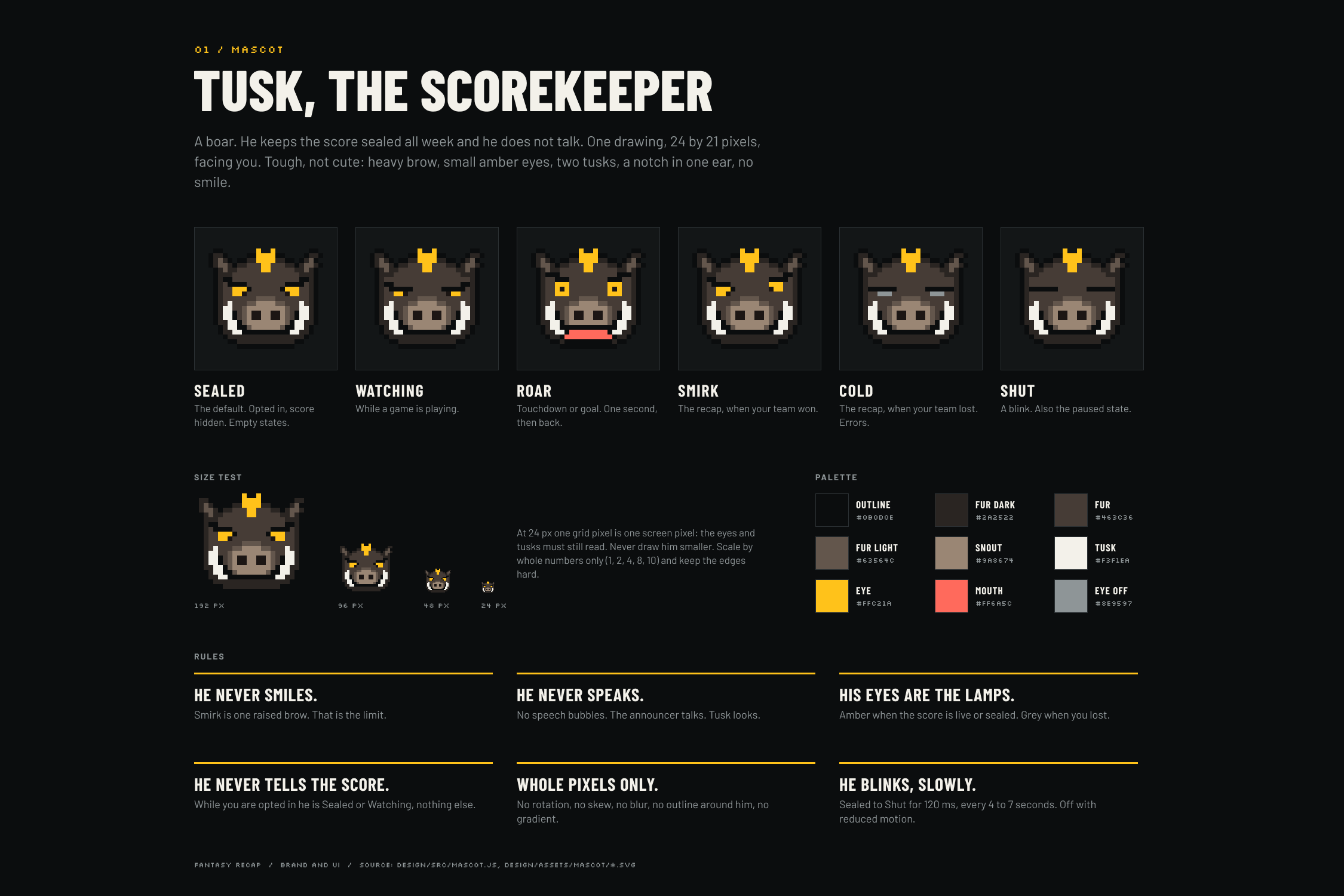
Tusk, the mascot
-
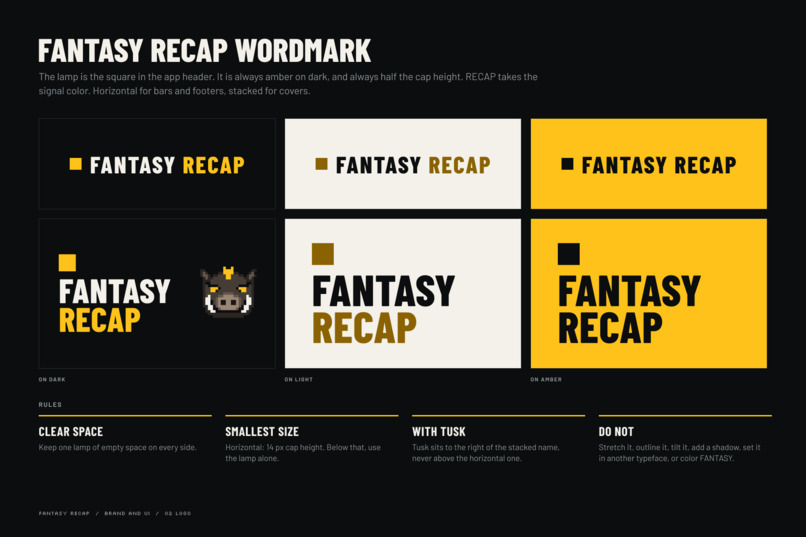
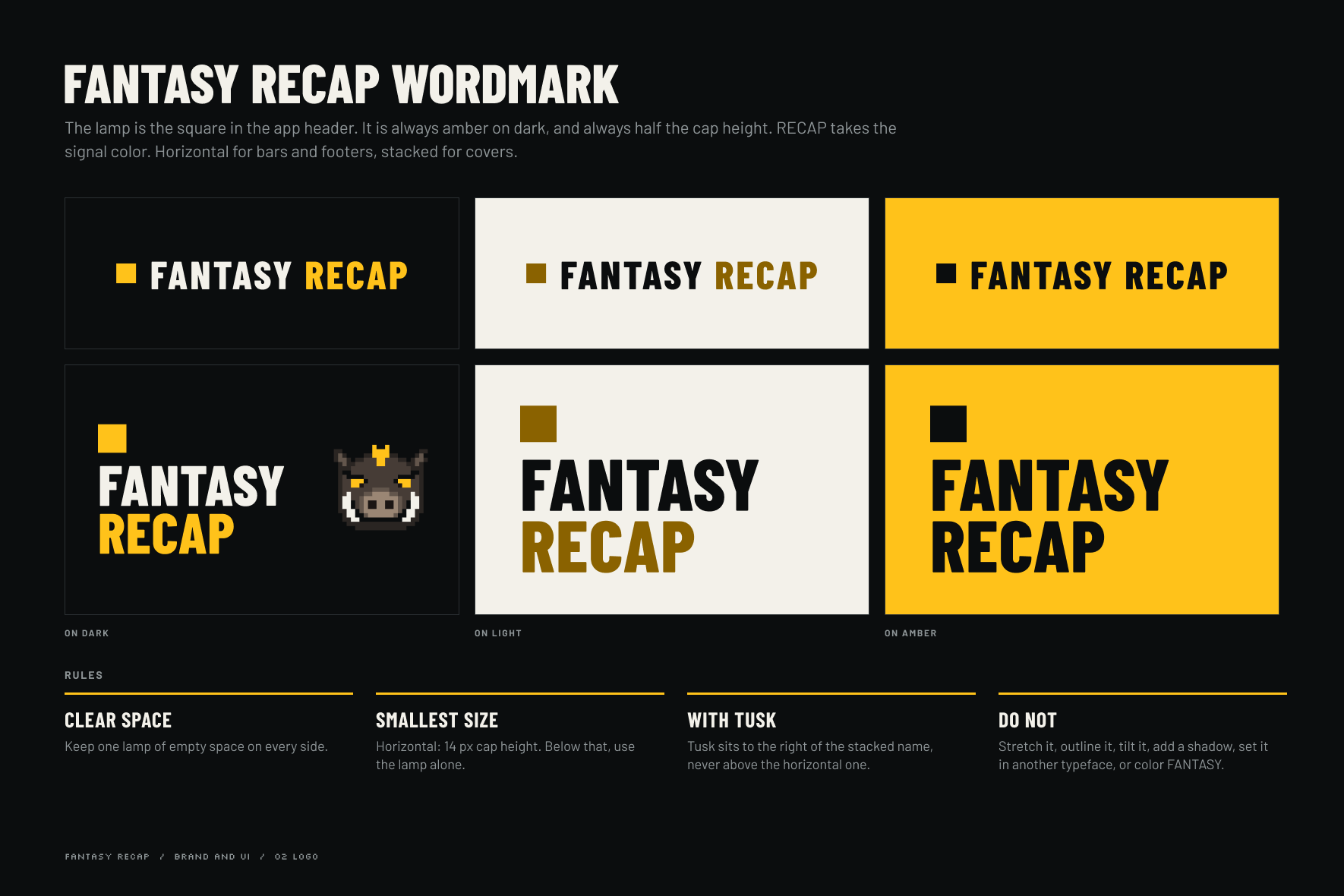
The wordmark
-
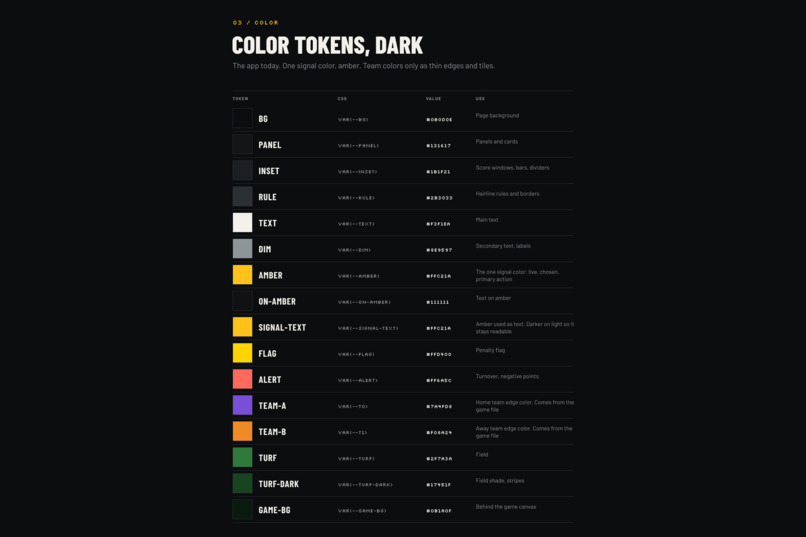
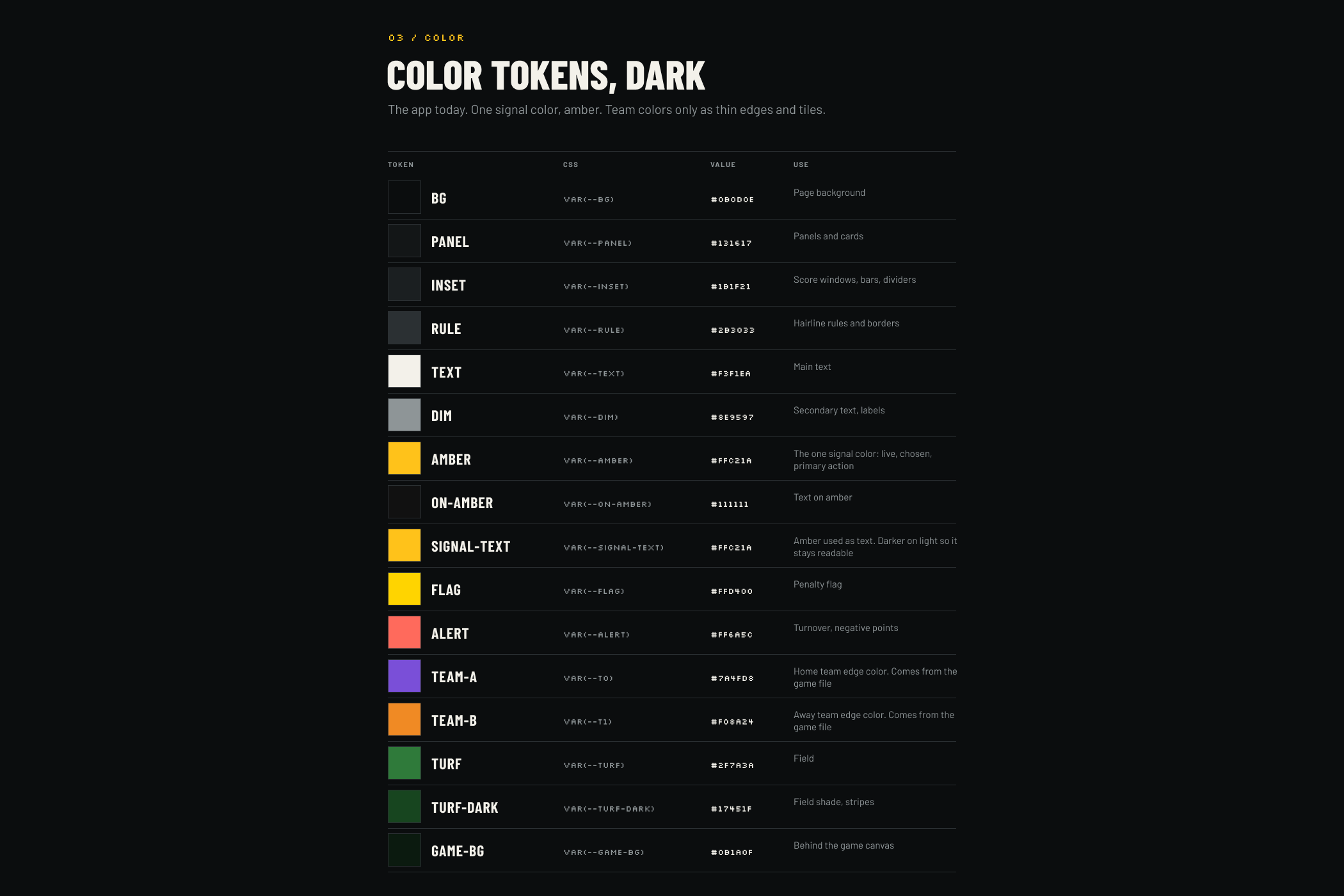
Color tokens
-
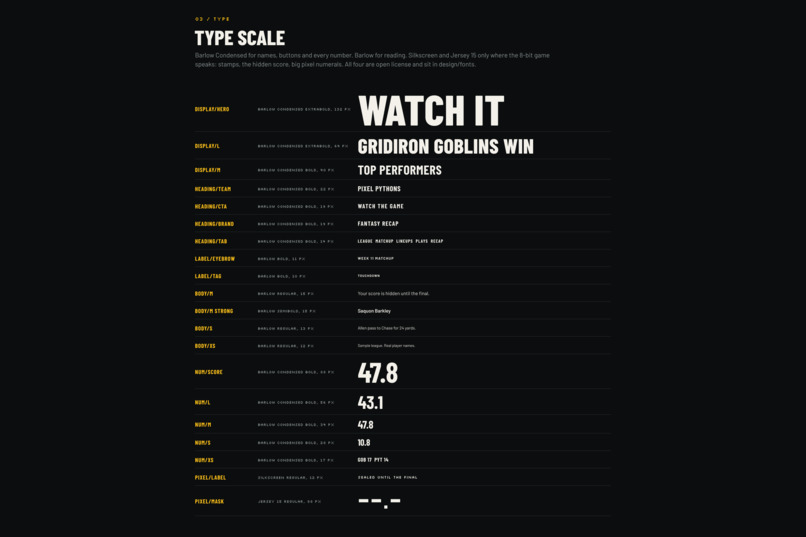
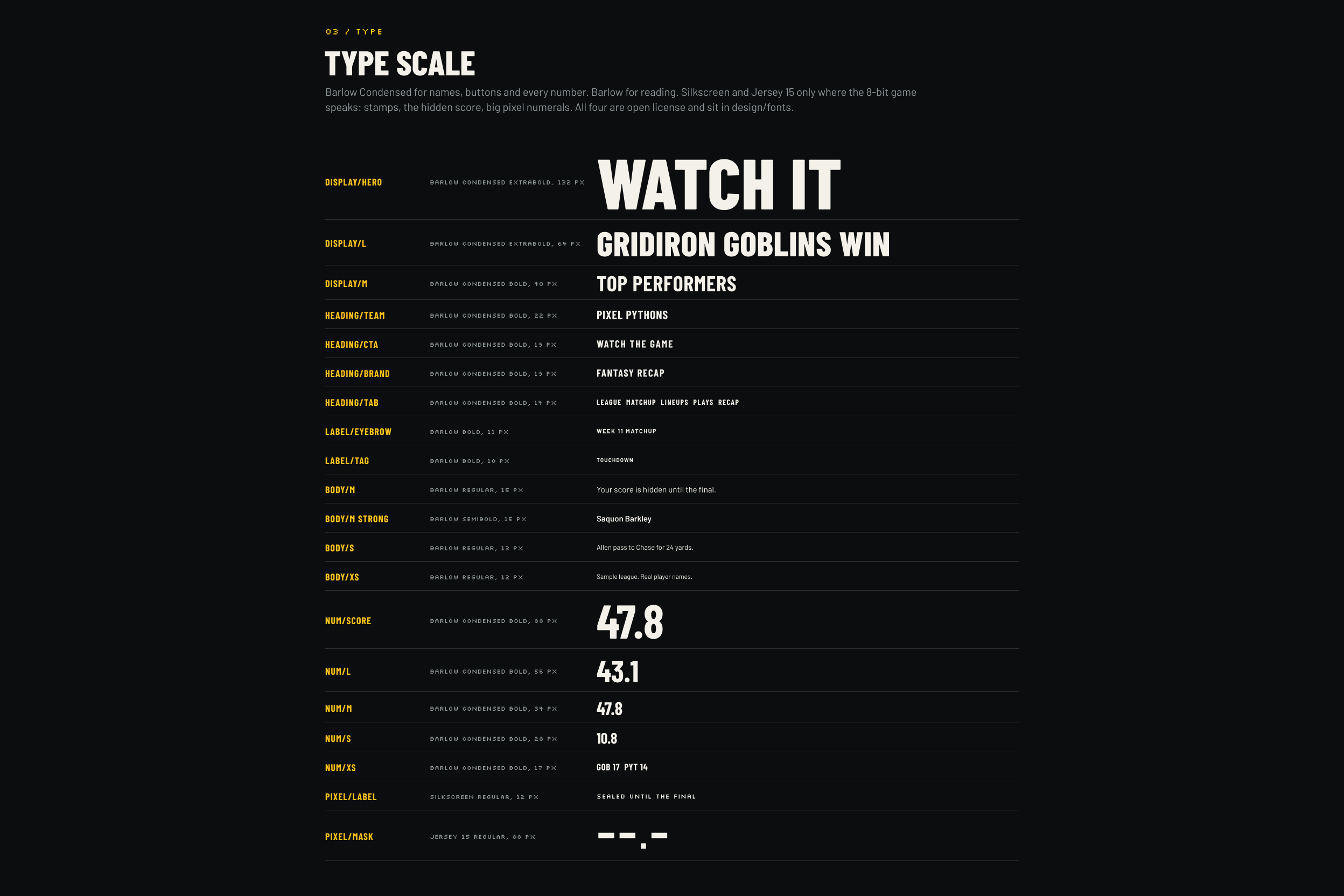
Typography
-
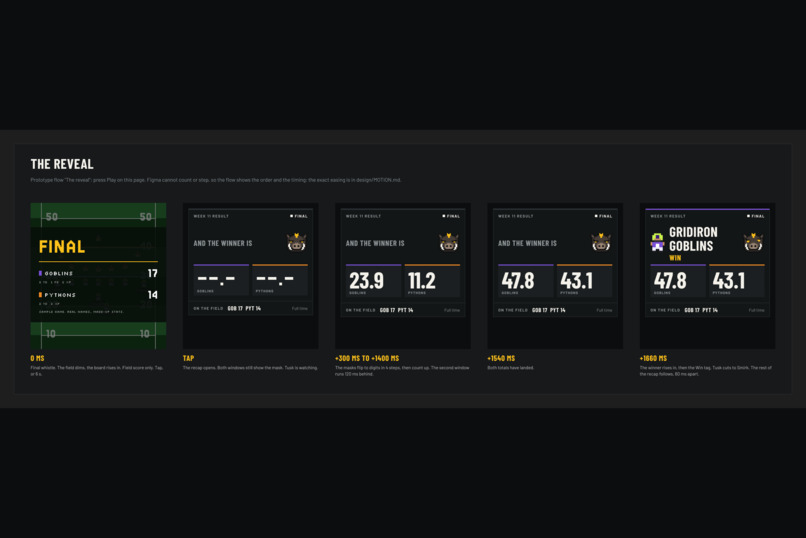
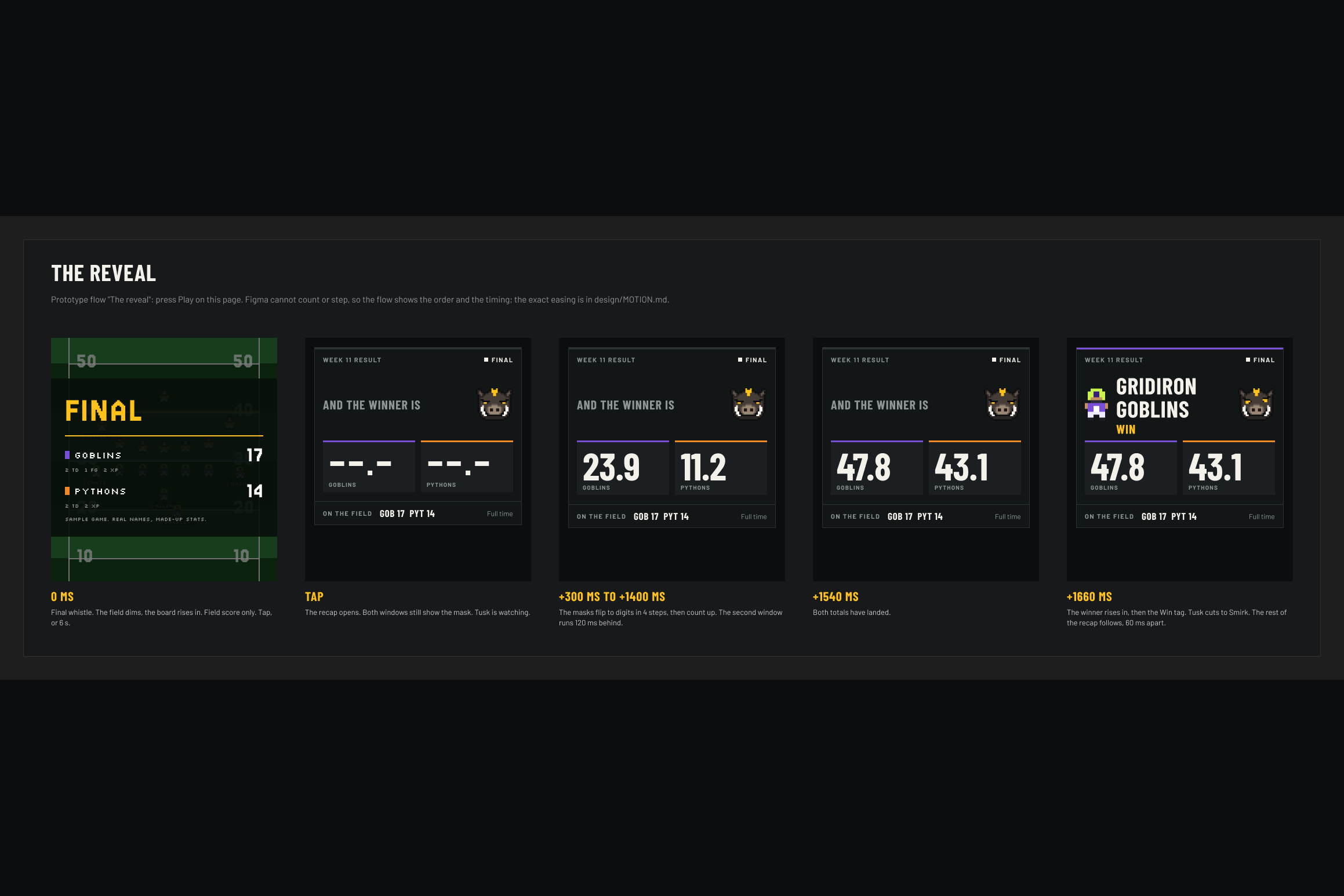
Motion storyboard: the reveal
Inspiration
Fantasy football managers never get to watch their own roster play together, and once you know your score there is nothing left to watch. We wanted the end of the week to feel like game day again.
What it does
Two managers opt in when their matchup is set. Their scores stay hidden. At the end they watch their two rosters play each other: pixel players on a stadium field with a crowd, a play by play announcer, a halftime report that leaves out the points, speed controls. Only at the final whistle does the recap say who won, with the story of the game, the top performers and every scoring play. Soccer works the same way on its own page.
In this demo there is one viewer on one device, not two accounts, and no real week of waiting. The opt-in is kept in the browser, and also sent to our service when the page is opened with its address. The players are real NFL players and footballers. The football game the app opens on is built from the real plays of NFL week 9: every catch and run these players really made, arranged into one matchup, so the fantasy points are real and the matchup and the score on the field are ours. A second football game (Goblins against Pythons) and the soccer match come from invented stat lines, so neither is a real result.
How we built it
Four people, each directing AI coding agents on one part, coordinated through a written contract and a board. The app is plain browser code with no framework and no build step. A rules engine works out downs, distance and score. A game maker builds a full legal game, either from a real week's plays or from target stat lines, so every player ends with exactly those numbers; a separate check replays each game and compares every number. For a game built from stat lines a play caller called Jev picks the plays: Jev chose 40 of the 84 plays of the Goblins against Pythons game, and the rules engine refereed every play. The announcer writes its lines from templates, and the lines of the featured games are ElevenLabs recordings. Scout, a research agent, reads Sleeper and ESPN and produces player profiles and scouting reports. A small Node service on Tiger Data stores plays and serves the league, momentum, player trends and Scout's reports.
Tiger Data track
The database is Tiger Data (PostgreSQL with TimescaleDB). Every play is a row stamped with the time it happened in the game, in a hypertable. Continuous aggregates give fantasy points per player per game, per team per quarter and per player per week. Three more pieces use what TimescaleDB adds over plain PostgreSQL: momentum buckets each team's fantasy points over game time with time_bucket; a hypertable of fantasy awards feeds the weekly continuous aggregate that answers GET /players/:id/trend (week over week points and a hot streak); and push-game spreads games over real weeks so the weekly buckets mean something.
What ran on Tiger Data: all of it. From Juan's laptop, sh db/laptop.sh applied the schema, the seed and every migration on the real Tiger Data service, started our service against it, pushed every football and soccer game file and called every route. The first run was honest with us: the momentum route answered with date_bin, because our check for time_bucket failed on Tiger Data (the function has many overloads), and the weekly trend came back from files, because the continuous aggregates only showed refreshed rows. We fixed both that night (the function is now found through pg_proc, and a migration makes the aggregates real-time) and ran it again: no step failed, the momentum answer said time_bucket, and a 19 check test against a real database (node server/test-db.js) passed on Tiger Data, with the database's momentum buckets equal to the JavaScript buckets and the trend read from the weekly aggregate. Both run reports are in the repository. Before that night everything beyond the first schema had only run on a plain PostgreSQL 16, with date_bin standing in for time_bucket. What the app does today: it plays from a game file and reads no plays from the database; opened with the service address it sends the opt-in, reads the league and uses the commissioner and watch party routes.
LangChain deep agents track
Scout is a deepagents team: a main agent plans with a todo list and delegates through the task tool to three subagents. The stats researcher builds a profile from Sleeper season numbers. The film room studies a player's real play by play from ESPN (3,177 snaps of the 28 roster players) and returns findings as structured claims. The fact checker verifies every cited play against the plays file and writes the report; the report writer refuses any claim without evidence and any play that is not a real play of that player. Every report claim links to the ESPN game behind it. Offline tests run the whole team on a scripted stand-in model, including a made-up play being refused. The agent itself has run once with a real model: one player (Puka Nacua), model gemini-3.5-flash-lite, about 2 minutes, with the main agent and all three subagents working. Its report passed the evidence check but was weaker than the one we kept. That was the only model run, so the other 27 players have not run through the agent. The 28 scouting reports in the repository were written by hand with Scout's tools, not by the agent, and say so on their second line: the numbers were pulled live from Sleeper and ESPN, each claim was written from the splits the film room tools returned, and every cited play passed the fact checker's tool before the report writer saved it. Each football team also has a team profile built the same way: how the offense moves the ball, who gets the ball in the red zone and on third down, and who is hot or cold.
What is real and what is simulated
Real: the rules engine and the check that replays every game; the player names and rosters; season tendencies and recent form read live from Sleeper, cross-checked against ESPN (all agree); 3,177 real plays and the two week 9 games built from them, one of which is the game the app opens on; the database, tested end to end on Tiger Data; Jev's play calls in the two football games built from stat lines; the ElevenLabs recordings (about 740 football lines and 280 soccer lines); 28 scouting reports with the plays behind every claim.
Simulated: every play of the Goblins against Pythons game, the Turtles against Owls game and the soccer match (invented stat lines, real names); in the games built from real plays, the drive starts, incompletions, penalties, the clock and the score on the field; the league and the second manager (sample data); the week of waiting.
Not checked: sound and speed on a real phone, the voice by ear on the demo machine, the app reading its plays from the database (it does not), one summary route that came back empty on Tiger Data, the Claude path of Scout, and a model run for 27 of the 28 players.
Run it
python3 -m http.server 8000, then openhttp://localhost:8000(no install, no build).- Check everything:
node data/checks/all.js(addDATABASE_URLfor the database and browser checks). - With a database:
DATABASE_URL=<connection string> sh db/laptop.sh, thennode server/index.jsand open the app with?api=http://localhost:3001.
Challenges we ran into
Keeping several agents from stepping on each other: we gave each person their own files and an agreed contract. Hiding the score in every place it could leak: floating points, the recap text and stat lines. Building a game that is legal football and still reproduces every stat line exactly. And the first run on the real database told us our own service was quietly using the fallback query, which we only saw because the report says which engine answered.
Accomplishments that we're proud of
A full game that plays start to finish in a browser, with scores hidden until the end if the viewer opts in. A game maker that reproduces every stat line exactly, with a decision model choosing the plays, and a second mode that builds a game from a real week's plays. A rules engine checked against every game. A database that ran end to end on Tiger Data. A second sport, soccer, on the same pattern.
What we learned
Writing the interface down first saves more time than any single feature. Saying what we did not check was as useful as saying what we did.
What's next for Fantasy Recap
Run Scout across all 28 players on a stronger model. Build a game with the filled profiles. Have the app read plays, momentum and trends from the service. Real leagues with two managers watching together, accounts, and testing on phones.
Built With
- claude-code
- css3
- deepagents
- elevenlabs
- espn
- gemini
- html5
- javascript
- jev
- langchain
- node.js
- postgresql
- python
- sleeper
- timescaledb
- typesafe
