-
-
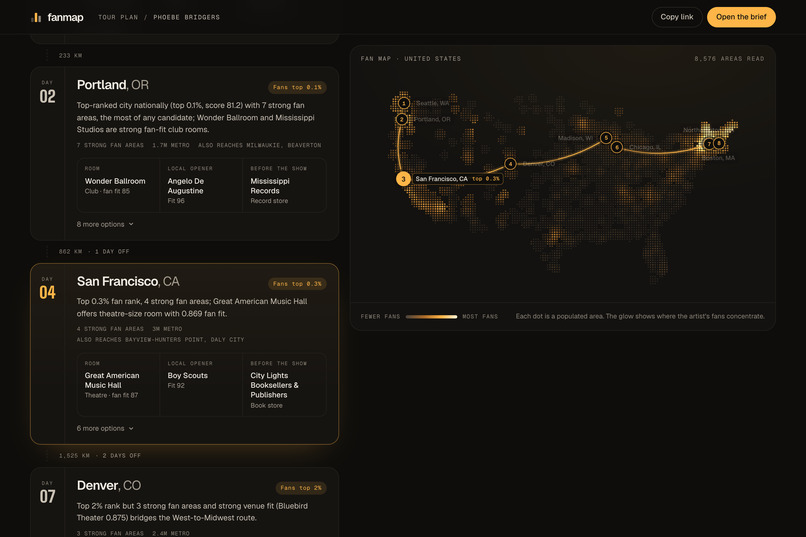
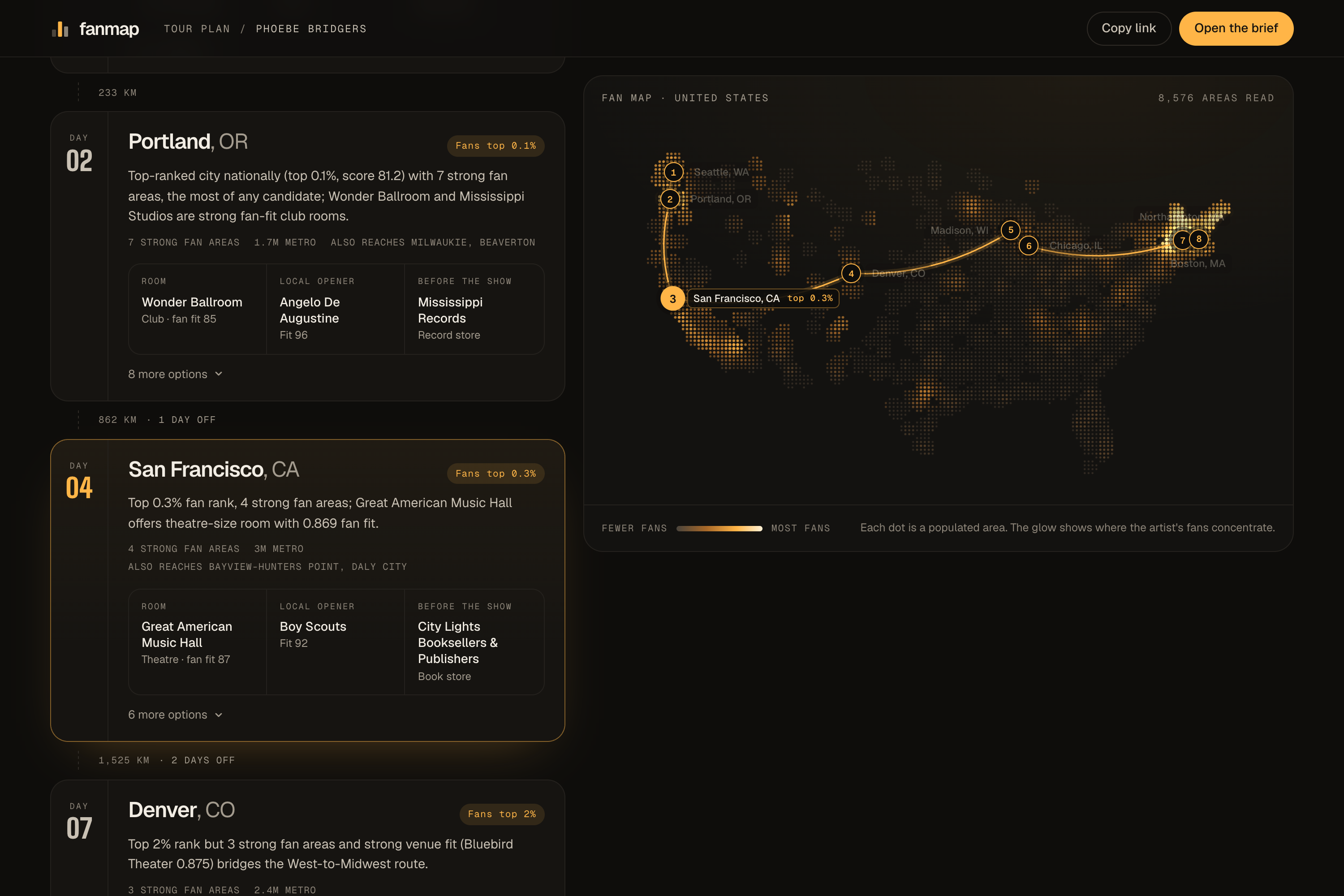
Night by night: a room, a local opener and the reason for every stop, linked to the route on the pinned fan map.
-
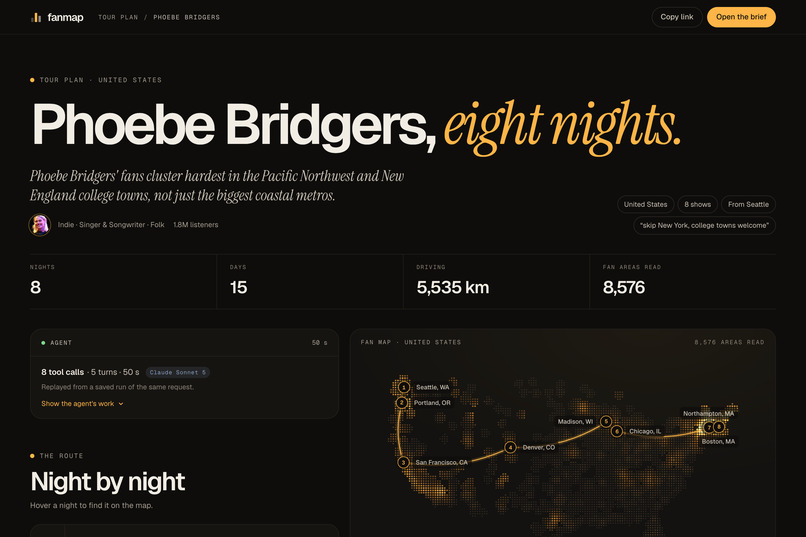
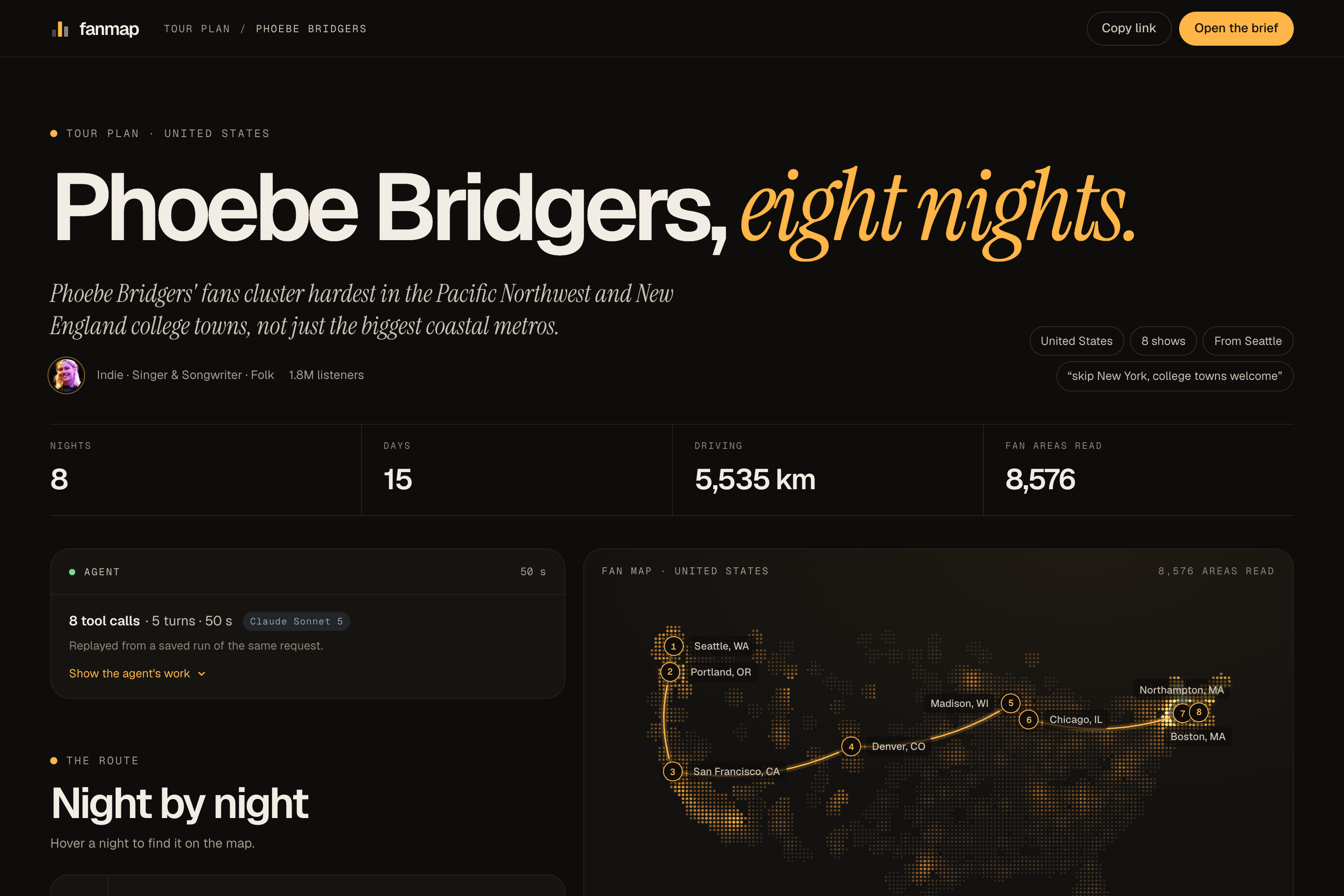
Phoebe Bridgers, eight US nights: 8,576 fan areas read, a 5,535 km route, built live by the agent.
-
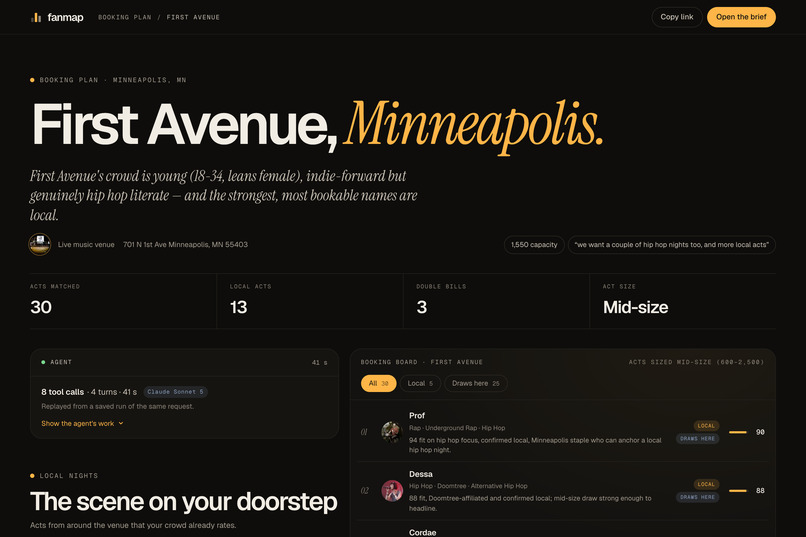
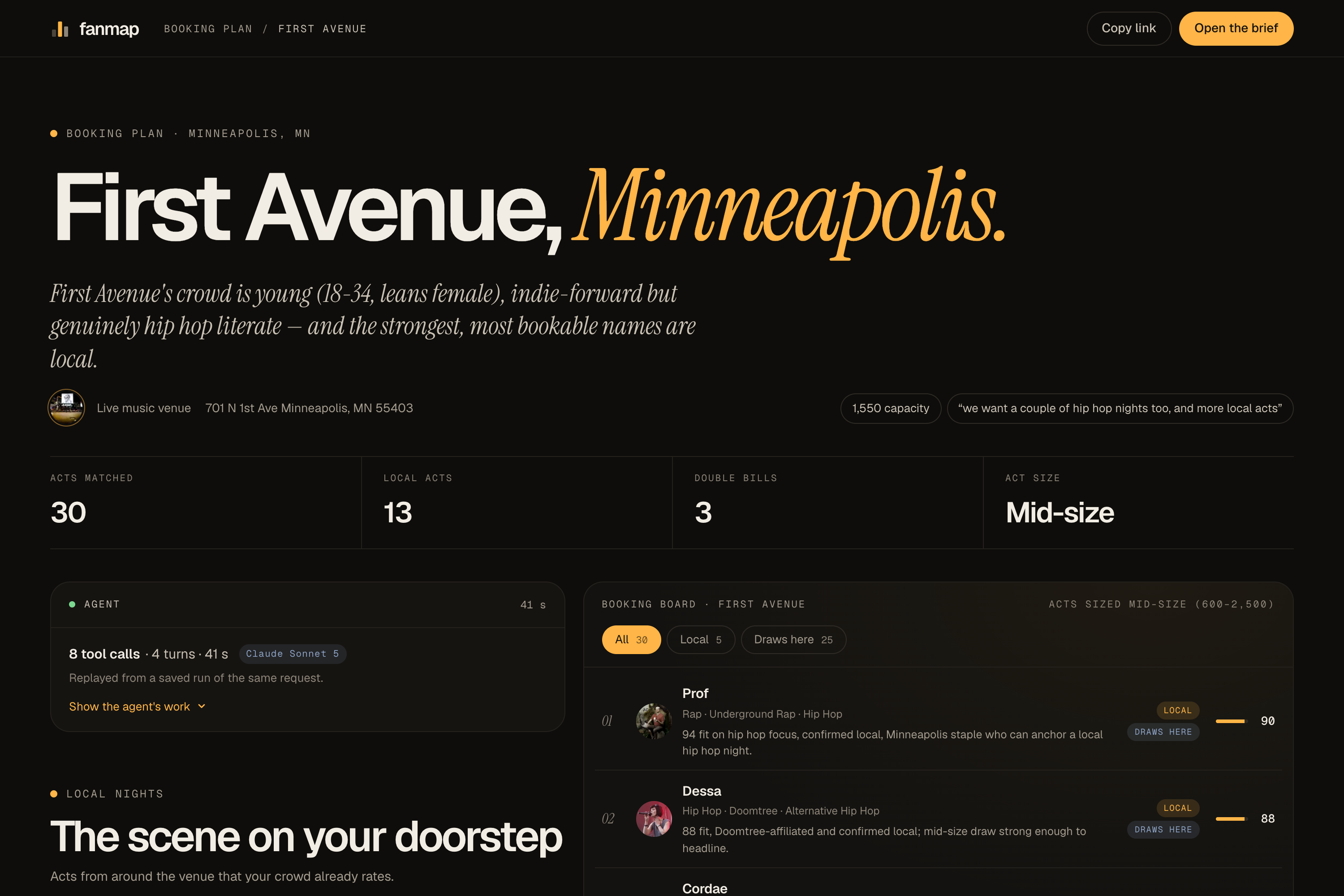
Venue mode: First Avenue's crowd, the acts it loves sized to the room, and the local scene for support slots.
-
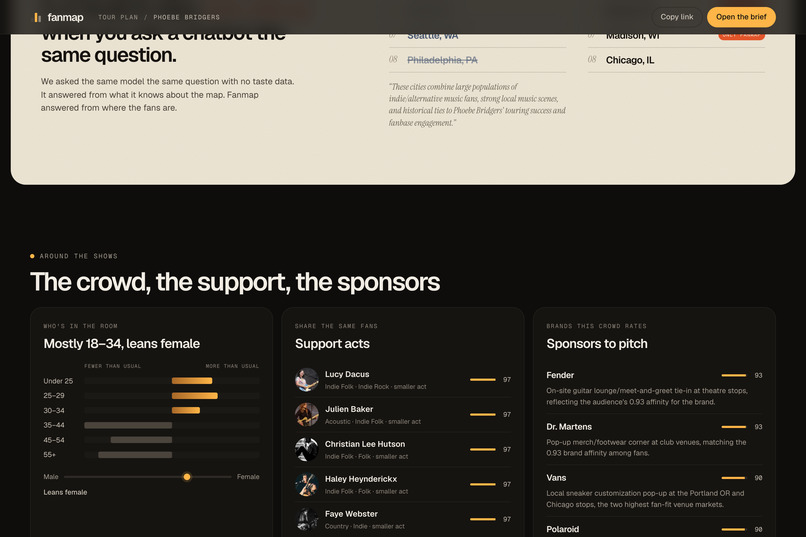
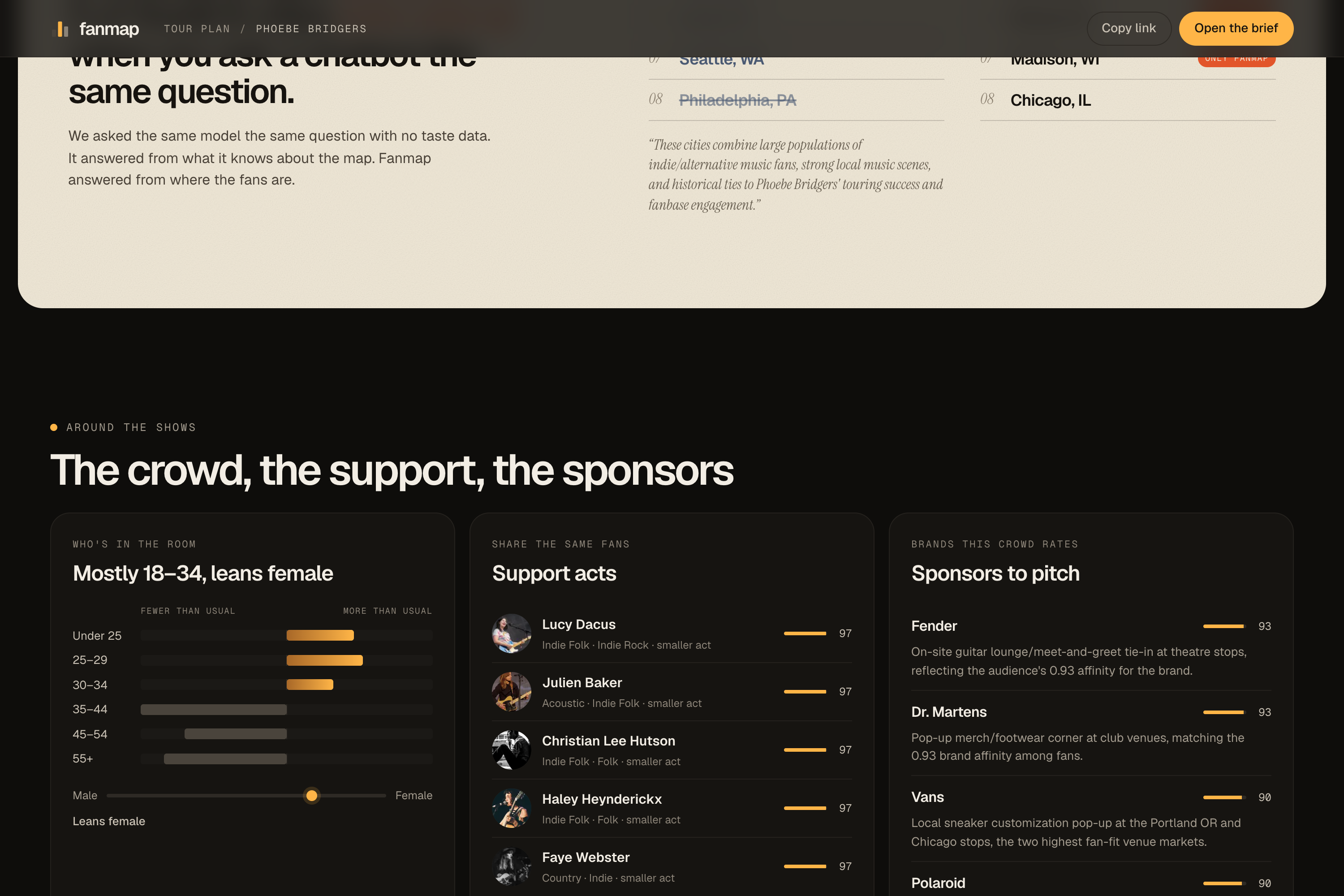
Who's in the room, support acts who share the fans, and sponsors this crowd rates, each with a pitch.
-
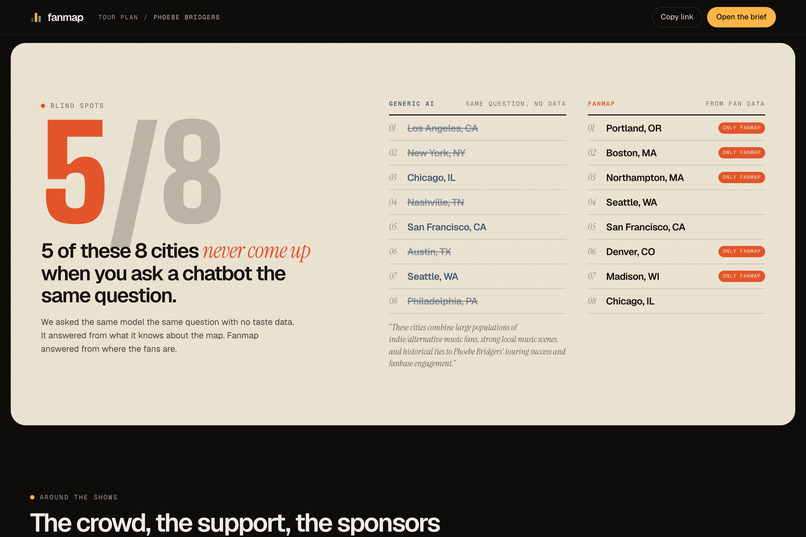
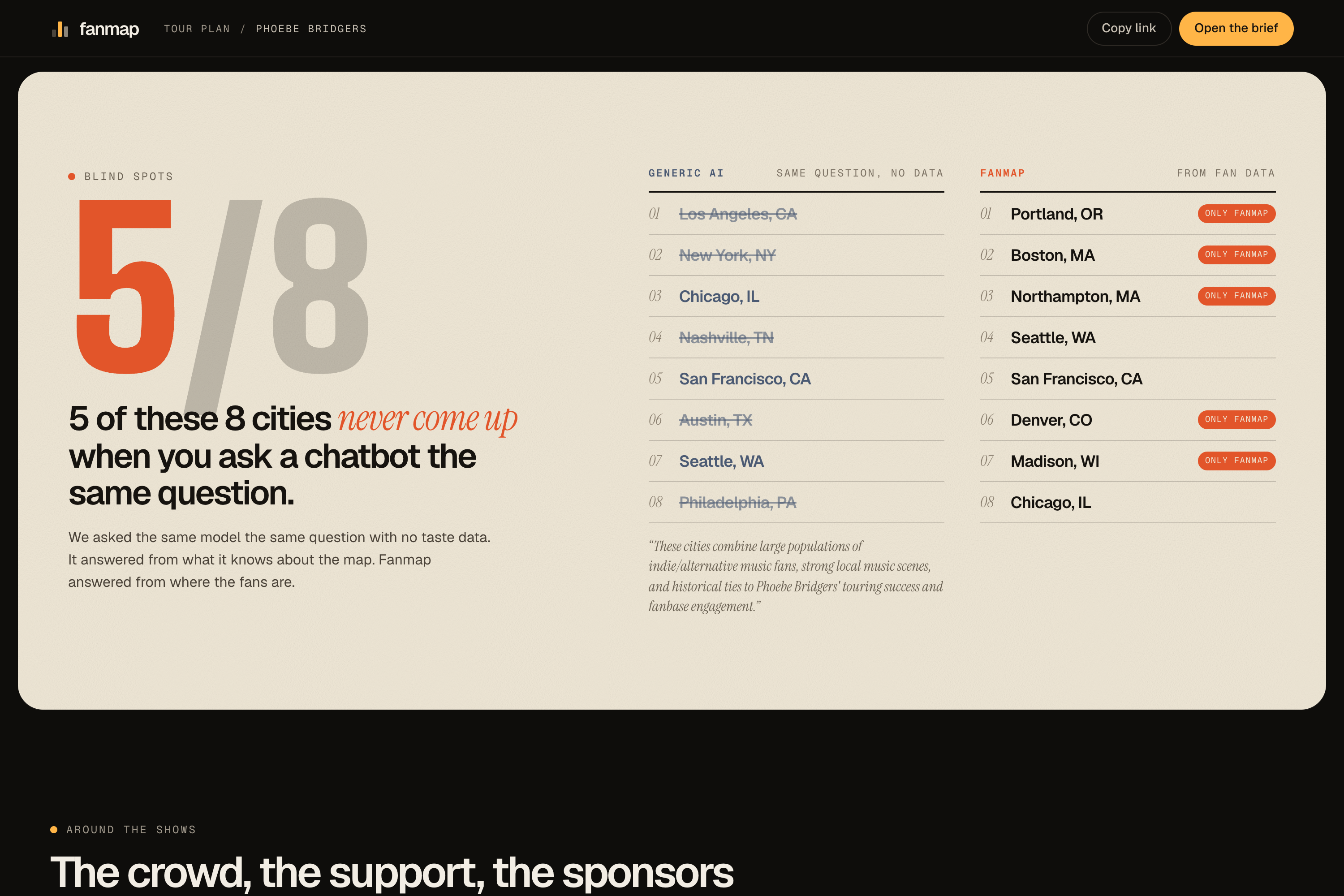
Blind spots: 5 of the 8 cities never come up when you ask a chatbot the same question without Qloo data.
-
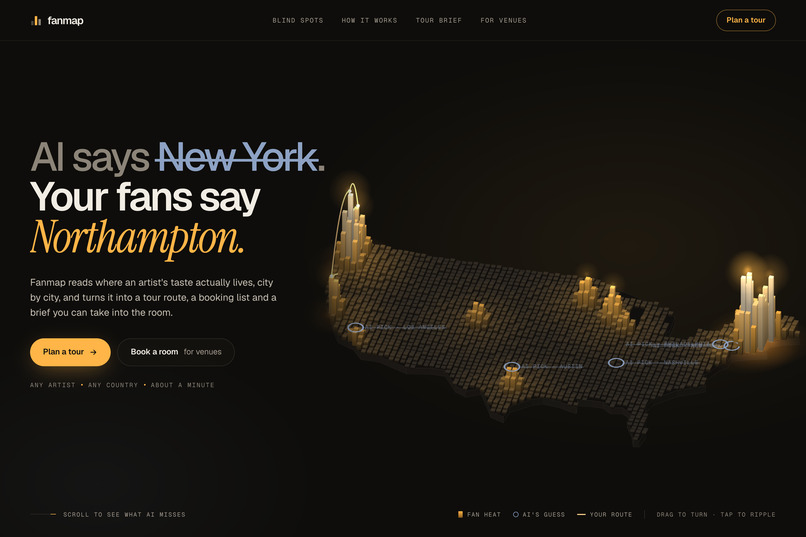
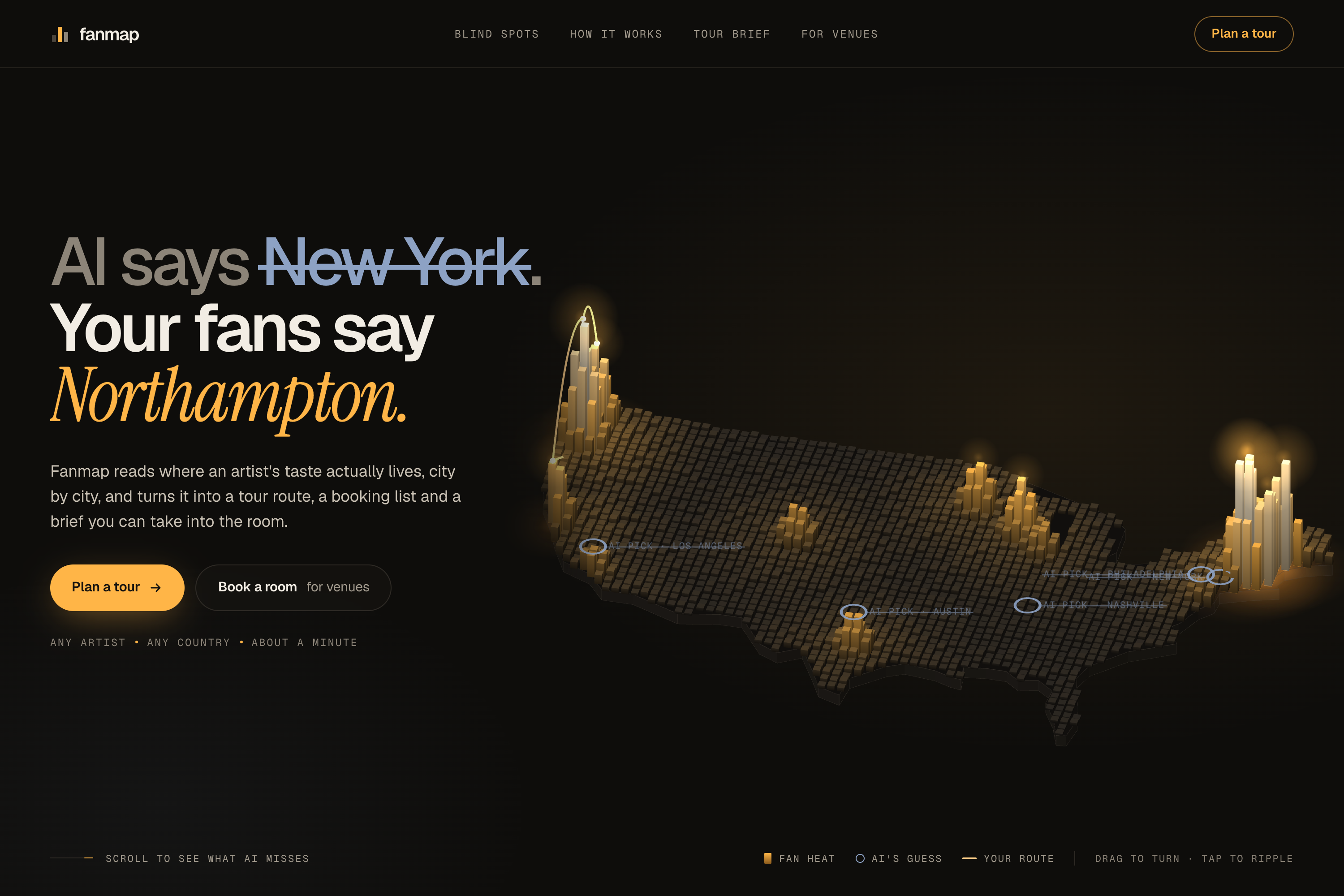
AI says New York. Your fans say Northampton. Fanmap reads where an artist's taste actually lives.
-
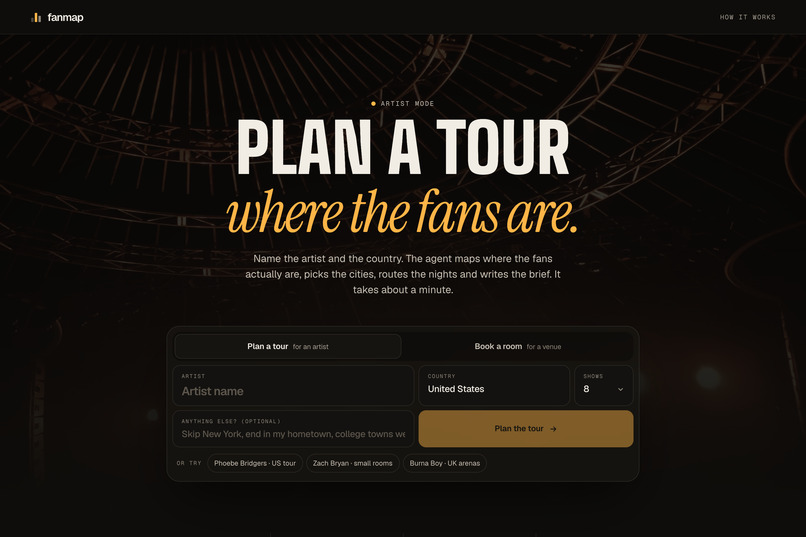
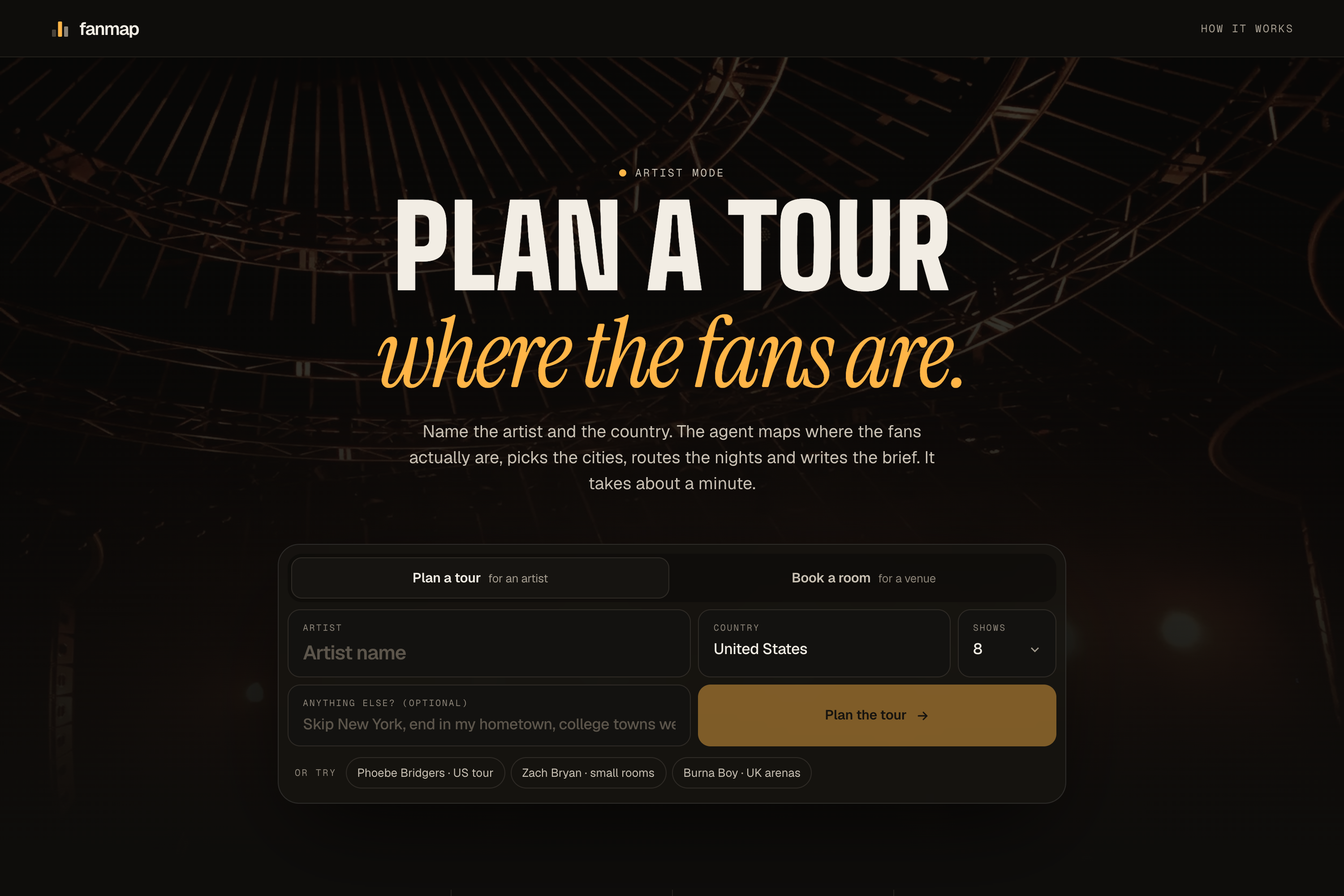
Plan a tour or book a room: name the artist or venue, add any wishes, and the agent does the rest in about a minute.
-
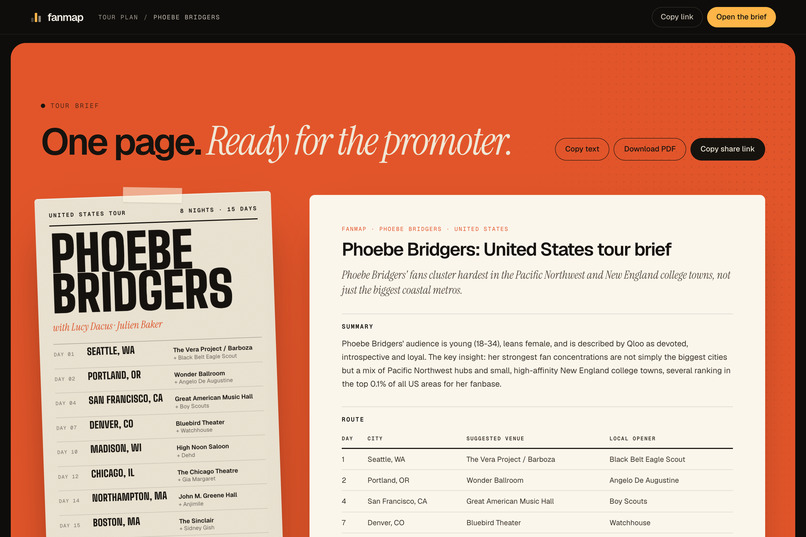
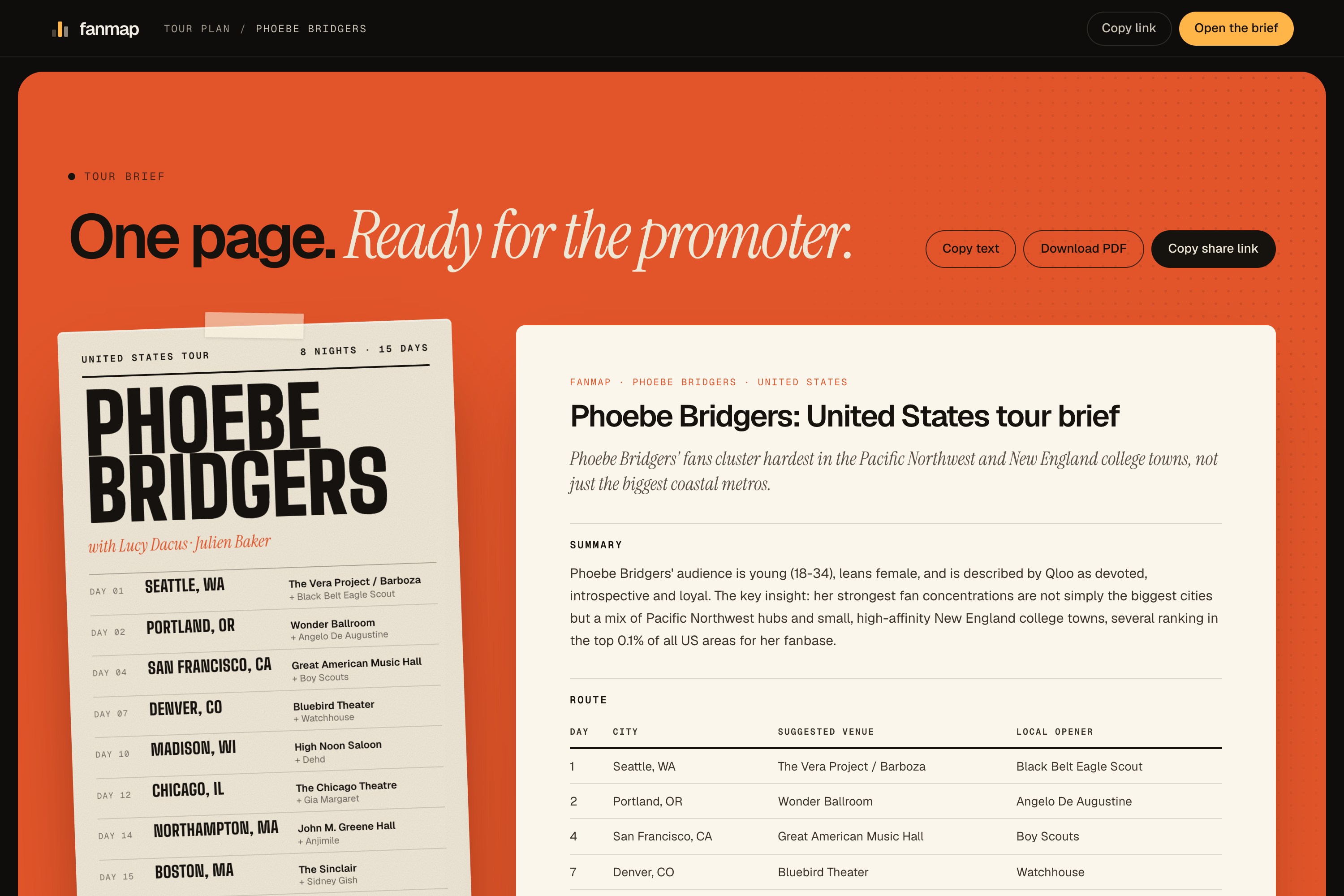
One page, ready for the promoter: a gig poster plus the written brief, with copy, PDF and share link.
Inspiration
Ask any AI where an indie artist should tour and you get a population map: New York, Los Angeles, Chicago, Austin, Nashville. But fans don't live by city size. Most touring acts below arena level have no data team, so they route by habit and guesswork, and pay for it in half-empty rooms. Venues have the mirror problem: talent buyers book from charts and agents' pitches, not from what their own crowd actually loves.
Qloo's taste graph knows where taste is concentrated, area by area. We wanted to turn that into decisions a manager, agent or talent buyer can act on today.
What it does
Fanmap is an AI agent that plans tours and bookings from where fans actually are.
- Artist mode — "Where should I tour?" Name an artist and a country. Fanmap maps fan concentration across thousands of areas, ranks real tour cities, routes the nights, and picks a room, a local opener and a pre/after-show spot for each city. It adds support acts, the crowd profile and sponsors to pitch, and writes a one-page brief for the promoter.
- Venue mode — "Who should I book?" Name a venue. Fanmap finds the acts its crowd loves, sized to the room, the local scene for support slots, and double bills with shared taste behind them.
- Proof, every time. Each plan is compared with what the same model answers without Qloo data. For Phoebe Bridgers' 8 US nights, 5 of 8 Fanmap cities (Portland OR, Boston, Northampton MA, Denver, Madison) never appear in the generic answer. For First Avenue in Minneapolis, 10 of 10 booking picks are ones the chatbot didn't name.
You watch it work: the agent's steps and notes stream live while a map of the country fills with fan heat, candidate cities light up and the route draws itself. Then you get night-by-night cards linked to the map, the blind-spots comparison, crowd / support / sponsors, and a gig poster plus the written brief (copy, print to PDF, share link).
Try it: fanmap.xyz — no login. The six examples replay real runs in seconds; any artist, country or venue runs live in about a minute.
How we built it
Technological implementation (deep use of Qloo). Fanmap is not one API call wrapped in a chat. A Claude agent runs a tool loop over our own engine, and the engine chains Qloo endpoints:
- Search for artists and venues, with disambiguation.
- Heatmaps of an artist's fan concentration across every area in a country (8,576 areas for Phoebe Bridgers in the US), which we cluster into real metros with an offline GeoNames city index and rank against the whole country ("top 0.1%").
- Insights for venues near each city (sized to the act), local artists with the same fans, places fans like before or after a show, audience demographics, and brands.
filter.results.entitiesto score fixed shortlists, and compare to find shared taste for double bills.
The agent decides what to look at and follows plain-English wishes ("skip New York", "end in Oklahoma", "more hip hop nights"). Artist-mode tools: find_artist, map_fans, get_audience, find_support_acts, find_brands, scout_cities, compare_artists, plan_route, submit_plan. Venue mode: find_venue, find_acts, find_local_acts, get_crowd, find_brands, build_double_bills, submit_booking_plan. A typical run is 7–8 tool calls in 35–60 seconds for about $0.05–$0.11.
Every step streams to the browser as newline-delimited JSON, including partial results, so the map builds while the agent thinks. If Claude is unavailable, a plain data pipeline still returns the plan. Identical requests replay from a plan cache with the same step-by-step story.
Stack: Next.js 16 (App Router, streaming route handler), React 19, TypeScript, Claude (Anthropic API), Qloo API, Upstash Redis (plan cache, shared Qloo cache, rate limits), Vercel, GSAP and Three.js for the landing map, and a canvas dot-map for the results that works for any country.
Design
One flow: pick artist or venue → watch the agent work → get a plan you can act on. No login. Cached examples load instantly. The results page builds itself live, links every night to the map, and ends in a poster and brief ready to send. It works on a phone.
Potential impact
Thousands of touring acts below arena level, their managers and agents, independent promoters and talent buyers make routing and booking calls without data. Fanmap gives them a data team for the price of a subscription:
- Artists and managers: route to where fans concentrate, not to where people live.
- Venues and promoters: book acts your crowd already rates, and build local nights.
- Brands: see who's in the room and which brands that crowd loves.
The same engine extends to comedy tours, festivals, sports exhibition games and brand pop-ups.
Responsible by design: Fanmap only uses aggregated, anonymous taste data. It says where taste is concentrated, never promises ticket sales, and tells you when data is thin. It also drops acts it can't book any more (late artists, split-up bands).
Quality of the idea
Qloo is usually used to recommend a movie. Fanmap uses it for business decisions with money on the line, and proves the difference on every run with the side-by-side comparison. Venue mode turns the same question around: instead of "where are my fans?", "who are my crowd's fans of?"
Challenges we ran into
- Turning areas into cities. Raw heat cells don't map to tour stops. We cluster neighbouring areas into metros (so Northampton isn't split into Holyoke and Pittsfield) and weight down tiny towns that rank high but aren't real tour stops.
- Thin-data countries. Some countries have far fewer data points; Fanmap says so and still returns a usable plan.
- Keeping the agent honest. The agent can only choose from cities and acts the data produced; it explains its picks (and its compromises, like keeping Chicago for market size) in the brief.
- Making a minute of waiting feel good. Streaming partial results so the map, route and board build in front of you.
Accomplishments that we're proud of
- A Phoebe Bridgers tour that a generic AI would never plan — Portland OR at #1, Northampton and Madison in the route — that holds up when you look at it.
- First Avenue's crowd turns out to be hip hop literate with a deep local bench (Prof, Dessa, Bad Bad Hats, Hippo Campus), so the hip hop nights it wants can be built locally.
- A live map that works for any country, from the US to the UK to Nigeria.
What we learned
Taste concentration and population are very different maps, and the gap is exactly where an LLM alone goes wrong. We also learned to be honest about where the data says less: Burna Boy's UK plan mostly matches the generic answer (1 of 6 cities differ), and Fanmap shows that too.
What's next
Ticketing and capacity data to pair taste with on-sale history, multi-country legs, saved plans for teams, and comedy, festival and sports versions of the same engine.
Built With
- anthropic
- claude
- gsap
- next.js
- node.js
- qloo
- react
- redis
- three.js
- typescript
- upstash
- vercel

Log in or sign up for Devpost to join the conversation.