Inspiration
Building can be lonely. A message can say “well done” or “I am here,” but sometimes the thing a person needs is less verbal: the feeling that someone is present with them. Human Moment explores the smallest digital gesture that might carry a trace of that feeling.
What it does
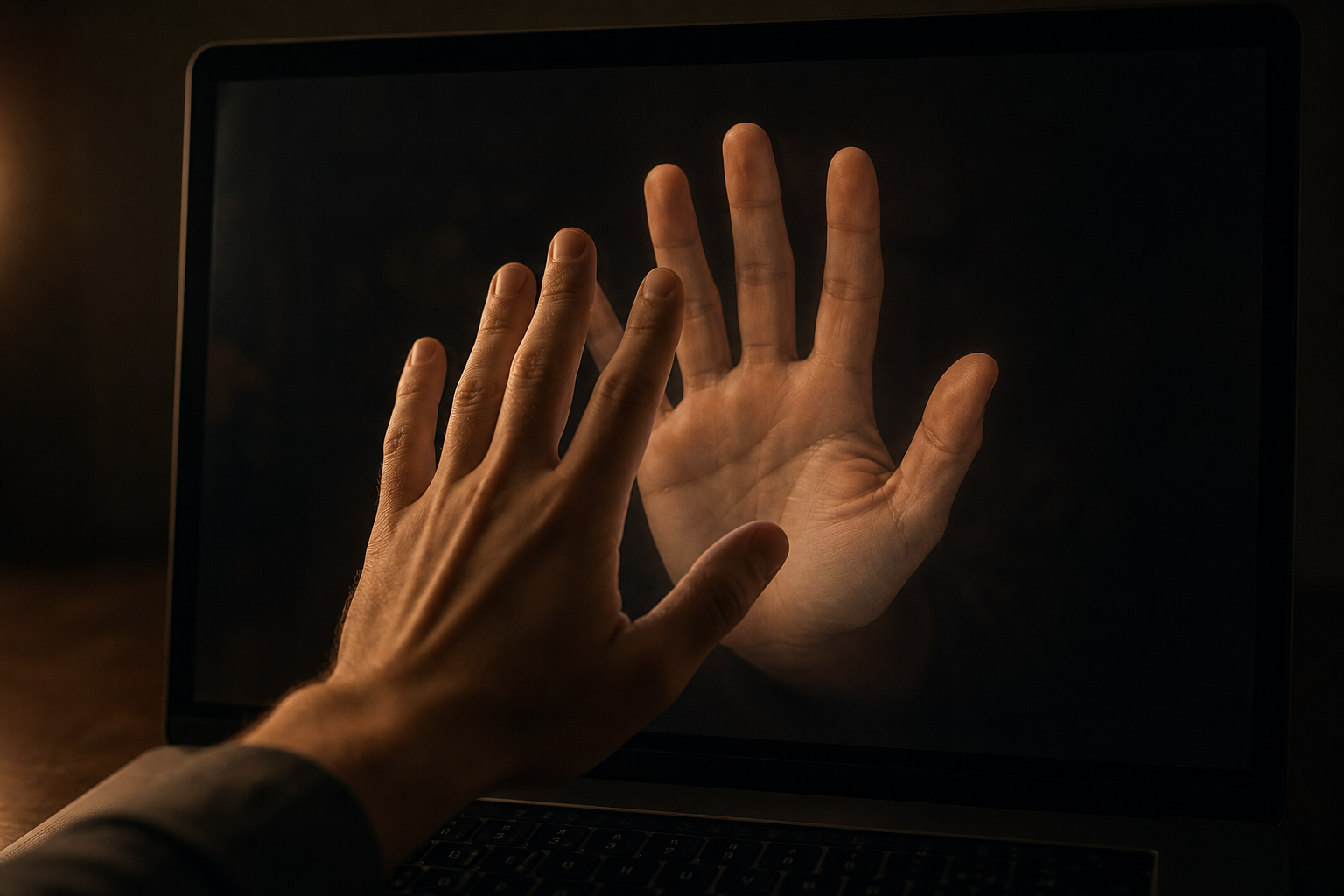
Someone sends a private link containing their name and, optionally, one short line. A living open palm waits on the other side of the display. Optional on-device hand tracking lets it follow an approaching hand and remain present when the real hand leaves a laptop webcam's view near the glass. Touch devices use an honest fingertip-contact path. The sender's words appear only after contact has been held quietly.
There are no accounts, feeds, streaks, scores, public posts, or analytics. The camera is optional. Camera frames and landmarks remain local, and the message stays in the URL fragment rather than being sent to a server.
How we built it
Human Moment is a React, TypeScript, and Vite application with a deterministic browser-independent experience core. MediaPipe Hand Landmarker runs from self-hosted model and WebAssembly assets with GPU-to-CPU fallback. The renderer combines a living hand performance with damped steering, progressive local calibration, camera-loss projection, and bounded contact lock. Pointer Events cover mouse, pen, keyboard, single-finger, and multi-finger paths. Vitest and Playwright exercise the state machine, privacy protocol, responsive surfaces, sharing, moderation, and major user journeys.
How Codex and GPT-5.6 shaped it
I built Human Moment in a sustained collaboration with Codex using GPT-5.6. I tested the physical interaction and described what felt false in human terms: bouncing, lag, a hand that looked like a floating image, or a jump between performances. Codex helped trace that feedback into measurable behavior and implementation: camera-disappearance contact, stationary-depth stabilization, amplified but velocity-bounded steering, progressive calibration, video normalization, a phone-safe compositor, local moderation, responsive behavior, and regression tests.
GPT-5.6 was the reasoning model inside the Codex workflow, not a cloud dependency in the finished product. The human decisions remained central: an open palm from the first frame; realism over gamification; optional local camera processing; silence by default; and a product small enough to remain a gesture between two people.
Challenges we ran into
The hardest problem was that a hand naturally disappears below a laptop webcam immediately before touching the screen. Treating that as ordinary tracking loss made the virtual palm leave at precisely the wrong emotional moment. Human Moment recognizes a strong approaching-hand disappearance as temporary contact occlusion, carries a bounded local signal, settles toward a stable palm anchor, and reacquires live tracking when the withdrawing hand reappears.
The hardest visual problem was continuity: convincing clips can still feel fake if scale, anchor, background, or motion jumps at their junction. We analyzed exact anchor frames, framing safety, media motion, and screen-space transforms, then preserved the final contact pose through the hold-to-release handoff.
Accomplishments that we're proud of
The experience has a camera path without making camera access a requirement; privacy without a backend disclaimer hiding complexity; and desktop, keyboard, pointer, touch, and phone paths that describe what each device can honestly do. The app is deployed through a private GitHub repository to Cloudflare Pages with deterministic asset provenance and deployment gates.
What we learned
Embodied interfaces are judged by felt continuity, not by whether a detector returns landmarks. Correct data can still feel false if media is static, motion is over-responsive, or the virtual hand abandons the viewer at contact. We also learned that restraint is a feature: the sender's message waits, the product stays silent, and there is no reward loop around a private human gesture.
What's next for Human Moment
Next is one clean, purpose-produced hand-performance family with matched hold and withdrawal anchors, followed by physical QA across final iOS, Android, Windows touch, and laptop hardware. Agent integrations may eventually send a Human Moment after a genuinely significant event, but the trigger should remain rare and human-centered.
Built With
- cloudflare
- codex
- github
- gpt-5.6
- mediapipe
- playwright
- pointer
- react
- share
- typescript
- vite
- vitest
- web

Log in or sign up for Devpost to join the conversation.