Inspiration
Inspired by Ken Perlin's Chalktalk, we wanted to bring live, sketch-driven spatial computing to Meta Quest and Meta VR Glasses without requiring controllers, large room-scale playspaces, or cloud round-trips for basic interaction. Most spatial AI tools either block the render loop waiting on an LLM or offer no standalone value offline. Fancy Fingers splits fast local spatial creation (System-1) from asynchronous external reasoning (System-2), all inside a comfortable two-foot seated arc.
What it does
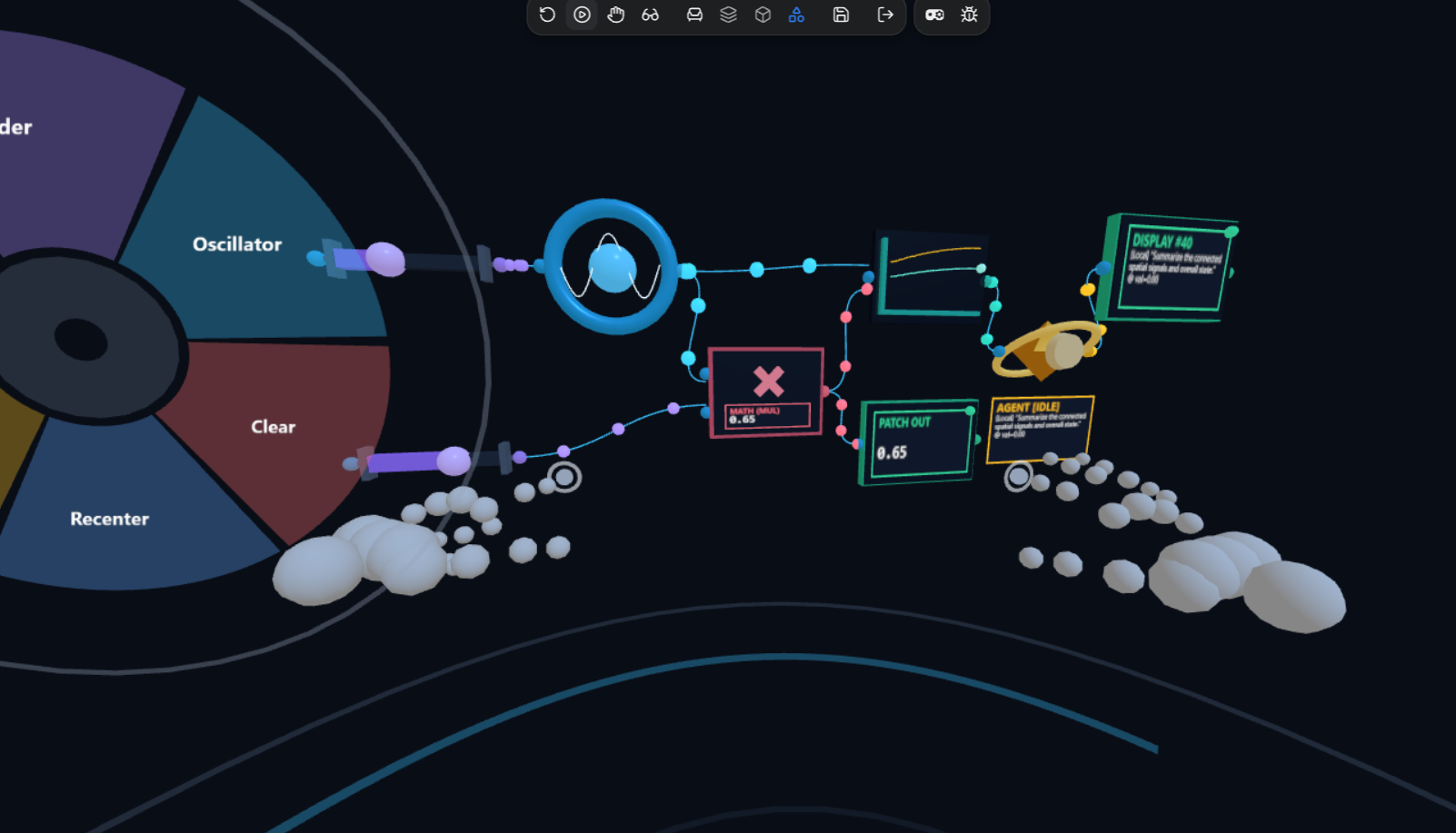
Fancy Fingers turns freehand 3D air-pinches (or desktop pointer strokes) into live, interconnected 3D data-flow widgets:
System-1 — Zero-Latency Local Spatial Loop (60–90fps, Offline-Ready): 7 Spatial Glyphs: Draw a Circle → Oscillator (0.5–6.0 Hz), Horizontal Line → Slider (0.00–1.00), + / = / ◇ → Math (ADD, MUL, SUB, AVG), L + Wave / Zigzag → 48-sample dual-trace Chart, Square → Display, Triangle → Agent Node, and X → Clear. Smooth Morphing & Live Wiring: Recognized strokes morph into canonical 3D geometry in 0.30s, expose +X / -X ports for live Bezier signal linking with animated pulses, and support fast wire-slashing to sever connections. 2-Foot Seated Comfort Shell: Everything stays clamped within 0.30m–0.60m horizontal radius and -0.35m to +0.18m vertical offset on a 0.48m forward work plane, with a left-palm-up (350ms) 6-slice radial menu and instant head-pose recentering. System-2 — Non-Blocking Agentic Escalation: Drawing a Triangle (or poking an Agent pad) asynchronously escalates the connected spatial signal graph to Local deterministic summaries, Webhooks, MCP (HTTP / SSE) tools, or BYOK LLMs (OpenAI, Gemini, Anthropic) without ever dropping a frame in System-1. How we built it Core Stack: Pure TypeScript, Three.js (^0.170.0), WebXR (hand-tracking, local-floor), and Vite (^5.4.11), deployed on Cloudflare Pages. Hand Tracking & Gestures: Custom XRHand pipeline with EMA tip smoothing, pinch hysteresis (2.2cm engage / 3.2cm release for index; 2.4cm / 3.4cm for middle-finger grab), two-hand scale/rotate transforms, and full desktop pointer/keyboard parity. Deterministic DAG & Multi-Stroke Recognition: MultiStrokeCollector (550ms window, 0.28m spatial radius) with early-flush on closed single-stroke shapes (>= 0.72 confidence) and topological graph evaluation every frame. System-2 Bridge: Browser-native mcpClient (Streamable HTTP with legacy HTTP+SSE fallback and tools/list discovery), configurable timeouts, and redactSecrets log sanitization.
Challenges we ran into
Preventing WebXR BufferGeometry draw-range glitches during dynamic stroke morphing and keeping scaled port pips accurately snappable (>= 1.2cm clear of center poke colliders). Ensuring seated recentering re-anchors existing widgets cleanly to the user's current horizontal yaw while keeping the work plane upright (up.y ≈ 1). Filtering out accidental right-hand triggers on the left-palm-up radial menu and isolating System-2 network latency from the 60–90fps XR render loop.
Accomplishments that we're proud of
100% Standalone System-1 Value: Zero API keys or network calls needed to sketch, wire, plot, and interact in 3D. Hands-First Ergonomics ("Airplane Seat Test"): Every glyph, wire, slider, and radial menu action works comfortably within a 2-foot seated shell with zero controllers. Universal System-2 Connectivity: Works out of the box with Local deterministic summaries, custom CORS Webhooks, browser-direct MCP servers, and BYOK OpenAI/Gemini/Anthropic endpoints.
What we learned
Hysteresis on index and middle pinches plus generous port snap radii (0.12m) are essential for controller-free XRHand reliability. Keeping visual morphing (0.30s) and spawn bloom (260ms) decoupled from logical graph evaluation keeps interactions snappy and deterministic.
What's next for Fancy Fingers
Persistent spatial workspace save/load, richer multi-modal System-2 tool outputs (e.g., generative 3D geometry nodes), and collaborative multi-user WebXR rooms
Built With
- cloudflare-pages
- gemini
- model-context-protocol-(mcp)
- openai
- three.js
- typescript
- vite
- webxr
