Inspiration
💡 Inspiration
The 2026 FIFA World Cup will bring an estimated 5 million international fans from over 200 countries to 16 host cities across North America. While logistics and ticketing are often solved, a critical blind spot remains: Travel Health and Language Barriers.
Imagine a Brazilian fan collapsing in the 40°C (104°F) Dallas heat. His daily medication is called "Frontal". An American paramedic has never heard of it. The reality? "Frontal" is alprazolam—a DEA Schedule IV controlled substance in the US. The fan didn't declare it at customs, and he doesn't speak English.
Language barriers in healthcare aren't just inconvenient; they can be fatal. We built FanCare to give every international fan a personal, multilingual health assistant that understands their medical background, translates foreign drug brands to US equivalents, and integrates real-time environmental risks.
⚙️ What it does
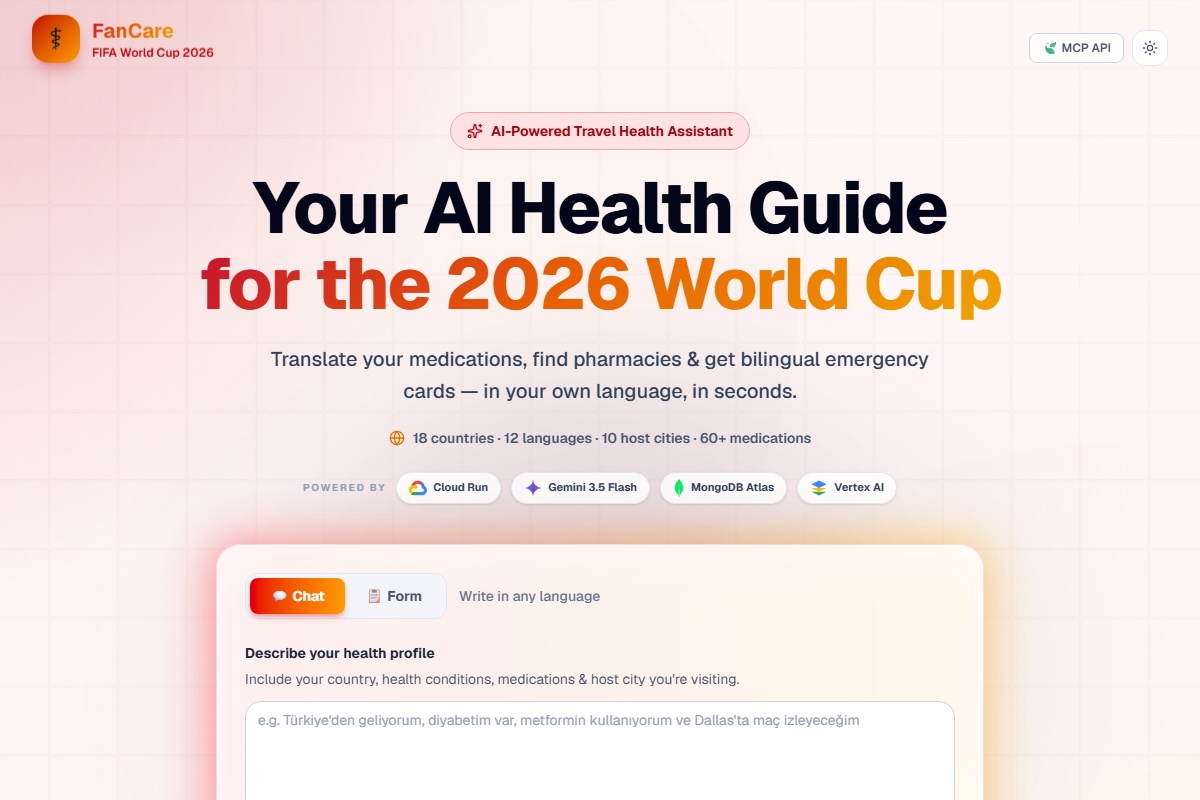
FanCare is an intelligent travel health dashboard that allows users to input their health conditions and medications in their native language. Using advanced agentic workflows, it automatically:
- Brand Resolution & Translation: Translates international medication brands (e.g., Sultanol in Germany, Glukofen in Turkey) to their generic names and US equivalents.
- Cross-Border Legal Alerts: Flags controlled substances (like DEA Schedule IV drugs) and generates auto-translated US Customs declaration guidance.
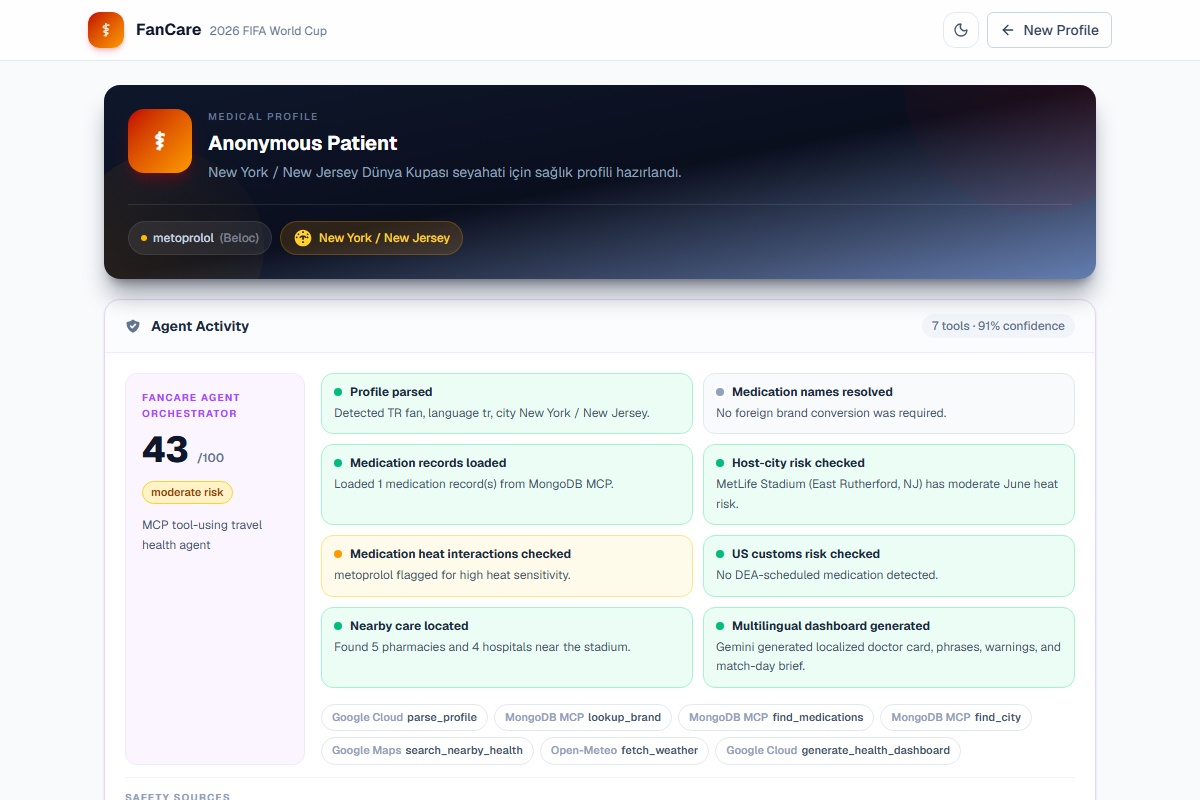
- Hyper-Local Risk Assessment: Analyzes the user's destination city (e.g., Dallas heat, New York pollen) and cross-references it with their specific medications (e.g., warning that Beta-blockers impair sweating in high heat).
- Bilingual Emergency Cards: Generates downloadable, bilingual doctor cards and low-digital-literacy emergency action steps designed to be shown directly to a 911 operator or ER nurse.
🛠️ How we built it
FanCare is built on a cutting-edge Agentic Architecture utilizing the Model Context Protocol (MCP):
- The Brain: We used Google Gemini on Vertex AI to handle complex multilingual reasoning, symptom analysis, and natural language understanding.
- The Tools (MongoDB MCP): We developed a custom MongoDB Atlas MCP Server that acts as the single source of truth. It exposes powerful tools (
find_medications,lookup_brand,find_city) directly to the Gemini Agent. This allows the LLM to query our global medication database with deterministic accuracy, preventing hallucinations. - External APIs: The agent simultaneously orchestrates queries to Google Places API (for local pharmacies) and Open-Meteo API (for real-time weather and pollen data).
- Infrastructure: The entire application is containerized with Docker and deployed securely on Google Cloud Run for instantaneous global scaling.
⚠️ Challenges we ran into
One of the biggest challenges was preventing LLM hallucinations when dealing with critical medical data. If a user inputs an obscure regional drug brand, the AI cannot guess. We solved this by implementing the Model Context Protocol (MCP) with MongoDB Atlas. By offloading the deterministic search to MongoDB's powerful querying capabilities, Gemini only acts on verified data returned by the MCP tools.
🏆 Accomplishments that we're proud of
- Building a truly language-agnostic healthcare tool—one Gemini prompt and one MongoDB collection successfully handle Portuguese, Turkish, German, and countless other languages dynamically.
- Achieving Zero-Wait UI Synchronization: We designed a glassmorphism, dark-mode UI that feels incredibly premium, with streaming responses that dynamically render the bilingual health cards in real-time.
- Successfully implementing an MCP Server that acts as an independent bridge between structured NoSQL data and generative AI reasoning.
📚 What we learned
We learned the immense power of the Model Context Protocol. By decoupling the "tools" from the "agent," we realized how easily we can expand FanCare's capabilities without changing a single line of the LLM prompt. We also discovered how deeply weather (like extreme heat) interacts with common medications, reinforcing the need for personalized travel health advice.
🚀 What's next for FanCare
Currently, our MongoDB MCP server communicates with the agent via an InMemoryTransport within our Next.js backend. Our immediate next step is to upgrade the architecture to an HTTP/SSE (Server-Sent Events) Transport. This will decouple the MongoDB MCP tools into a fully independent microservice, allowing external apps, iOS clients, or even third-party World Cup ticketing platforms to securely connect to our health database using the universal MCP standard.
What it does
How we built it
Challenges we ran into
Accomplishments that we're proud of
What we learned
What's next for FanCare
Built With
- docker
- gemini
- google-cloud-run
- mcp
- mongodb-atlas
- next.js
- tailwind-css
- typescript

Log in or sign up for Devpost to join the conversation.