The problem
A small label or manager planning a release or a club tour usually has stream counts and a guess. Stream counts say where listeners already are. They do not say what those listeners also love, which brands fit them, which films and books sit in the same world, or which local venues, record shops and galleries belong to the same scene. A generic language model will fill that gap with plausible-sounding inventions. That is the gap Fan World closes.
What Fan World does
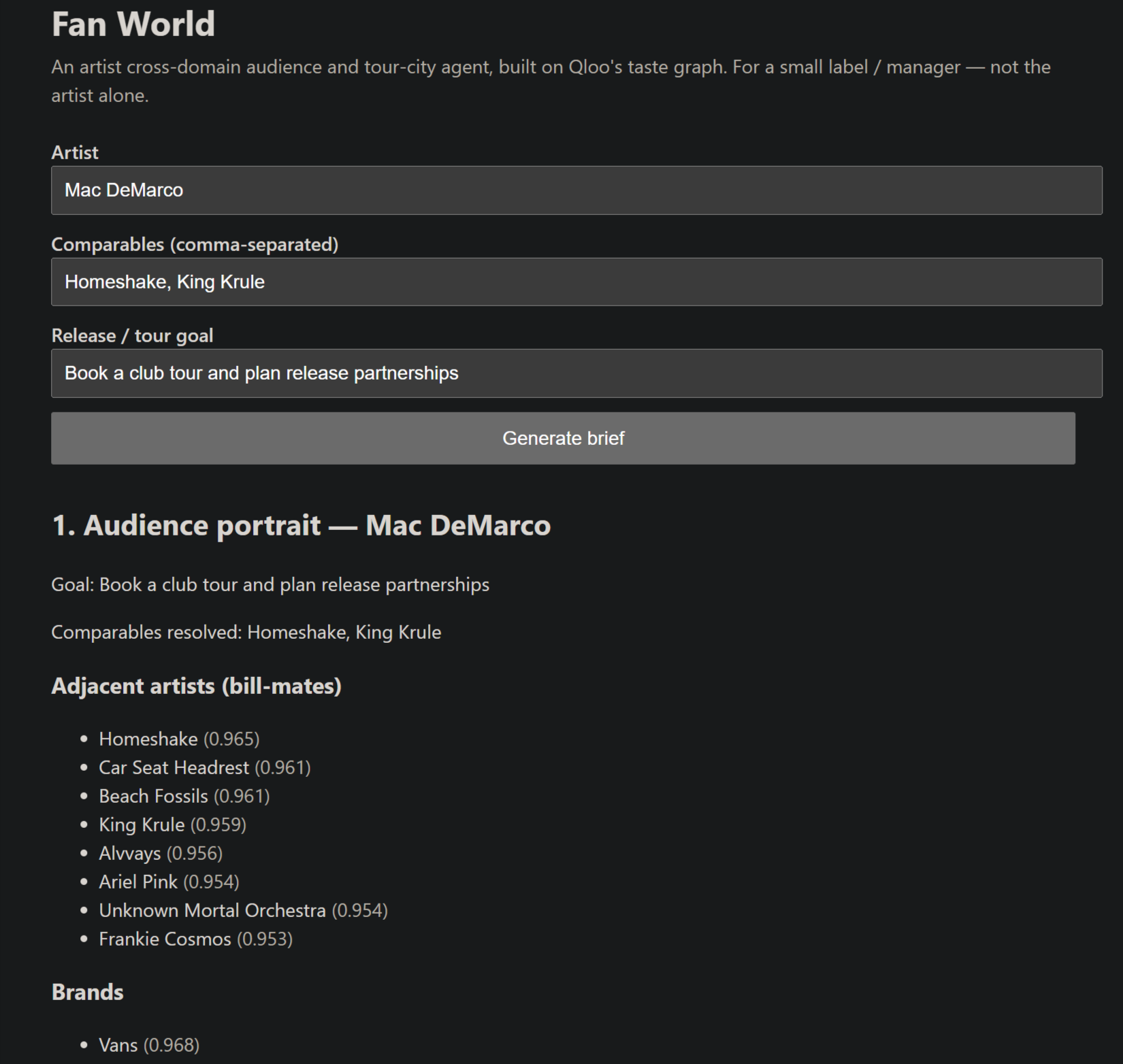
Enter an artist, 2–5 comparables, and a release / tour goal. Fan World resolves the artist in Qloo's taste graph, then runs Qloo Insights across six entity types — artist, brand, movie, place, podcast and book — and renders a structured brief a label or manager can actually use:
- Audience portrait — adjacent artists, brands, movies, places, podcasts and books, each with its Qloo affinity score.
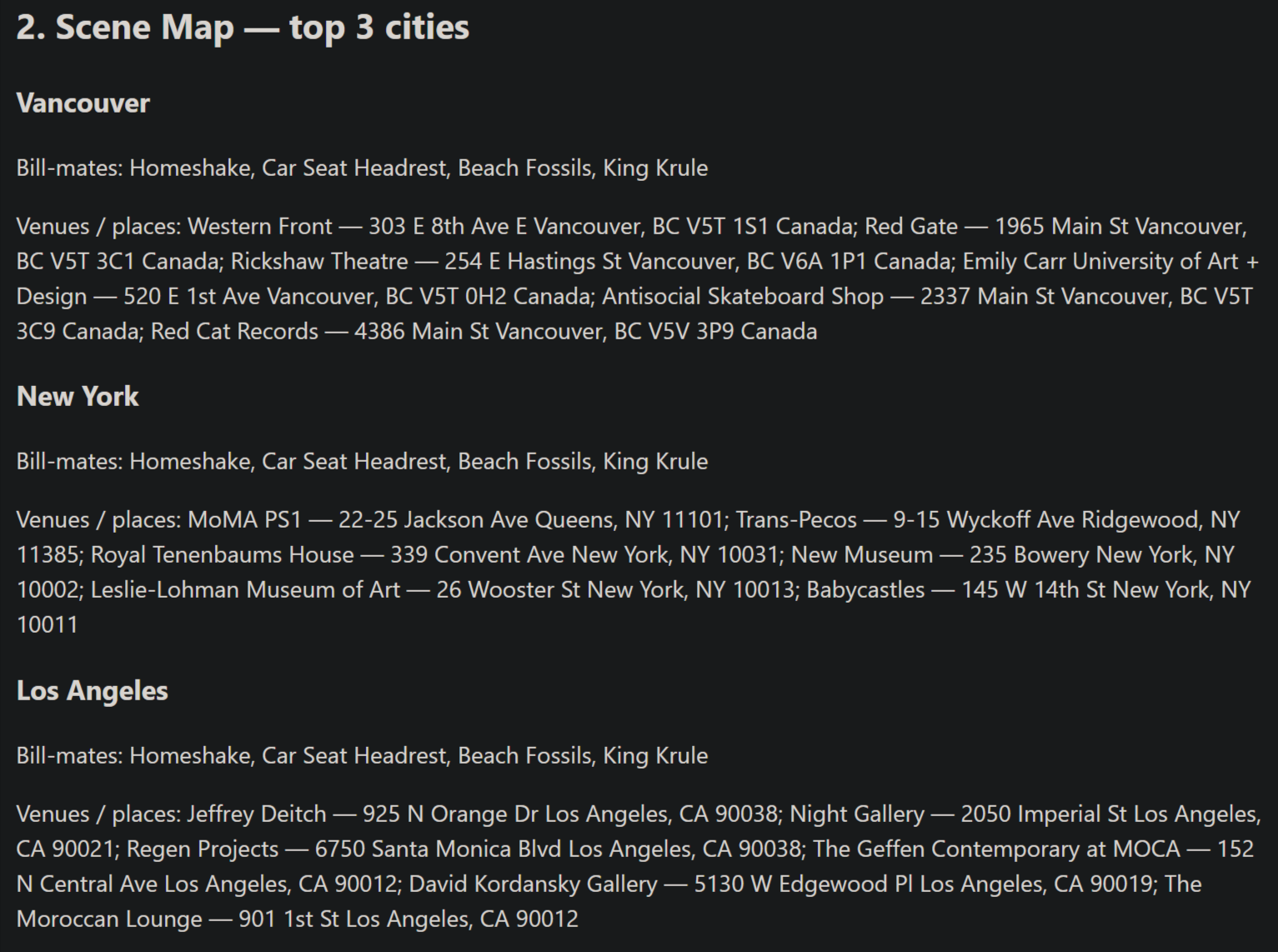
- Scene Map, top 3 cities only — Vancouver, New York and Los Angeles in the demo. Per city: adjacent artists as bill-mates, and city-filtered venues and places with addresses.
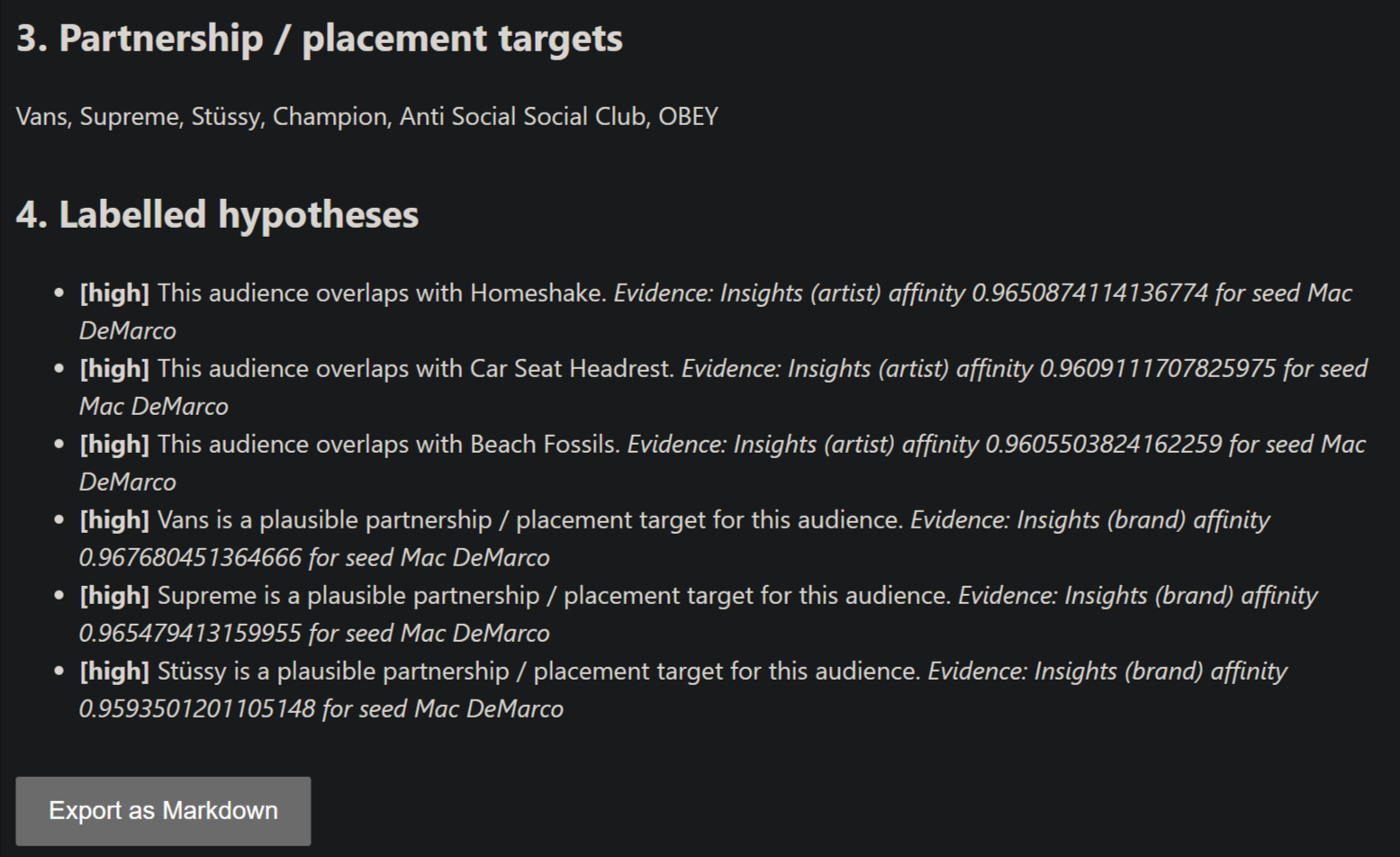
- Partnership / placement targets — derived from cross-domain affinities, not from a free-text prompt.
- Labelled hypotheses — every claim carries its Qloo affinity as evidence, with a high / medium / low confidence label.
- Data-trail appendix — every Qloo query behind the brief, and which brief section it fed.
- Export — the brief exports as Markdown.
Try it — canned demo
- Open https://fan-world-jet.vercel.app/
- Artist: Mac DeMarco Comparables: Homeshake, King Krule Goal: Book a club tour and plan release partnerships
- Click Generate brief.
You should see, among other results: bill-mates Homeshake, Car Seat Headrest, Beach Fossils and King Krule; partnership targets Vans, Supreme, Stüssy, Champion, Anti Social Social Club and OBEY; and a Vancouver Scene Map led by Western Front, Red Gate and Rickshaw Theatre.
Why Qloo is essential, not decorative
If this brief were written by a language model alone, it would look similar and be unverifiable. Every section of a Fan World brief cites a Qloo affinity. Remove Qloo and there is no brief — no affinities, no city-filtered places, no evidence labels, no data trail. That is the test the hackathon sets ("if your submission would work the same without Qloo, you're building the wrong thing"), and Fan World is built to pass it.
The agent behaviours are deliberately small and honest: self-correcting resolution (the top Qloo match per artist name), gap handling through the affinity data itself, and a hard rule that no claim is made without Qloo data behind it.
Who it is for, and who it is not for
For a small label or manager who cannot afford a major-label research budget. Not for the artist alone — independent artists generally have no budget for this, which is why the user is framed as label / manager throughout. This is a prototype, not a product with clients: it has not been adopted by a label, used in a live campaign, or validated to improve performance, and this submission does not claim otherwise.
What is honestly not in this version
- Demographic read: not implemented, and no demographic claim is made.
- Bill-mates and local media in the Scene Map are global affinities, not yet city-filtered. Places in the Scene Map are city-filtered, via Qloo's filter.location.query.
- No LLM synthesis layer yet. This version is deterministic from Qloo data, which keeps the no-overclaim rule intact. An LLM layer, if added, must never add a claim without Qloo evidence.
- No Spotify import, no auth, no collaborator engine.
Inspiration, in one line
The Scene Map is inspired by the idea of a cultural scene as a shared ecosystem — Brian Eno's "scenius" concept, cited once here as inspiration, not as a product layer.
What's next
- Demographic read, city-filtered bill-mates and local media.
- A parked, separate idea: Scene Builder, a standalone collaborator tool. Qloo measures audience overlap, not creative compatibility, so it is not built into Fan World, and must not be described as such.
- The same engine re-skinned as a brand-brief agent for marketing teams — the same taste-graph workflow, applied to a brand instead of an artist.
Built With
- github
- javascript/node.js
- qloo-taste-ai-api
- vercel
