-
-
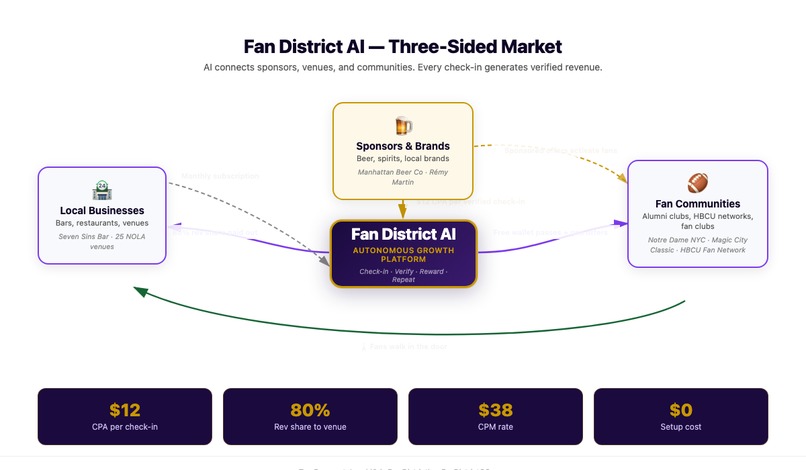
Revenue Model
-
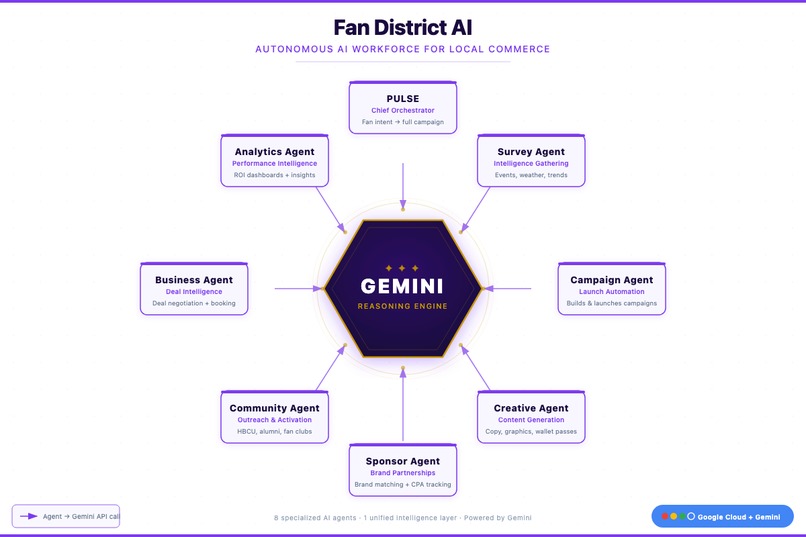
Agent Architecture
-
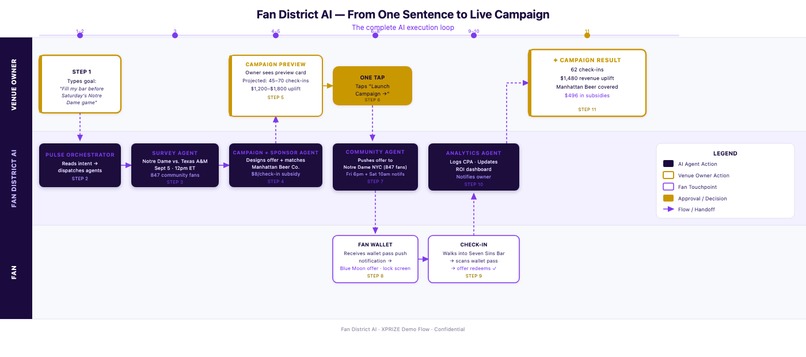
Demo Flow
-
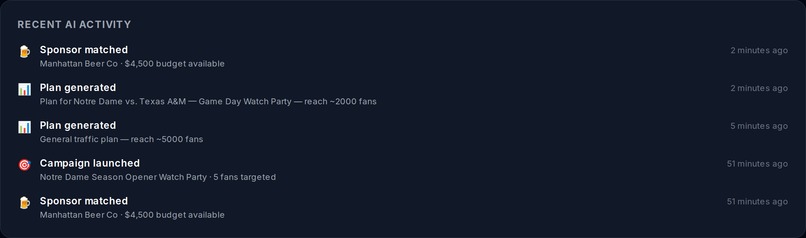
Recent Activity
-

AI Campaign Planner
-
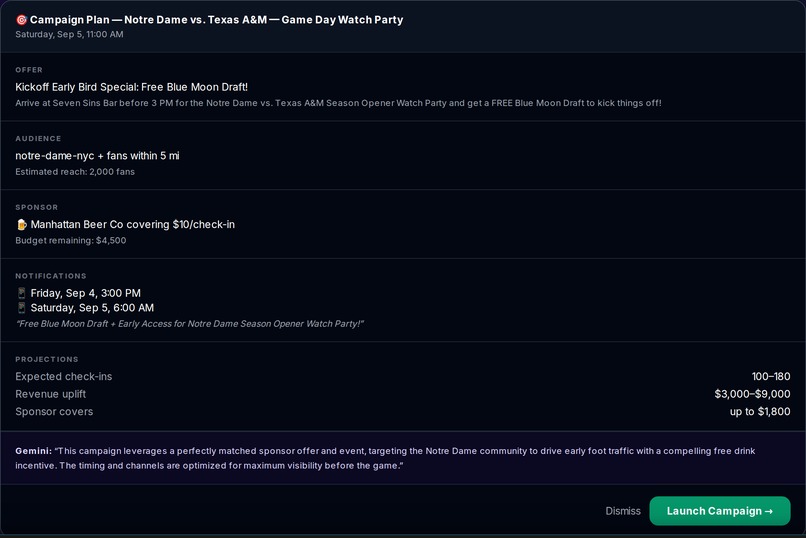
Campaign Plan
-
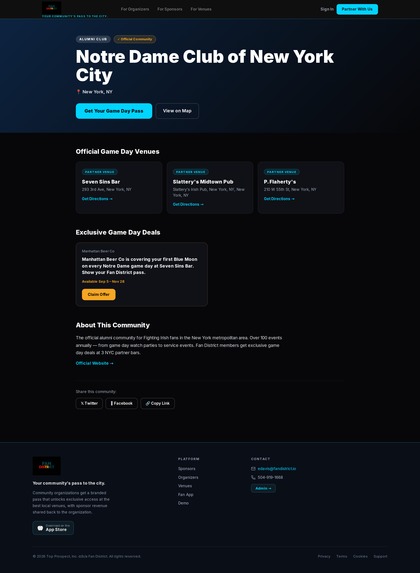
Community Page

Inspiration
I run an MLB Youth Academy in New Orleans. That's my day job.
Every fall, I watch 60,000 people walk past the bars and restaurants near the Superdome on Saints game day — and most of those businesses don't see a dollar more than they would on a random Tuesday. They don't have time to market. They can't afford an agency. The moment passes.
I've also spent my career inside communities that don't get served by mainstream marketing tech. HBCU classics — Magic City Classic in Birmingham, Bayou Classic at the Superdome, Celebration Bowl in Atlanta — draw 60,000+ fans, have deep alumni networks, and loyal sponsor relationships. But the fan experience is still paper flyers and word of mouth.
This pattern repeats at every major event in America. The problem isn't the event. It's that the local businesses around it are invisible — every single time.
The technology to fix this existed. Nobody had connected the dots.
So I asked myself: what if a bar owner could just say what they want — and the AI handled everything else?
That question became Fan District AI.
What it does
an District AI — Executive Summary
The Autonomous Growth Platform for Local Commerce
The Problem
Small businesses near live events sit at one of the most valuable intersections in commerce — 60,000 fans within a mile radius, all ready to spend. Most of them never capture it.
The problem isn't effort. It's bandwidth. A bar owner managing a staff of eight doesn't have time to track game schedules, build targeted offers, coordinate with sponsors, push marketing to the right fans, and measure what worked — all in the same week. Marketing agencies are slow and expensive. DIY platforms require skills they don't have. The moment passes, and the revenue with it.
This happens at every NFL game, every HBCU Classic, every alumni weekend, every major event weekend, at thousands of venues in every American city. The total addressable opportunity in event-proximate commerce is measured in the hundreds of billions. The technology to capture it finally exists.
The Solution
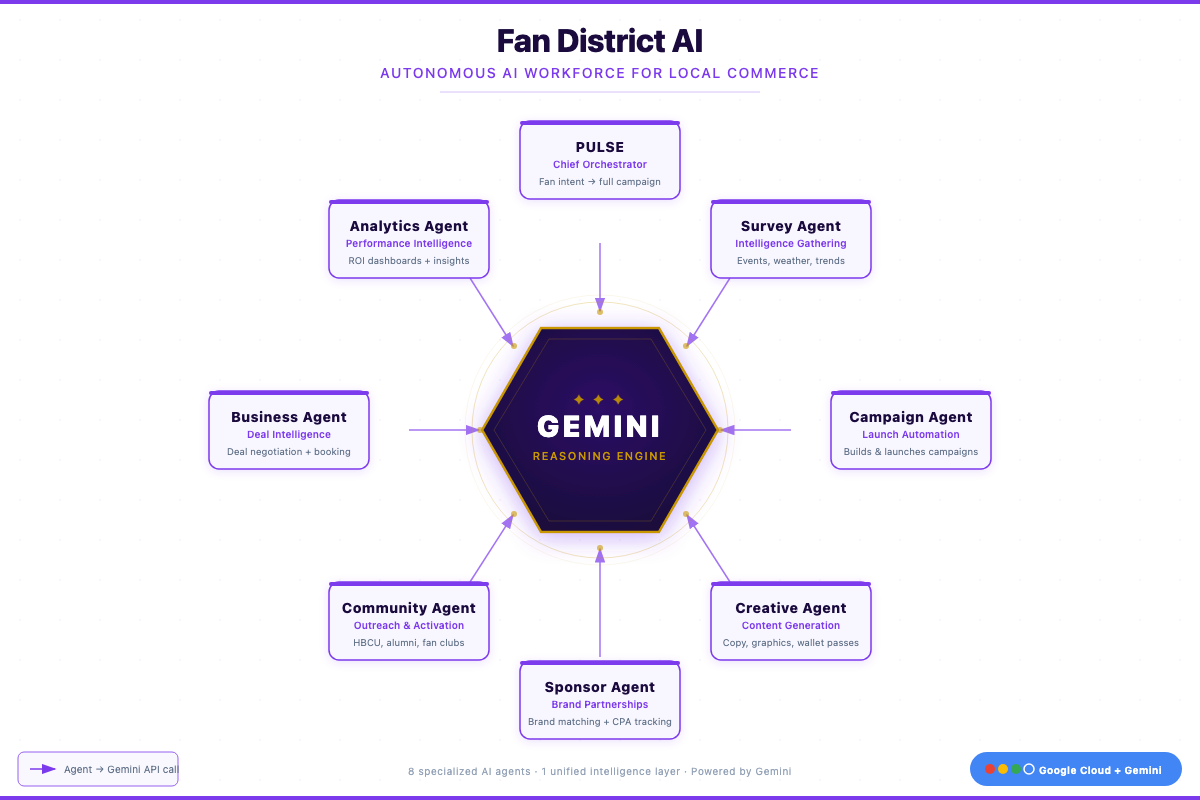
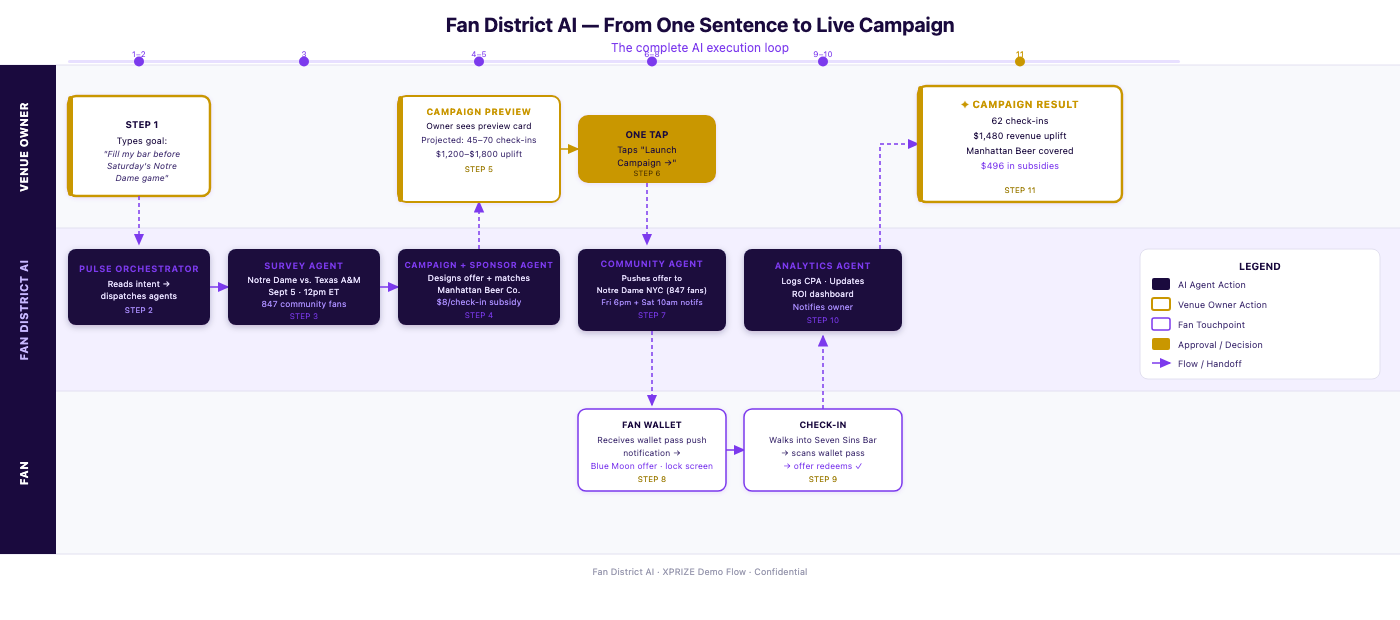
Fan District AI is an autonomous AI operating system for local businesses. The owner types a goal — "fill my restaurant before the Saints game Saturday" — and eight AI agents execute everything: survey the market, build the campaign, write the copy, find the sponsor, negotiate the deal, push the offer to fans, manage the bookings, and deliver an ROI report when it's done.
The owner typed one sentence. The AI ran the business.
The eight-agent workforce:
- PULSE (Chief Orchestrator) — reads natural language intent, coordinates all agents, builds the execution plan
- Survey Agent — pulls event data, attendance forecasts, weather, traffic, competitor activity
- Campaign Agent — designs and launches marketing campaigns autonomously
- Creative Agent — writes offer copy, social posts, and wallet pass graphics
- Sponsor Agent — matches businesses with brand sponsors, manages CPAs, tracks verified check-ins
- Community Agent — activates fan clubs, alumni networks, HBCU communities
- Business Agent — negotiates venue deals, applies sponsor subsidies, confirms bookings
- Analytics Agent — produces ROI dashboards, explains performance, recommends next move
This is not an AI assistant that suggests what to do. It's an AI workforce that does it.
What's Live Today
Fan District AI is a production platform at fandistrictos.com. Current live capabilities:
- PULSE Orchestrator — natural language intent engine; owner inputs a goal, AI builds full execution plan
- Sponsor Agent — active campaign management with geo-targeted offer delivery, CPA at $12 per verified fan check-in
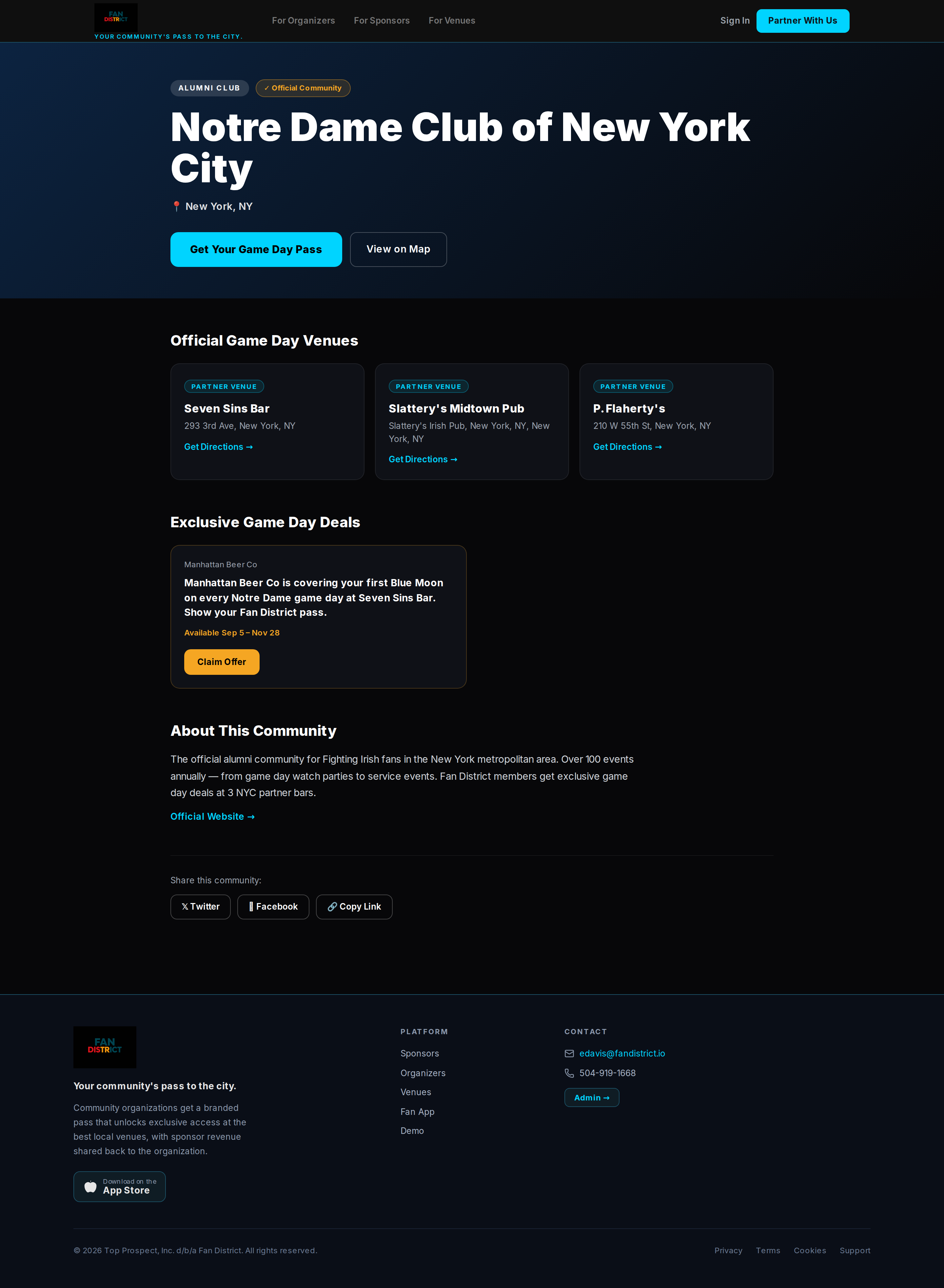
- Community Agent — active in HBCU communities (Magic City Classic, Bayou Classic, Celebration Bowl), Notre Dame NYC Alumni Club, and regional fan clubs
- Business Agent — venue deal negotiation, auto-approval workflows, sponsor subsidy injection into offers
- Fan District Pass — Apple Wallet + Google Wallet native; no app download required for fans
- Check-ins Dashboard — real-time CPA tracking, admin CSV export, verified redemptions
- 4-step booking flow — 48-hour expiry, instant confirmation
- Tech stack — Next.js 14 App Router, TypeScript strict, Drizzle ORM, Neon Postgres, NextAuth, Resend, Mapbox
The platform is built and deployed. The first pilot fires August 15, 2026: Saints vs. Jaguars preseason, 25 New Orleans venues enrolled.
Google Cloud Integration Plan
Fan District AI will integrate four Google Cloud products during the 90-day window:
- Gemini API — powers the natural language interface. Owner types a business goal; Gemini parses intent and dispatches to PULSE. This is the human-AI handoff point. Currently handled by structured prompts; Gemini adds multi-turn context, campaign reasoning, and offer optimization.
- Vertex AI Agent Builder — formal agent orchestration layer, replacing the current custom routing with a production-grade multi-agent framework
- Firebase Cloud Messaging — push notifications directly to issued Apple and Google Wallet passes; zero-app-download fan engagement
- BigQuery — campaign analytics pipeline; stores check-in events, offer redemptions, and sponsor performance data for ROI reporting and ML training
Sprint 1 (first 30 days): Gemini NL interface. Sprint 2 (days 30–60): Firebase push to wallet passes. Sprint 3 (days 60–90): BigQuery analytics pipeline + Vertex AI agent orchestration.
Business Model
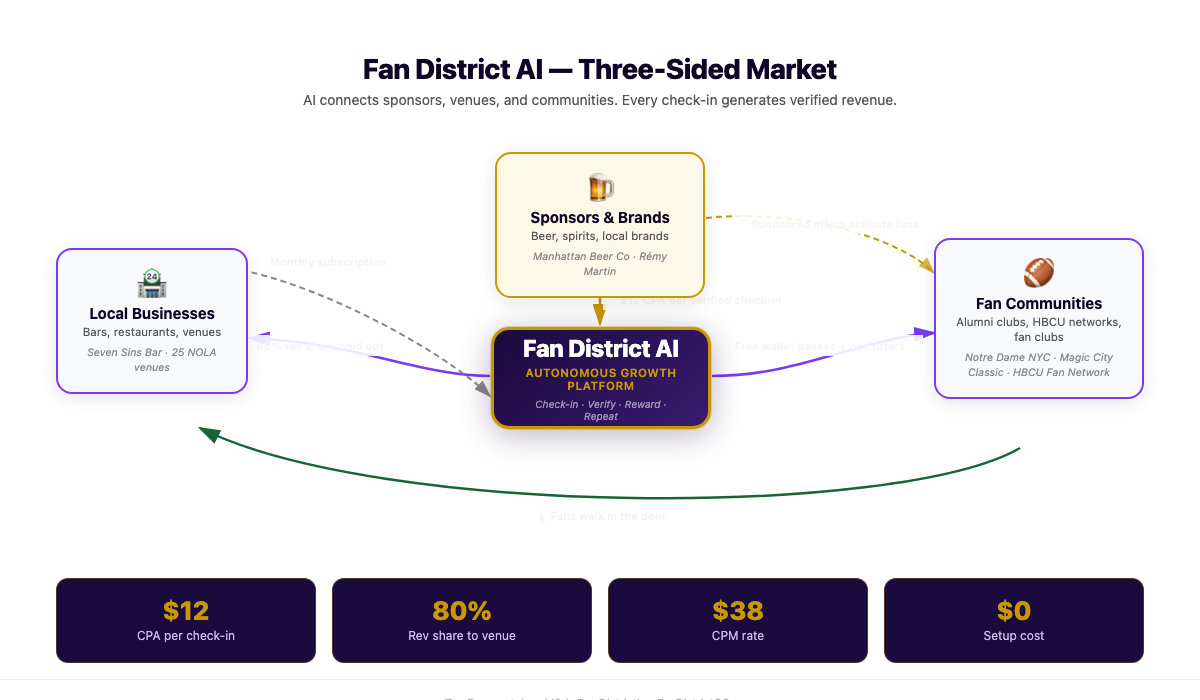
Revenue is performance-based, earned only when a fan walks in the door:
- $12 CPA per verified fan check-in (sponsor pays; split 80% venue/partner, 20% platform)
- $38 CPM for display campaigns within the Fan District pass and itinerary flow
- Monthly subscription — business dashboard and agent access (planned)
The CPA model aligns platform revenue with venue revenue. No check-in, no charge. This removes the main objection for venues signing up.
At 1,000 check-ins per event weekend, platform revenue is $2,400. At 10 event weekends, $24,000. At 50 venue partners per event across 20 active cities, the math scales quickly without the revenue model changing.
Traction
- Manhattan Beer Co × Notre Dame NYC Alumni Club × Seven Sins Bar — sponsor deal in active negotiation for the 2026 football season. Three-way deal: brand sponsor, fan community, venue.
- HBCU communities live — Magic City Classic (Birmingham, October 17), Bayou Classic (New Orleans, November 28), Celebration Bowl active in community agent
- Perren King (VP, Eventive Sports) — WIN-fluencer partner and board adviser; covers Magic City Classic and Red Tails Classic
90-Day Plan (Post-Acceptance)
- Days 1–30: Close Notre Dame NYC × Manhattan Beer × Seven Sins deal. Deploy Gemini NL interface. Document first revenue.
- Days 30–60: Expand to 5 NYC venues for ND football season. Fire Firebase push notifications to wallet passes. Close 2–3 additional HBCU event deals.
- Days 60–90: Magic City Classic activation (Birmingham, October 17). 20+ venues. BigQuery analytics live. First documented $10K+ event revenue.
Team
Eddie Davis — Founder, Top Prospect, Inc. (d/b/a Fan District). Director, MLB Youth Academy New Orleans. Sports-tech background; built and deployed the platform solo while running a full-time youth athletics program.
The platform was built by one person and an AI workforce. That is not a liability — it's the proof of concept.
Vision
Fan District AI starts with sports events because the use case is concrete and the revenue is immediate. The infrastructure — autonomous agent workforce, sponsor CPA network, fan community layer, business negotiation engine — applies to every event-proximate business in every city.
The long-term build is an AI workforce that any small business can deploy to compete at a level previously reserved for brands with dedicated marketing teams. The first proof is New York September 2026.
How we built it
I'm a solo founder with a day job. I have no dev team. What I have is a Mac mini, an OpenClaw AI system running 24/7, and a conviction that AI agents can replace what used to require an entire marketing department.
The build methodology was unconventional: I describe features to an AI agent in plain English. The agent writes the code, runs the tests, flags the architecture problems, and ships to production. My job is to make product decisions — what to build, what order, what matters — and the AI executes.
Over the past year, that process shipped:
- PULSE — a natural language orchestrator. Fan types "plan my Saints game day." AI builds a full itinerary with venue offers, sponsor deals, and wallet passes.
- Sponsor Agent — brands set a budget and a goal. The agent plans, launches, and optimizes campaigns without human intervention.
- Community Agent — activates HBCU alumni networks, fan clubs, and sports communities. Magic City Classic, Bayou Classic, Notre Dame NYC Alumni Club all live on the platform.
- Business Agent — negotiates venue deals autonomously within pre-set parameters. Applies sponsor subsidies. Confirms bookings.
- Analytics Agent — generates ROI dashboards for every campaign. Sponsors see verified CPA data, not impressions.
The fan-facing product is a digital wallet pass — Apple Wallet and Google Pay, no app download. Fan checks in at the venue, sponsor offer fires, CPA logs. The whole loop runs without me.
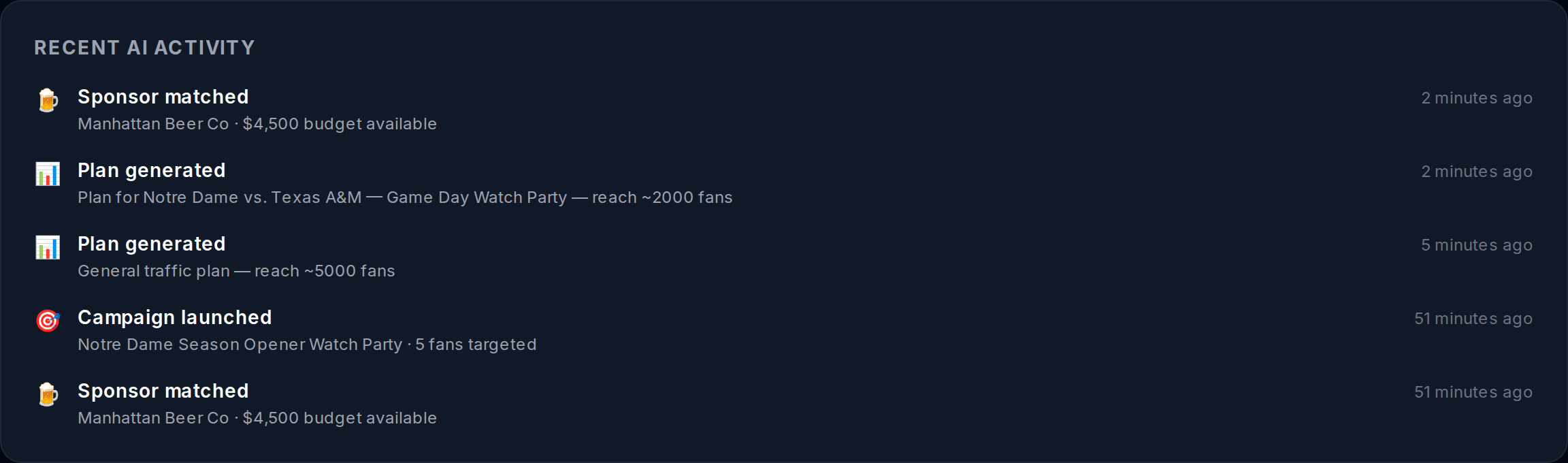
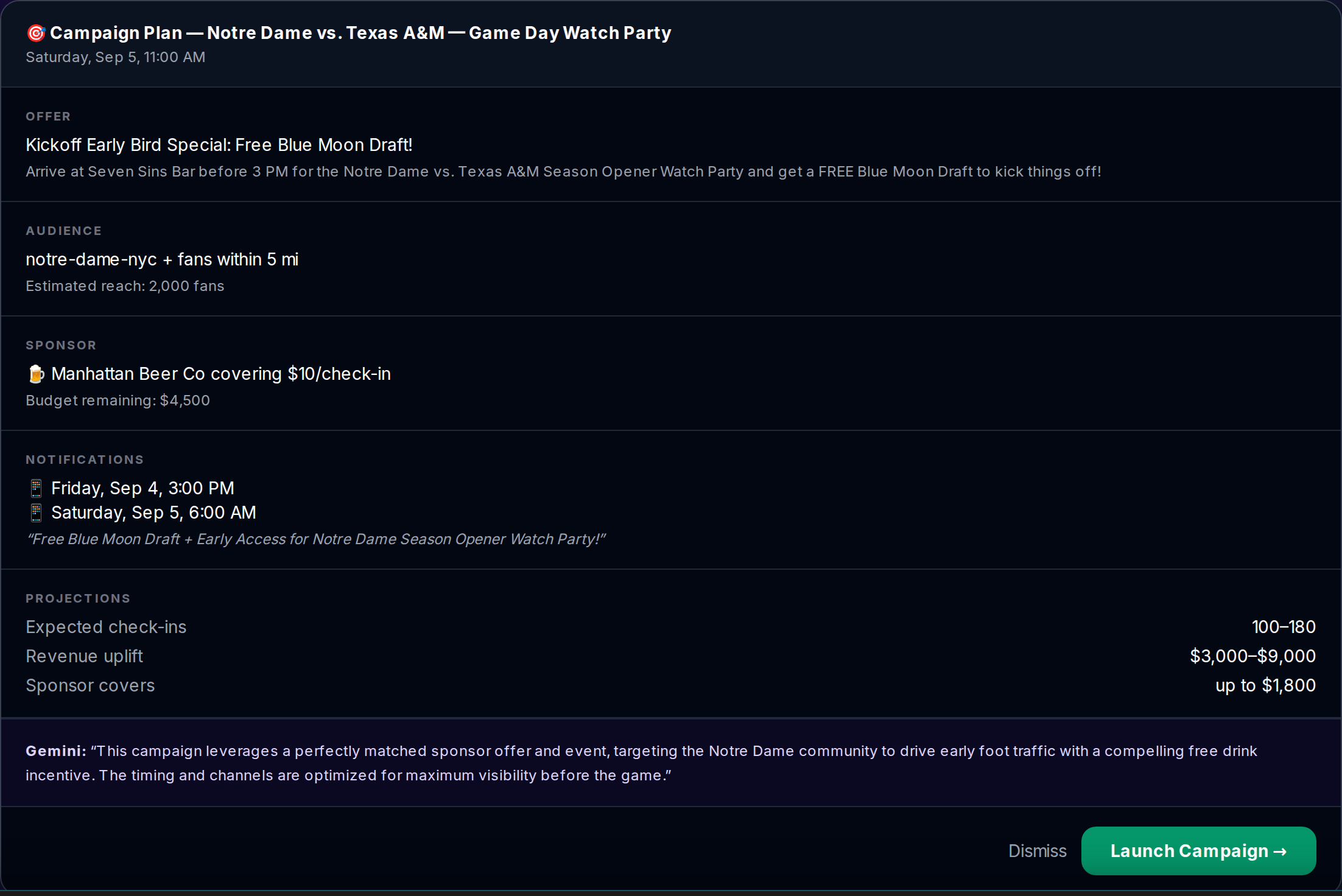
I used Google's Gemini as the reasoning layer for campaign planning. A venue owner types: "Fill my bar before Saturday's Notre Dame game." Gemini identifies the event, designs the offer, matches an available sponsor, schedules notifications, and projects outcomes — all before the owner clicks a single button.## Challenges we ran into
Accomplishments that we're proud of
The platform is live at FanDistrictOS.com.
Notre Dame NY Alumni Club is onboard as well as several NY Bars. Notre Dame NYC Alumni Club has confirmed participation for the 2026 football season. Seven Sins Bar in Gramercy is the official watch venue. Magic City Classic activation is set for October 17. Bayou Classic is November 28.
Perren King — VP of Eventive Sports, which manages Magic City Classic and the Red Tails Classic — is our first WIN-fluencer partner. He brings institutional sponsor relationships and stadium-scale events. Fan District gives him a digital activation layer he can bundle into every Eventive Sports proposal.
The 90-day window is the revenue proof. The infrastructure is built. The partners are enrolled. The events are on the calendar.
We're ready.
What we learned
The hardest part isn't the AI. It's trust.**
Venue owners don't trust that a platform they've never heard of will actually send customers through their door. The product can be technically perfect and still fail because the owner doesn't believe it will work. The Saints pilot — 25 venues, August 15 — is designed specifically to generate one documented success story that makes the next conversation easier.
AI as infrastructure changes what's possible for a solo founder.
I shipped three production platforms this year — Fan District, COMPS (youth baseball analytics), and ARMORY (MLB Hackathon entry) — while working a full-time job. That's not possible with a traditional dev team I can't afford. It's only possible because AI handled the execution layer and I focused on decisions.
Revenue models that feel elegant on paper break on the first real customer.
I've rebuilt the business model four times. CPA-only doesn't work because venues don't understand it. Subscription-only doesn't work because owners won't pay before they see results. The version that works — sponsors fund the first transaction, venue sees the outcome, subscription follows — took a year to figure out.
HBCU communities are the most underserved market in local commerce tech.
Magic City Classic draws 60,000 people. The fan network is organized, loyal, and ready to engage. The sponsors already exist. What's missing is the infrastructure to connect them. Every major marketing platform has ignored this market. Fan District doesn't.
What's next for Fan District AI
Built With
- ai
- ai-agents
- apple-wallet
- autonomous-agents
- bigquery
- drizzle-orm
- firebase
- gemini
- google-cloud
- google-gemini
- google-wallet
- large-language-models
- local-commerce
- mapbox
- neon
- next.js
- node.js
- openai
- openrouter
- postgresql
- resend
- stack
- typescript
- vertex-ai


Log in or sign up for Devpost to join the conversation.