Inspiration
Scams do not work because people are stupid. They work because scammers create panic, urgency, secrecy, and confusion at exactly the wrong moment. A person may know something feels wrong, but still be pressured into calling a fake number, sharing a verification code, buying gift cards, or sending money before they have time to verify.
I wanted to build something that helps families slow down before the damage happens.
FamilyShield was inspired by the idea that scam defense should not just be detection. It should be a calm, private safety checkpoint that helps people stop, verify, and contact someone they trust before acting.
What it does
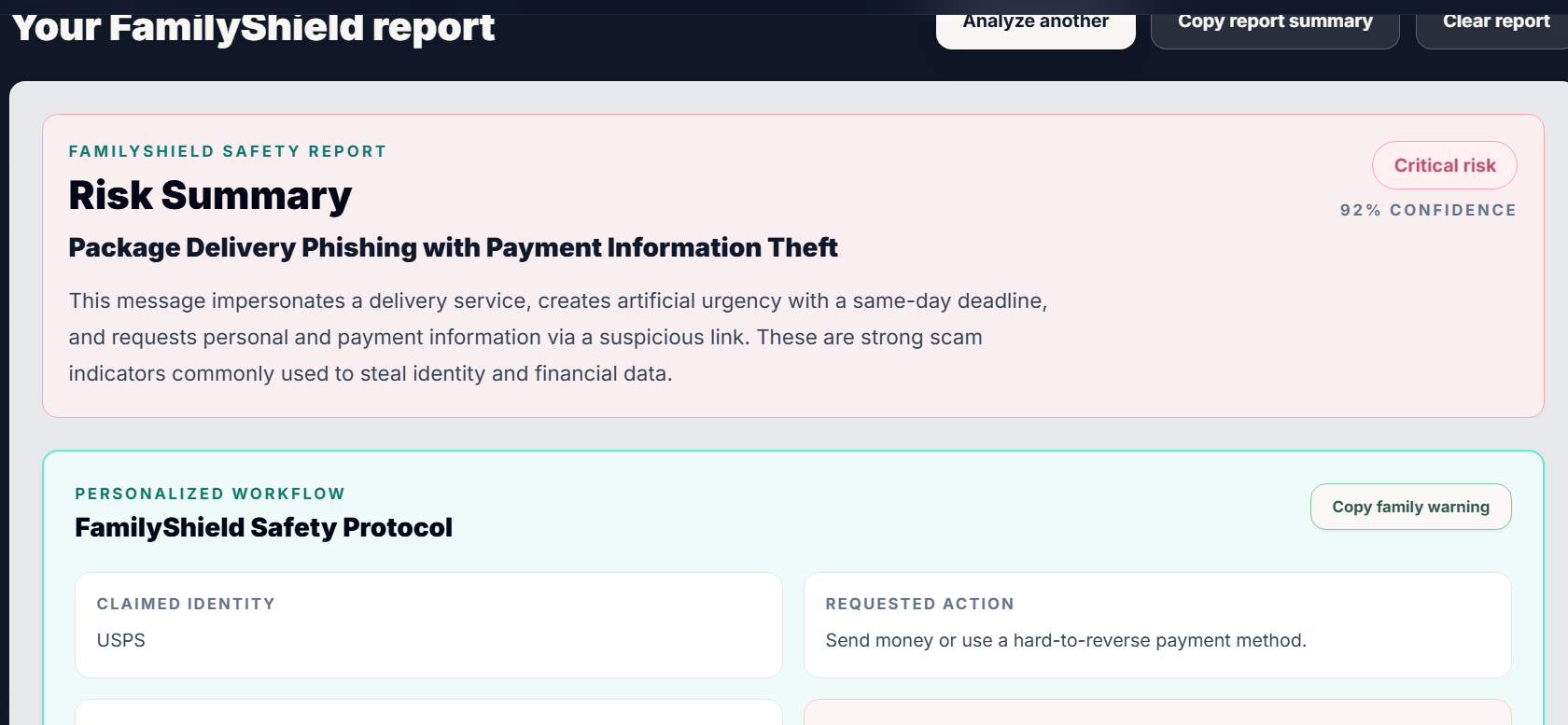
FamilyShield turns suspicious calls, voicemails, and messages into a personalized safety report.
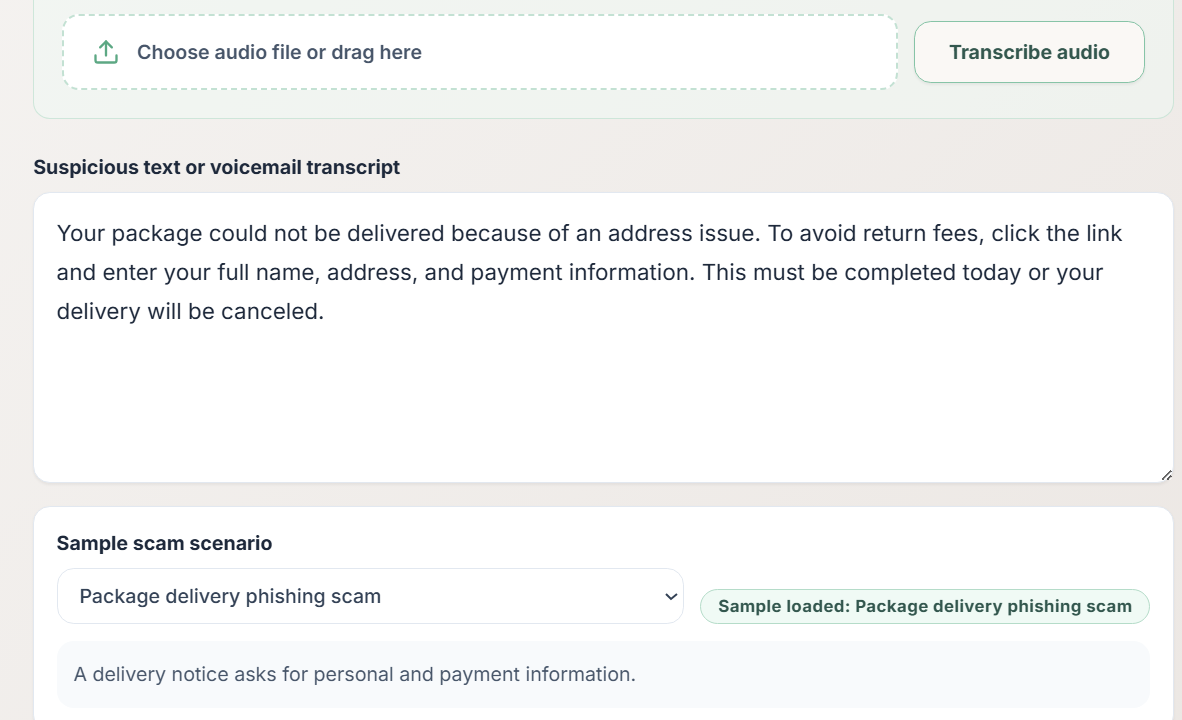
Users can paste a suspicious message or upload an audio file. FamilyShield transcribes audio, analyzes the content for scam signals, and generates a clear report explaining:
- the likely scam type
- red flags and manipulation tactics
- suspicious requested actions
- evidence from the message or transcript
- safe verification steps
- what not to do next
- a copyable warning to send to a trusted person
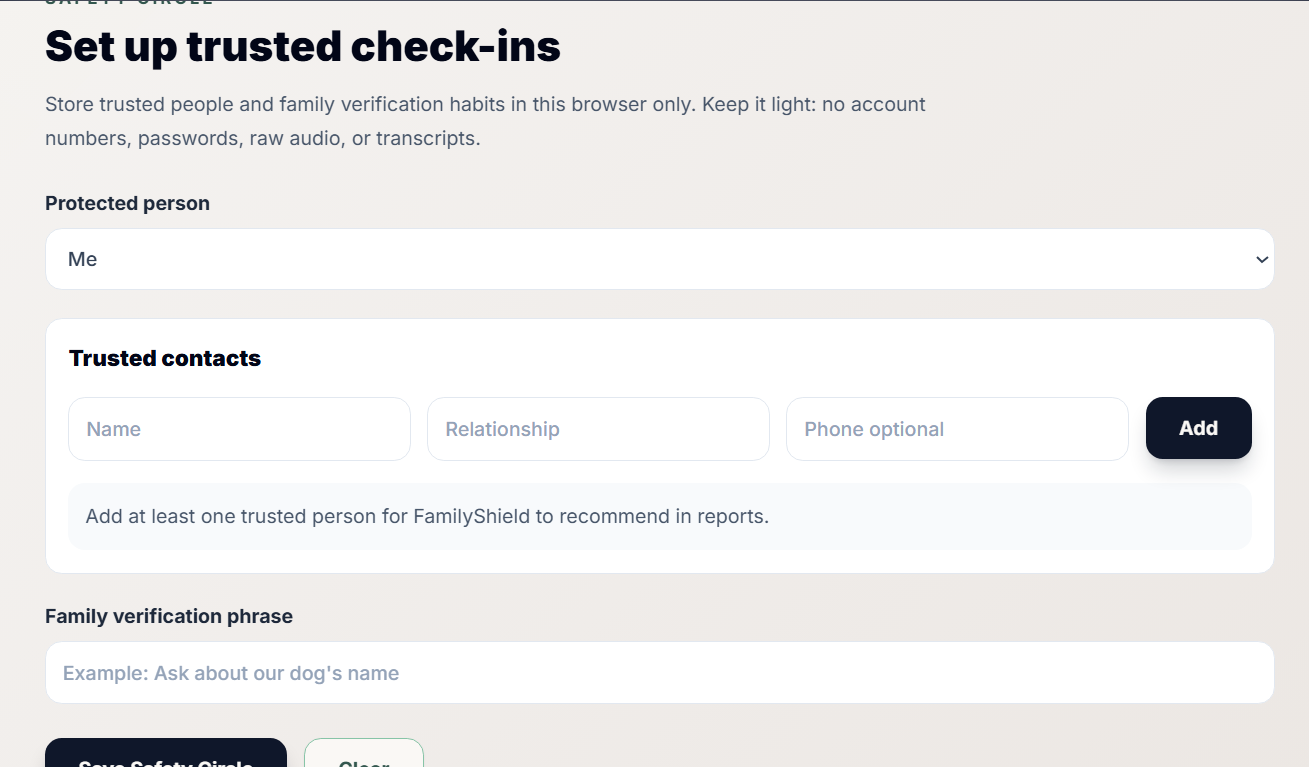
FamilyShield also includes two local personalization features: Profile and Safety Circle.
The Profile describes who the app is protecting, such as “Me,” “Parent / grandparent,” or “Family member,” along with an optional name and preferred verification style.
The Safety Circle stores trusted contacts, relationships, optional phone numbers, and an optional family verification phrase for emergency impersonation scams. This helps users check with a real person before responding to scam pressure.
Both features are stored only in the browser using localStorage and are not sent to Anthropic. The AI analysis happens first, and the local profile information is only used afterward to personalize the Safety Protocol and Safety Circle Check.
How I built it
FamilyShield was built with a Next.js frontend and API routes for backend logic. The interface uses Tailwind CSS and shadcn/ui components to create a calm, readable safety-focused experience.
I used Deepgram to transcribe uploaded voicemails or recorded calls into text. Then I used Anthropic Claude to analyze the transcript or pasted message and return a structured scam-safety report.
I used Redis as a scam playbook layer. The playbook stores common scam patterns such as gift card requests, verification code theft, family emergency impersonation, government impersonation, remote access scams, urgency pressure, secrecy pressure, and unverified callback requests.
Instead of treating the playbook as the entire universe of scams, FamilyShield first analyzes the message broadly, then uses Redis to enrich matched scam patterns with safer next steps.
The final report combines:
- Deepgram transcription
- Anthropic scam analysis
- Redis scam playbook matches
- local Profile and Safety Circle personalization
- a clear Safety Protocol for the user’s next action
Challenges I ran into
One major challenge was avoiding a generic “AI says this is a scam” experience. Early versions felt too much like a simple AI wrapper. I realized the product needed to focus less on classification and more on what happens after detection.
That led us to build the Safety Protocol and Safety Circle Check. These sections turn the report into a practical next-step workflow: do not call the provided number, do not share codes, do not send money, contact someone trusted, and verify through an independent channel.
Another challenge was catching setup-stage scams. Some scams do not immediately ask for money or passwords. For example, a fake credit card interest-rate reduction voicemail may only ask the victim to call an unverified number. The actual scam happens later. I updated FamilyShield to detect these suspicious setup paths, not just obvious payment requests.
I also had to think carefully about privacy. Since scam victims may be older adults or families dealing with sensitive situations, I avoided storing raw audio, full transcripts, or personal account details in the personalization layer.
Accomplishments that I're proud of
I are proud that FamilyShield became more than a scam detector. It became a stop-and-verify workflow.
The Safety Circle feature directly attacks one of the most dangerous scam tactics: isolation. If a caller says “do not tell your daughter” or pressures the user to act alone, FamilyShield highlights that behavior and encourages the user to contact someone trusted before making a decision.
I are also proud of the end-to-end flow: users can upload audio, receive a transcript, get a structured scam analysis, see matched scam playbook patterns, and receive personalized next steps based on their local Safety Circle.
Most importantly, the app is designed to be calm. Instead of overwhelming the user with technical explanations, FamilyShield gives plain-English guidance at the moment when slowing down matters most.
What I learned
I learned that scams are not just an information problem. In many cases, a calm person can identify a scam. The real danger is that scammers manipulate emotion, urgency, and isolation so the victim acts before verifying.
I also learned that AI products become stronger when the model is only one part of a broader workflow. Claude helps understand messy human language, but FamilyShield adds structure around that analysis: scam playbook matching, safety protocols, trusted-contact checks, and local personalization.
Finally, I learned that privacy-first design matters. For a tool like this, personalization should help the user without requiring invasive tracking or unnecessary storage.
What's next for FamilyShield
Next, I would like to add optional saved incident history so families can notice repeated scam patterns over time without storing raw transcripts or audio, and also expand to Website scams like purposely typoed domains trying to fake, and turn it into a browser extension.
I also want to improve the Safety Circle experience with one-tap SMS sharing, better accessibility for older adults, multilingual scam reports, and more robust detection for long-form scams such as romance scams, fake job scams, and investment scams.
Long term, FamilyShield could become a family scam-safety companion: a private place where suspicious messages, voicemails, and calls are turned into clear verification steps before anyone sends money, shares codes, or acts under pressure.
Built With
- anthropic-claude-api
- deepgram-api
- localstorage
- next.js
- node.js
- react
- redis-cloud
- shadcn/ui
- tailwind-css
- typescript
- vercel

Log in or sign up for Devpost to join the conversation.