-
-
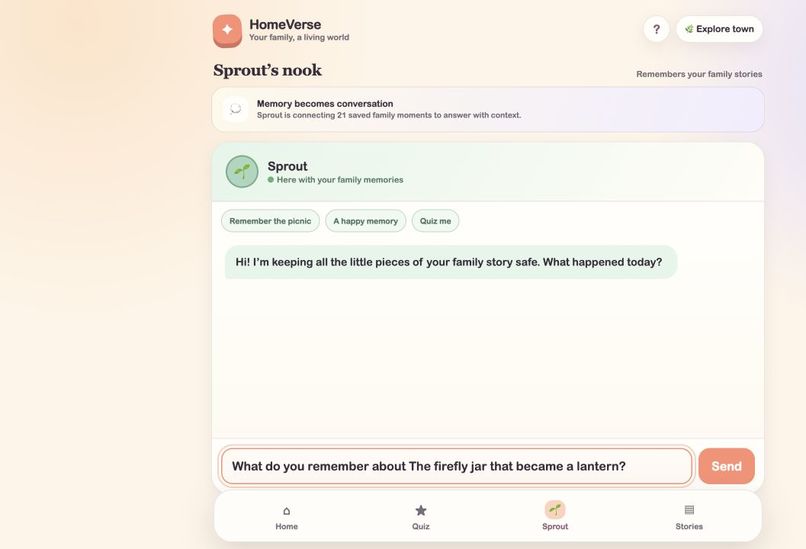
Sprout remembers this family's real history, not generic chat.
-
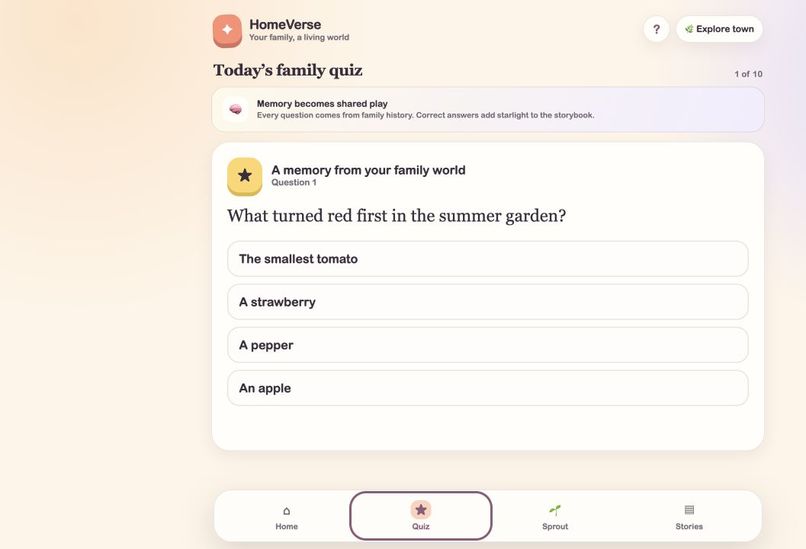
Family-specific quizzes turn shared memories into play.
-
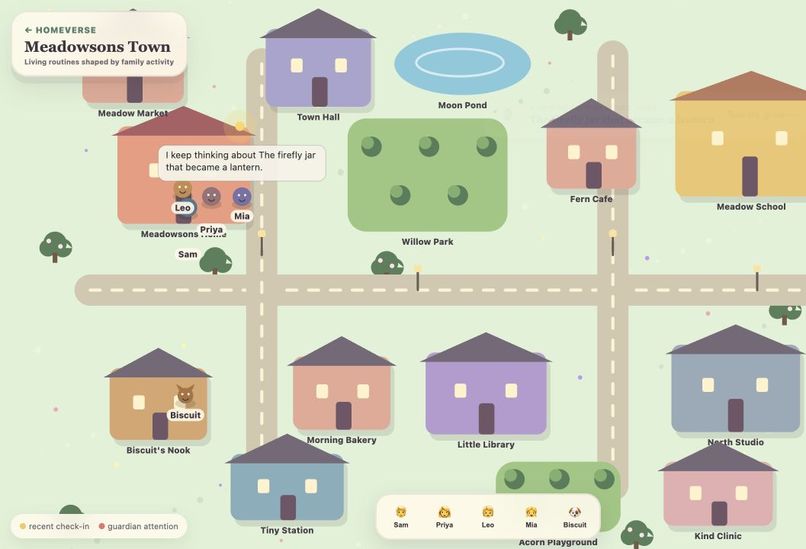
The living town carries the newest memory into the family world.
-
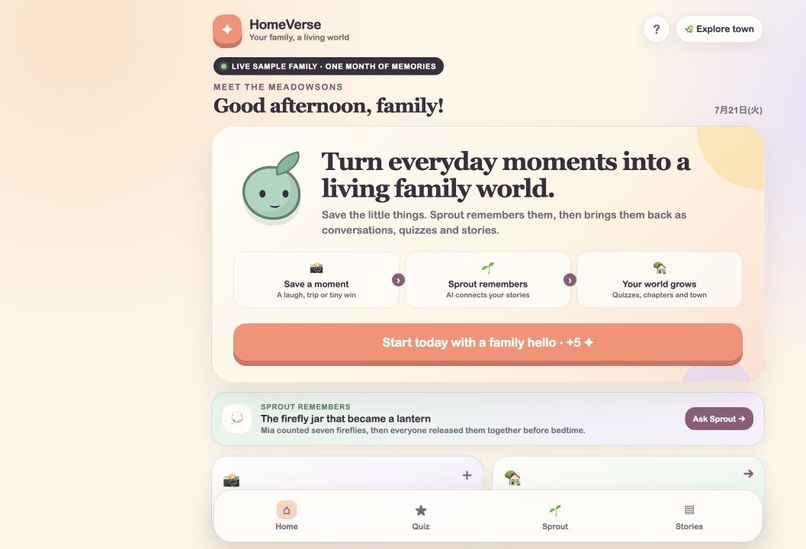
Start with one memory—and see the whole family loop.
-
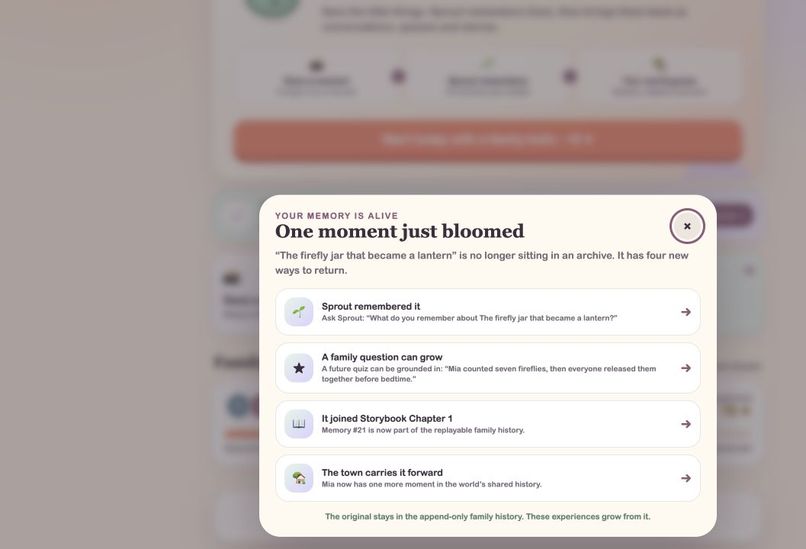
Memory Bloom: one saved moment returns in four meaningful ways.
-
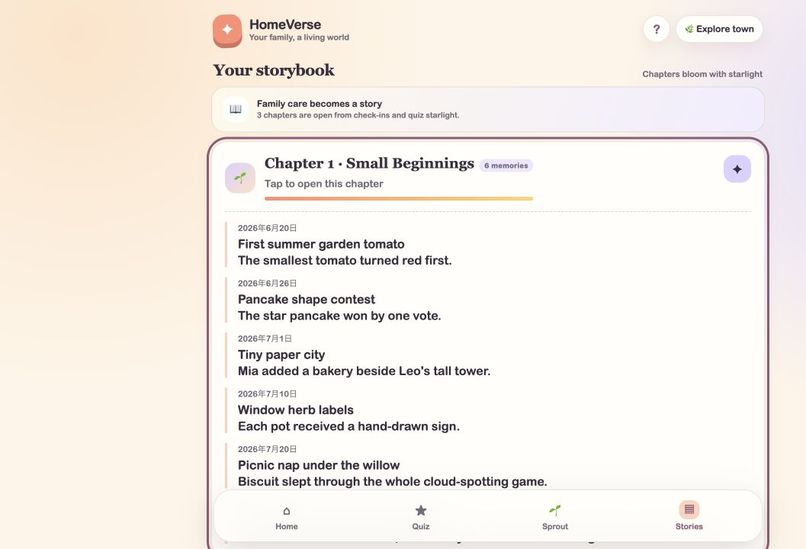
Starlight unlocks a storybook built from moments worth keeping.
HomeVerse — Devpost project story
Inspiration
HomeVerse comes from a slightly embarrassing realization: our family takes hundreds of photos, notes, and screenshots, and almost never looks at any of them again. Nothing is lost, exactly. It's all technically saved. It just stops participating in daily life about four seconds after it's captured.
We didn't invent this project for the hackathon. For months before Build Week, we'd been running a scrappy private system for our own family that logged small daily moments and fed them back through quizzes and a little virtual world. It was held together with duct tape and affection, and it was never meant to be shown to anyone. But it taught us something we couldn't unlearn: kids will not browse an archive, ever — and the same kids will happily fight over a quiz question about something that happened three months ago. And a loss in our family earlier this summer made the gap between "stored" and "remembered" stop being abstract for us.
So the idea at the center of HomeVerse is simple: memories shouldn't just survive. They should keep showing up.
For Build Week we rebuilt the useful structure from scratch as a clean, private, shareable kit. One thing we want to be explicit about: the sample family in the demo, the Meadowsons, is entirely fictional. No real names, family composition, identifiers, or private memories ship with this project. The architecture came from lived experience; the data did not.
What it does
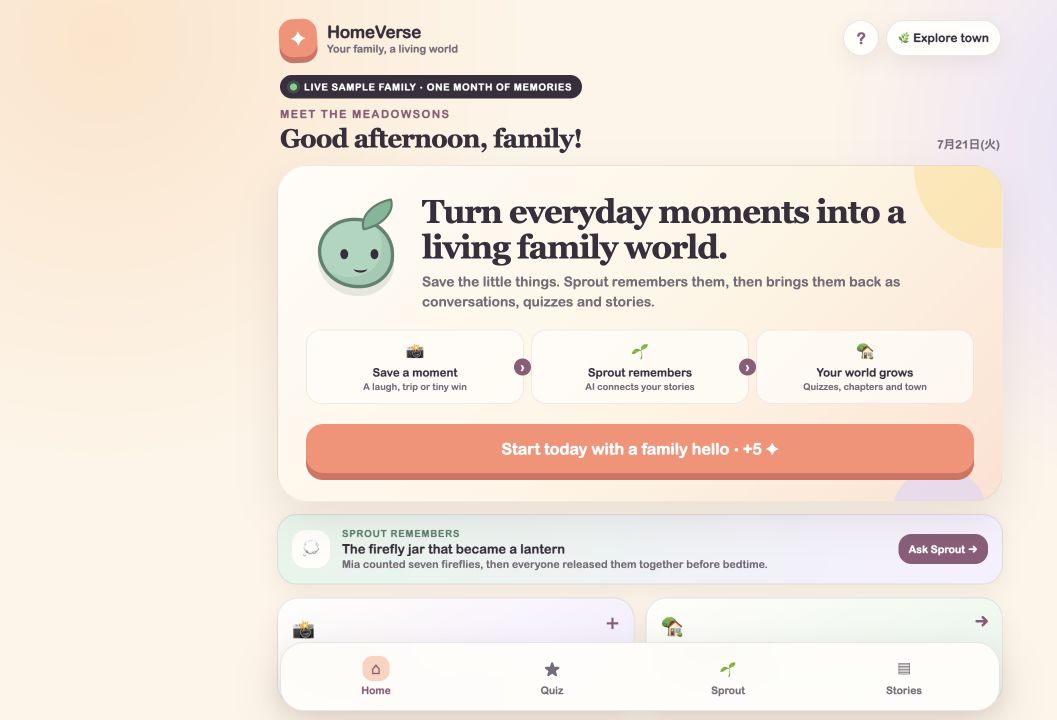
HomeVerse turns everyday family moments into a loop:
- Someone saves a small moment, or checks in.
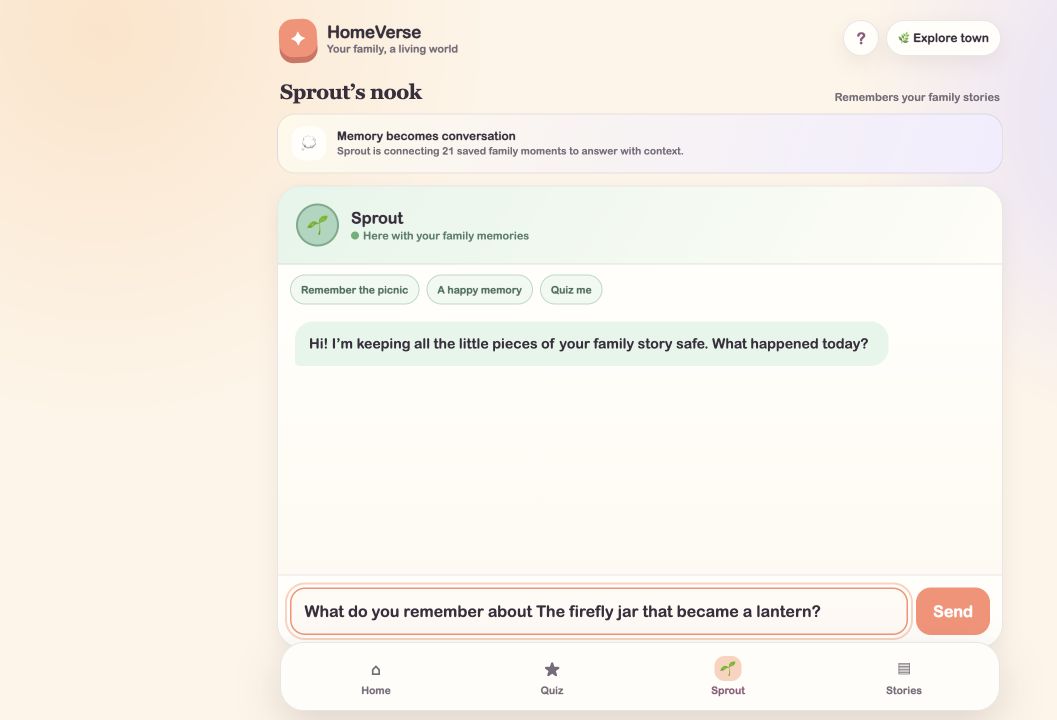
- Sprout, a memory-aware AI companion, can talk about that family's own history.
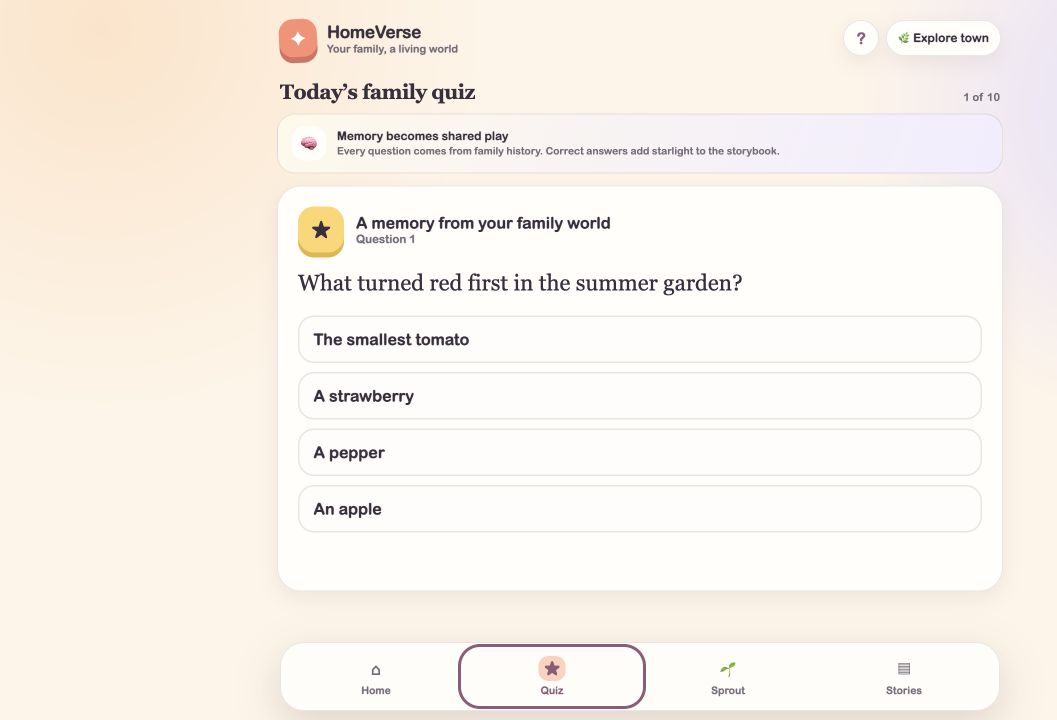
- The same memories come back as family-specific quizzes.
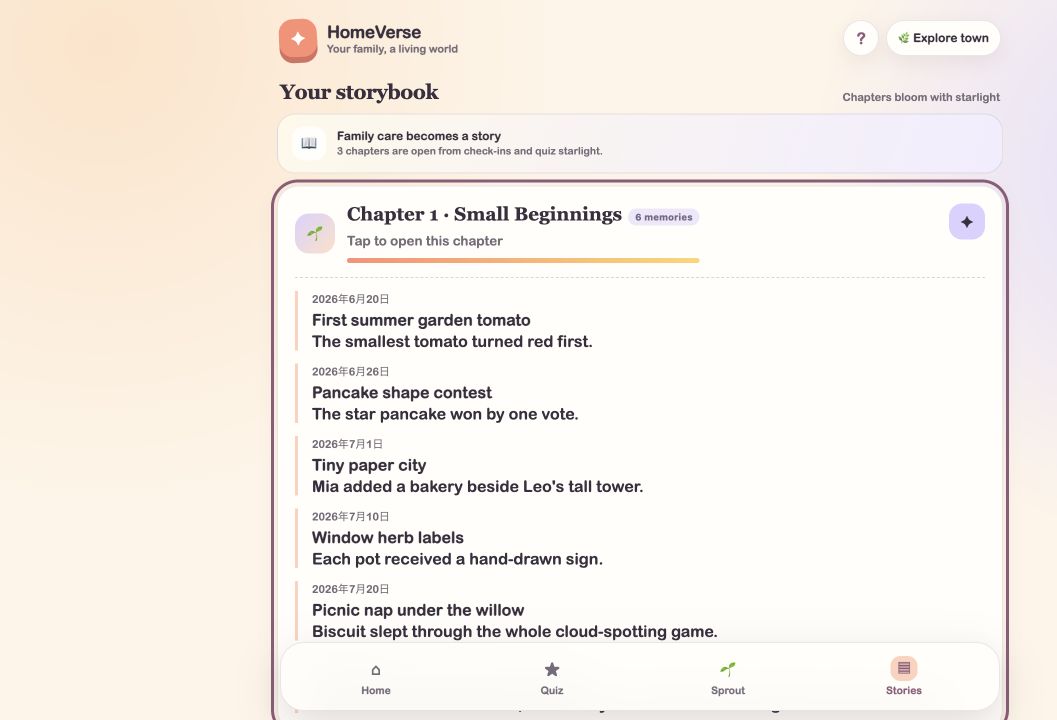
- Check-ins and quiz answers earn starlight, which unlocks chapters in a storybook album.
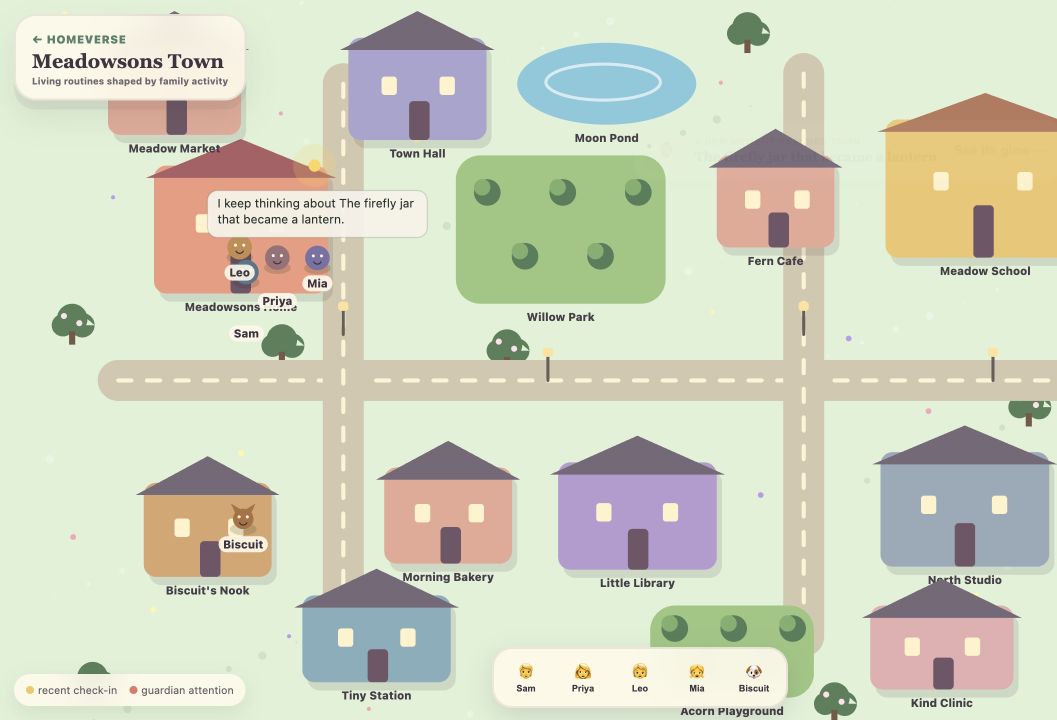
- The family shows up in a living town whose residents follow time-aware routines.
The important part is that this isn't a chatbot bolted onto a photo album. The event history is the single shared source for the companion, the quizzes, the storybook, and the town. One memory can come back as a conversation, a question, a story chapter, or a small detail in the world — sometimes all four.
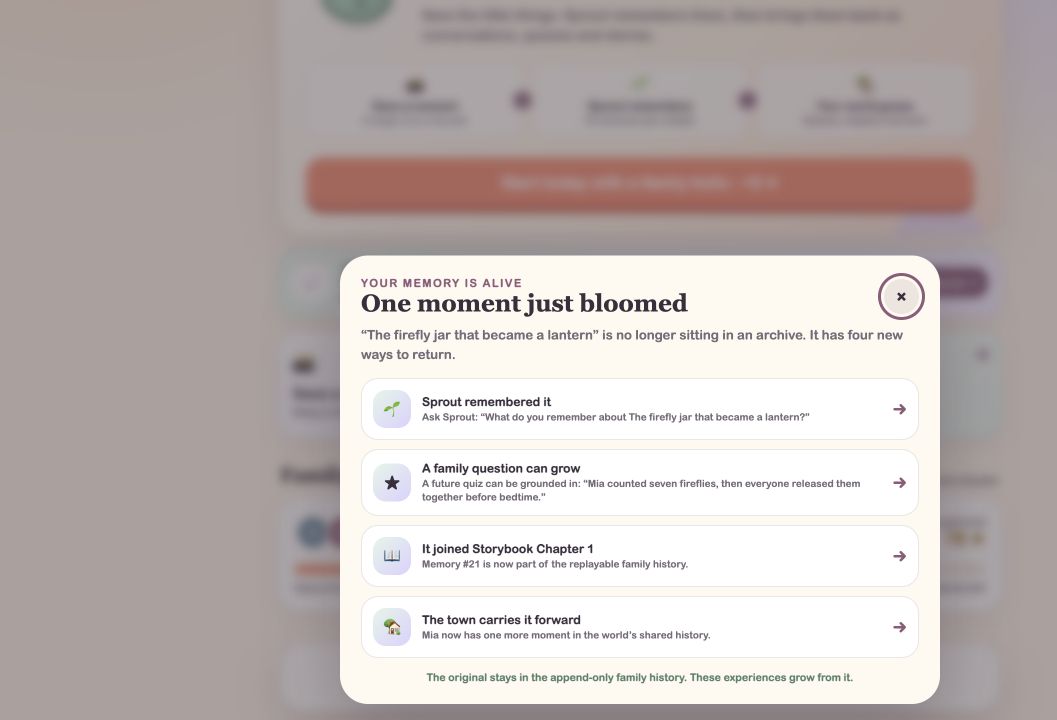
We made that loop visible with a feature we call Memory Bloom. The moment you save something, HomeVerse shows you the four places it can return — Sprout, a quiz, the storybook, the town — and lets you jump straight into any of them. Before we built this, the whole "one memory, four futures" idea only existed in the architecture diagram, which is a terrible place for a product promise to live.
Sprout: AI that remembers this family
Before each model call, we project a compact context out of recent family memories and waiting state. GPT-5.6 receives that context through the OpenAI Responses API, so Sprout can bring up the actual beach trip from Tuesday instead of being generically warm.
One decision we feel strongly about: child safety is not the model's job. A deterministic guard runs first. If a message contains worrying phrases, the child gets a fixed, age-appropriate response and a guardian gets flagged — before any generated output is even considered.
Quizzes no template could write
The daily quiz prefers unseen questions and rewards the first ten answers with starlight. GPT-5.6 can also turn captured moments into brand-new questions. A quiz template can ask what sound a cow makes; only the memory log can ask what went wrong at this family's picnic.
A world kids actually come back to
Kids won't open an archive, but they'll come back for a character, a quiz, a story, or a tiny town. So caring actions grow the world: check-ins and shared remembering unlock storybook chapters, and the Canvas town is alive the moment it loads. Residents run on deterministic schedules, so the town doesn't freeze while waiting for an AI. The newest saved memory travels into town too — as a glowing lantern by the family home, and as a memory-aware line from whoever captured it.
How we built it
The heart of it is boring on purpose: an append-only event log and a deterministic projector.
Family history is never treated as mutable model output. Check-ins, memories, quiz answers, companion messages, safety flags — all of it is appended as events. The projector replays them into a reproducible snapshot: starlight, album unlocks, quiz progress, memory context, companion waiting state. That's a product decision as much as a technical one. Family history shouldn't get silently overwritten, and an LLM should never be the authority on what happened.
The stack:
・ FastAPI + Python for the API, event store, projector, safety guard, and OpenAI integration ・ OpenAI Responses API with GPT-5.6 for memory-aware conversation and memory-derived quiz generation ・ vanilla JavaScript in a PWA shell (dependency-light on purpose) ・ Canvas 2D for the animated town ・ Docker Compose, so it starts with one command
About process, honestly: HomeVerse existed before Build Week as a family prototype maintained with Tina/Fable. For the hackathon, that maintainer extracted the privacy-safe technical foundation, and Codex took over the submission build — redesigning the full UI and UX through repeated three-pass critique loops, wiring the product narrative through every feature, building Memory Bloom, making the town interactive, and testing the whole experience in a real browser, over and over, on desktop and mobile. It's not a prompt-generated mockup, and it's not a greenfield project wearing a "months of history" costume. It's a working, auditable transformation of a real system into a focused product.
Challenges we ran into
Privacy without losing authenticity. The product came from real family needs, but a submission can't expose the family behind it. We drew a hard export boundary: architecture and interaction patterns could leave; real data and identifying details could not. The fictional Meadowsons seed exists so judges get a lived-in first experience without us copying our own household into a public repo. Writing a fake month of family history that still feels real turned out to be harder than most of the code.
Making the AI necessary instead of decorative. Our rule was: the model only goes where family context changes what's possible. That left exactly two places — a companion that remembers, and quizzes that can only be written from this family's history. Everything else (town, projector, rewards, safety) stayed deterministic. We cut several "wouldn't it be cool if the AI also..." ideas to keep that line clean.
Making the first minute work. The system has a genuinely nerdy core, but nobody falls in love with an event log. We kept iterating until the loop is something you feel in the first minute: save a moment, watch Sprout remember it, see it come back as play, watch the world grow.
Accomplishments that we're proud of
・ A complete family-memory loop, not a pile of disconnected AI features ・ Memory Bloom — one saved moment visibly traveling into four future experiences ・ An append-only, replayable source of truth for sensitive family history ・ Memory-aware GPT-5.6 features with deterministic child-safety handling ・ A living, interactive town that never waits on a model ・ A fictional month of family history that makes the first launch feel inhabited ・ One-command startup, and graceful behavior without an API key ・ Tested across desktop and mobile in a real browser, including accessibility states
What we learned
The big one: preservation is not memory. A memory is alive when it can return in a new context and cause another family interaction. Storage is a checkbox; return is a design problem.
The other one: the safest role for an LLM is not owning family state. Let the model transform trusted history into conversation and play. Let deterministic code own the history, the safety gates, the rewards, and the projections.
What's next for HomeVerse
Private multi-user family accounts, consent-aware sharing, richer story formats, and maybe optional generated dialogue inside the town. The same event history could also power family-controlled exports — so memories can outlive any one interface, including ours.
The goal hasn't moved:
Don't build another archive. Give families a reason to return.
Built With
- codex
- docker
- event-sourcing
- fastapi
- gpt-5.6
- html5
- javascript
- openai
- pwa
- python
- responses-api

Log in or sign up for Devpost to join the conversation.