-
-
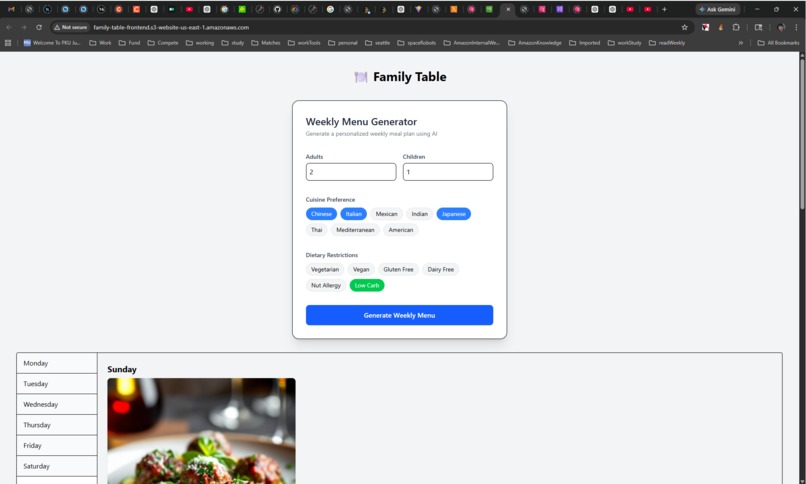
Collect information UI
-
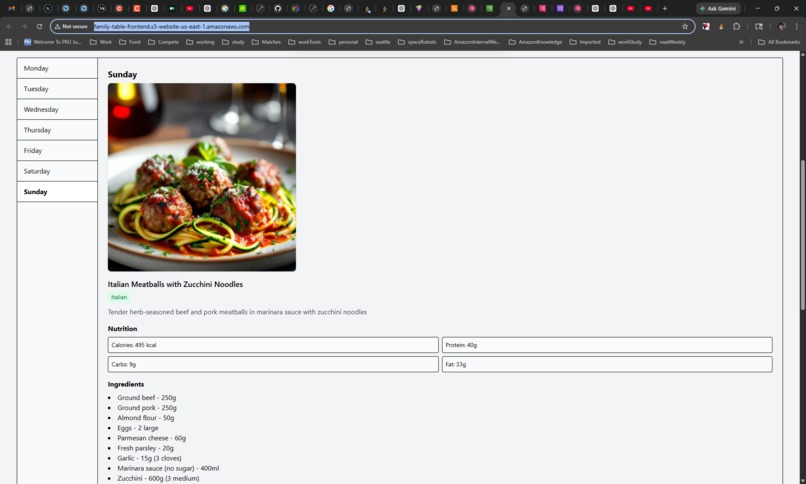
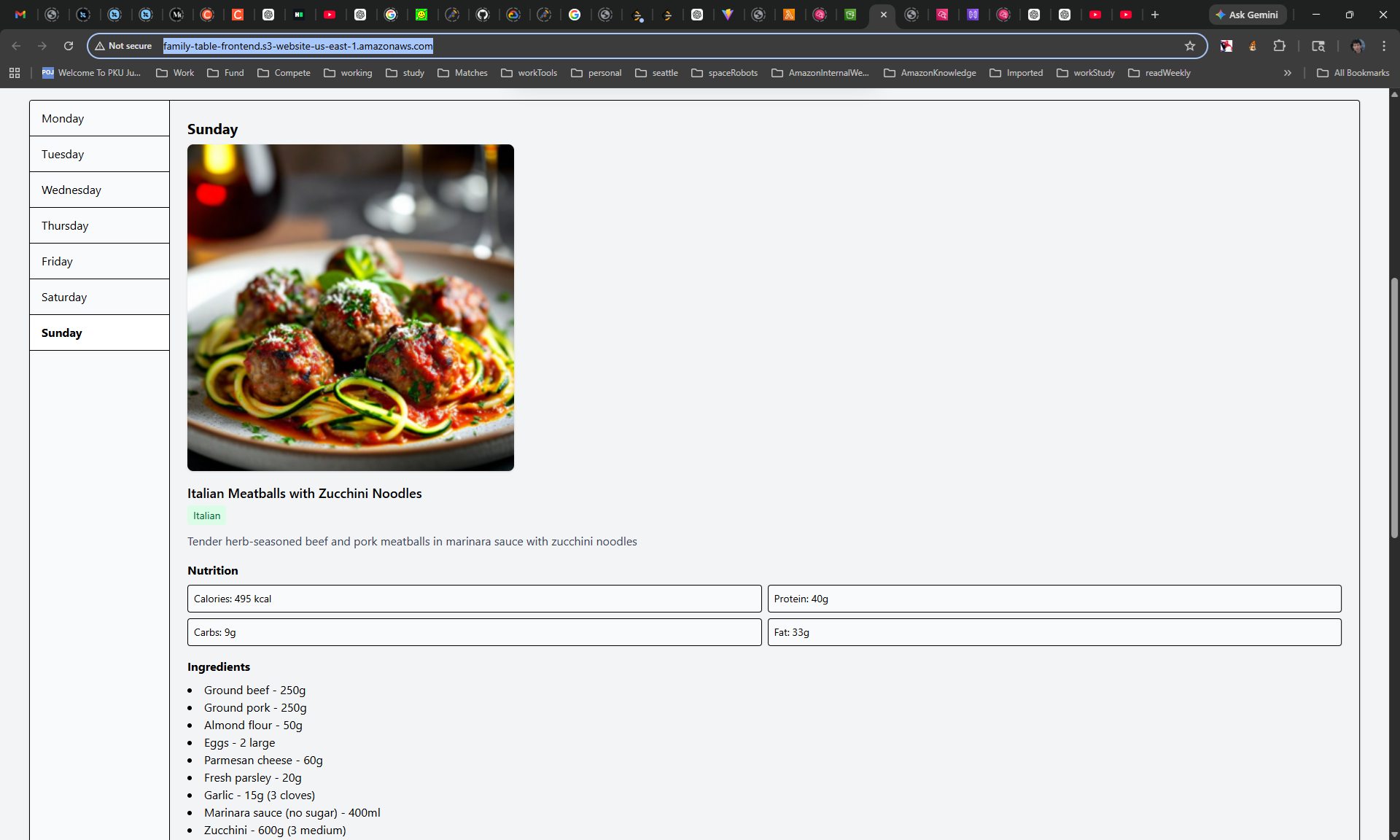
Present dinner's detail inforamtion
-
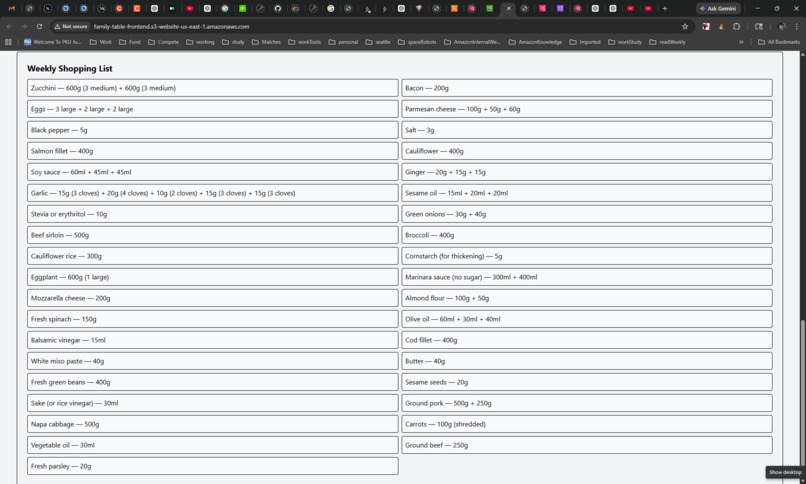
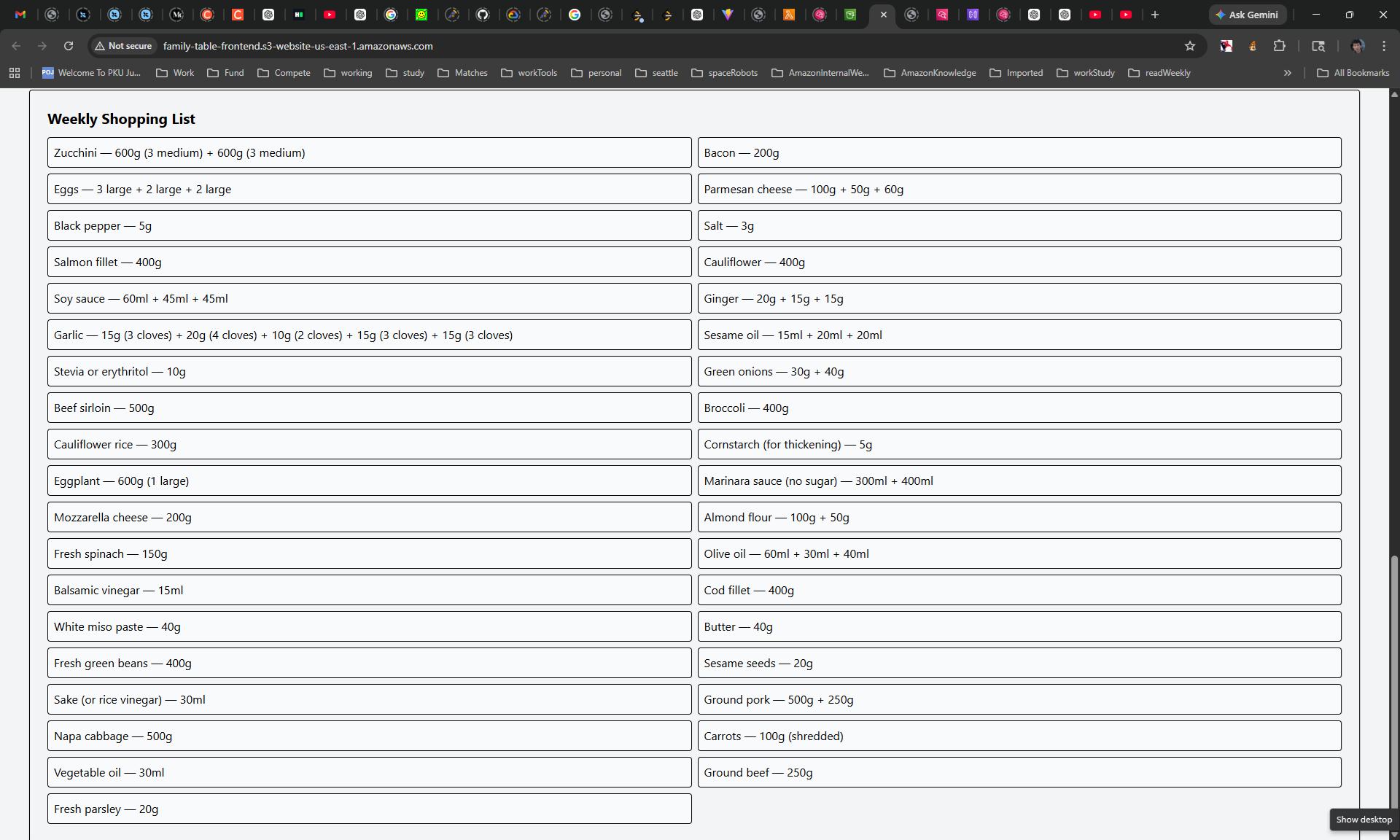
Present merged shopping list
Inspiration
Dinner is one of the most important moments for families to connect. However, planning dinner every day can be surprisingly difficult. Families often need to decide what to cook, make sure they have the right ingredients in advance, and prepare a long shopping list. On top of that, many people also wonder whether their meals provide balanced nutrition, which is not always easy to evaluate.
What if AI could help simplify this entire process? We built Family Table to leverage generative AI to help families plan their weekly dinners, organize shopping lists, and better understand the nutrition of their meals.
What it does
This application provides the following capabilities:
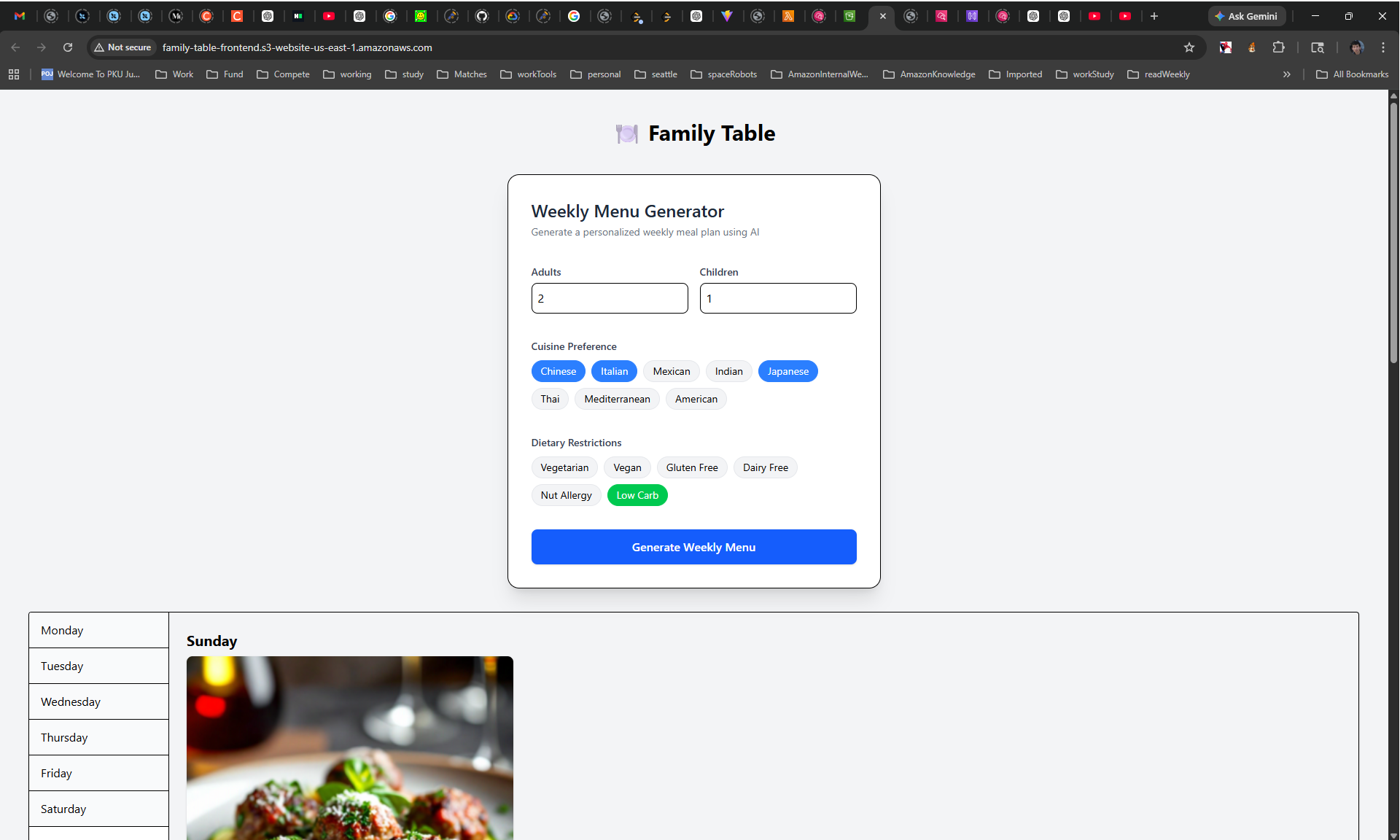
- It collects family information relevant to meal planning, such as the number of adults, number of children, cuisine preferences, and dietary restrictions.
- It generates a complete weekly dinner plan, including detailed descriptions, ingredients, and nutritional information for each meal.
- It automatically merges ingredients across the entire week to create a consolidated shopping list.
- It generates AI-created images for each dish to make the menu more engaging and visually appealing.
How we built it
We built the frontend using React, while the backend is implemented with AWS Lambda using Python.
The workflow works as follows:
- The frontend collects family preferences and meal requirements from users.
- The frontend sends this information to the backend through an API.
- The backend uses AWS Bedrock to generate a weekly dinner plan tailored to the family’s needs.
- Bedrock generates detailed information for each dinner, including cuisine, ingredients, and nutrition.
- We also use Amazon Nova Canvas to generate a high-quality image for each dish.
- The backend returns the generated data to the frontend.
- The frontend processes the results further, such as merging ingredients across meals to generate a comprehensive shopping list, and then renders all information to the user.
Challenges we ran into
Generating both meal plans and images with Bedrock/Nova can take some time. However, API Gateway requires requests to complete within 30 seconds, which creates a challenge when multiple images are generated.
To address this limitation, we explored several optimizations, such as parallelizing image generation and improving backend processing efficiency to ensure the response can be returned within the required time window.
Accomplishments that we're proud of
We are proud that Family Table solves a real-life problem that many families face every day. The application demonstrates how generative AI can simplify everyday decision-making, reduce planning effort, and improve the dining experience.
We are also excited about the potential to extend this idea further, as it provides a strong foundation for building practical AI-powered lifestyle tools.
What we learned
Through this project, we learned that AWS Bedrock and Nova provide powerful and flexible capabilities for generative AI applications. The ability to integrate Bedrock seamlessly with other AWS services such as Lambda and API Gateway makes it straightforward to build scalable AI-powered applications.
This project demonstrated how quickly a practical and impactful AI application can be built using the modern AWS ecosystem.
What's next for Family Table
There are many potential enhancements we plan to explore in the future:
- Provide nutrition evaluation and health insights for each dinner
- Allow users to update or regenerate a specific day's dinner
- Extend meal planning to breakfast and lunch
- Integrate with third-party services such as map or grocery platforms to help users shop more efficiently
- Support personalized dietary goals (e.g., weight loss, muscle gain, low-carb diets)

Log in or sign up for Devpost to join the conversation.