-
-
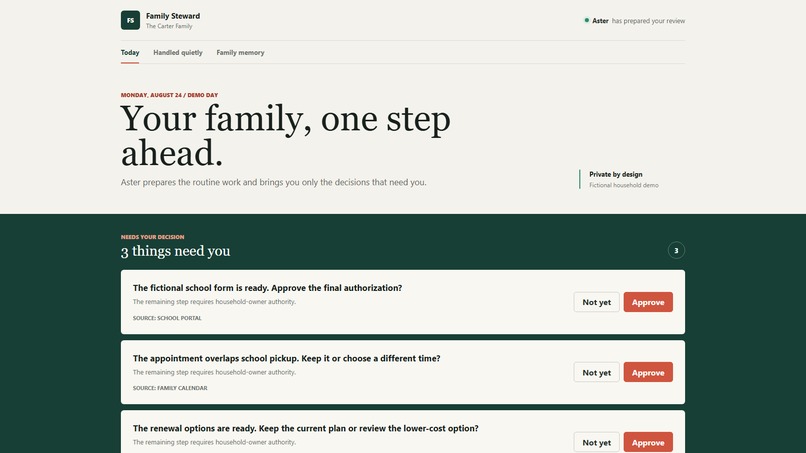
The fictional Carter household: prepared work, source-backed context, and decisions reserved for the human.
Inspiration
Families repeatedly juggle school forms, appointment conflicts and renewals. Another inbox is not relief. Family Steward explores assistance that prepares routine work and stops when a person needs to make the decision.
What it does and who it is for
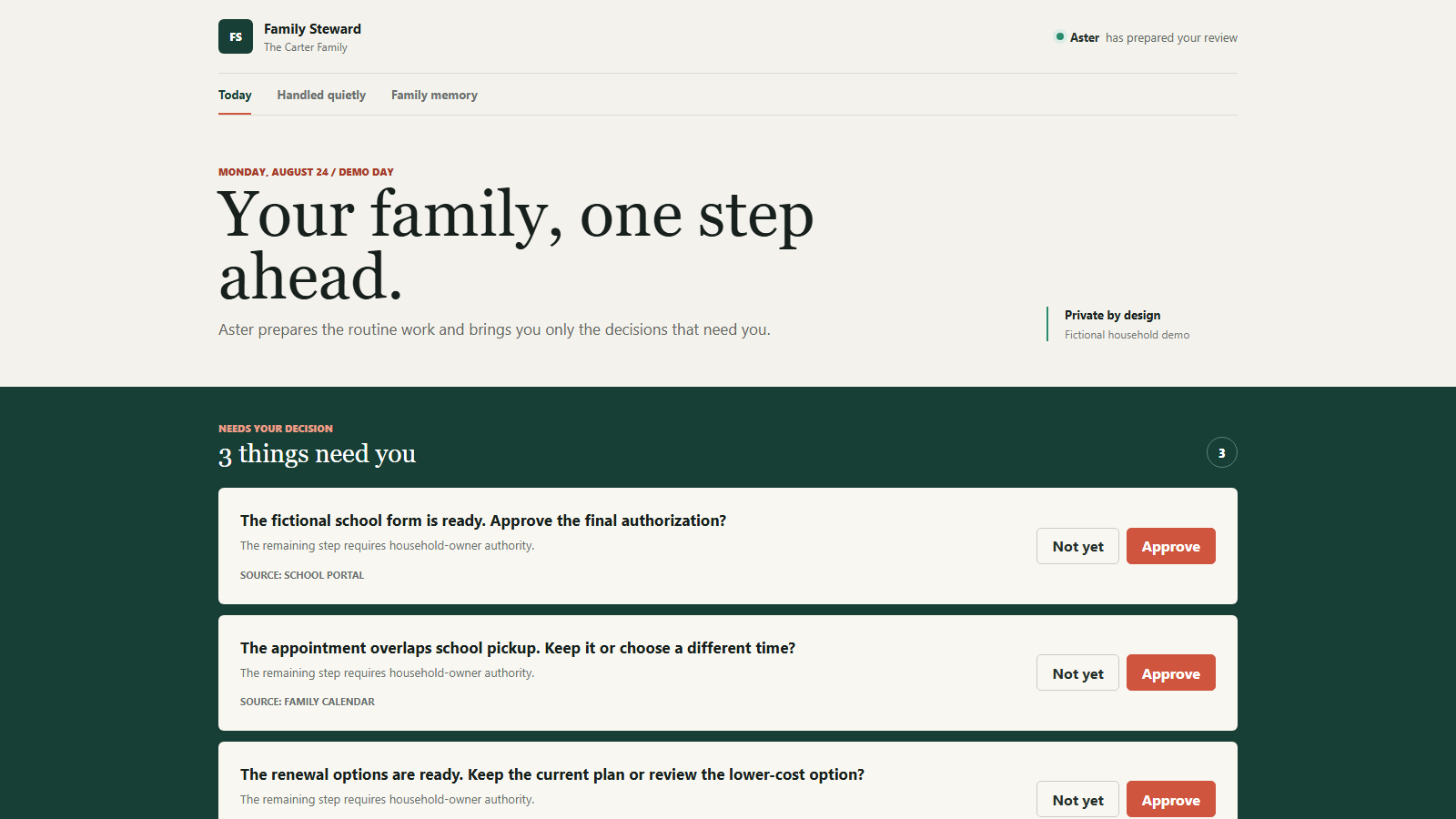
Family Steward is a prototype for families managing recurring household administration. The fictional Carter household demonstrates three workflows: school-form preparation, an appointment overlapping school pickup, and renewal options requiring an owner choice. The interface separates prepared items from decisions that need a human.
Aster, our Strands-based reviewer on Amazon Bedrock AgentCore, explains the original fictional decision packet using Amazon Nova Micro. It cannot sign, pay, send or approve. Optional local QMD search retrieves a family preference only after validation against accepted source records. A simulated owner approval reduces pending decisions from three to two and appends an outcome while preserving the original request.
How we built it
Python implements the deterministic authority gate and in-process append-only micro-memory. HTML, CSS and JavaScript provide the local household interface. QMD discovers candidates locally; source-digest and active-state checks determine whether a result may be displayed.
The browser explicitly requests a review through the local server. An IAM-authenticated call reaches the deployed AgentCore runtime, where a bounded Strands tool and Nova Micro review a packaged fictional fixture. Only a fixed action identifier is transmitted, not browser text, search queries or local approvals. Calls are limited to one attempt per server session, with successful results cached. Refreshing the page does not invoke the model.
Architecture
Local browser -> Python controller and authority gate -> IAM-authenticated AgentCore runtime -> Strands read-only review tool -> Amazon Bedrock Nova Micro.
Local memory and optional QMD retrieval remain on the controller. The cloud reads its original packaged snapshot; local approval closes that snapshot review rather than presenting stale cloud results as current. The repository architecture document contains the full service diagram.
Challenges
Keeping assistance useful without granting execution authority was the central challenge. Another was connecting a real cloud reviewer without exposing an unrestricted public paid endpoint. We also needed to make the boundary between the cloud's fixed snapshot and local approvals explicit.
Accomplishments
A real browser-to-AgentCore review, verified local memory recall, an explicit human approval boundary, and a complete fictional demonstration. The current Python suite has 43 passing tests. The interface remains usable without cloud credentials; missing cloud access fails honestly.
What we learned
Preparation and execution are different promises. Useful agents need to explain what was actually done, what remains pending and who has authority. Source validation matters as much as semantic retrieval.
Why it matters and what is next
The goal is less household administration and clearer decisions without surrendering control. This demonstration does not claim measured time savings or production readiness. All data is fictional; no real forms are submitted, purchases made or messages sent. Approval outcomes last only for the server session. The next step is evaluation with consenting households before implementing durable storage, access controls and real integrations.
Disclosure
This is a separate project built for Agents for Humans. Strands, QMD, AWS libraries and other dependencies are pre-existing third-party tools, not claimed as original work. AI coding assistance supported development; the video uses ElevenLabs narration. No private companion or household data is included.
Built With
- amazon-bedrock
- python
- strands-agents

Log in or sign up for Devpost to join the conversation.