-
-
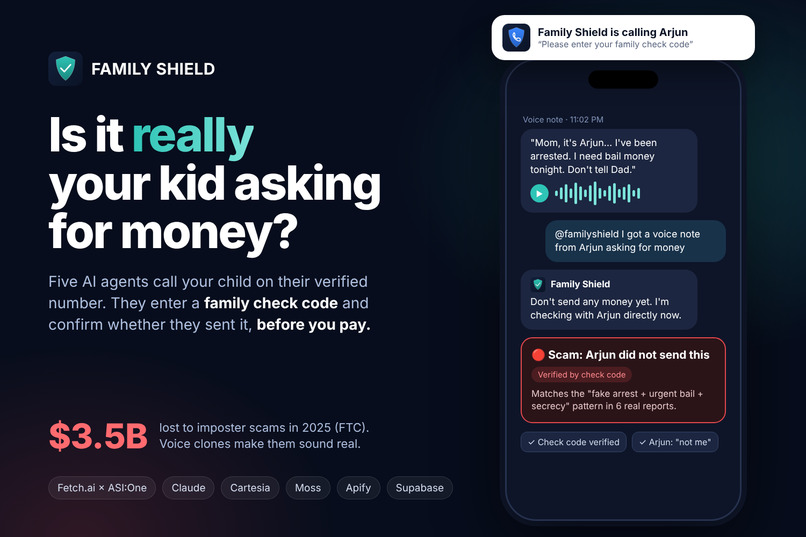
Is it really your kid asking for money? Family Shield checks with your actual child before you pay.
-
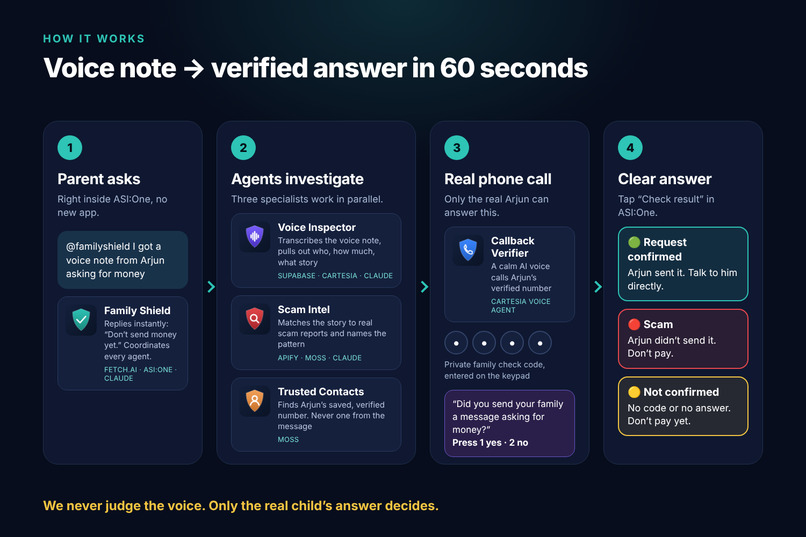
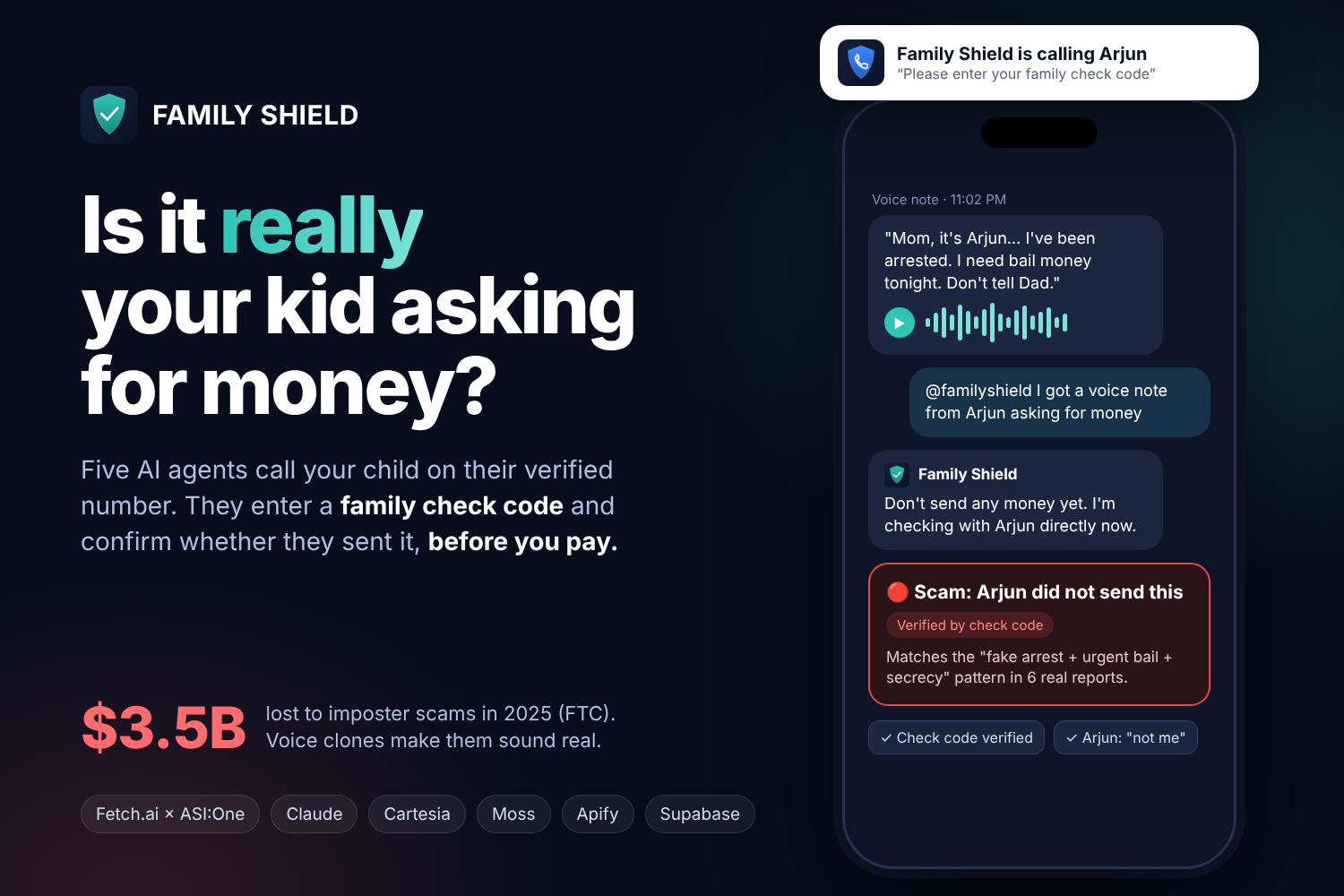
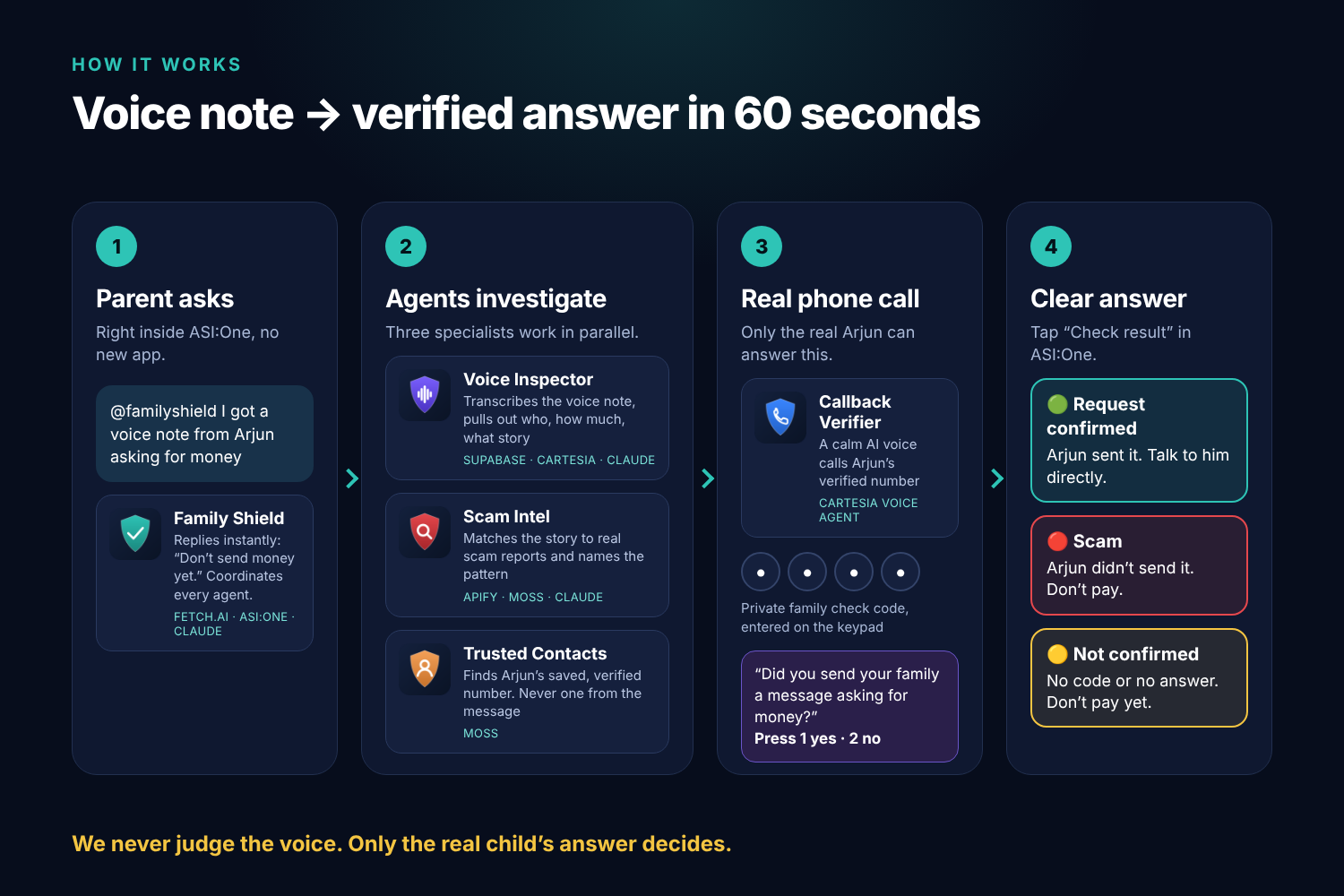
How it works: the parent asks in ASI:One, agents investigate, a Cartesia voice agent calls the child, the parent gets a clear answer.
-
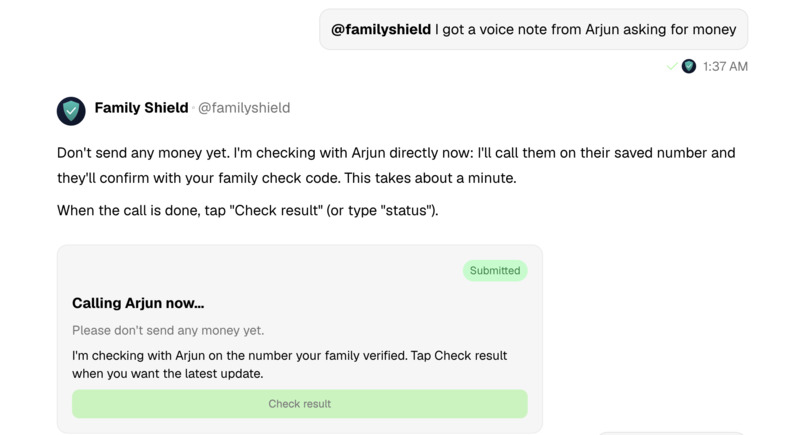
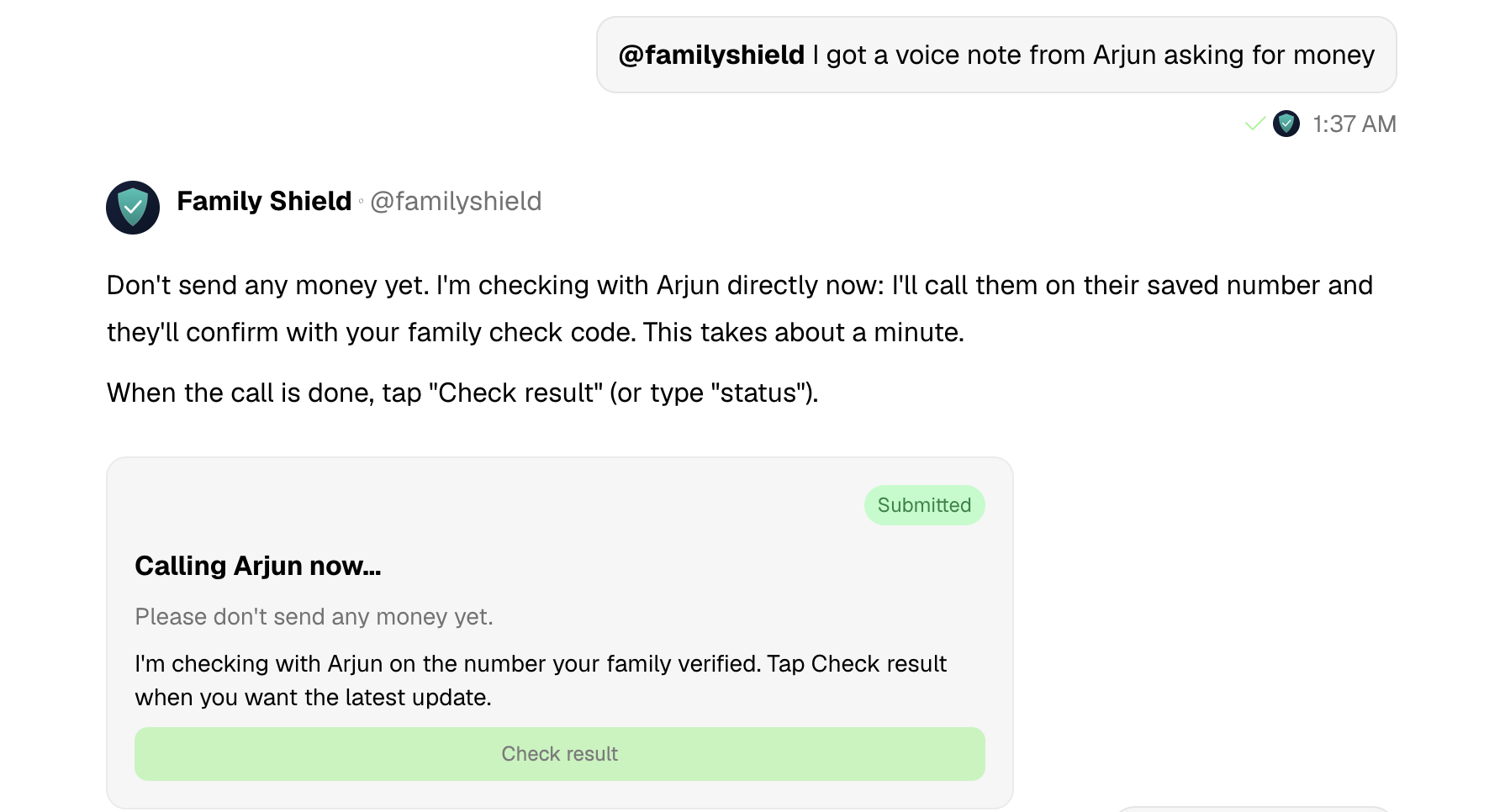
Real ASI:One chat: Family Shield replies instantly, starts the call to Arjun and shows a Check result button.
-
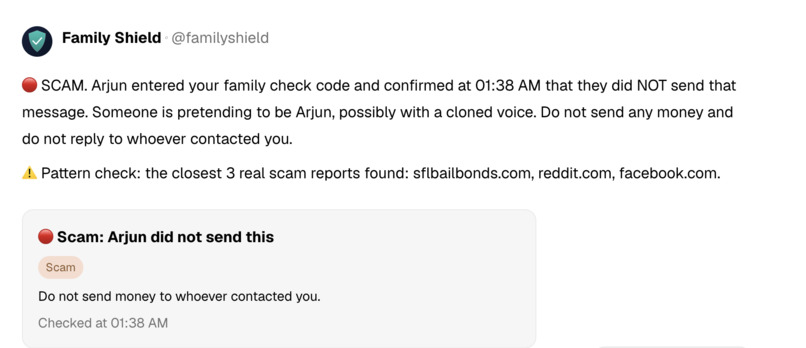
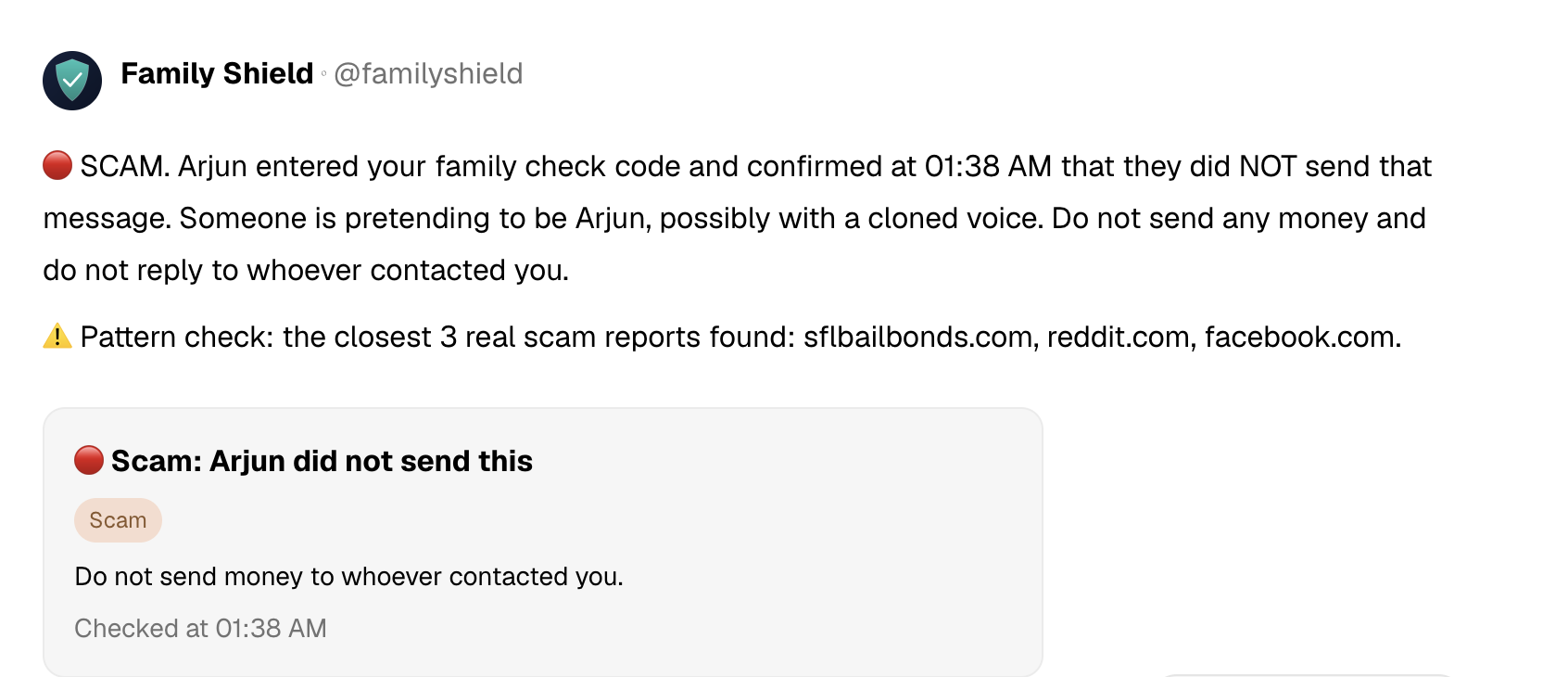
Red, scam: Arjun entered his check code and said he didn't send it. Scam Intel lists the closest real scam reports.
-
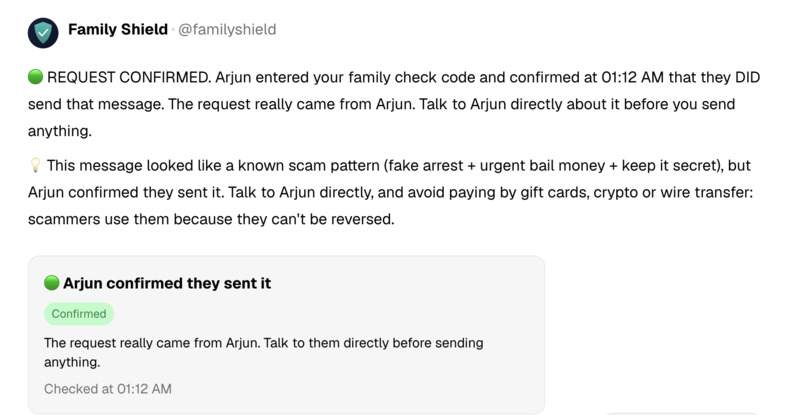
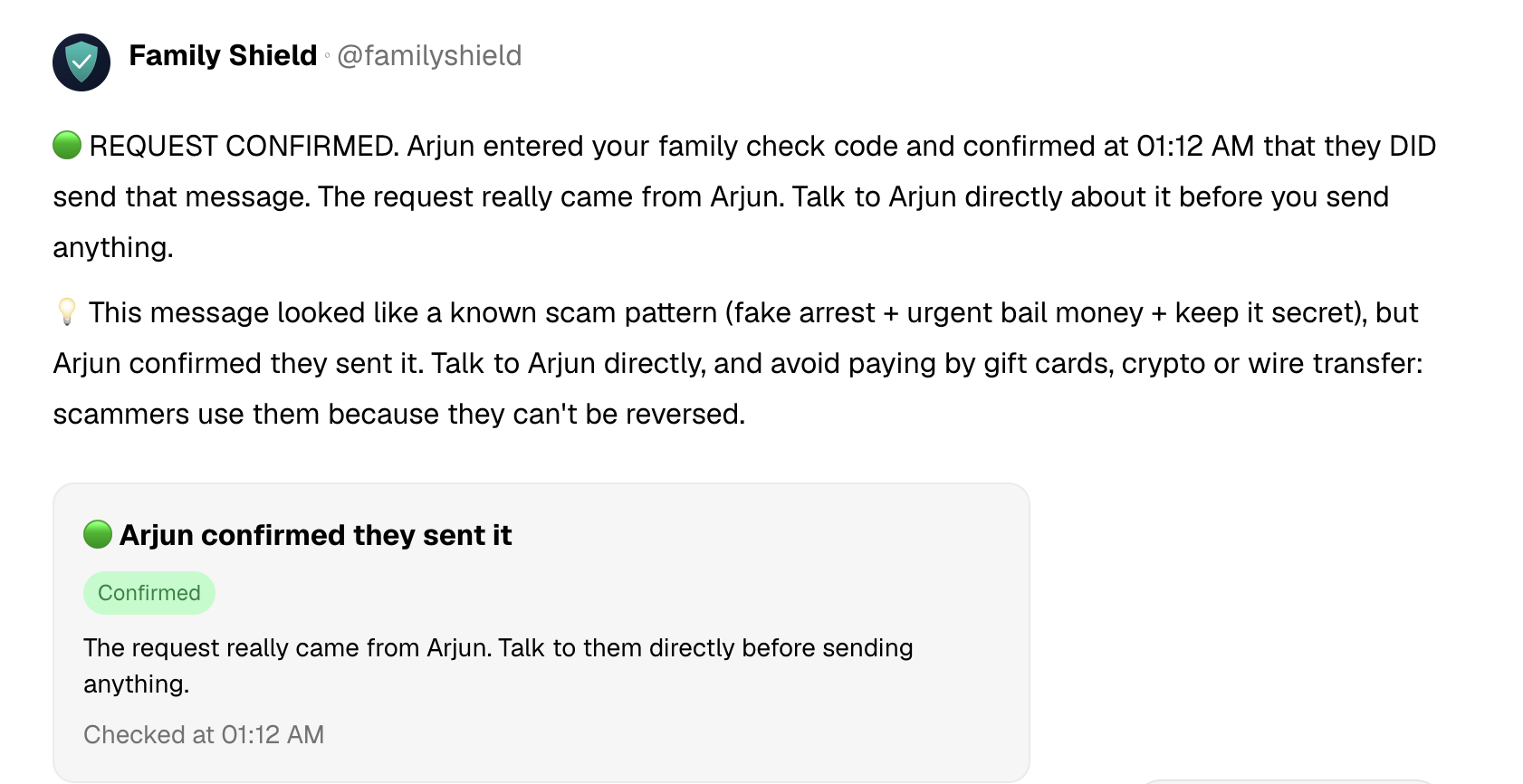
Green, confirmed: Arjun said he sent it. Family Shield still names the scam pattern and warns against gift cards, crypto and wire.
-
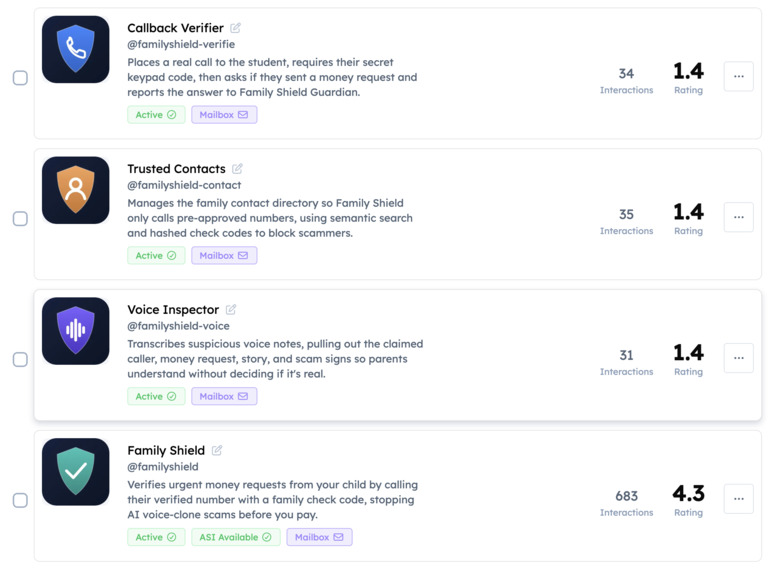
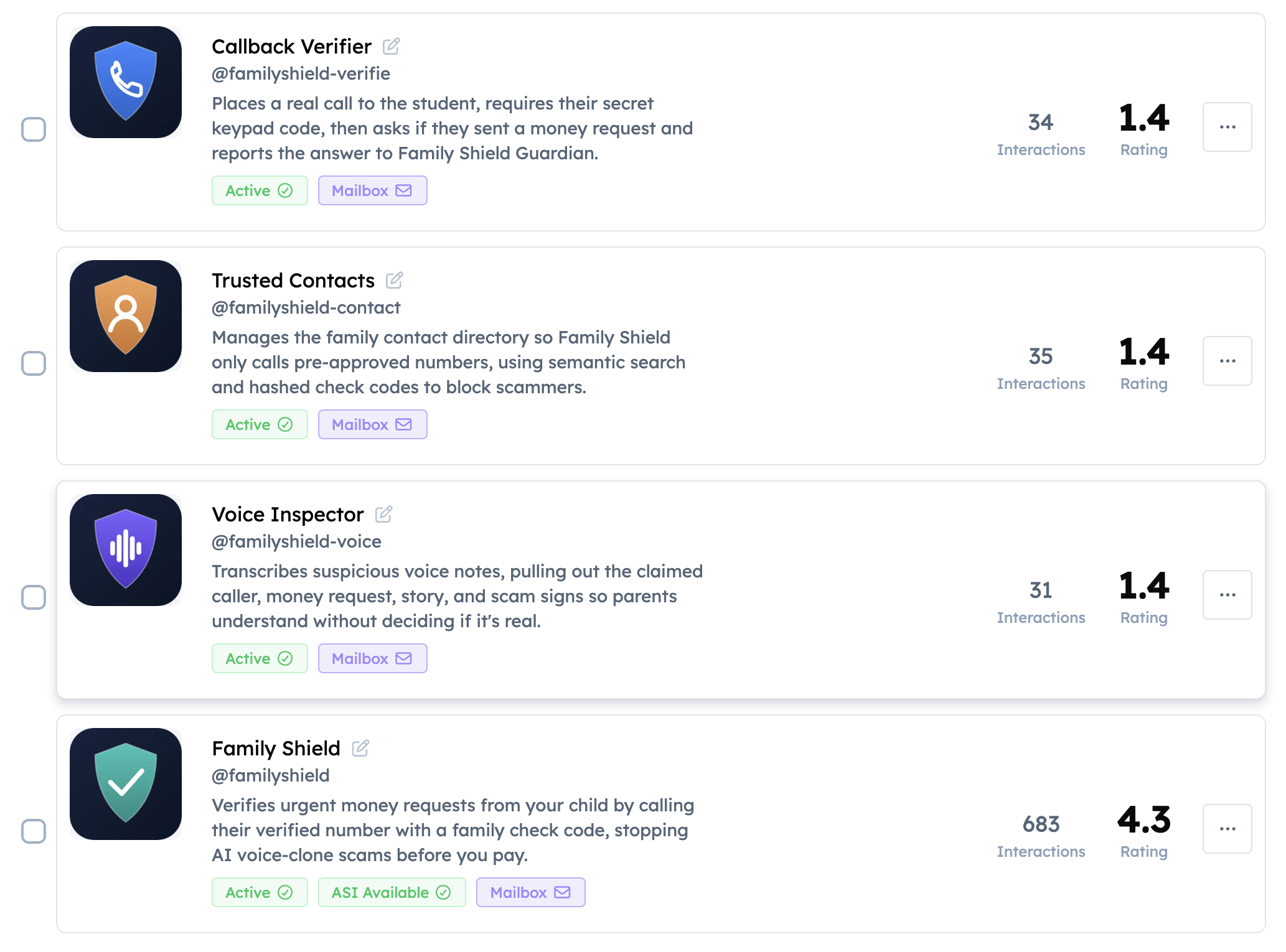
Our agents on Agentverse: Family Shield (Guardian), Callback Verifier, Trusted Contacts and Voice Inspector.
-
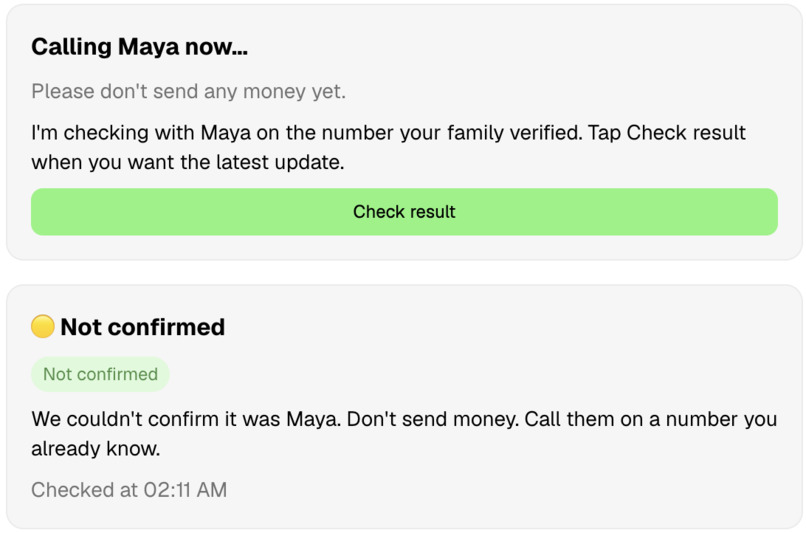
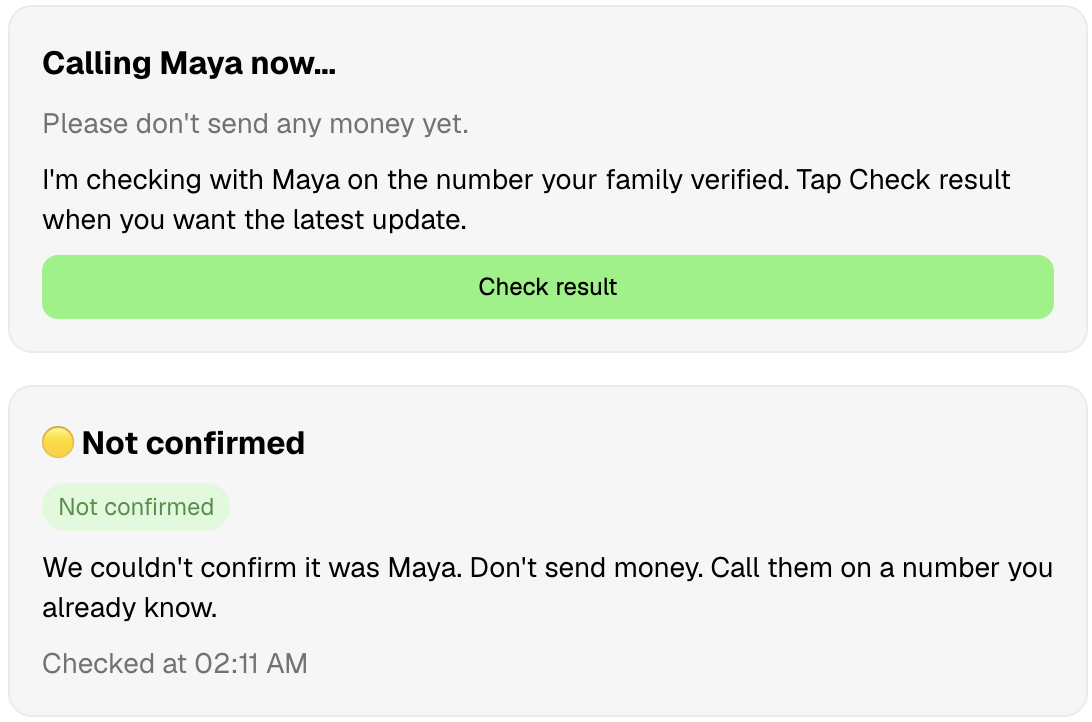
Amber, not confirmed: we couldn't verify it was Maya, so the parent is told not to pay and to call a number they already know.
Inspiration
A voice note arrives at 11 PM: "Mom, it's me. I've been arrested; I need bail money tonight. Please don't tell Dad." It sounds exactly like your son, because a scammer cloned his voice from a few seconds of video.
Who it's for
Parents of college students who live far from home, especially families of international students, where a parent may be in another time zone, can't easily reach their child, and feel pressure to pay fast.
Many of us are students far from home, and our parents would pay first and ask questions later. In 2025, Americans reported losing $3.5 billion to impostor scams, the most-reported fraud category (FTC), and people 60+ lost $7.7 billion to fraud, up 59% (FBI IC3). The FBI now describes "distress" scams that use voice cloning to imitate family members.
Deepfake detectors are an arms race we'll lose, because clones keep getting better. So we stopped asking "does this voice sound real?" and started asking "what does the real person say?"
What it does
A parent opens ASI: One and tells Family Shield: "I got a voice note from Arjun asking for money."
- Instantly: "Don't send any money yet. I'm checking with Arjun."
- Five agents get to work:
- Voice Inspector transcribes the voice note and extracts what it claims (who, how much, what story).
- Scam Intel compares the story against real scam reports we collected and names the pattern, e.g. "fake arrest + urgent bail money + secrecy, described in 6 real reports", with government sources first.
- Trusted Contacts finds the number Arjun's family registered in advance, never a number from the suspicious message.
- Callback Verifier places a real phone call. Arjun enters his private family check code on the keypad, and only then is asked: "Did you send your family a message asking for money? Press 1 or 2."
- The parent taps Check result:
- 🟢 Request confirmed: Arjun really sent it. Talk to him directly, plus safe-payment advice (never gift cards, crypto, or wire).
- 🔴 Scam: Arjun didn't send it. Don't pay. Family Shield also writes a family alert the parent can forward to the family group chat, because scammers who clone one person's voice often try the grandparents next.
- 🟡 Not confirmed: wrong code, no answer, or no saved number. Don't pay yet.
The same voice note can be real or fake. In our demo, we play the identical recording twice; only Arjun's answer after he checks the code decides the outcome.
How we built it
- Fetch.ai uAgents + Agentverse + ASI:One: five agents with mailboxes, coordinating over typed messages. The Guardian speaks the Agent Chat Protocol, so the whole workflow runs inside ASI: One, with interactive cards (green/red/yellow results and a Check result button).
- Cartesia: speech-to-text for the voice note, and an outbound voice agent that collects the keypad code and the 1/2 answer through two webhook tools served by a FastAPI endpoint behind a Cloudflare tunnel.
- Claude: reads the parent's message (name, amount, warning signs), extracts the voice note's claims, and decides which scam reports truly match and names the pattern.
- Moss: a semantic family directory ("AJ" still finds Arjun; unknown names never match someone else) and a second index of real scam reports.
- Apify: the Google Search Scraper collected about 58 news, government, and consumer-alert reports about voice-clone family-emergency scams, seeded into Moss.
- Supabase Storage: the voice notes, looked up by the child's name.
Safety by design
- The check code always comes first, so whoever answers the phone can't just press 1.
- We only call numbers the family registered, never a number from the suspicious message.
- Check codes are stored only as hashes and never read back on the call.
- Claude never decides the result. It can misread a name or match the wrong scam report, so its output is information only. Green or red comes only from the child's own answer after their check code.
- We never tell a parent to send money, only whether the request really came from their child.
- Every call says it's an AI calling on the family's behalf.
Challenges we ran into
- ASI: One's chat model. ASI: One shows an agent's reply only if it comes back within seconds, but a real phone verification takes a minute. We redesigned around it: an instant first reply with a Check result button, and the result delivered when the parent taps it.
- Personal AIs answering for the parent. The user's ASI: One assistant started replying to our agent, creating AI-to-AI loops that could have triggered phone calls. We built a loop guard: messages that mention @familyshield are always trusted, while unmentioned, AI-sounding replies are quietly ignored.
- iPhone call screening intercepted our verification calls from an unknown number, which taught us to onboard the verifier's number as a contact.
- Agentverse mailbox outages during the night meant building every step to fail safe: 🟡, never 🟢.
- Getting the question right. Our first version told parents "your child did not send that message" after the code, which isn't what a code proves. We added the explicit 1/2 question so green and red mean exactly what they say.
Accomplishments that we're proud of
- A real end-to-end flow: chat in ASI:One → real phone call → keypad code → yes/no → verdict card, in about a minute.
- Five cooperating agents using six sponsor technologies, each doing a job that matters.
- A design that gets stronger as voice clones get better, because it never relies on detecting them.
- Every outcome is fail-safe: anything uncertain ends 🟡 "don't pay yet", never 🟢.
What we learned
- Verification beats detection: ask the real person through a channel the scammer doesn't control.
- Multi-agent systems need the same safety thinking as payments: one result per case, explicit states, and loop protection.
- How conversational platforms actually deliver messages, and how to design the experience around that.
What's next for Family Shield
- Verified payments with the Fetch.ai Payment Protocol: families register the student's account in advance. When a "send money now" message arrives, the parent doesn't have to choose between panic and doubt: they place the money with Family Shield as a hold while we verify. 🔴 Scam: the hold is refunded. 🟢 Confirmed: it goes only to the account registered in advance, never to one named in the message. Money moves only after proof, and a scammer has nowhere to receive it.
- Automatic family alerts: when a scam is confirmed, text or call every relative in the family directory instead of only showing a forwardable message.
- Family onboarding in chat: add family members, numbers, and codes from ASI: One, stored hashed in Moss.
- Backup contacts: if the student doesn't answer, try a roommate or the other parent.
- Forwarding the actual voice note from WhatsApp or iMessage straight to Family Shield.
- Scam Intel that keeps learning: scheduled Apify runs and anonymized patterns from confirmed scams.
- Languages: parents of international students often speak Hindi, Mandarin, Korean or Spanish, and Cartesia supports multilingual voices.
Built With
- agentverse
- apify
- asi-one
- cartesia
- claude
- cloudflare
- fastapi
- fetch.ai
- moss
- python
- supabase
- uagents

Log in or sign up for Devpost to join the conversation.