Inspiration
Family emergency scams exploit people's love for their families. In the HuskyHack case, Linda receives an urgent call from someone pretending to be her grandson Tommy, asking for $8,500.
Traditional fraud systems detect suspicious transactions, but they can't always tell whether the recipient is legitimate. We wanted to solve a simpler problem: Is Linda actually sending money to the person she trusts?
What it does
Family Recognition protects members by verifying recipients before suspicious payments go through.
Saved contacts: If the account matches Tommy's previously saved account, the payment proceeds normally.
New accounts: If a payment to an unfamiliar account is high-risk, it's automatically paused for verification.
Family verification: If the recipient claims to be someone Linda knows, Sound's AI calls that person using their previously saved trusted phone number.
Account verification: Even if Tommy confirms the request, Sound must independently verify account ownership before releasing the payment.
Scam prevention: If Tommy rejects the request, the payment is blocked as suspected fraud.
Choosing "Custom Recipient" cannot bypass a required verification hold. Members can also report scams and initiate recovery assistance.
How we built it
We analyzed Linda's case (M1001) and identified key warning signs: an unfamiliar account, an unusually large payment, and her first wire transfer in years.
We built our prototype using:
Frontend: Nuxt.js and Vue
Backend: Python FastAPI
Database: Supabase
Deployment: Vercel
Our working demo demonstrates both legitimate and suspicious payments. AI calls and bank verification are currently simulated, not connected to real banking systems.
Challenges we ran into
Our biggest challenge was closing a loophole: scammers could simply claim to have a new bank account.
We solved this by requiring verification for high-risk new accounts, even when users choose a custom recipient.
We also learned that confirming someone's identity and verifying their bank account ownership are two different steps. Both are important for preventing fraud.
Accomplishments that we're proud of
We built an end-to-end prototype showing two outcomes:
Scam: Tommy rejects the unfamiliar account, and Linda's payment is blocked.
Legitimate payment: Tommy confirms the request, account ownership verification succeeds, and the payment is approved.
Our system focuses on taking action rather than simply displaying fraud warnings.
What we learned
Fraud prevention requires more than detecting suspicious activity. It requires helping members verify who they're actually paying.
We learned that independent verification through trusted contact information is more effective than relying on warnings alone. AI agents could also make this process faster and easier to scale.
What's next for family recognition
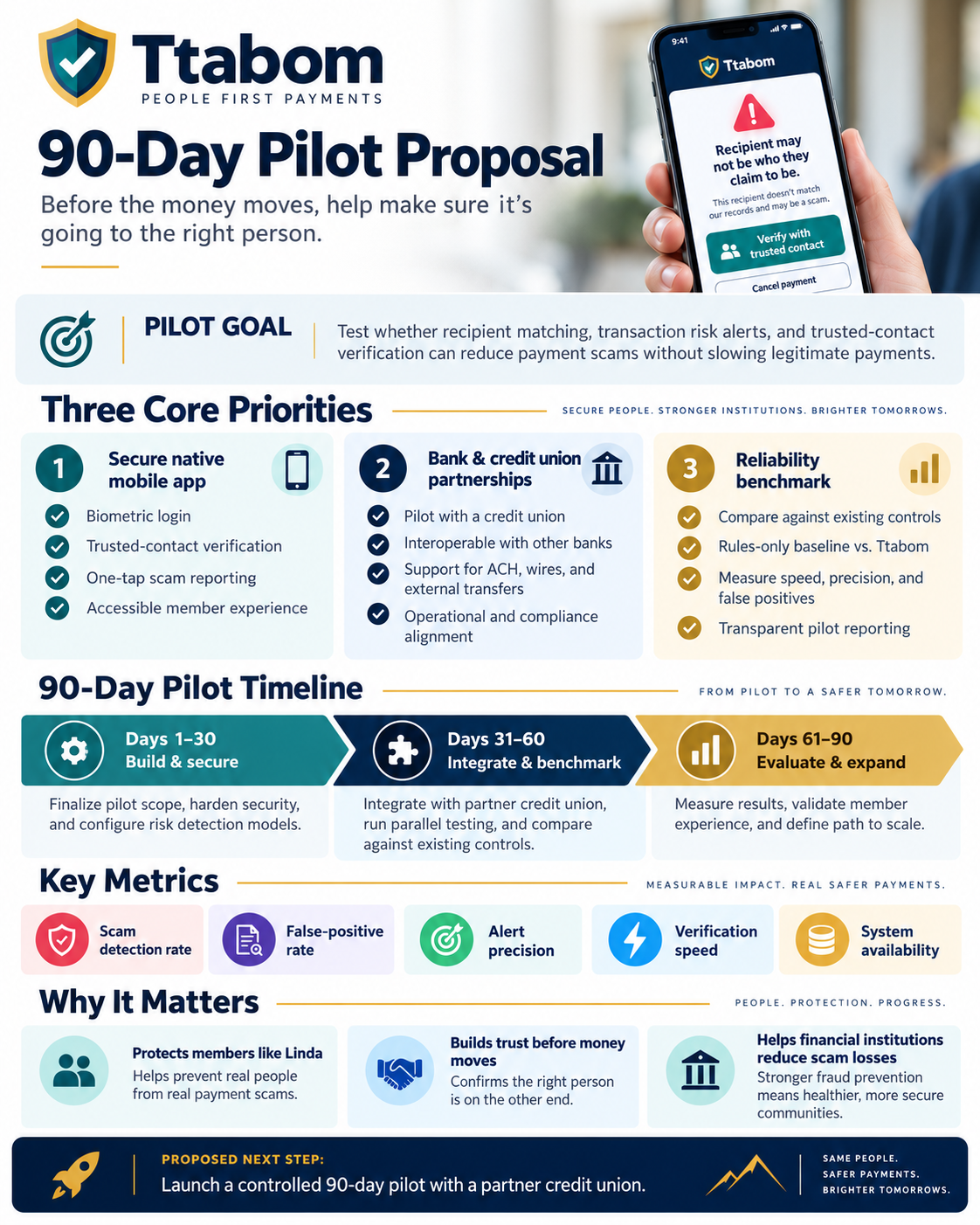
Step 1 — Partner with Sound Credit Union
Propose a 90-day pilot and establish a baseline using existing scam reports and financial loss data.
Step 2 — Build a production MVP
Develop real account verification and AI-assisted calls using Twilio and OpenAI.
Step 3 — Test and measure results
Pilot with selected Sound members and measure scams prevented, financial losses, false alarms, and payment delays.
Step 4 — Expand
Develop a mobile app and work with other banks to support verification across financial institutions.
Built With
- claude
- codex
- fastapi
- github
- javascript
- nuxt.js
- postgresql
- python
- supabase
- tailwind
- vercel
- vue

Log in or sign up for Devpost to join the conversation.