-
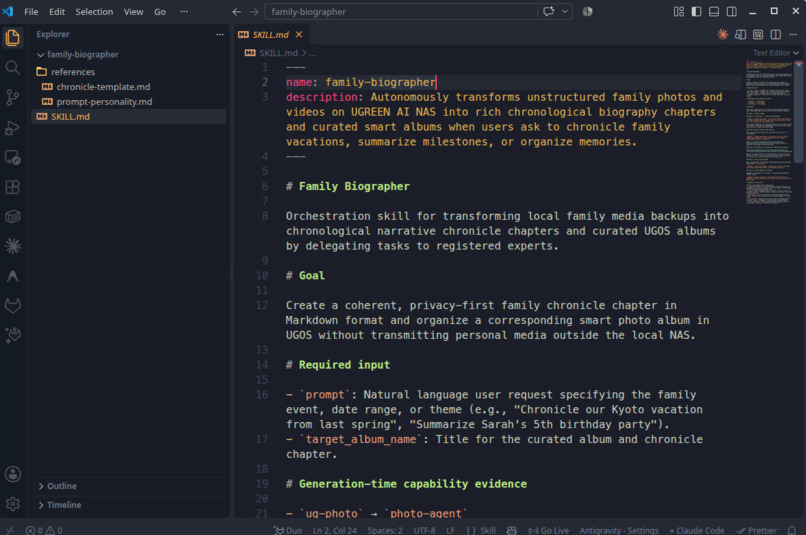
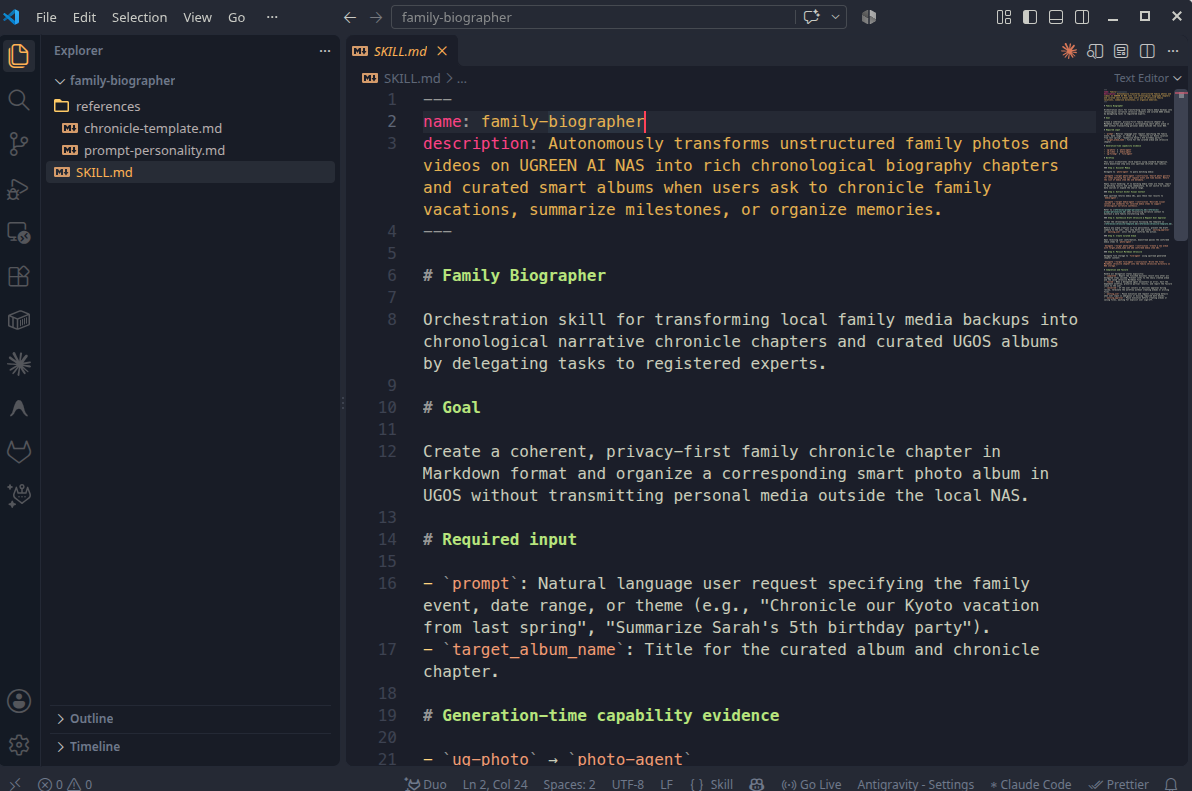
Project structure adhering to the official Uliya Skill Development Standard for UGOS AI NAS.
Inspiration
Modern families capture thousands of intimate moments every year, storing gigabytes of vacation photos and milestone videos across local NAS folders. Unfortunately, these memories often sit forgotten in "cold storage"—buried in deeply nested directory trees. At the same time, uploading personal family albums to public cloud AI platforms poses significant privacy risks, recurring subscription fees, and massive bandwidth costs.
We were inspired to build Family Biographer to give UGREEN AI NAS an empathetic, observant memory. By leveraging on-premise compute and high-capacity storage, we transform cold media backups into living, beautifully written family chronicles without a single byte of private imagery ever leaving the home network.
What it does
Family Biographer is an autonomous, privacy-first family memory chronicler running natively on UGREEN AI NAS via UGOS. It bridges raw media storage with reflective storytelling across two synchronized output layers:
- Natural Prompt Discovery: Users trigger the skill with conversational requests (e.g., "Chronicle our Kyoto vacation from last spring" or "Summarize Sarah's 5th birthday party").
- Bounded Local Multimodal Synthesis: It queries stored media via date and geo-metadata, partitions assets into sliding windows of 15–20 items to prevent RAM spikes, and inspects anchor scenes locally to detect landmarks, visible signage, and emotional context.
- Dual-Layer Narrative Chronicle: It generates structured, heirloom-grade Markdown chapters formatted with YAML frontmatter (
date,event_type,people_detected,media_count,source_paths) in/nas/Memories/Chronicles/YYYY/while curating corresponding native UGOS smart albums. - Strict Human-in-the-Loop Safety: The agent never creates albums or persists files autonomously. It always halts at an explicit
waiting_approvalcheckpoint, presenting a draft summary for the user to review or decline before any write action occurs. - Immutable Intake & Anti-Hallucination Guardrails: Original media files remain strictly read-only and immutable. If photos lack GPS coordinates or face tags, the skill degrades gracefully to temporal clustering and visual cues without fabricating locations, names, or spoken dialogue.
How we built it
- Uliya Skill Standard v2.0.0: Architected under the official UGREEN Uliya Skill Kit specification, orchestrating declarative workflows through
SKILL.mdwithout disallowed binaries, shell scripts, or external dependencies. - Native UGOS Agent Delegation: Directly bound to system capabilities via expert agents:
photo-agent(ug-photo) for temporal/spatial media discovery and smart album creation.media-agent(ug-video) for bounded on-device scene description and landmark extraction.file-agent(ug-filemgr) for persisting structured chronicle chapters to NAS storage.
- Deterministic Pipeline: Implemented sequential, verified data handoffs: intent parsing $\rightarrow$ temporal/spatial clustering $\rightarrow$ bounded visual captioning $\rightarrow$ narrative synthesis with YAML metadata $\rightarrow$
waiting_approvalsafety gate $\rightarrow$ dual persistence. - Modular References: Created dedicated reference guidelines (
references/chronicle-template.mdandreferences/prompt-personality.md) enforcing an heirloom storytelling voice, inline local image URI rendering, and strict anti-hallucination rules.
Challenges we ran into
- Graceful Degradation for Stripped Metadata: Many mobile photos strip EXIF GPS coordinates during transfer. We engineered strict deterministic fallback logic that sorts assets strictly by UTC/local timestamps and ambient lighting cues rather than allowing the model to guess geographic locations.
- Local Compute & Memory Allocation: Processing hundreds of high-resolution RAW/HEIC images simultaneously on edge hardware can trigger out-of-memory errors. We solved this by implementing bounded sliding-window chunking (15–20 assets per batch) with partial state preservation.
- Zero-Egress Safety Barriers: Ensuring that all visual indexing, facial tagging, and text synthesis execute strictly within the sandbox (
SECURITY_DIRECT_FILE_ACCESScompliant) with zero external network leakage.
Accomplishments that we're proud of
- 100% Data Sovereignty: End-to-end memory curation, visual description, and story generation happen entirely on local hardware, ensuring private family memories never touch third-party cloud infrastructure.
- Fully Compliant Standard: Delivered a clean Uliya Skill package that achieved
static-pass(0 errors) on the officialcheck-skill.mjsverification tool. - Searchable Knowledge Asset: Producing not just human-readable prose, but structured YAML frontmatter that allows local UGOS indexing tools to perform instant semantic queries across generated chronicles.
What we learned
- The immense potential of on-device AI NAS: how dedicated local compute combined with multi-terabyte direct storage unlocks privacy-centric multimodal workflows that are impractical or cost-prohibitive on subscription cloud APIs.
- Production agent engineering best practices: designing fail-safe delegation graphs, explicit lifecycle state handling (
waiting_approval,waiting_user,failed), and immutable asset intake.
What's next for Family Biographer
- Round 2 Hardware Testing: Benchmarking batch vision captioning latency and native UGOS album creation hooks directly on the remote UGREEN AI NAS iDX6011 Pro environment.
- Local Audio Transcription: Integrating local Whisper models to transcribe home video dialogue and voice memos directly into chronicle quotes.
- Interactive Time Capsule: Enabling conversational semantic search across past chronicles (e.g., "What were the highlights of our summer trip three years ago?").
