-
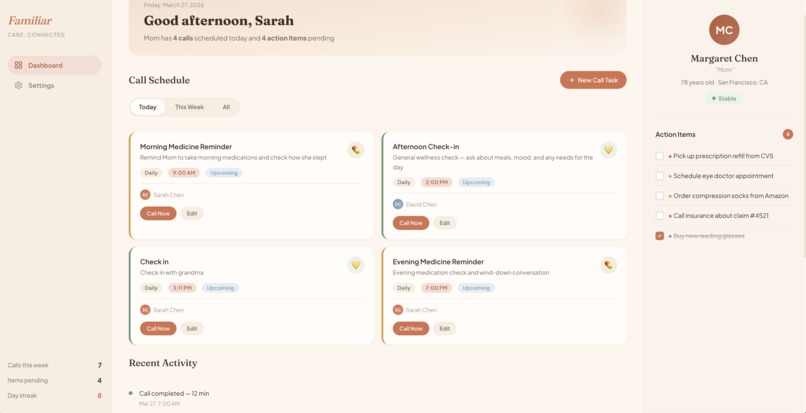
UI
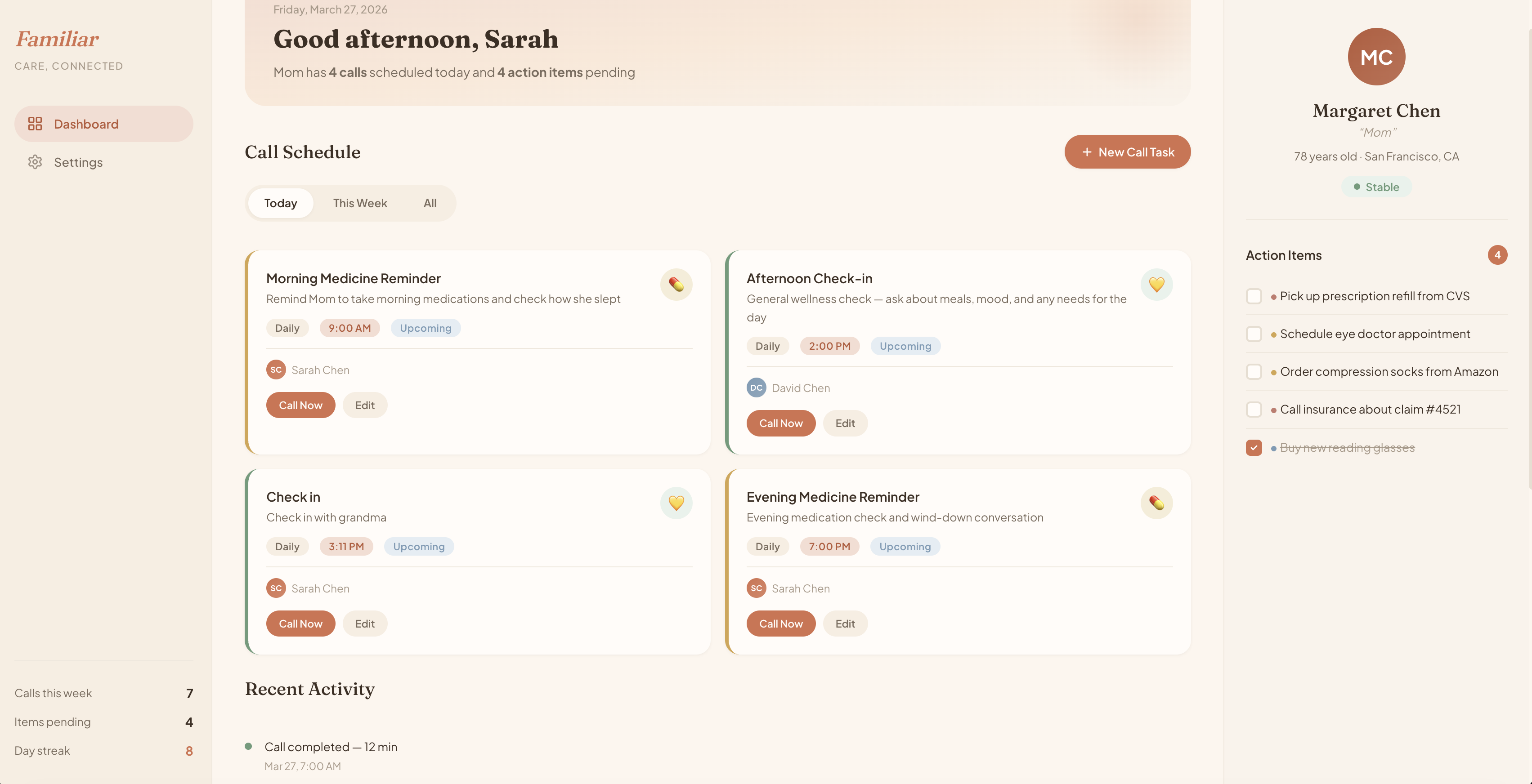
Familiar: Project Story
Inspiration
Millions of families coordinate elder care through scattered text threads, forgotten reminders, and guilt about not calling enough. We've seen it firsthand — important things fall through the cracks: medications get missed, appointments go unscheduled, and no single family member has a clear picture of how their loved one is actually doing. We built Familiar because caregiving shouldn't feel like chaos. It should feel like what it is: family taking care of family.
What it does
Familiar turns ad-hoc check-ins into a reliable care rhythm. Family members collaboratively schedule purposeful voice calls — medicine reminders, daily wellness check-ins — and the app ensures nothing gets missed. Every call generates actionable follow-ups visible to the whole family, so everyone knows what needs to happen next. Care becomes shared responsibility, not a burden carried by one person.
How we built it
We built Familiar with a focus on simplicity and reliability:
- Frontend: Next.js for a warm, inviting dashboard UI deployed on Vercel
- Backend: FastAPI (Python) running as serverless functions on Vercel
- Voice calls: Bland AI handles the actual phone calls to patients using our custom "Elderly Care Companion" agent
- Database: Ghost (ghost.build) for managed PostgreSQL
- Senso AI: Knowledge base that helps family members quickly find answers to caregiving questions — from medication info to care best practices.
The architecture is straightforward: the app triggers Bland AI to make calls, and Bland AI sends transcripts back to our webhook endpoint. From there, we extract action items and surface them to the family.
Challenges we ran into
Voice agent design: Creating a voice persona that feels warm and natural — not clinical or robotic — took iteration. We wanted patients to feel like they're talking to a caring companion, not a medical system.
Webhook reliability: Ensuring our webhook endpoint could reliably receive and process call transcripts from Bland AI required careful error handling and logging.
Balancing structure and warmth: The app needed to be structured enough to prevent things from falling through the cracks, but warm enough to feel like a family tool, not surveillance software.
Accomplishments that we're proud of
- End-to-end voice call integration working: We can trigger calls, receive transcripts, and surface action items — the core loop is live.
- Deployed and functional: The app is live on Vercel and ready for real-world testing.
- Warm, purposeful design: The UI feels inviting and human, not like a medical dashboard.
- Shared responsibility model: We've designed a system where care is distributed across the family, reducing burnout and guilt.
What we learned
- Voice AI is powerful but requires careful design: The persona, tone, and call structure matter as much as the technology.
- Serverless is ideal for this use case: FastAPI on Vercel gives us simplicity, scalability, and low operational overhead.
- Caregiving is deeply emotional: Every design decision needs to account for the guilt, anxiety, and love that families bring to elder care.
What's next for Familiar
- Action item extraction: Automatically parse call transcripts to surface tasks like "refill prescription" or "schedule doctor appointment"
- Family circle features: Shared notes, updates, and coordination tools for caregivers
- Patient profiles: A living view of medications, health history, and upcoming needs
- Smart scheduling: Suggest optimal call times based on family availability and patient routines
- Mobile app: Bring Familiar to iOS and Android for on-the-go care coordination
- Integration with health systems: Connect with pharmacies, doctor's offices, and medical records for seamless care
Built With
- auth0
- bland-ai
- fastapi
- ghost
- javascript
- next.js
- postgresql
- python
- react
- senso-ai
- typescript
- uv
- vercel

Log in or sign up for Devpost to join the conversation.