-
-
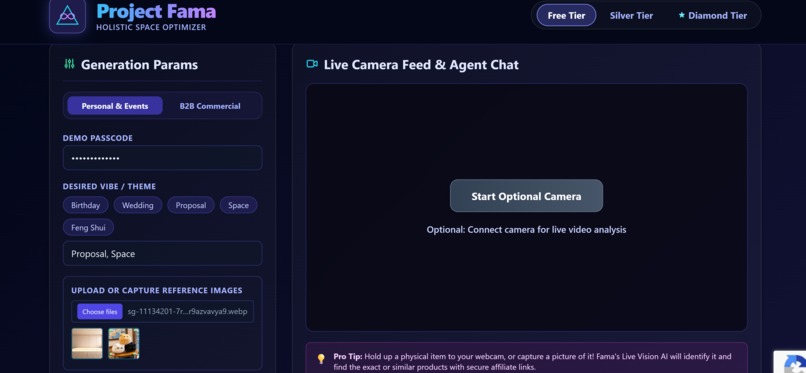
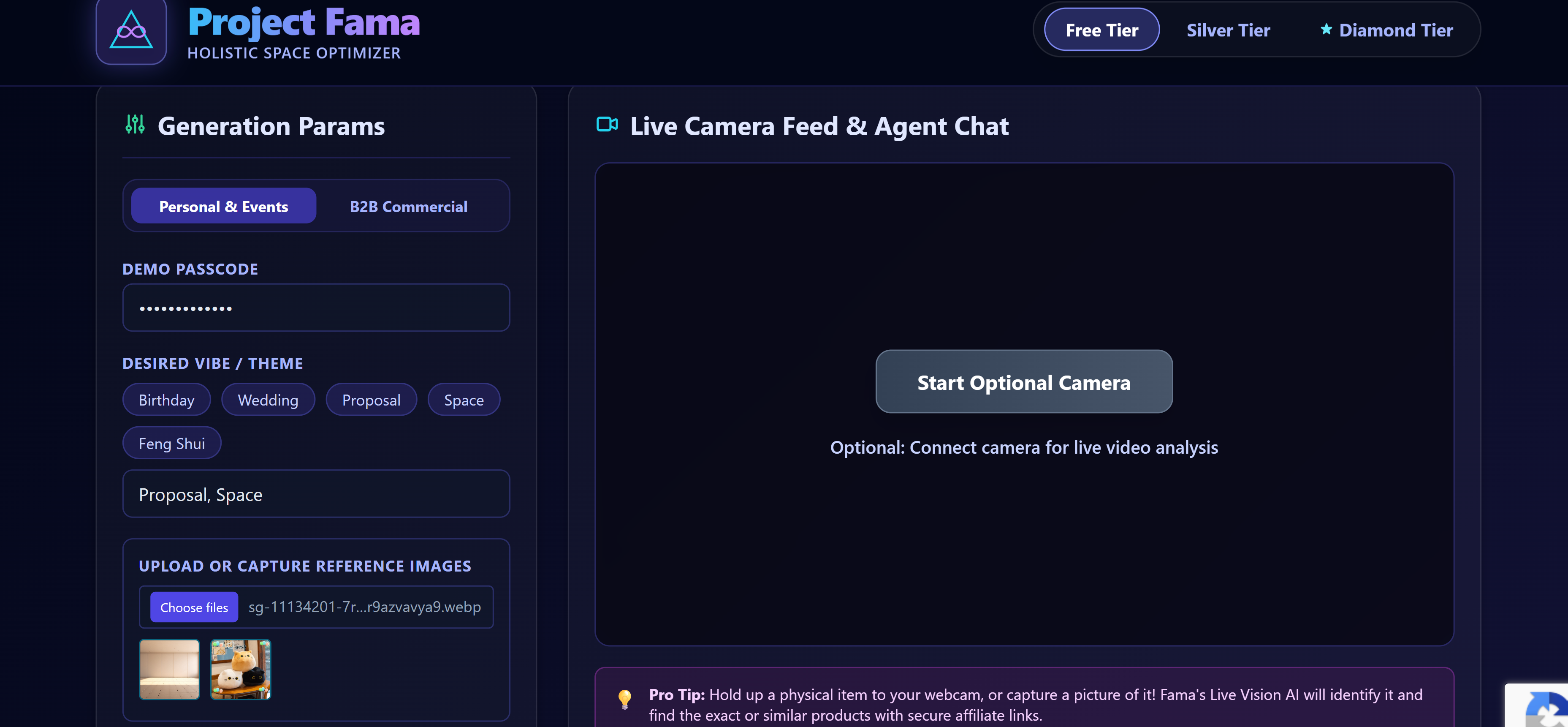
User interface
-

Generated image 1
-

Generated image 2
-

Generated image 3
-
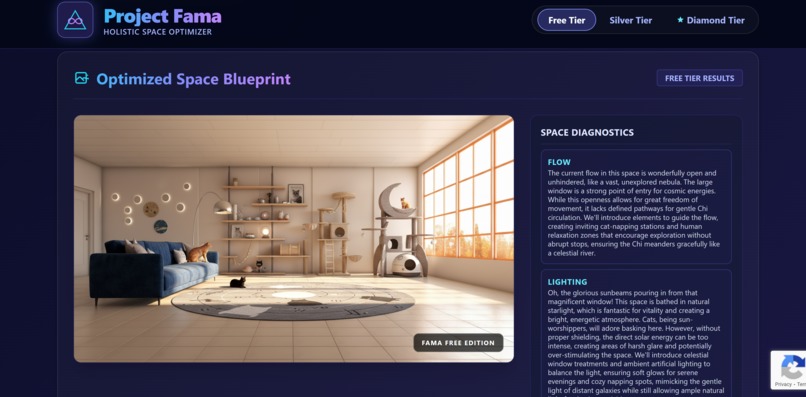
Generated image 3 with user interface
-
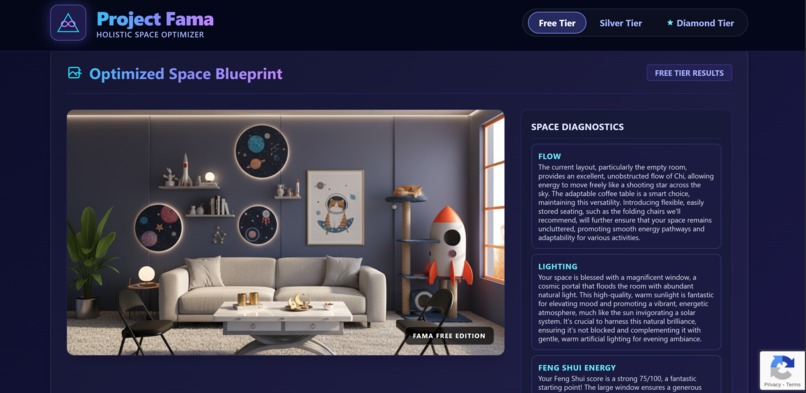
Userinterface with generated image 1 with details on how the AI views the room
-
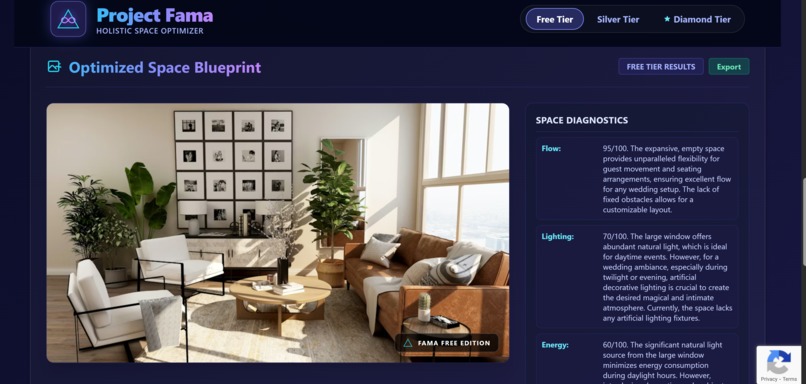
Userinterface with generated image 2 with details on how the AI views the room



Inspiration
Physical clutter negatively affects mental health in homes, and poor spatial layouts destroy conversion rates in retail stores. Yet, existing space-planning tools either offer generic 2D floor plans or require hiring expensive interior designers. I wanted to build a commercially viable product that solves these real-world spatial issues while exploring the absolute cutting edge of AI agents. The goal was to create an AI that doesn't just redesign a room aesthetically, but actively helps you organise it and gives you the exact links to buy the solutions.
What it does
Fama operates on two core product loops designed for both business-to-consumers and business-to-businesses, powered by a highly viable monetisation framework (Affiliate Marketing, Google Adsense, and $10/month Sponsored Product Placements).
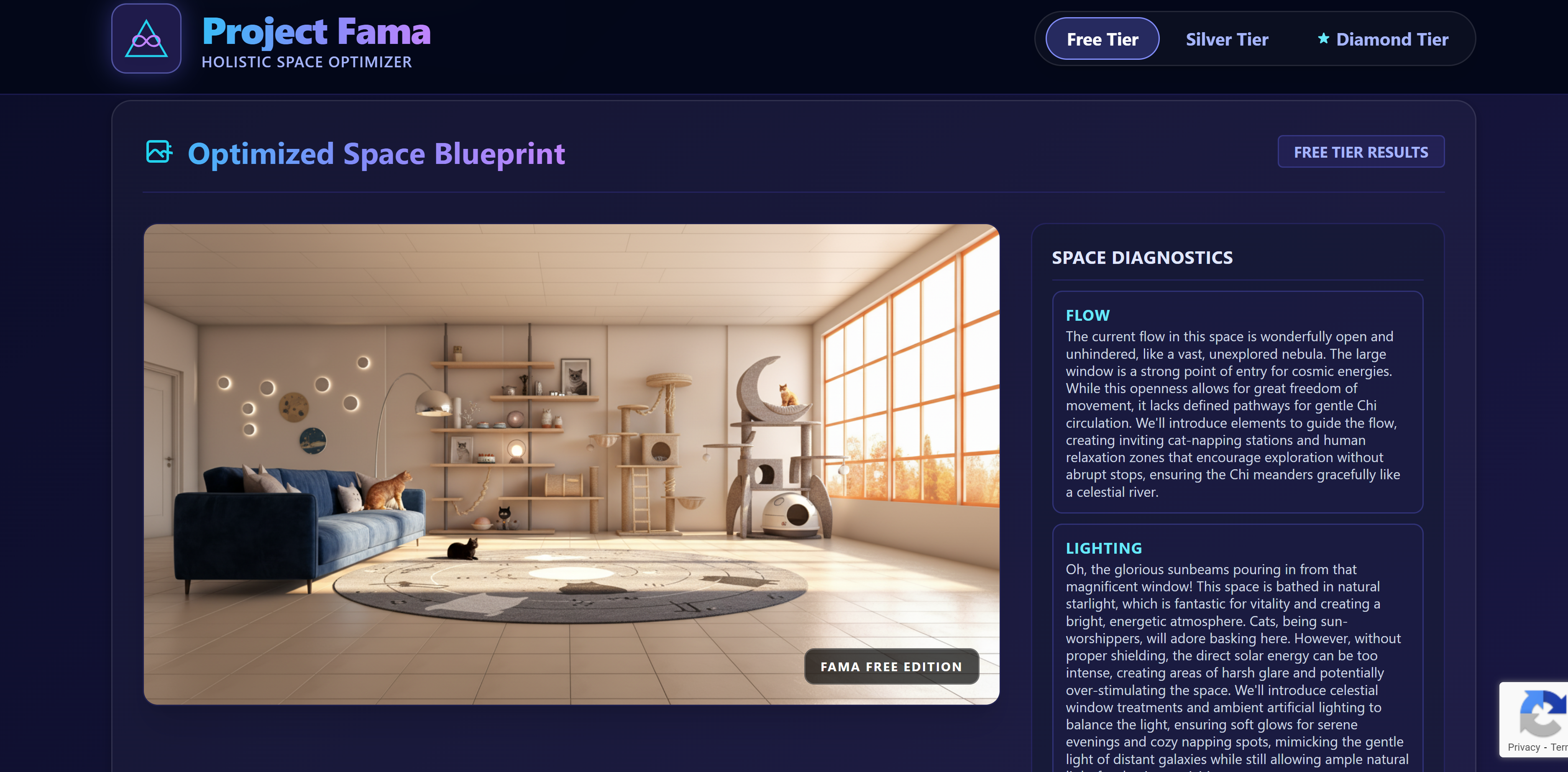
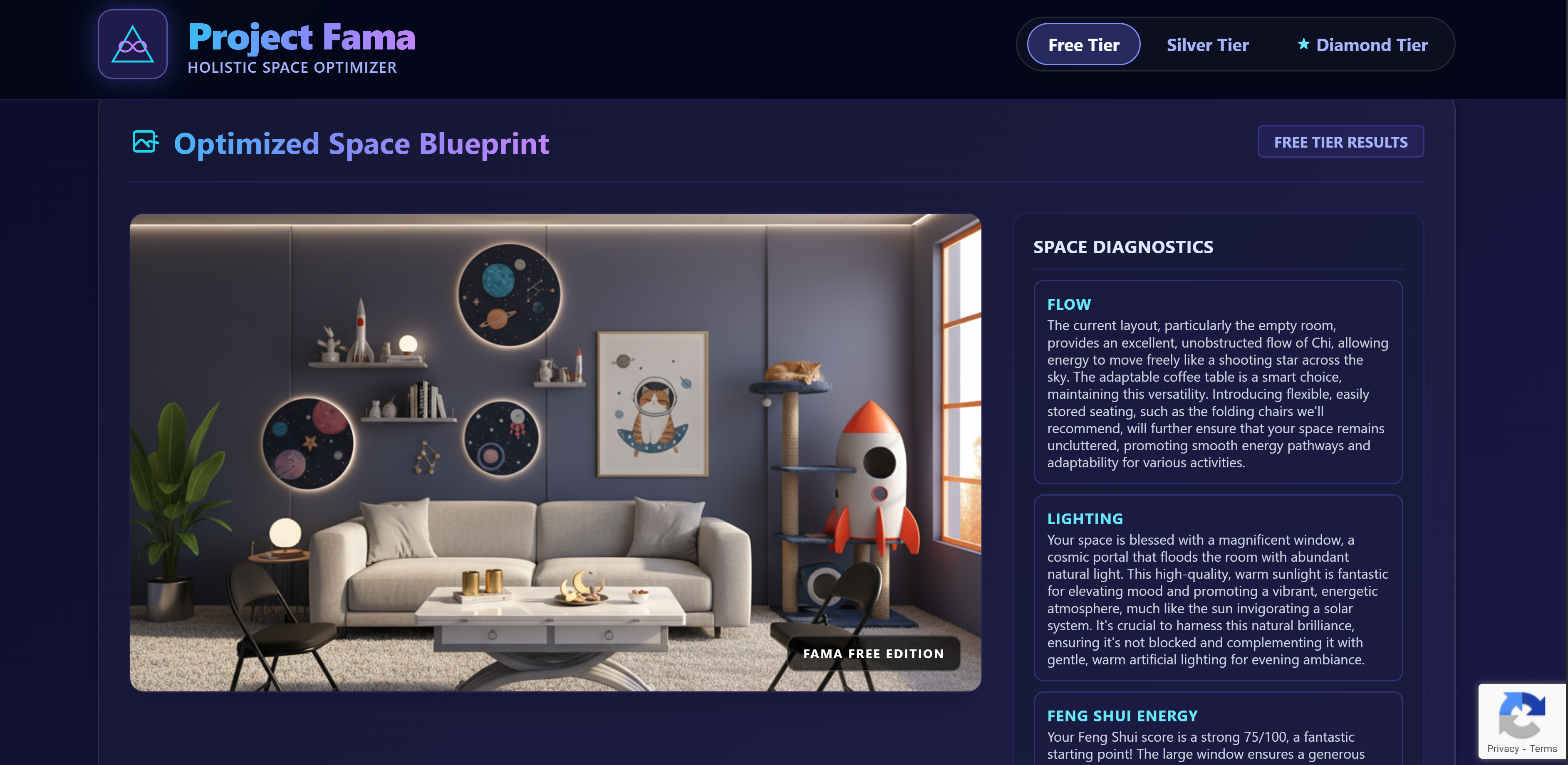
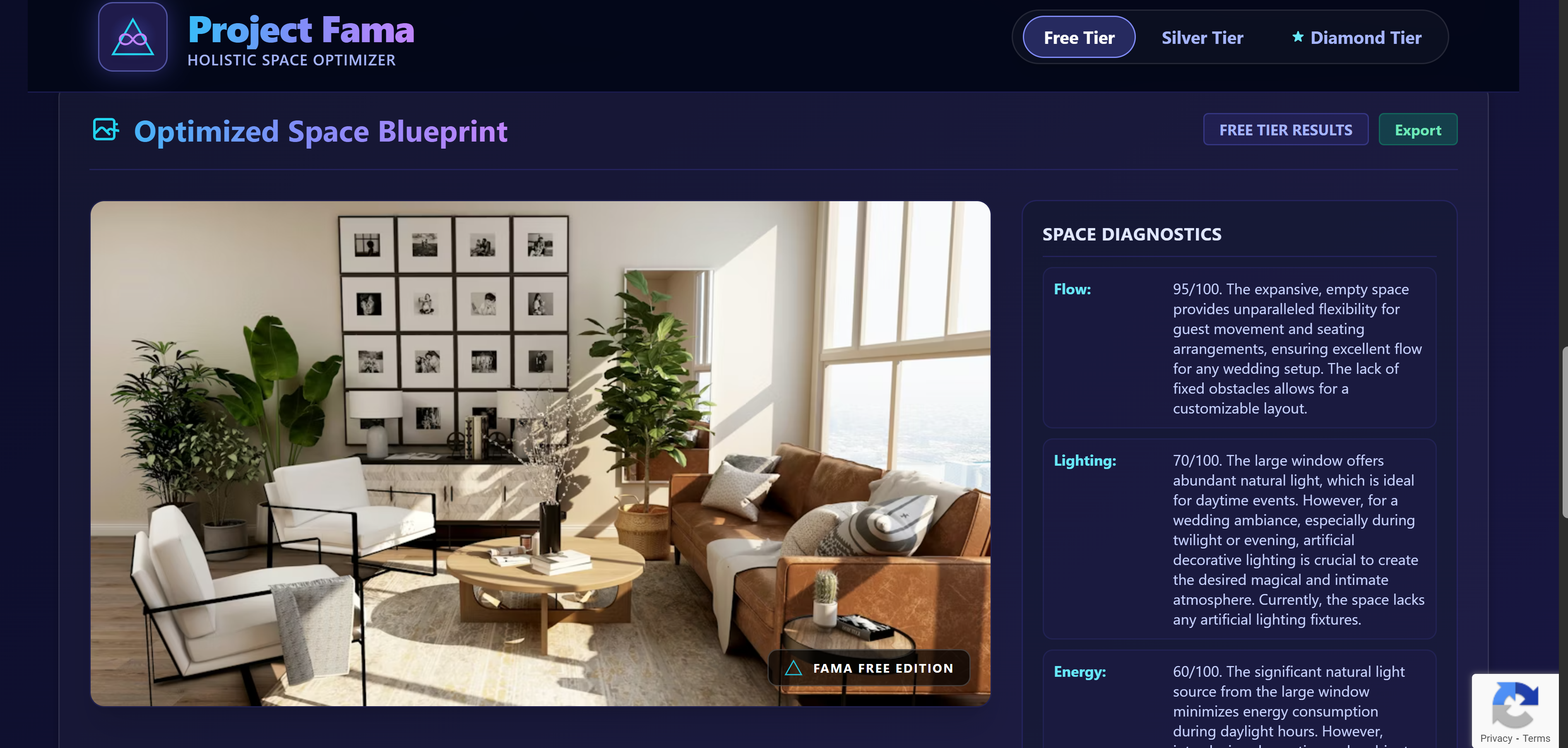
Product A (The Visualizer): Users upload a photo of their empty room and provide a product they wish to integrate. Fama's generative AI adapts the item's scale, applies a user-defined theme (from "Minimalist Zen" to "Pirate Cats"), and outputs a photorealistic architectural mockup. Crucially, it provides a diagnostic breakdown of the room's Feng Shui (how to harmonise the areas to fit well with people), physical flow (how easy it is for people to access and walk through the location), and lighting (how it affects the mood of the people in the room/area, as I read before that lighting does affect the psychology of people).
Product B (The Live Agent): Utilising WebSockets and the Gemini Live API, users show physical clutter to their webcam. Fama visually identifies the item in real-time, verbally advises on the most space-efficient storage method, and instantly sends affiliate links into the chat so users can purchase the product that they are showing to the screen or learn how to store that product. The chat is also shown to allow users to see what they have said and what the AI has said to the user.
I built this on a tiered SaaS model: a Free tier (watermarked, ad-supported), a Silver tier (high-res, detailed metrics, ad-free), and a Diamond tier (unlimited vendor matching and cloud backups). (This is so that I can also have a subscription-based model as another source of revenue)
How I built it:
This entire project was engineered from scratch in a 36-hour solo sprint.
The stack relies on Python (FastAPI) and WebSockets for the backend, and HTML/TailwindCSS for the frontend UI. I utilised gemini-2.5-flash-native-audio-preview for the live agent and gemini-2.5-flash-image for the generative blueprints. To prepare for production scaling, I containerised the application using Docker and utilised Terraform, learning Google Cloud Platform (GCP) and its best practices on the fly.
Challenges I ran into:
Building a multimodal agent in 36 hours while navigating severe constraints required aggressive DevSecOps pivots:
API Exhaustion & Limited Tools: I repeatedly hit rate limits on Gemini Pro and Claude, which severely slowed down development. I had to engineer strict FinOps circuit breakers (Spend Caps) and pre-cached JSON fallback payloads to mathematically guarantee the app would not crash during the judges' demo if quotas were exceeded.
WebSocket Deadlocks & Audio Buffer Latency: The Live AI frequently froze when interrupted by natural human speech. I aggressively re-engineered the LLM prompt to reduce cognitive latency, attempting to force the agent into a faster state-machine. While this mitigated the severity, the native audio model's turn-yielding logic still causes occasional freezing during rapid interruptions—identifying a core architectural limitation of current real-time voice buffers that I will target in the V2 roadmap.
Generative Drift: Getting the image model to respect the original room's geometry while forcing in new aesthetic themes and specific hardcoded products required immense prompt balancing and Python Regex middleware to sanitize LLM hallucinations.
Accomplishments that I'm proud of:
I only started learning about Cloud architecture two months ago, and only started exploring AI agents in early March. Despite having no teammates, limited API credits, and only 1.5 days of development time, I successfully built a fully functioning, multimodal MVP.
I am incredibly proud of the architecture I engineered. By implementing strict backend dictionary overrides and Markdown sanitisation, the application seems relatively secure (I will continue learning to ensure I have more experience securing apps and limiting cost)—ensuring the frontend UI always renders beautifully even if the LLM drops a payload or hallucinates a broken link.
I only discovered the hackathon on March 14th. Balancing a full-time job and part-time IT studies, I had exactly 1.5 days to execute the brainstorming, UI/UX, backend coding, security protocols, and cloud architecture completely by myself, whilst working on this project during the 1.5 days in my full-time job. I am proud that I managed to build as much as I did within this short time with no help except from Google Gemini, with limitations on the IDE's agents.
With all that said, I do deeply regret that I have to submit a project that is nowhere near completed, with plenty more ideas I would like to implement which I know I can achieve, but I am lacking the time and honestly experience as this is my first ever hackathon, but will certainly not be my last.
What I learned:
This sprint was a masterclass in rapid deployment. I learned how to pivot quickly from my baseline AWS knowledge to deploy on Google Cloud Platform. More importantly, I learned the nuances of LLM state management—specifically, that giving an audio agent overly rigid, multi-step prompts causes it to deadlock, and that fluid, conversational system instructions are required for low-latency voice interactions. I also learned that FinOps (managing API costs and rate limits) is just as important to an app's success as the code itself.
What I hope to do next for Fama (Holistic Space Optimiser):
This MVP proves the foundational architecture. The immediate roadmap includes:
Dynamic Web Scraping: Transitioning from our secure fallback catalogue bypass to real-time affiliate link scraping from platforms like Shopee, Lazada, and Amazon.
Stable Image-to-Image: Perfecting the structural integrity of room transformations so windows, doors and other key room details never shift during generation.
B2B Partnerships: Actively onboarding hardware and furniture companies for the $10/month sponsored SKU model.
Fixing issues such as the image not consistently generating what I want it to generate, the links not being consistently being pushed out, and the AI not replying properly after I interrupt it.
Full CI/CD: Fully automating the Docker and Terraform pipeline for seamless deployment to Google Cloud Run.
Built With
- docker
- gemini-2.5-flash-image
- gemini-2.5-flash-native-audio-preview
- google-cloud
- html
- python-(fastapi)
- tailwindcss
- terraform
- websockets

Log in or sign up for Devpost to join the conversation.