Inspiration
Research, policy analysis, journalism, and public debate increasingly rely on AI-generated or AI-assisted information. Yet most AI tools are designed to help users find supporting evidence, summarize sources, or strengthen an argument. Far fewer are designed to actively challenge a claim and show where its evidentiary chain may break.
Falsify started from a simple question: instead of asking AI to make an argument more convincing, what if we asked it to try to prove the argument wrong?
What it does
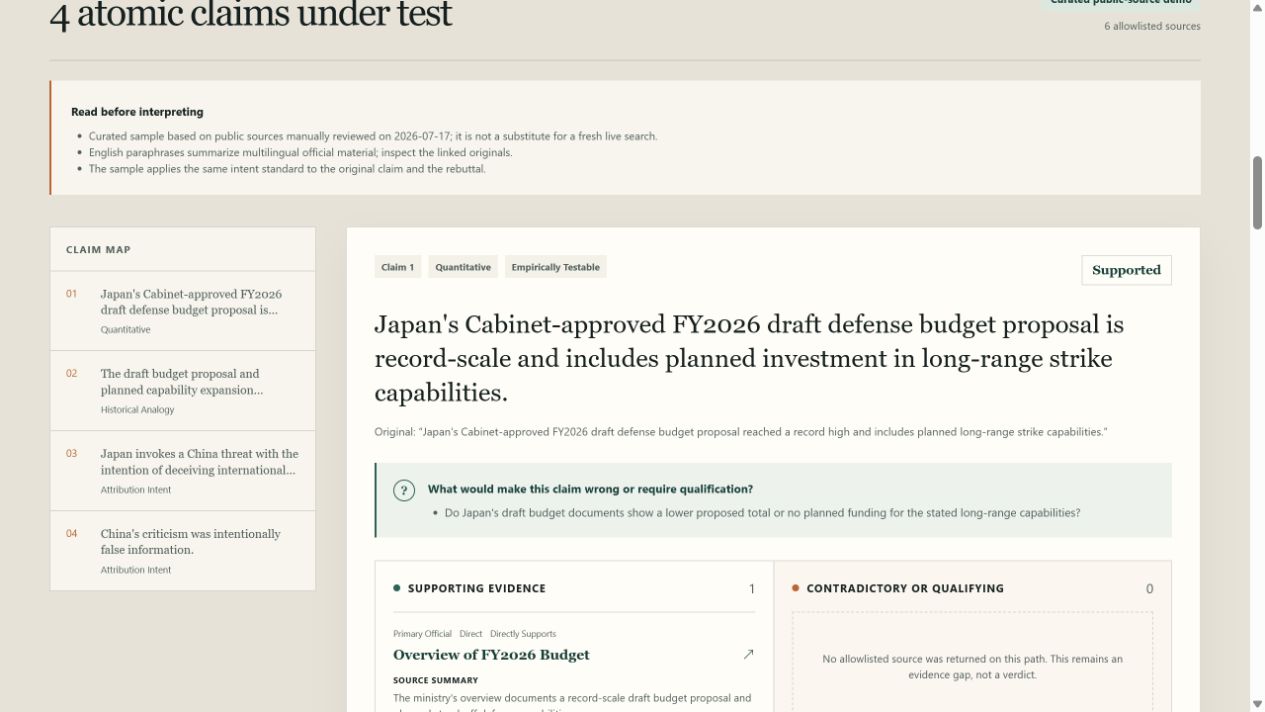
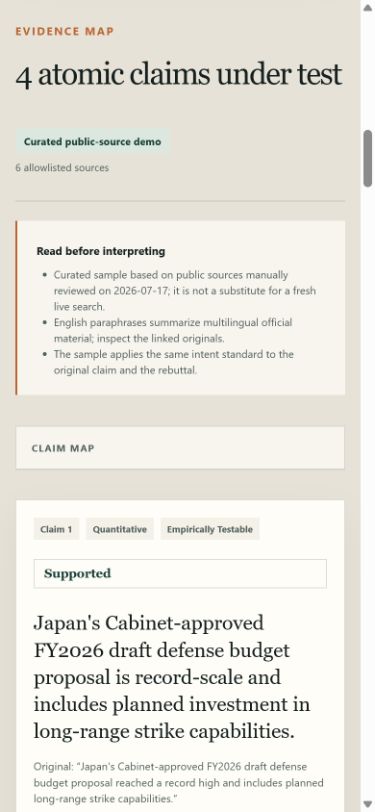
Falsify is an open-source adversarial evidence verification engine. It decomposes documents and public statements into testable claims, identifies what evidence each claim would require, searches for supporting and contradictory evidence, checks whether citations actually support the claims attached to them, and highlights logical or causal leaps that exceed the available evidence.
Rather than reducing complex questions to "true" or "false," Falsify distinguishes between supported, partially supported, contradicted, insufficiently evidenced, outdated, selectively framed, and logically overextended claims.
Every conclusion is designed to remain inspectable. Users can trace a finding from the original claim to the evidence, source, and reasoning behind the assessment, and challenge Falsify's own conclusions.
A first real-world use case
One initial application focuses on strategic narratives and evidence-dependent claims concerning Japan. Official statements and public narratives can combine accurate facts with selective context, historical analogies, unsupported attribution of intent, or causal claims that do not necessarily follow from the evidence.
Falsify separates these layers. For example, it can distinguish between a verifiable increase in defense spending and the separate claim that this necessarily proves a revival of pre-1945 militarism.
The same verification framework can also be applied to academic research, policy reports, journalism, corporate claims, and other evidence-dependent arguments.
How we built it
Falsify is a single Next.js and TypeScript application. The repository implements a typed GPT-5.6 Responses API and Structured Outputs path for claim decomposition, separate support and challenge evidence searches, finding synthesis, and adversarial re-check.
Codex was the primary development environment for the architecture, schemas, Evidence Map UI, provenance safeguards, deterministic audits, testing, security hardening, deployment, documentation, and demo production.
Because the Build Week promotional credits were exhausted before allocation, the public deployment also includes a transparent Gemini 3.1 Flash-Lite integration. The configured project's free Search-grounding quota is currently zero, so the reliable judge path is the curated public-source demo. Fresh submissions fail gracefully without inventing evidence, and the interface always displays the actual runtime model.
The complete project is publicly available under the MIT License on GitHub.
Our principle
Falsify should not be trusted simply because an AI produced the answer.
Its purpose is to help users inspect evidence for themselves.
Don't trust Falsify. Inspect its evidence.
Built With
- codex
- gemini
- github
- gpt-5.6
- next.js
- openai
- structured
- typescript
- vercel

Log in or sign up for Devpost to join the conversation.