🚀 FalsePass Hunter: Our Journey to Make Testing Honest
💡 What Inspired Us
The idea for FalsePass Hunter was born on a factory floor. We witnessed a high-pressure moment: a test operator, pushed by daily production quotas, marked a brake sensor as "PASS" despite seeing unstable signal readings.
Later, our research revealed a staggering reality: 40% of all field failures are traced back to undetected test escapes. A single automotive safety recall costs an average of $100 million.
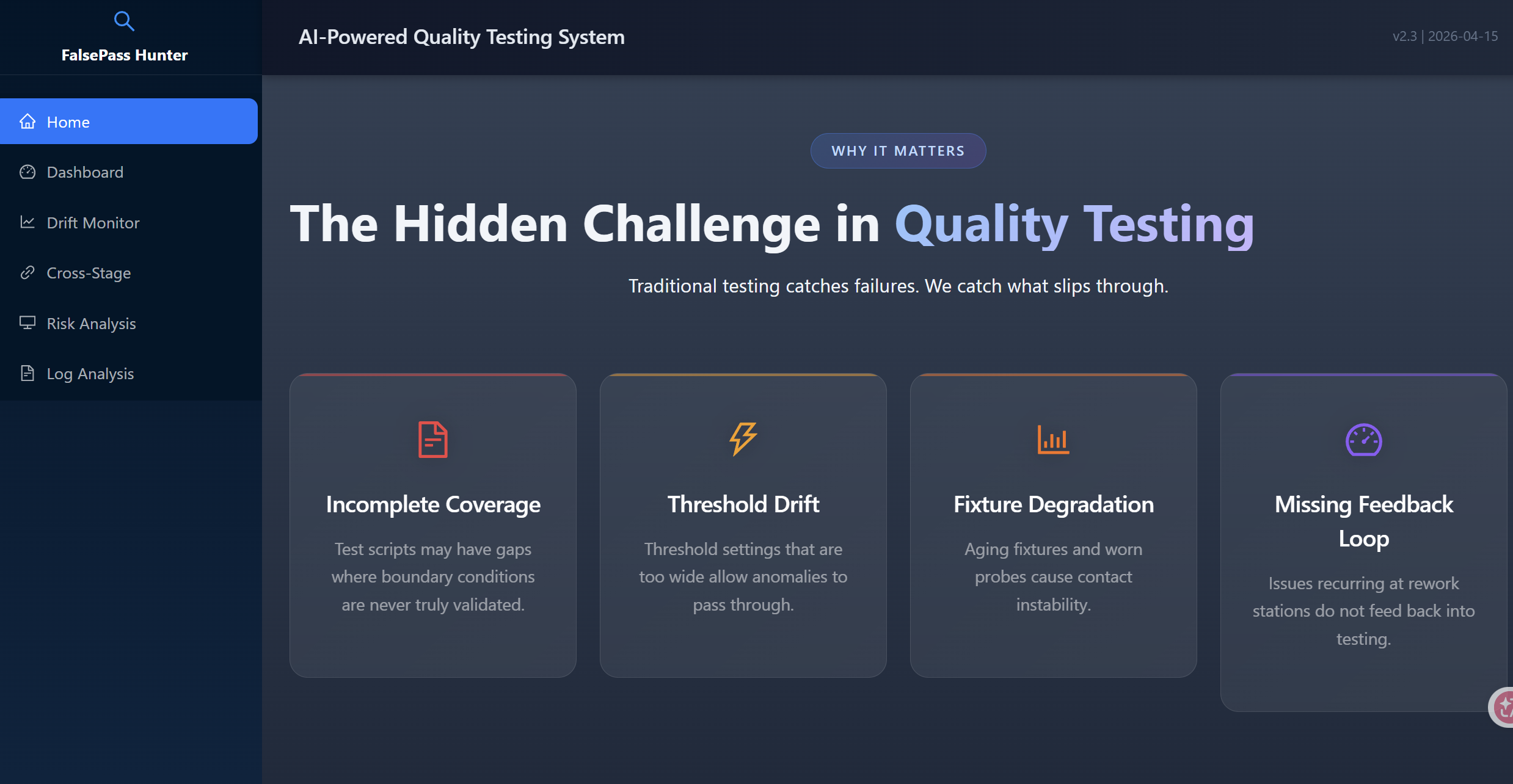
We realized that traditional testing operates on a flawed binary logic: Pass or Fail. It ignores the "Grey Zone" where a product meets specifications but has already drifted toward a failing state. These "False Passes" are ticking time bombs—they violate consumer trust, endanger lives, and cost billions. The most dangerous product in a factory is not the one that fails testing, but the one that passes when it shouldn't.
🧠 What We Learned
🛠️ Technical Insights
- Anomaly Detection > Thresholds: Static thresholds are too rigid. By shifting to statistical anomaly detection, we identify subtle deviations that standard "Go/No-Go" tests miss.
- Smart Feature Selection: Analyzing 592 parameters is a "Curse of Dimensionality." Using Cohen's d effect size is far more efficient than simple correlation for identifying true predictive features.
- Augmentation over Replacement: AI's true power in manufacturing is not replacing human workers but empowering front-line blue-collar engineers with actionable, visual insights.
⚖️ Ethical & Human Lessons
- Engineering is Ethics: Every technical threshold is an ethical decision. Our project exists because traditional systems prioritized short-term efficiency over long-term safety.
- User-Centered Design: We learned to design for the factory floor, not the lab. Simple color-coded alerts and "actionable" buttons are more valuable than complex, black-box algorithms.
- The Power of Feedback: A system that doesn't learn from its field failures is obsolete. Closing the loop between "After-Sales Data" and "Production Testing" is essential.
🏗️ How We Built It
1. Data Foundation
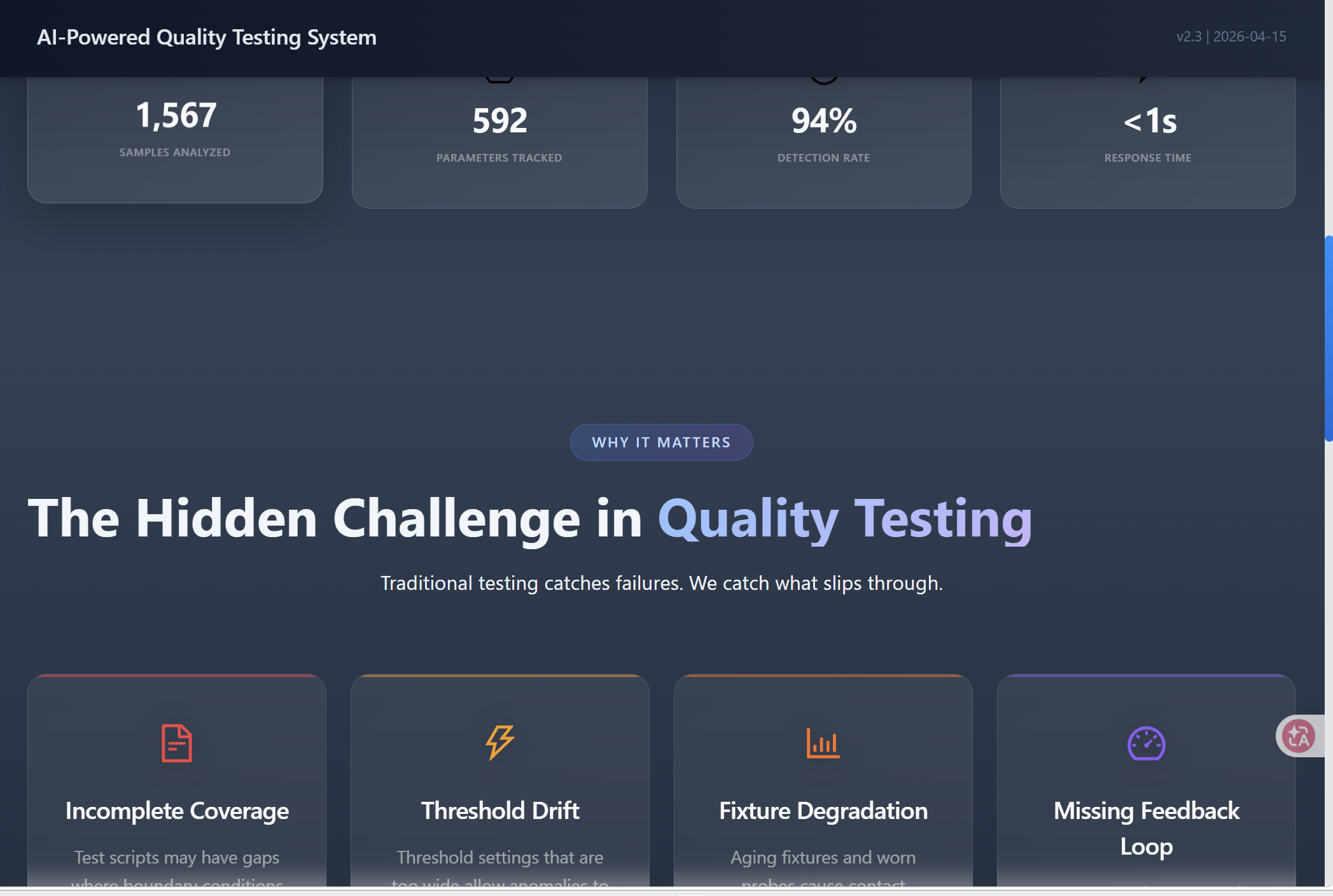
We utilized the Kaggle UCI SECOM dataset, containing real-world semiconductor manufacturing data (1,567 samples, 592 features).
- Control Group: 1,500 "Normal" samples.
- Experimental Group: 67 "Defective" samples.
2. The "FalsePass Hunter" Algorithm
We implemented a robust four-step statistical pipeline:
Step 1: Feature Selection (Cohen's d)
We quantified the "distance" between pass/fail groups to find the most sensitive sensors: $$d = \frac{\mu_{\text{Pass}} - \mu_{\text{Fail}}}{\sigma_{\text{pooled}}}$$ By selecting features with $d > 0.5$, we reduced dimensionality from 592 to 23, slashing computational overhead by 26x.
Step 2: Establishing the "Healthy Baseline"
Using normal distribution properties, we defined the "Safe Zone": $$\text{Healthy Range} = \mu \pm 3\sigma$$ (Capturing 99.73% of stable performance data).
Step 3: Real-Time Anomaly Scoring (Z-score)
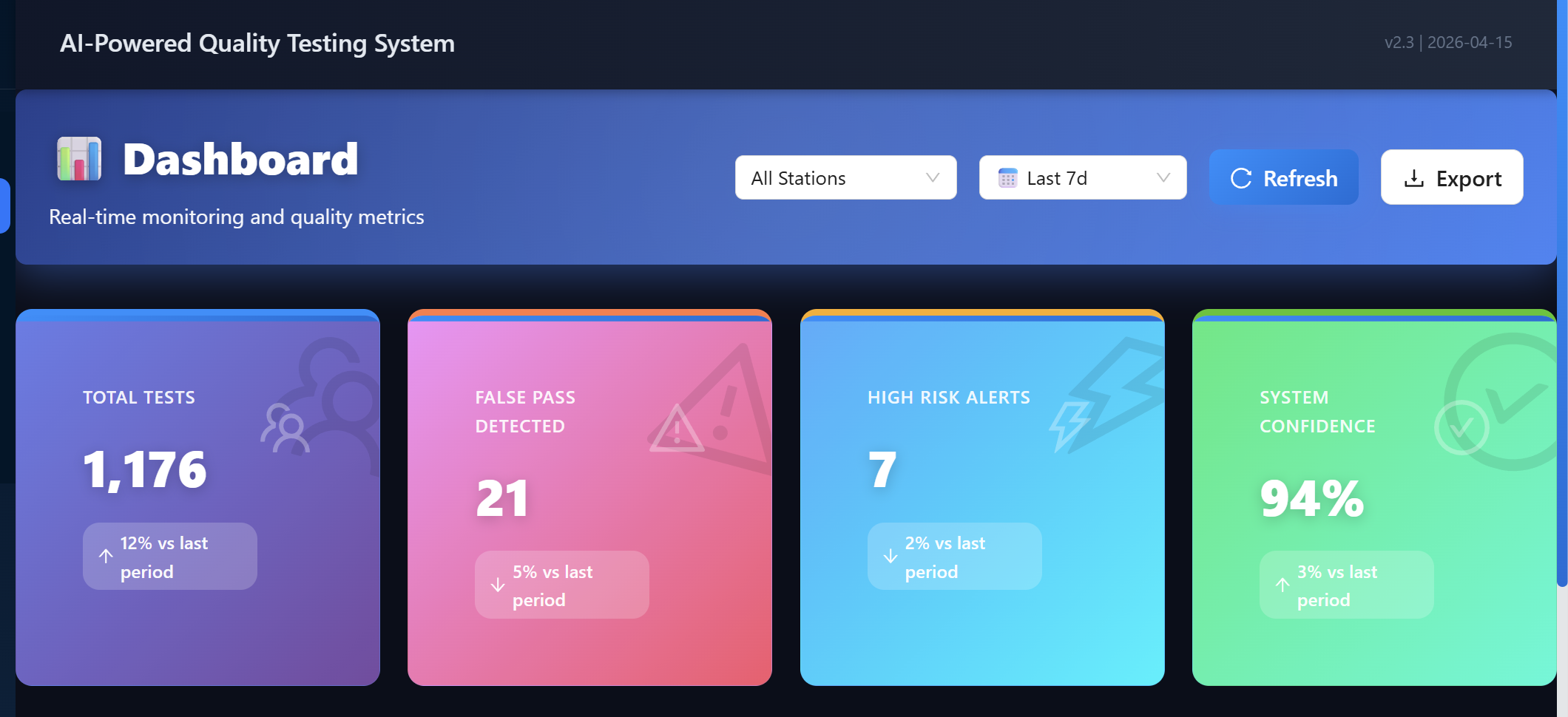
For every incoming unit, we calculate a Z-score: $$Z = \frac{x - \mu_{\text{baseline}}}{\sigma_{\text{baseline}}}$$ Any unit with $Z > 3$ is flagged as a High-Risk False Pass, even if it technically "passed" the machine test.
Step 4: Continuous Learning Loop
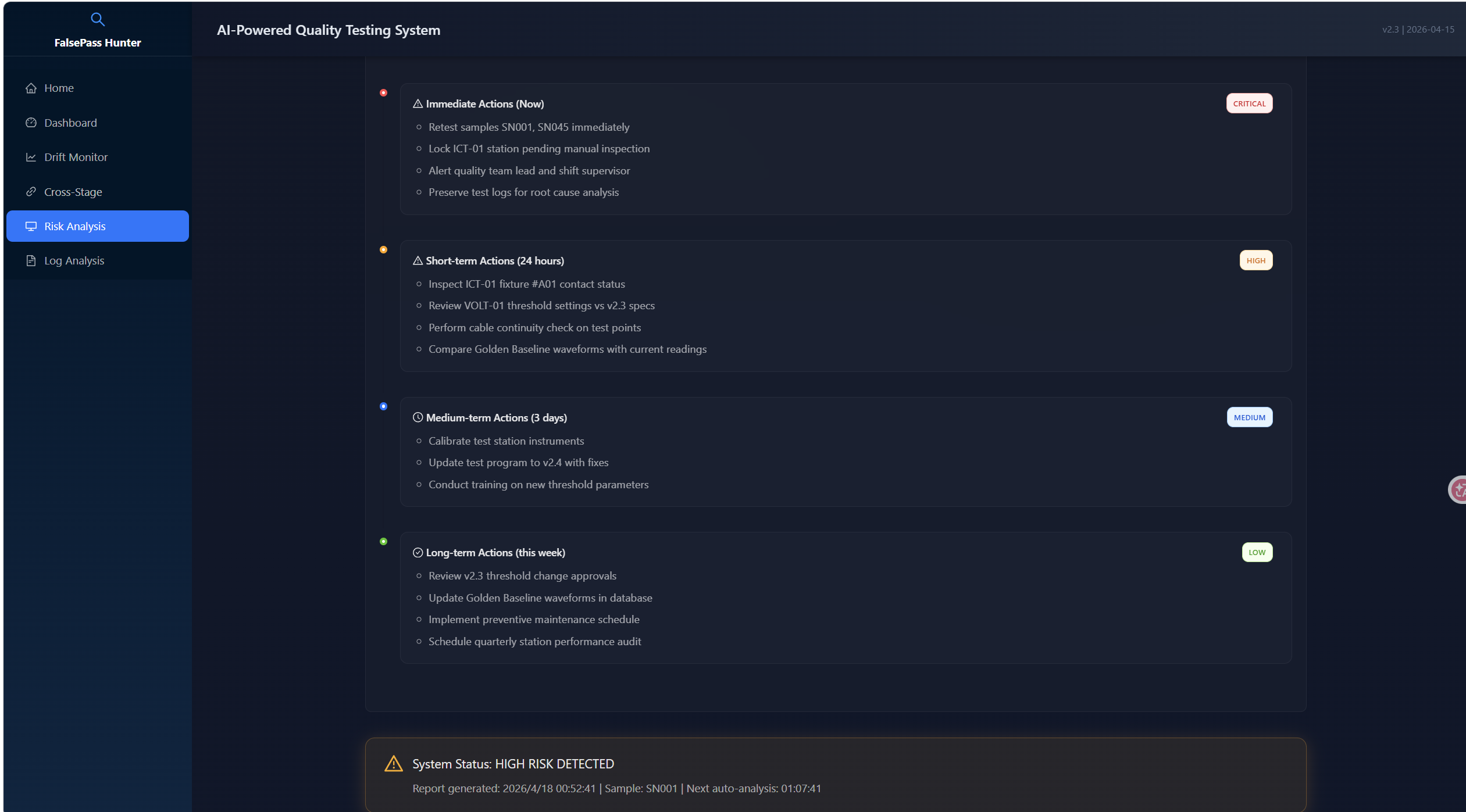
The system evolves by integrating post-production repair logs to recalibrate the baseline and feature sensitivity.
3. System Architecture
- Backend:
FastAPI+pandas+numpy(High-performance data processing). - Frontend:
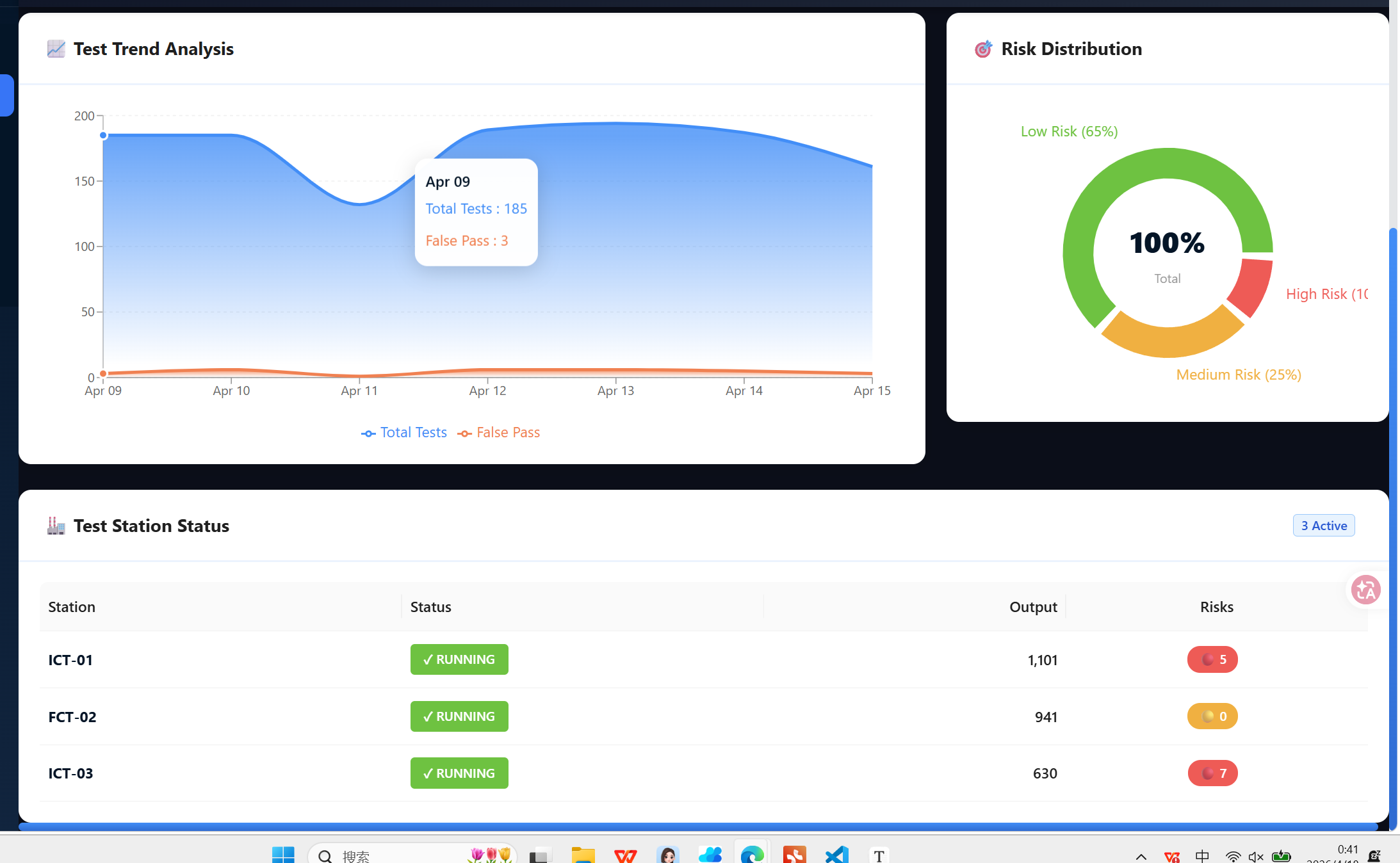
React+Ant Design+Recharts(Visualizing drift for engineers). - AI Engine:
Claude Code API/Featherless(Natural language log reasoning).
🚧 Challenges We Overcame
- Severe Data Imbalance: With very few "Fail" samples, we pivoted from a classification model to an Anomaly Detection model. This made the system more sensitive to "unknown unknowns."
- The Curse of Dimensionality: 592 features created noise. Cohen's d allowed us to find the "signal" within the noise without losing physical meaning.
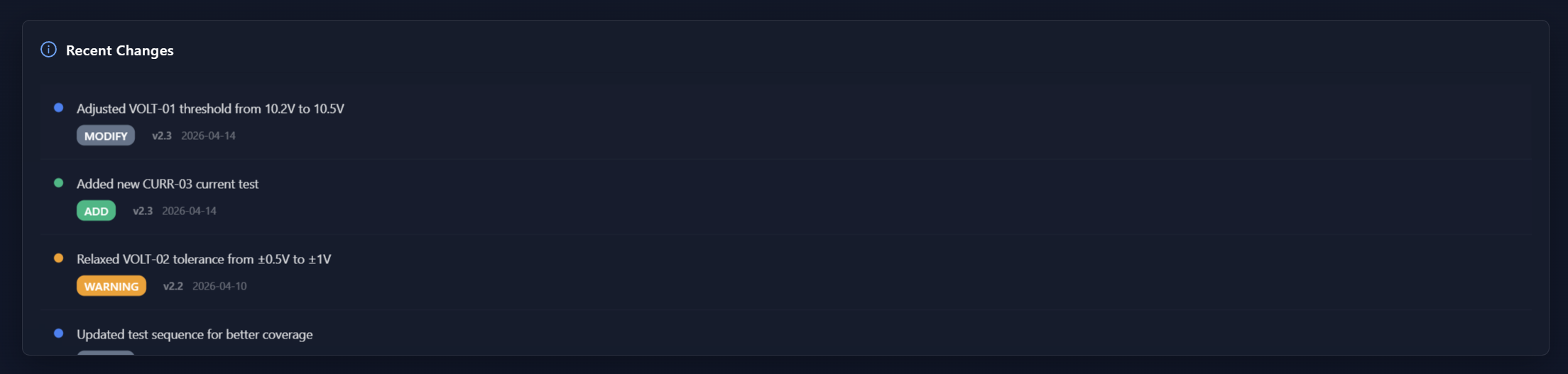
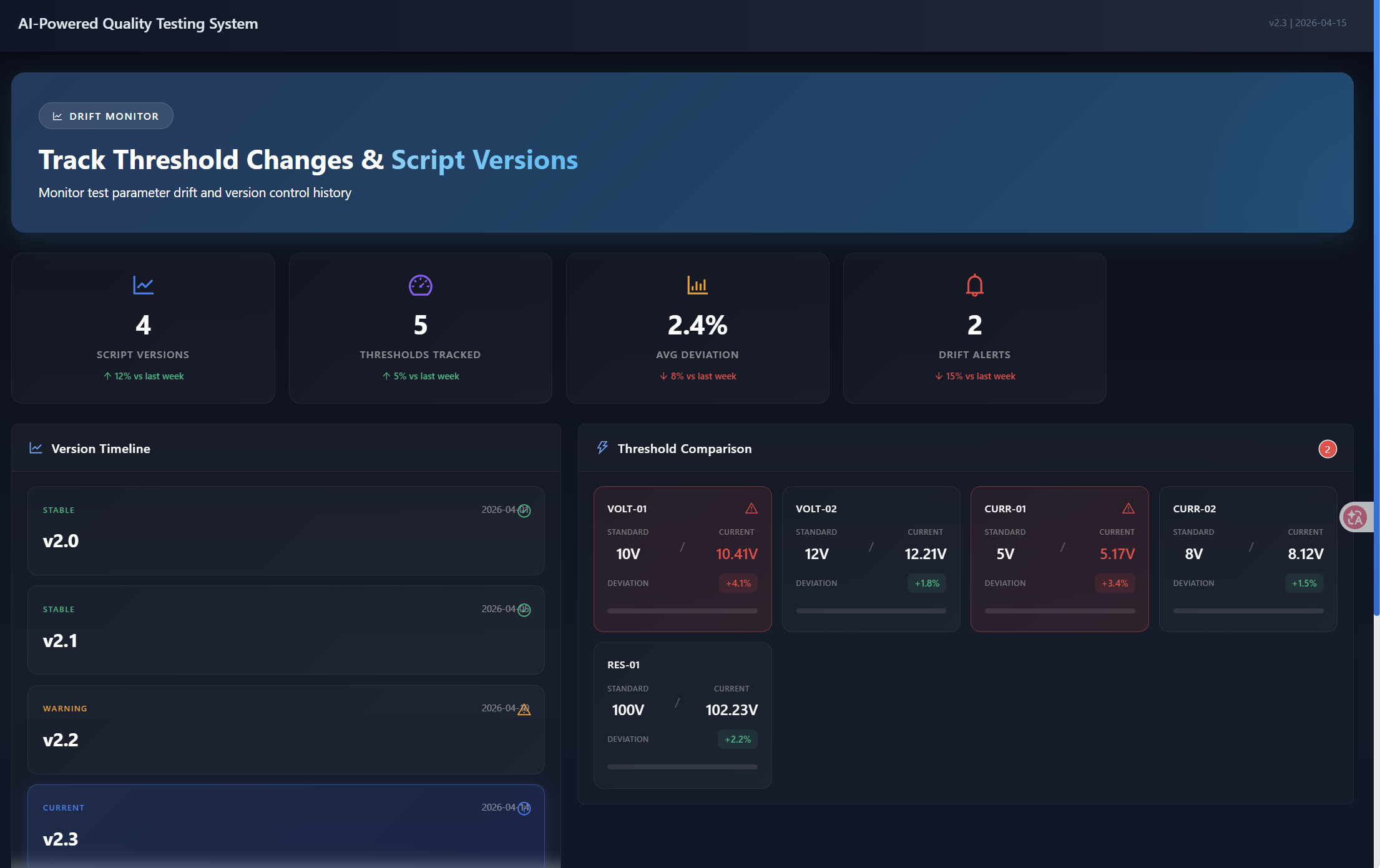
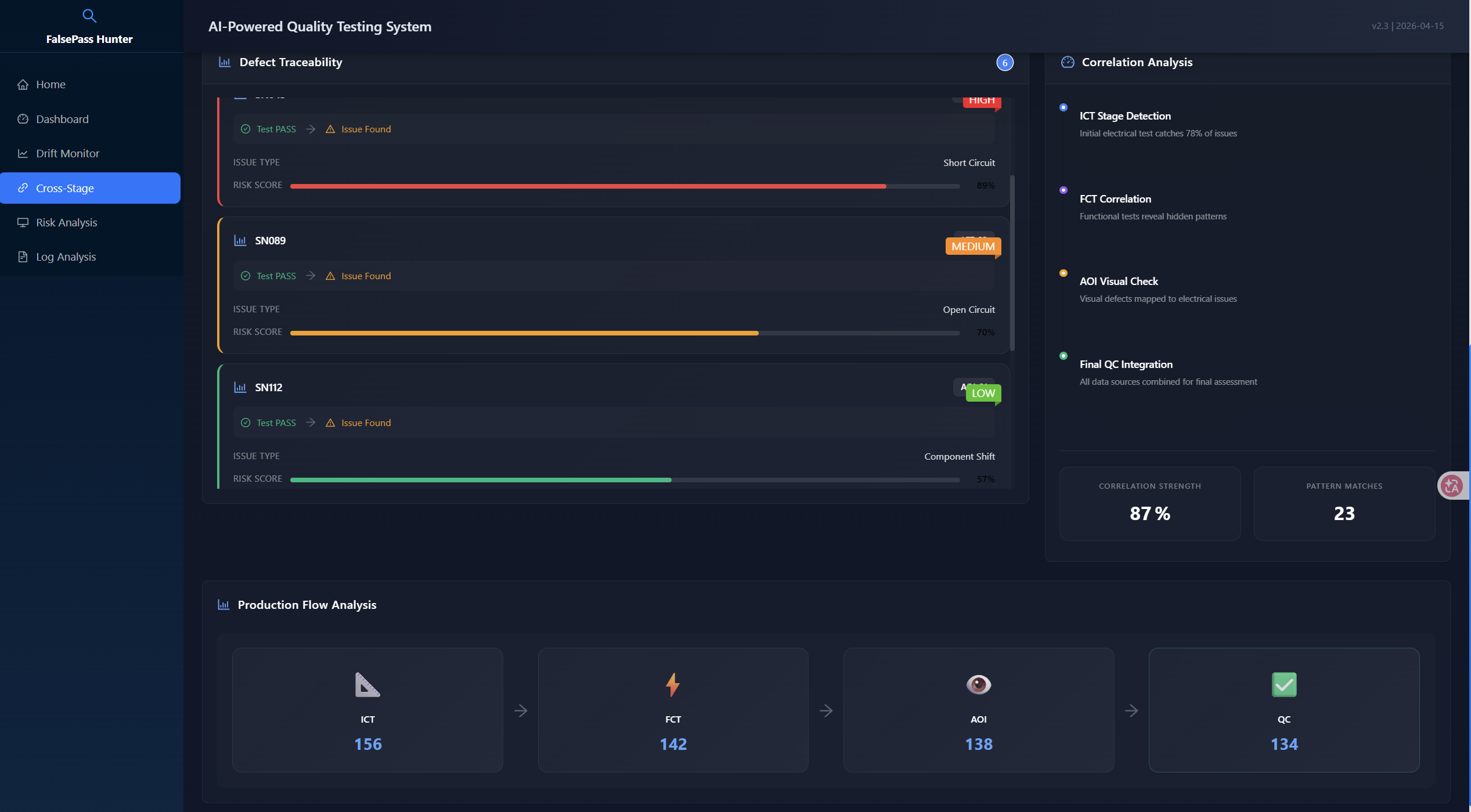
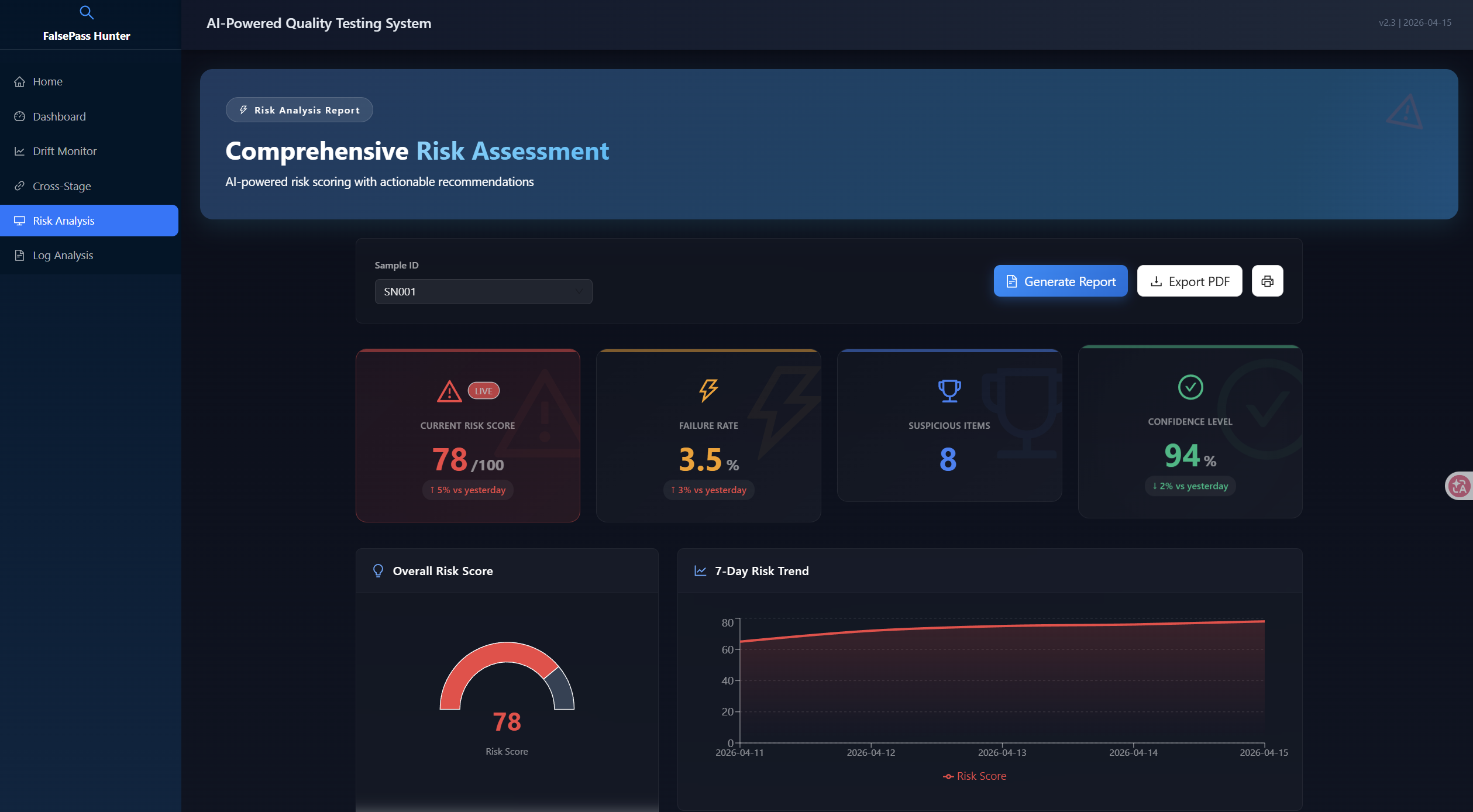
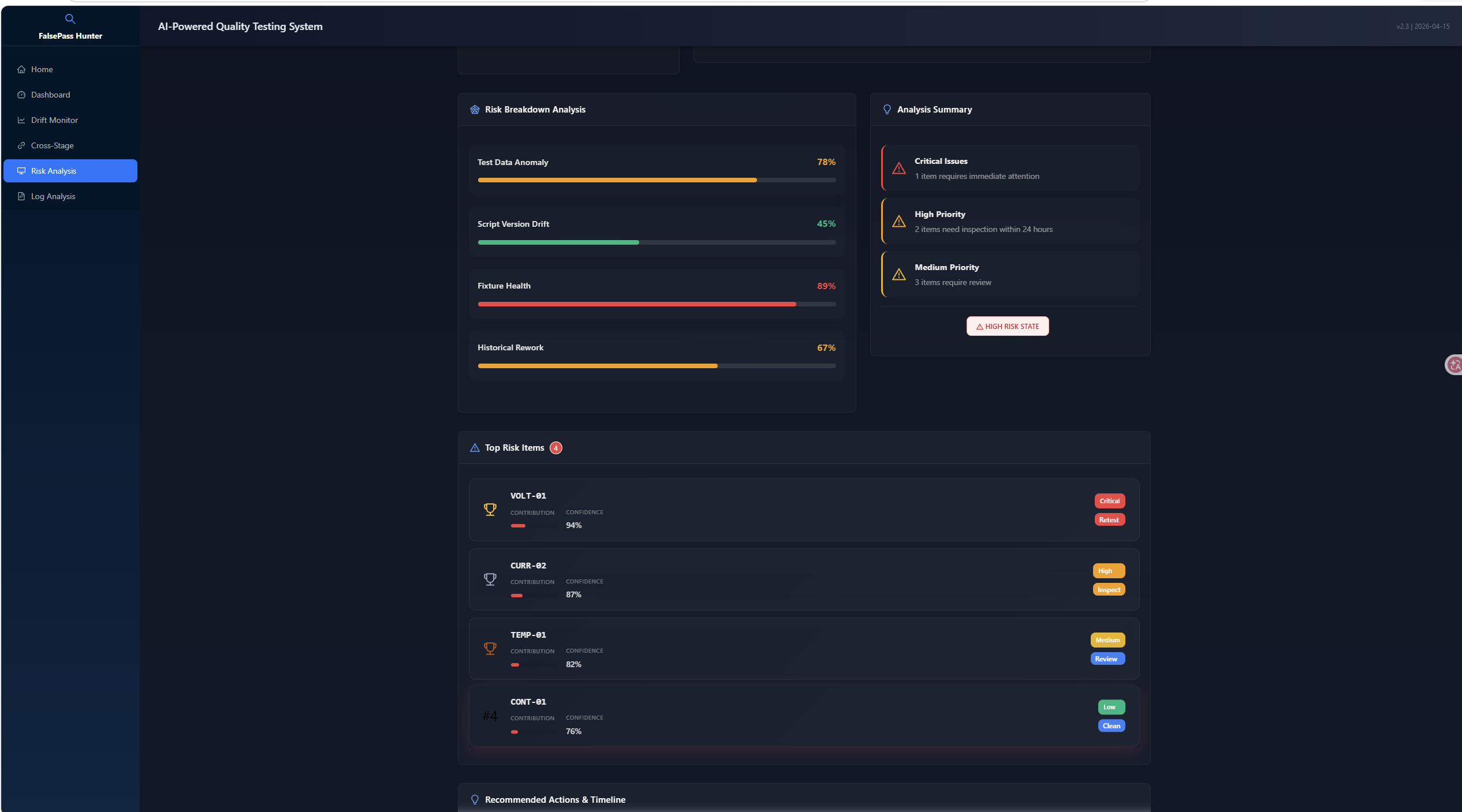
- Human-AI Trust: We realized engineers might ignore AI alerts. We solved this by adding Explainability—the AI doesn't just say "Risk," it shows the Drift Monitor (visual waveform deviation) so the engineer can see the evidence.
- UX for the Factory Floor: We stripped away the jargon. Our interface uses Red/Orange/Green logic, ensuring that a blue-collar worker can make a "Retest" or "Fixture Check" decision in seconds.
🎯 The Final Word
FalsePass Hunter is more than a technical tool; it’s a commitment to Test Integrity. By adding a layer of credibility review to every "Passed" result, we ensure that the products in our homes, cars, and hands are truly as safe as they claim to be.
"We don't judge Pass or Fail. We judge Credibility."


Log in or sign up for Devpost to join the conversation.