-
-
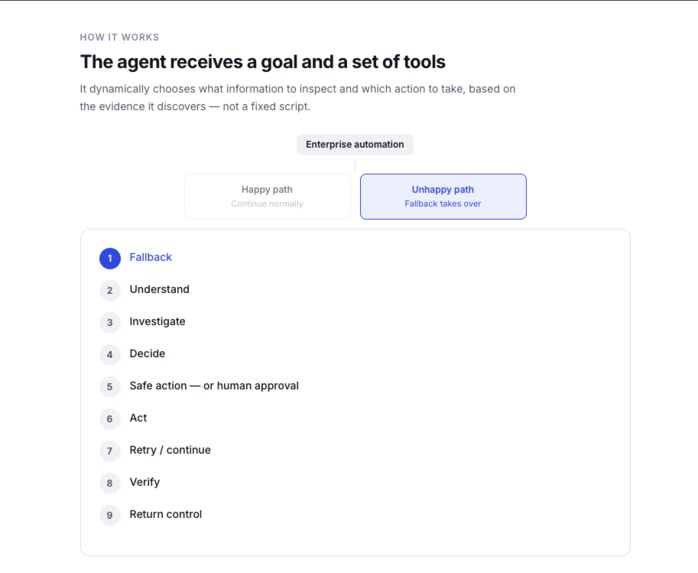
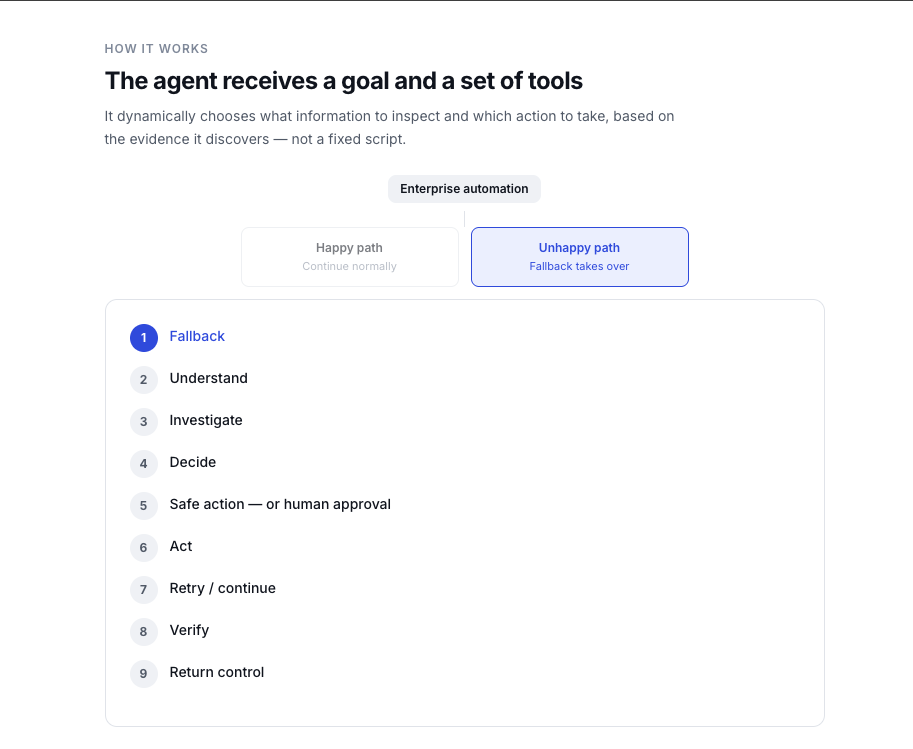
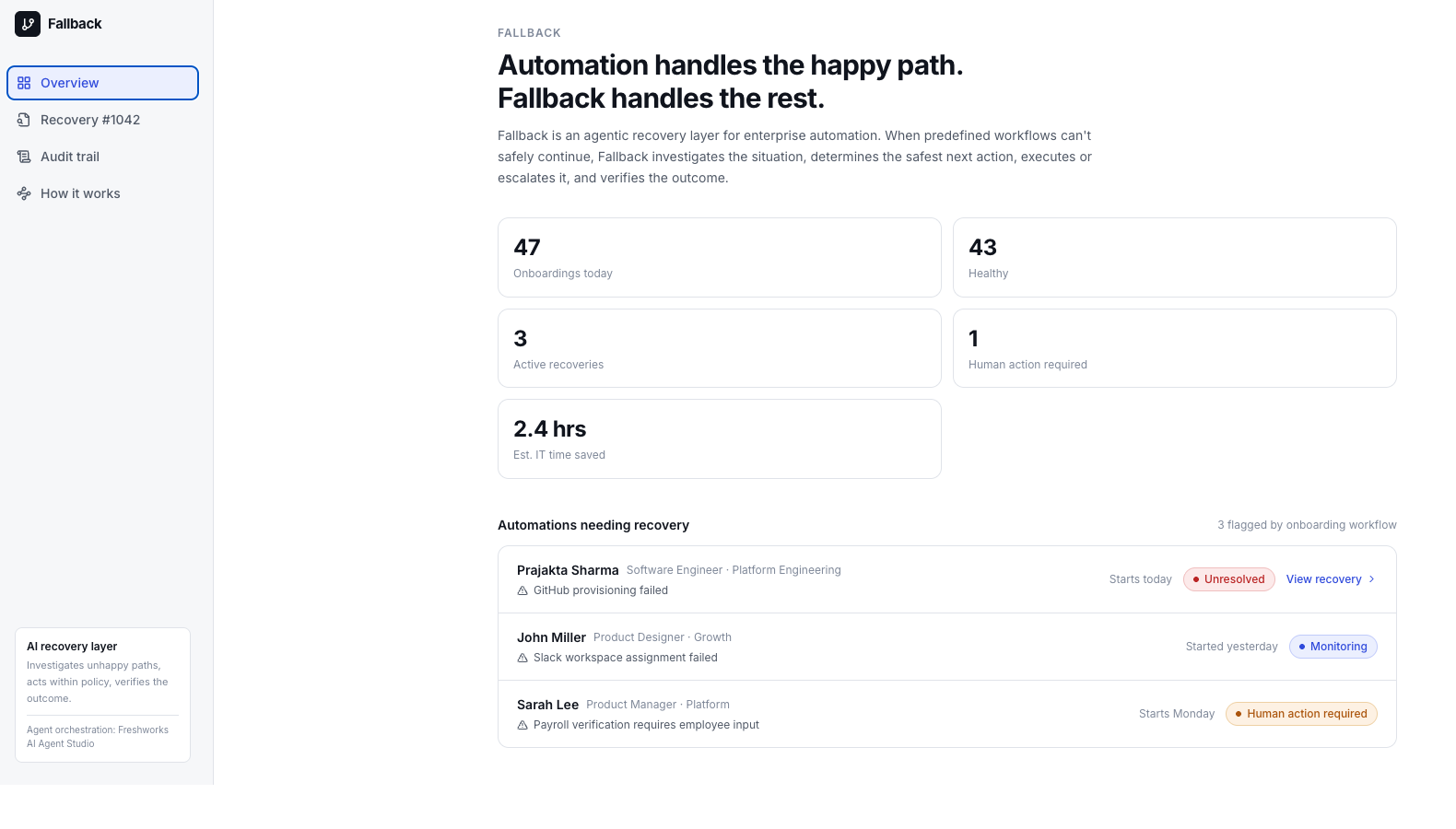
Automation keeps going on the happy path. Fallback only activates when it can't.
-
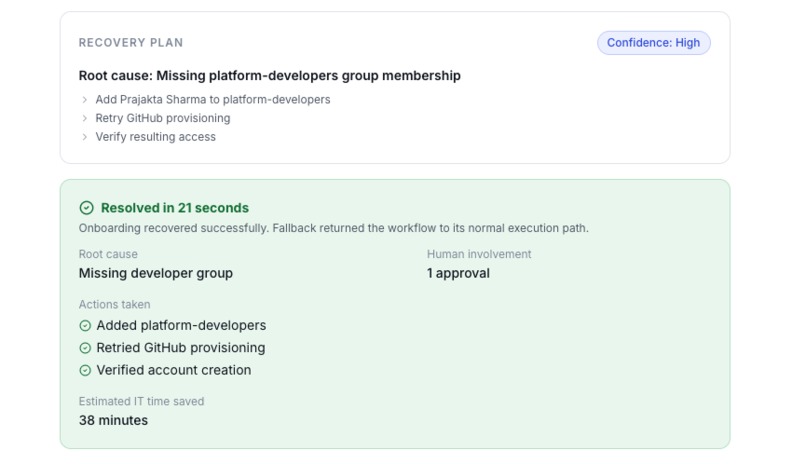
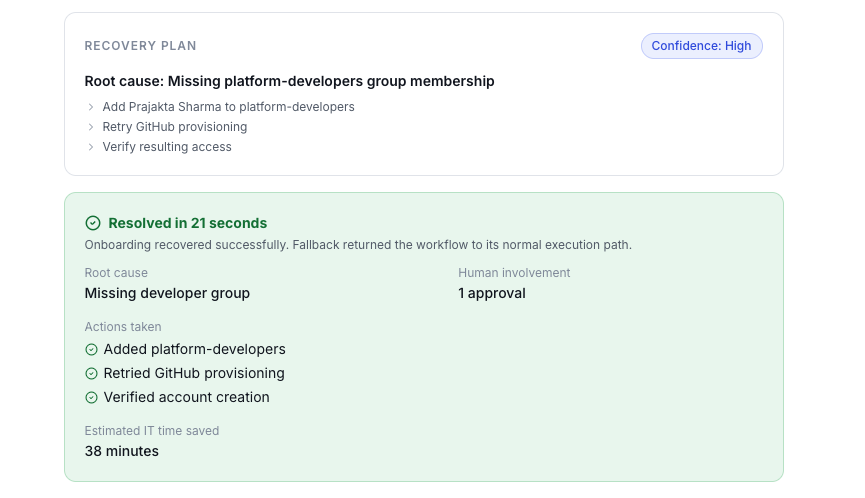
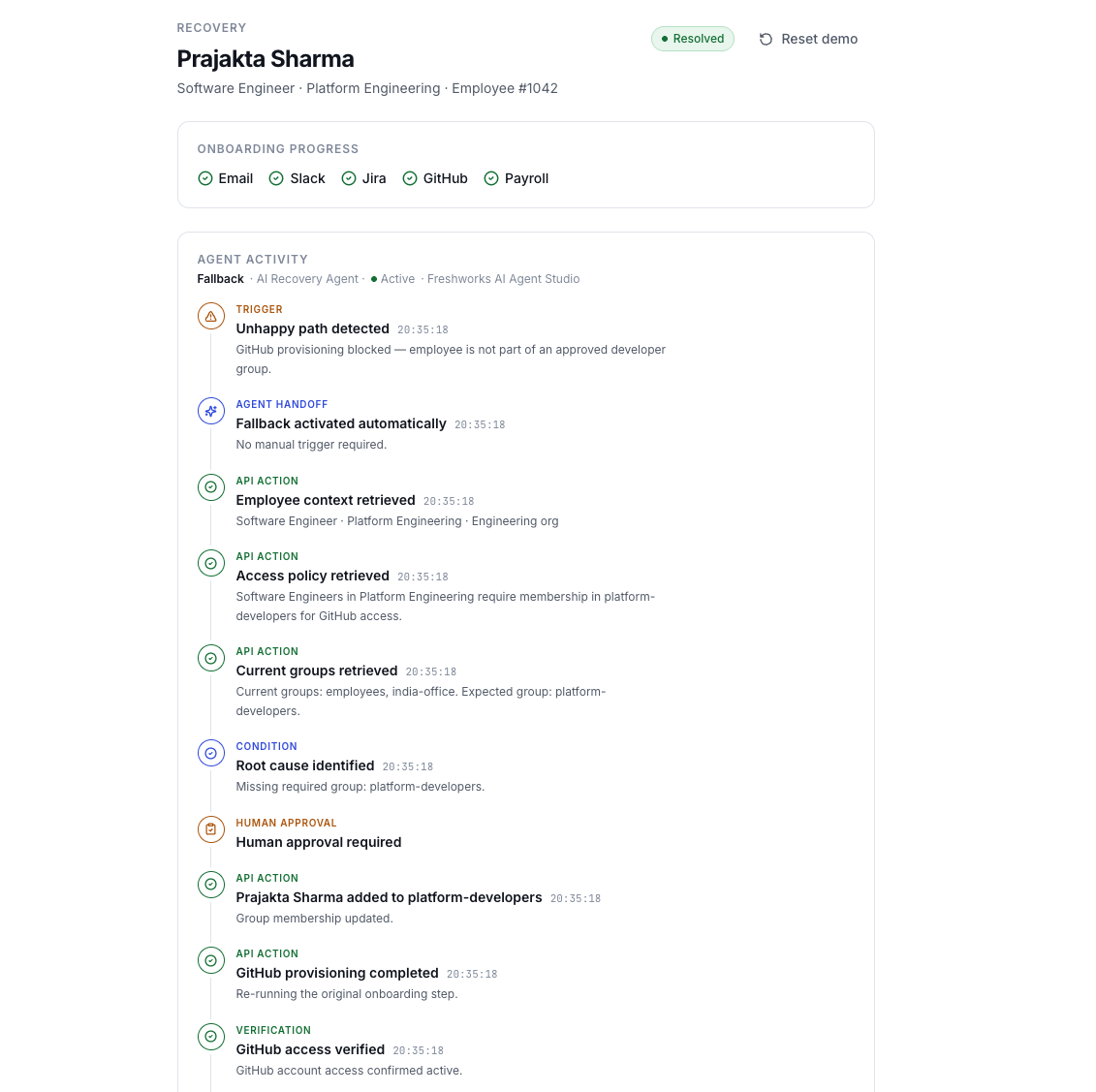
Resolved in 21 seconds, one human approval, full record of what changed and why.
-
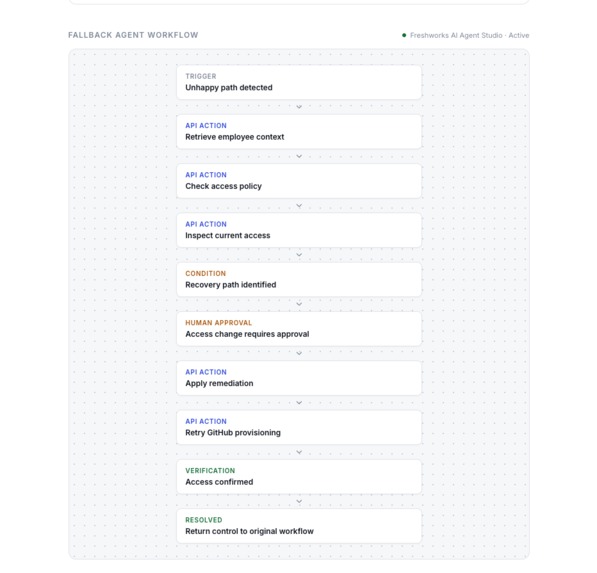
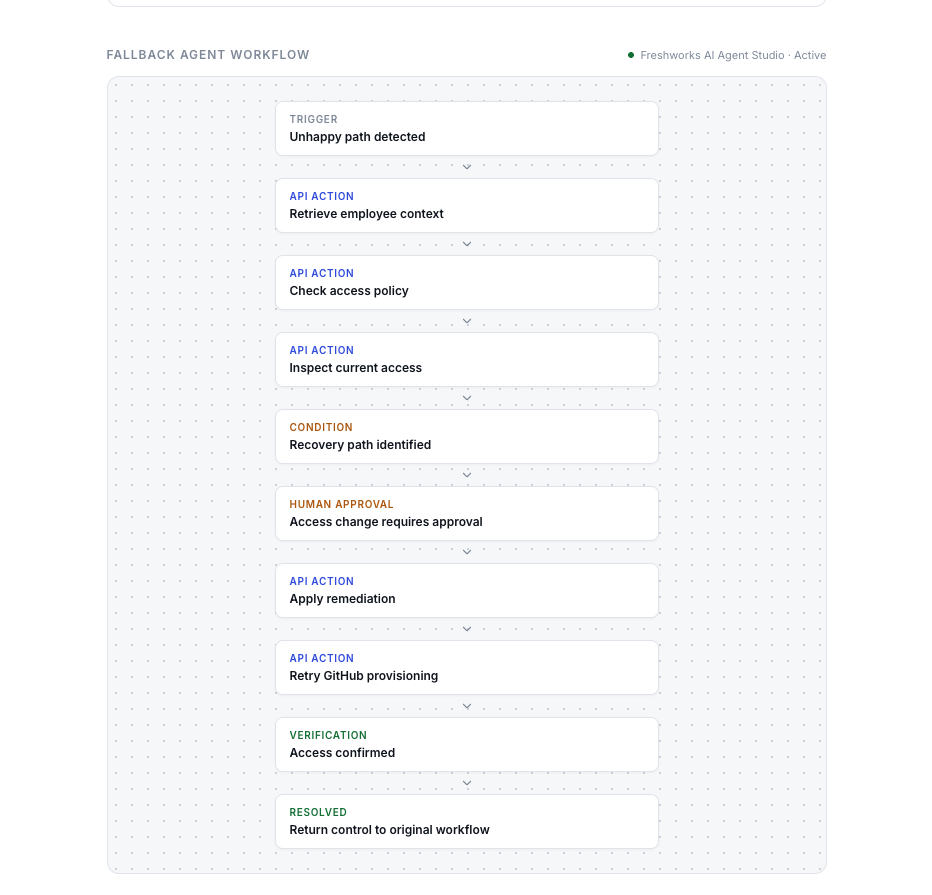
The same trigger → investigate → approve → verify loop, mapped as an agent workflow.
-
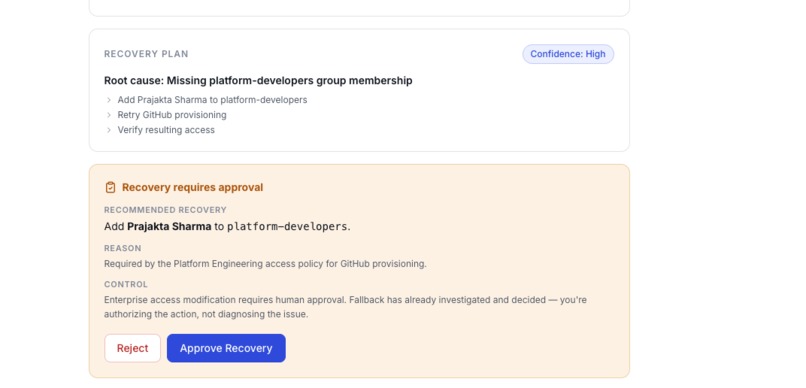
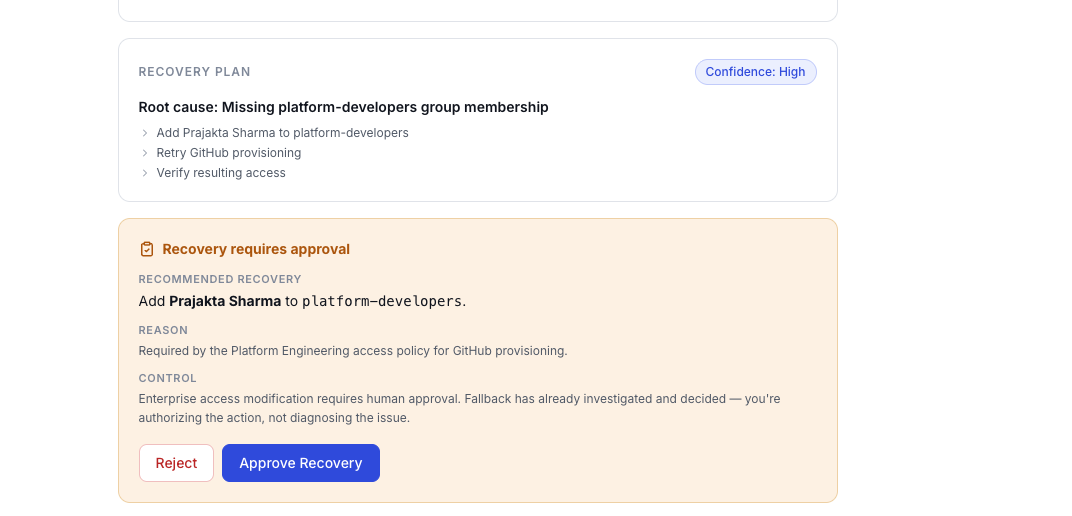
Fallback already diagnosed the issue and proposed the fix. The human only authorizes it.
-
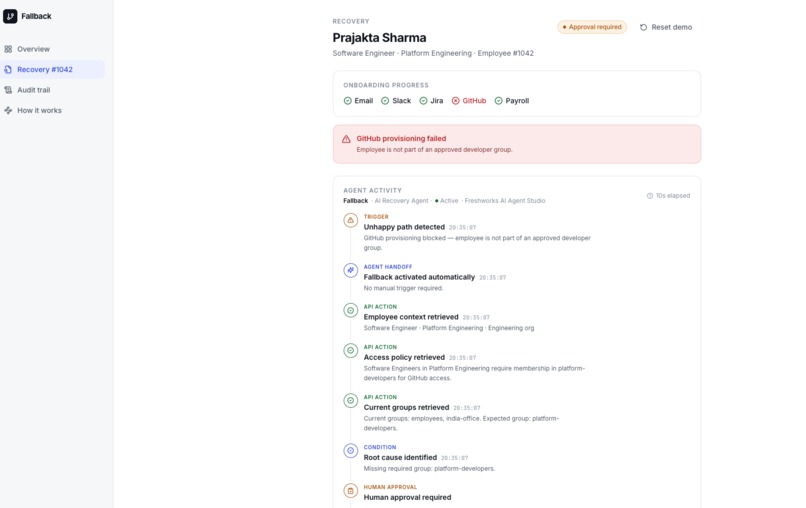
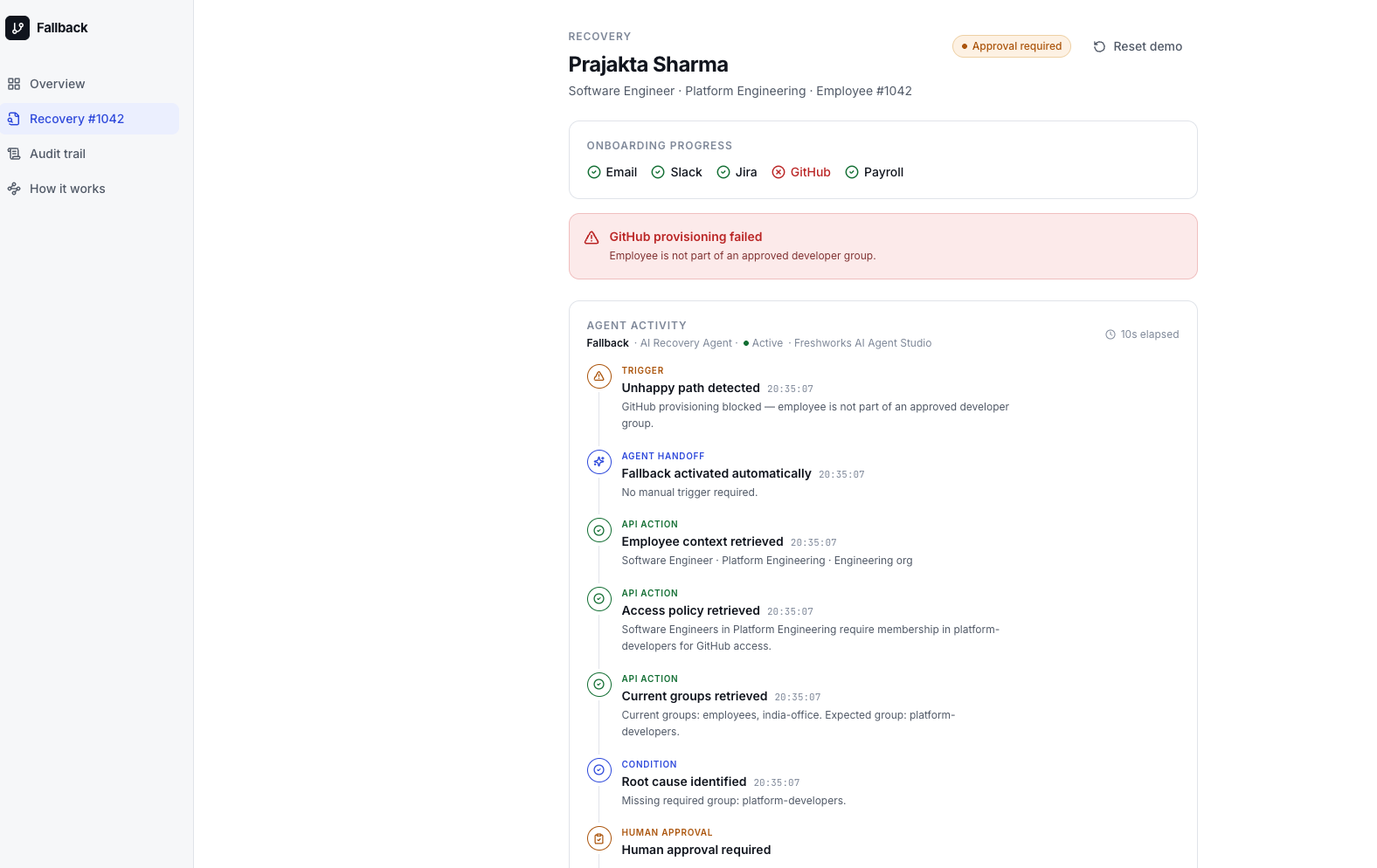
No 'Investigate' button. The moment the page opens, Fallback is already working.
-
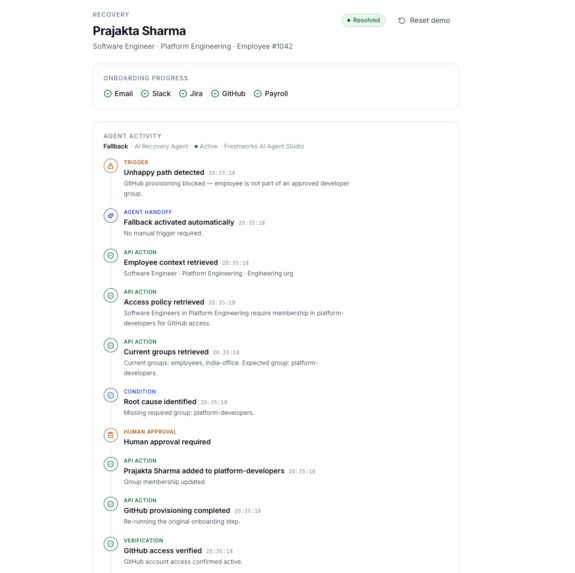
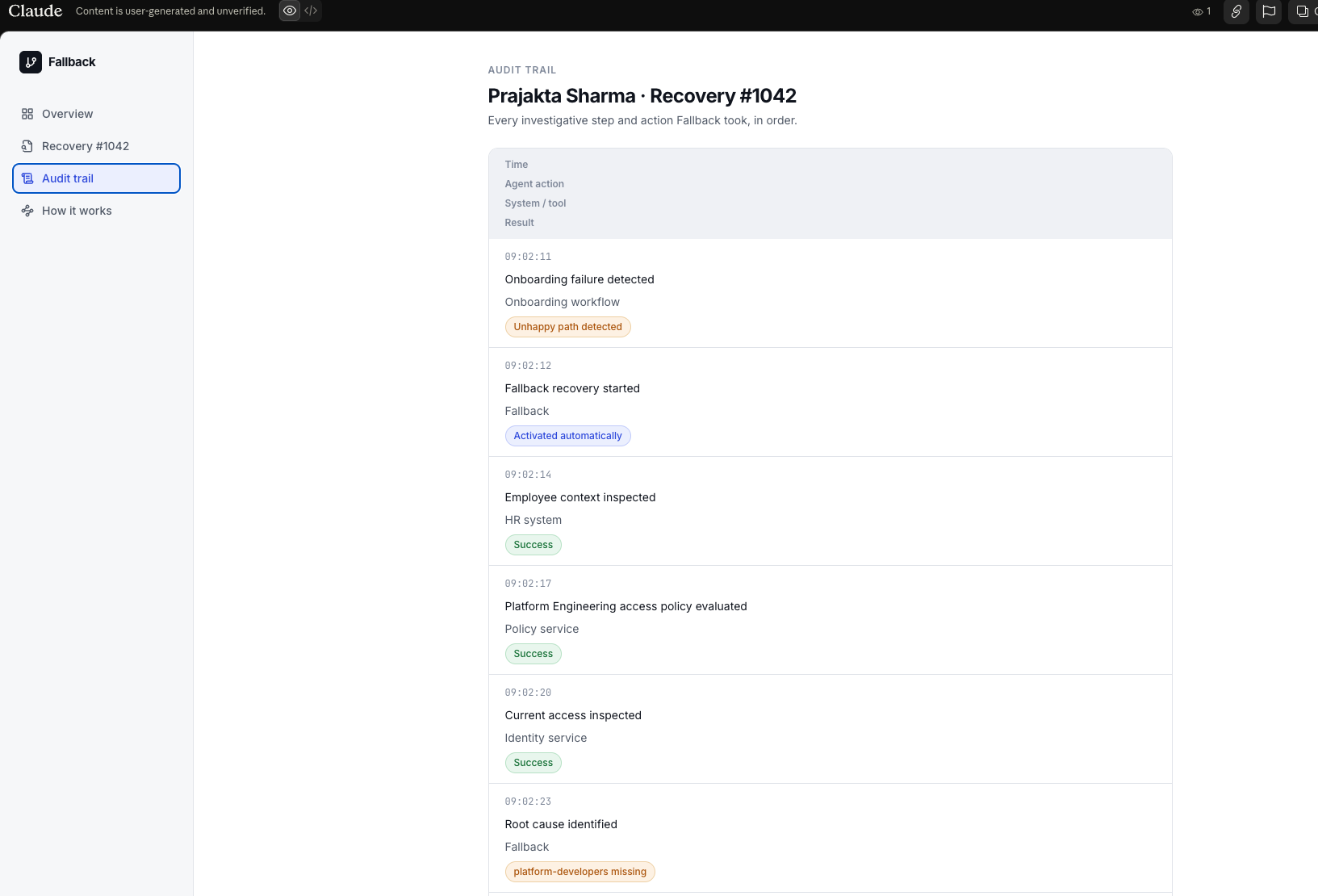
Every step visible: detect → investigate → decide → approve → fix → verify → resolved.
-
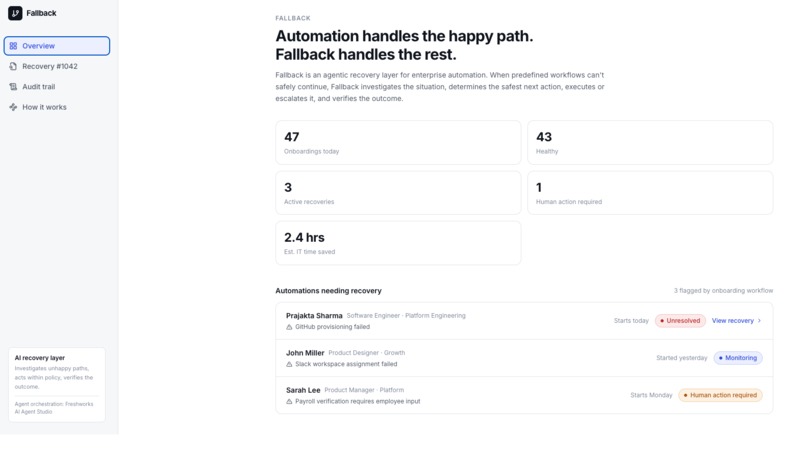
Every onboarding automation eventually breaks. Fallback flags it, before a human has to.
-
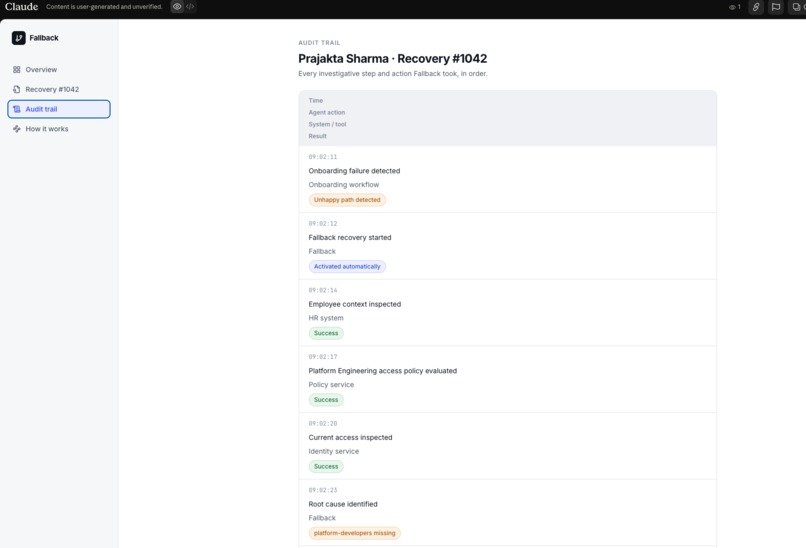
Activity Log : A governance-grade log of every action Fallback took, nothing is a black box.
-
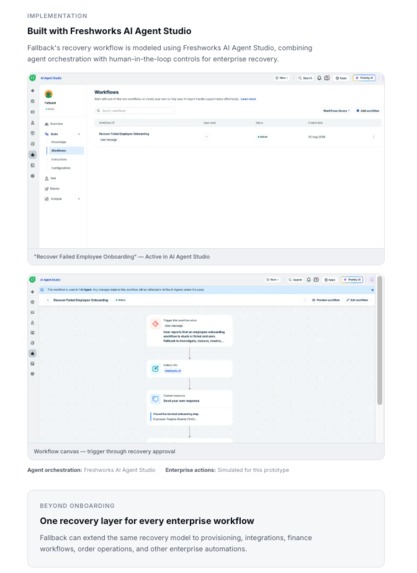
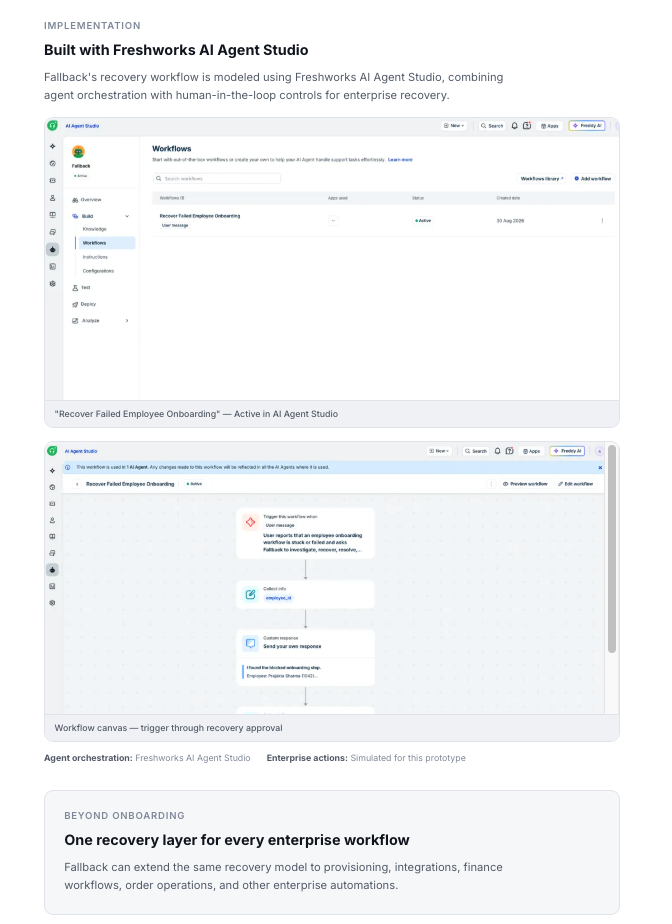
The actual recovery workflow, built and running in Freshworks AI Agent Studio.
Inspiration
Every company running onboarding automation eventually hits the same wall: one step in the chain fails — a missing access group, a policy that blocks the next action — and the "automation" quietly stops being automatic. What happens next is always the same. It becomes a ticket. It sits in a queue. A human has to notice it, dig through systems to figure out what actually went wrong, and fix it by hand.
We realized this isn't an edge case — it's the norm. Automation is only as good as its happy path, and nobody had built anything for the moment reality falls outside it. So we asked: what if the unhappy path had an agent too?
What it does
Fallback is an agentic recovery layer for enterprise automation. It doesn't replace onboarding automation — it activates only when that automation can't safely continue.
In our demo scenario, a new hire's GitHub provisioning fails because she's missing a required access group. Fallback automatically:
- Detects the failure and takes over — no human has to notice it first
- Investigates the employee's profile, the relevant access policy, and their current group membership
- Identifies the root cause and proposes a specific remediation
- Asks for human approval before making any consequential access change
- Applies the fix, retries the original failed step, and verifies the outcome
- Returns control to the normal workflow, with a full audit trail of everything it did
The human is never asked to diagnose the problem — only to authorize a decision Fallback already made.
How we built it
The prototype is a Next.js/React + TypeScript interface styled after modern enterprise SaaS tools (Linear, Vercel, Stripe) rather than a chatbot. It runs a deterministic state machine that drives a live, progressive "agent activity" timeline — investigation, approval, remediation, retry, and verification all animate in real time so the recovery process is fully visible, not a black box.
Behind the scenes, the actual recovery logic — the trigger, the collect-info steps, and the human-approval gate — is built and orchestrated in Freshworks AI Agent Studio, using the same employee/policy/access scenario shown in the UI. The frontend is the product experience; Agent Studio is the real orchestration layer behind it.
Challenges we ran into
- Keeping a live demo reliable. Since this has to run flawlessly on video and in front of judges, we built the entire flow as a deterministic sequence rather than depending on a live LLM call or external API mid-demo.
- Making autonomy visible without making it noisy. We wanted judges to see the agent reasoning step by step, without it turning into a wall of text — so each step shows a short "in progress" state before resolving to a checkmark with just enough detail.
- Getting the human-in-the-loop moment right. It was important that the approval step reads as authorization, not diagnosis — the copy and layout went through several passes to make clear that Fallback had already decided, and the human is only signing off.
Accomplishments that we're proud of
Built a working, polished prototype that clearly demonstrates the full recovery loop end to end — and connected it to a real Freshworks AI Agent Studio workflow, so this isn't just a UI mockup of an idea.
What we learned
That the hardest part of "AI agents for the enterprise" often isn't the automation itself — it's building the right amount of trust and visibility around it, so a human can approve a consequential action in seconds instead of re-investigating it themselves.
What's next for Fallback
Onboarding was the clearest story to demo, but the same recovery model applies anywhere deterministic automation can fail: provisioning, integrations, finance workflows, order operations, and beyond. Next steps would be generalizing the agent's tool set beyond this one scenario and connecting it to real enterprise systems rather than simulated ones.
Built With
- claude
- freshworks-ai-agent-studio
- next.js
- react
- tailwind-css
- typescript
