-
-
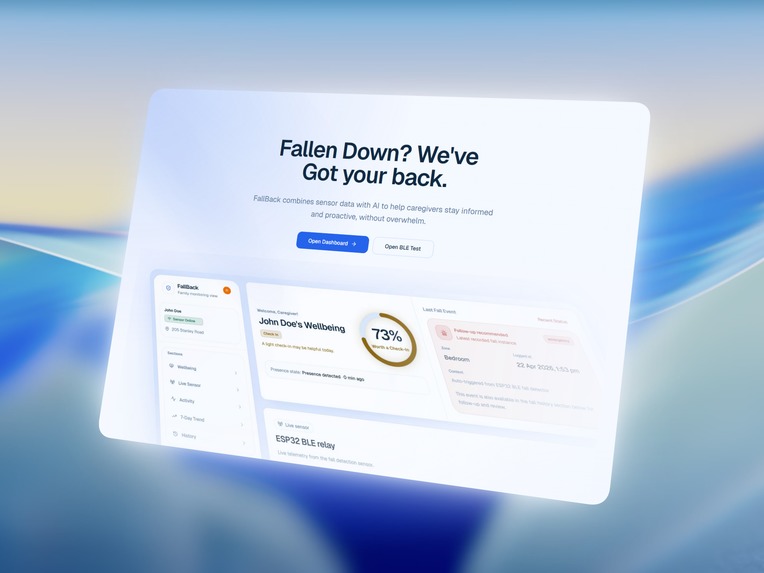
hero section
-
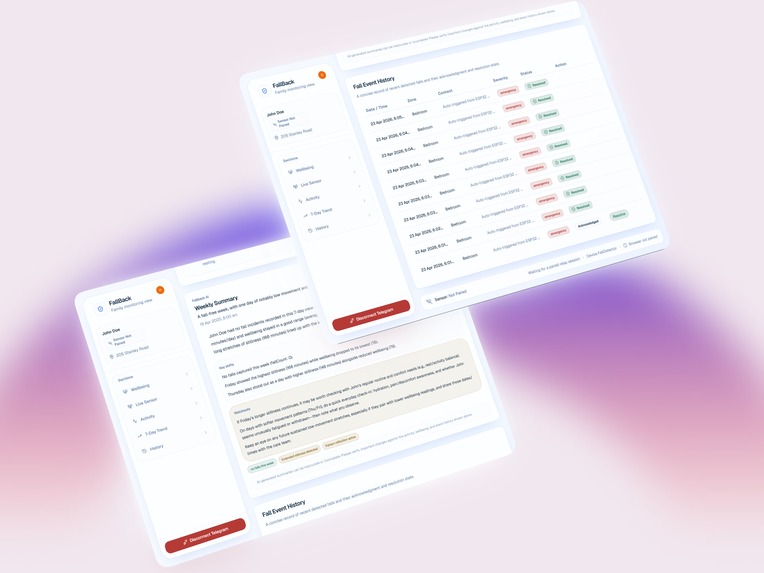
FallBack AI
-
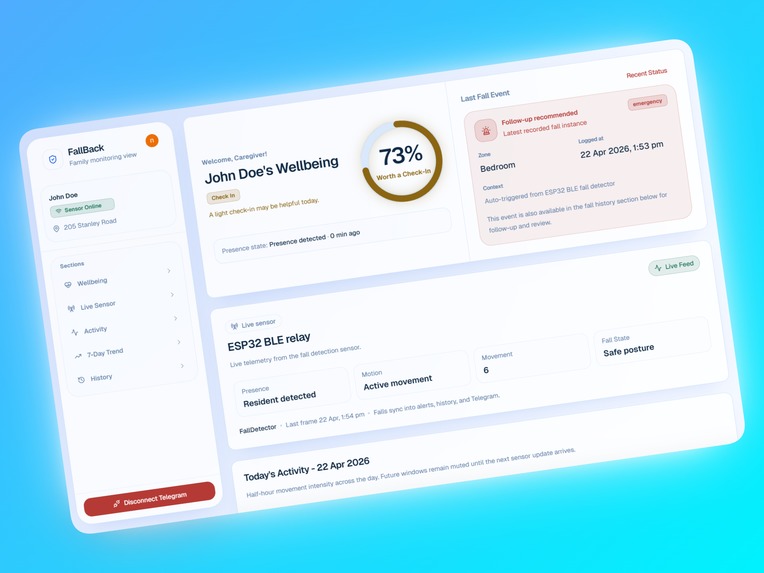
dashboard
-
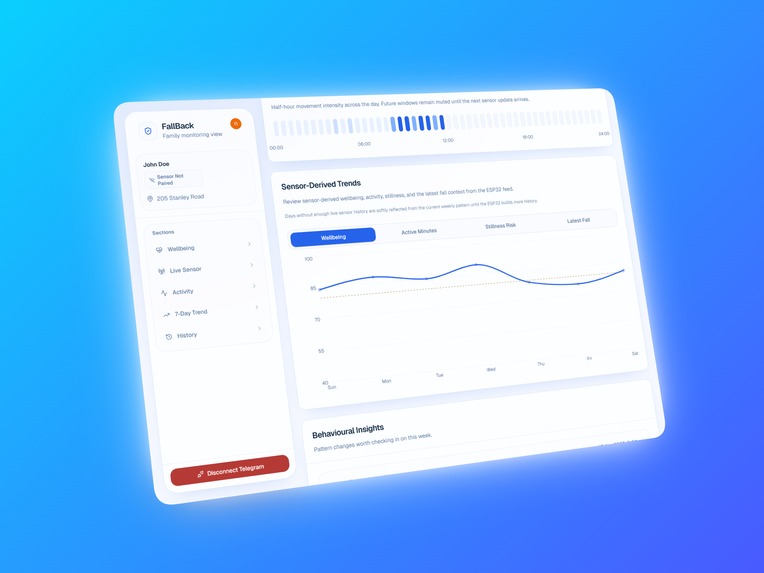
Insights
Inspiration
Falls are the leading cause of injury death among adults over 65. In Singapore, they account for more than 85% of elderly trauma cases. For a senior living alone, a single fall at 2am can mean hours on the floor before anyone knows.
But when we talked to families actually facing this, the real problem wasn't detection — it was the tradeoff they were forced to accept. Cameras feel like surveillance. Wearables only work when worn, and they're the first thing taken off at night or during a bath — precisely when falls are most likely.
Families were being told: choose privacy, or choose safety. That's not a real choice.
The insight that unlocked FallBack was a hardware one. mmWave radar — already deployed in automotive and industrial safety systems — can detect human posture and movement without capturing any imagery. No video feed. No photos. No footage ever stored. Just presence and motion signals.
If radar can tell a car when a driver is drowsy, it can tell a family when a parent has fallen. We surveyed 32 caregivers before writing a line of product code. 81% preferred passive radar. Privacy and peace of mind were the top two stated needs. We built what they asked for.
What it does
FallBack is a passive fall detection system that removes the camera-or-wearable tradeoff entirely.
A wall-mounted mmWave radar sensor paired with an ESP32 monitors movement continuously. When a fall is detected, the event is immediately:
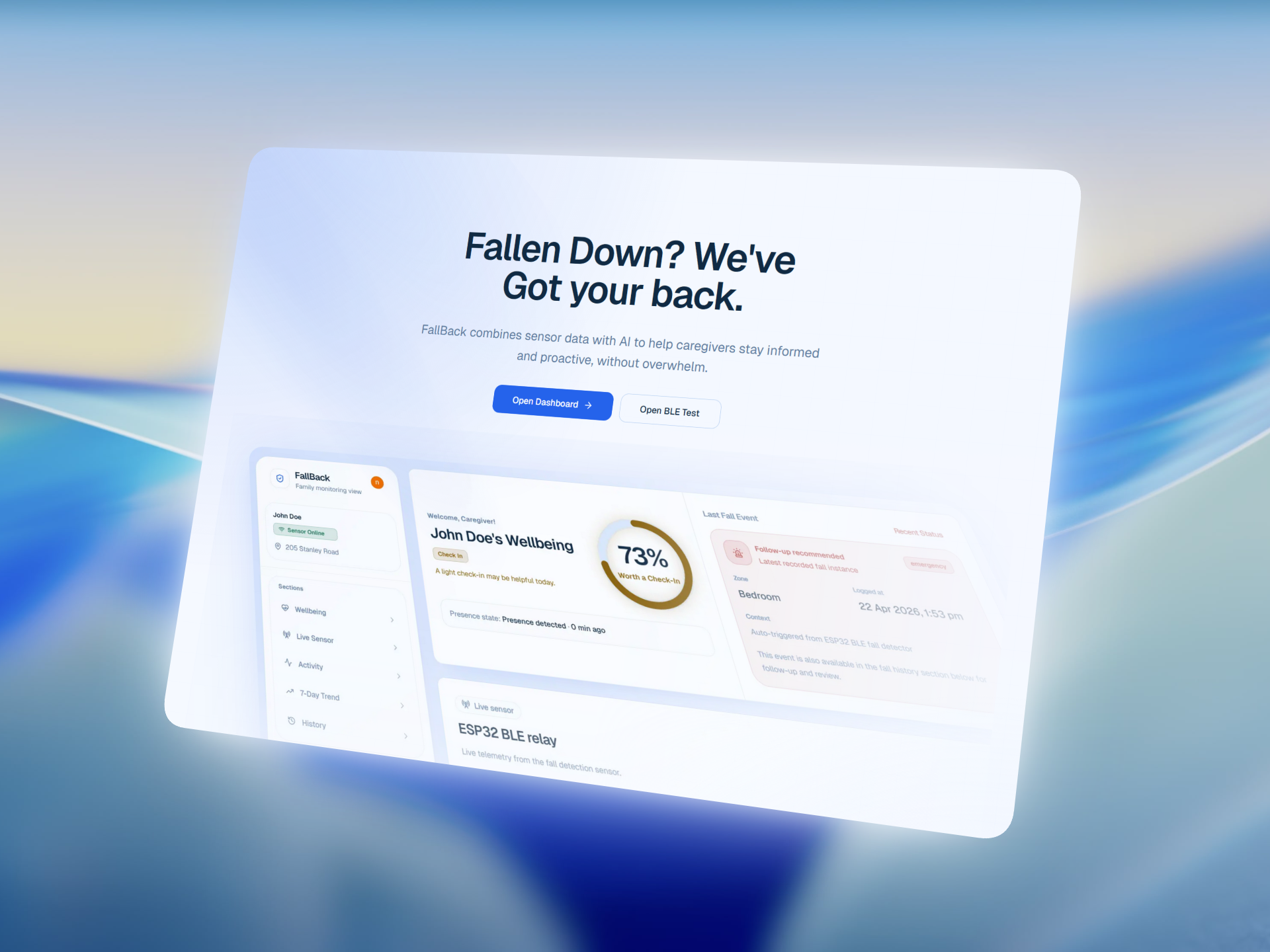
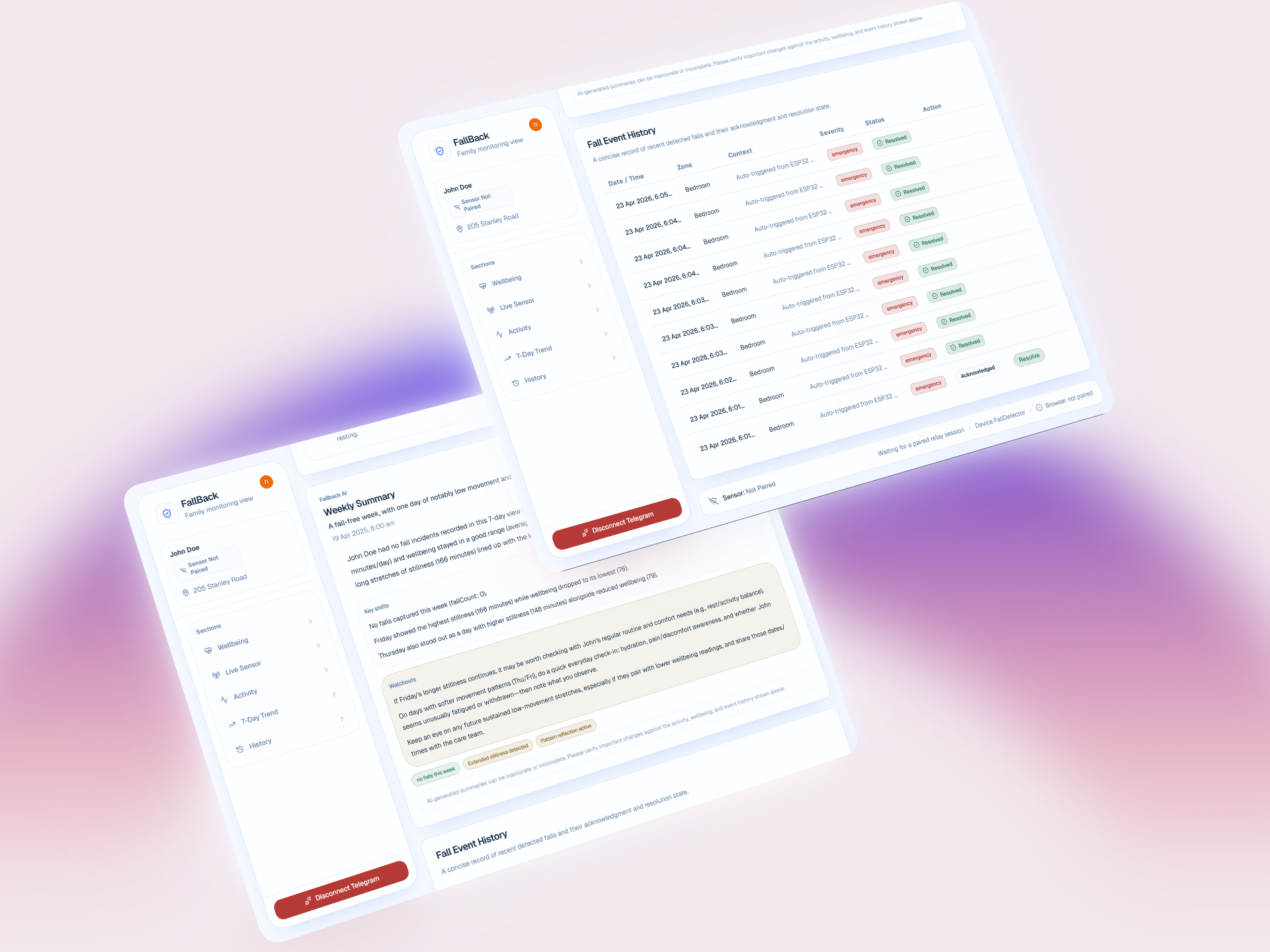
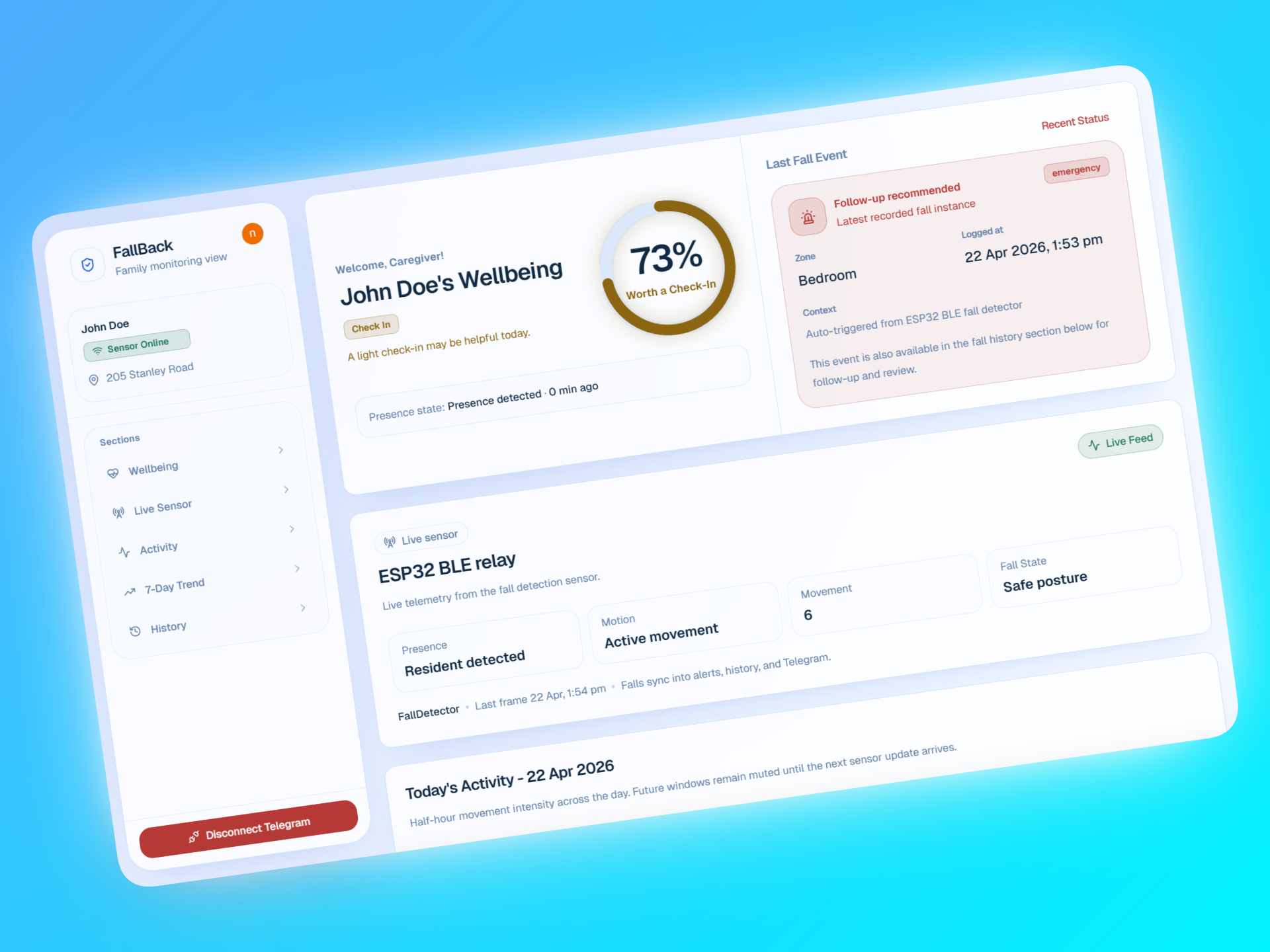
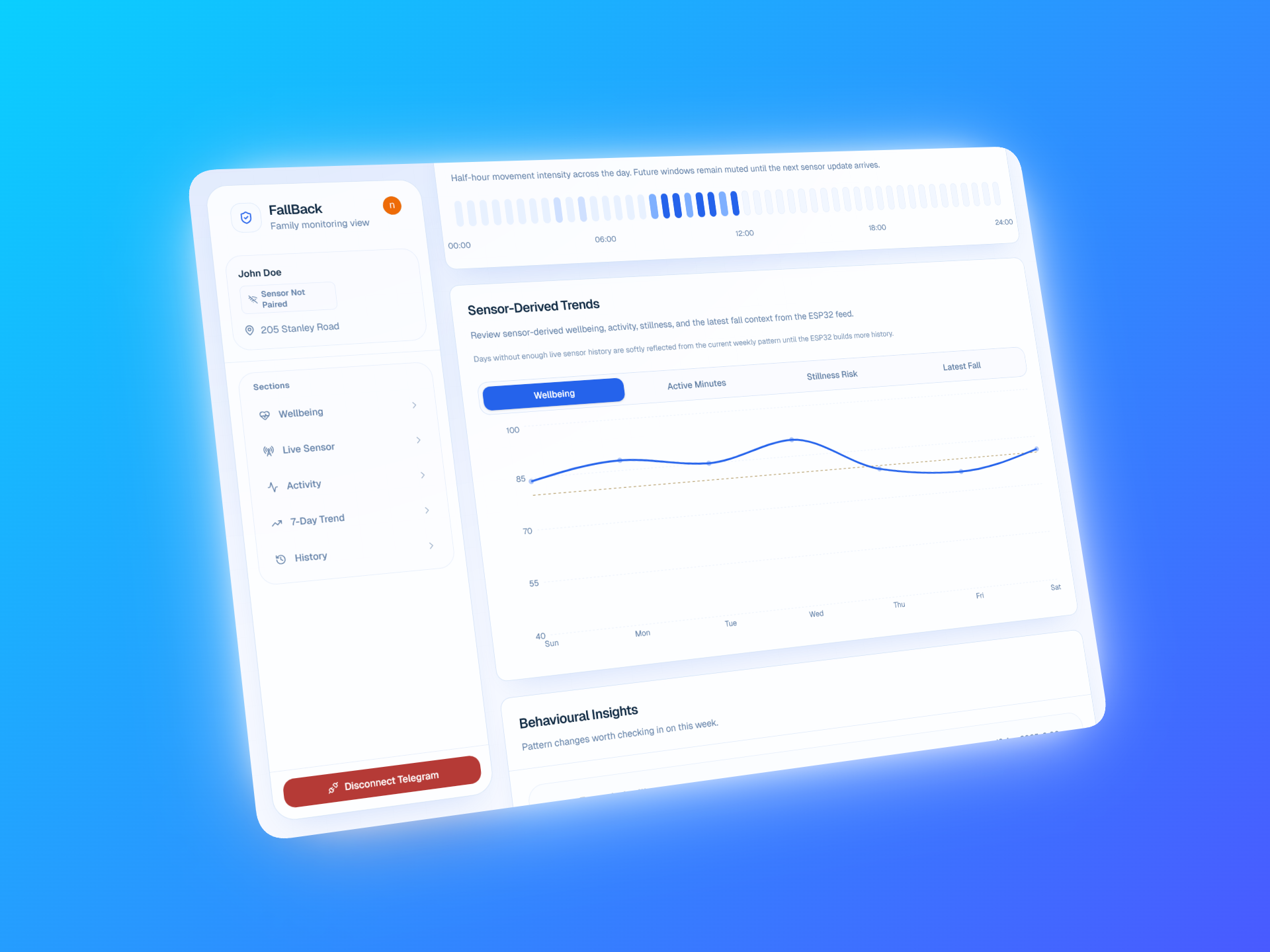
Persisted to a Supabase database so it survives page reloads and reconnections Pushed to a linked family member via Telegram with a deep-link back into the dashboard Surfaced on a family-facing dashboard with live alert overlays, fall history, wellbeing score, and weekly trend charts The dashboard is not generic admin UI. It is built specifically for family caregivers: last known fall, wellbeing signal, risk flags, sensor status, and a weekly AI-generated digest summarizing changes in movement and fall risk.
For demos and testing, /test supports both live BLE telemetry from the physical sensor and manual alert simulation — so the full pipeline can be shown without hardware present.
How we built it
Sensing layer: An LD2410 mmWave radar board + ESP32 reads presence, motion intensity, and fall posture. The ESP32 broadcasts numerical telemetry over BLE — no images, no audio, no footage.
Web relay: A browser-based BLE client using the Web Bluetooth API receives telemetry and forwards it to our API. /test also supports manual queuing for hardware-free demos.
Backend: Next.js 16 API routes handle fall alert persistence via Supabase. Clerk manages authentication with a webhook-based user sync pipeline into public.users.
Alerting: When a fall alert is created, the server checks for a linked Telegram account and dispatches a notification via the Telegram Bot API with a dashboard deep-link. Linking flows through a one-time magic-link token system.
Dashboard: Built in React 19 with Tailwind CSS v4 and Framer Motion. The wellbeing ring uses explicit SVG arc math. Alert overlays use a cross-tab BroadcastChannel bus scoped by Clerk user ID — so /test and /dashboard stay synchronized in real time across browser tabs without a persistent WebSocket server.
AI digest: An OpenAI Responses API call generates a caregiver-friendly weekly summary from stored movement and fall data, with graceful degradation if the key is absent.
Challenges we ran into BLE in the browser is unreliable. Web Bluetooth has strict browser requirements, inconsistent pairing behavior, and fails silently on some Chrome builds. We built a complete manual simulation path so the demo never depends on hardware being present — the product story holds with or without the sensor in the room.
Cross-tab real-time state without a server. We needed the dashboard to react to fall events triggered from the test page, without running a persistent WebSocket server. The solution was a BroadcastChannel bus with a localStorage fallback, scoped to Clerk user ID — lightweight, dependency-free, and reliable.
Alerts that survive page refreshes. Early builds used ephemeral in-memory state — fine for a demo, fragile for a real incident. Rebuilding the alert pipeline around Supabase persistence required rethinking the data contract at the API layer and the dashboard's initial render logic.
Demo design under time pressure. The architecture spans hardware, BLE, API, database, notifications, and AI. Judges have three minutes. Designing a demo that shows the full loop in under 60 seconds — without hiding what's underneath — forced us to simplify and sharpen the product itself.
Accomplishments that we're proud of
A live hardware-to-dashboard loop. A physical radar sensor detecting a fall, persisting the event, firing a Telegram alert, and surfacing an overlay on the dashboard — all in one continuous, unbroken flow.
Persistent incident storage. Fall alerts survive page reloads, tab closures, and network interruptions. This is a real product requirement. We didn't shortcut it.
Privacy by architecture. No camera feed, no video, no images — ever. The sensor emits only numerical telemetry. There is nothing to leak, intercept, or misuse. The privacy guarantee is structural, not policy-based.
Demand validation before building. 81% of the 32 caregivers we surveyed preferred passive radar over cameras or wearables. We validated the problem and the solution direction before writing a line of product code.
A demo path that never fails. Manual alert simulation ensures the full pipeline is demonstrable on stage regardless of hardware availability, network conditions, or BLE pairing issues.
What we learned
The dignity problem is the product problem. The technical challenge of fall detection is largely solved. The unsolved challenge is navigating the privacy-dignity tradeoff at a price point real families can adopt. That is the design space FallBack lives in — and it is almost entirely unoccupied.
Passive sensing is underexplored in consumer health. mmWave radar is mature, cheap, and already in mass production for automotive and industrial applications. The consumer health use cases are almost entirely untouched. The chip that detects driver fatigue can protect a senior living alone.
Real-time cross-tab state is harder than it looks. BroadcastChannel solved our problem cleanly, but the fallback logic and user-ID scoping took real iteration to get right. State that feels ephemeral to the user must be durable and synchronized underneath.
Demo design is product design. The constraints of a three-minute hackathon demo reveal exactly what a product's core loop is. Designing the demo forced us to cut everything that wasn't essential and sharpen everything that was.
What's next for FallBack
Clinical validation. Partner with a care facility to run a structured deployment and benchmark false positive and negative rates against current wearable standards.
Multi-room coverage. A single sensor covers one room. The next version tiles multiple radar nodes and aggregates presence signals across a full floor plan.
Proactive risk scoring. The weekly digest currently describes what happened. The next version flags behavioral drift — reduced mobility, longer stillness windows, changes in daily routine — before a fall occurs.
Hardware productization. Package the ESP32 and radar board into a single wall-mount unit with a QR-code setup flow. Current bill of materials is under $40.
Caregiver coordination. Multi-member families, role-based alert routing, and escalation chains. A fall at 3am should wake the right person — not everyone.
Built With
- bluetooth
- c1001
- clerk
- esp32
- next.js
- openai
- radar
- shadcn-ui
- supabase
- tailwind
- typescript
- vercel


Log in or sign up for Devpost to join the conversation.