-
-
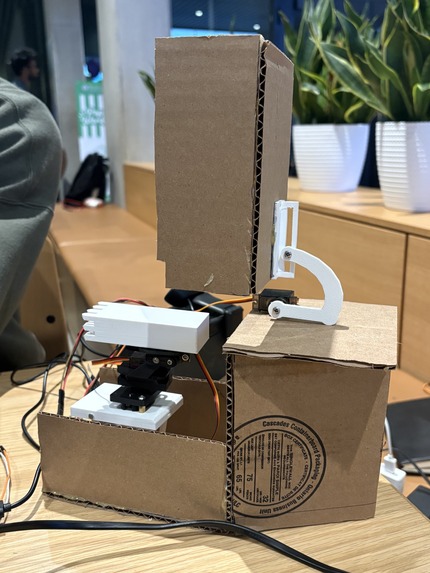
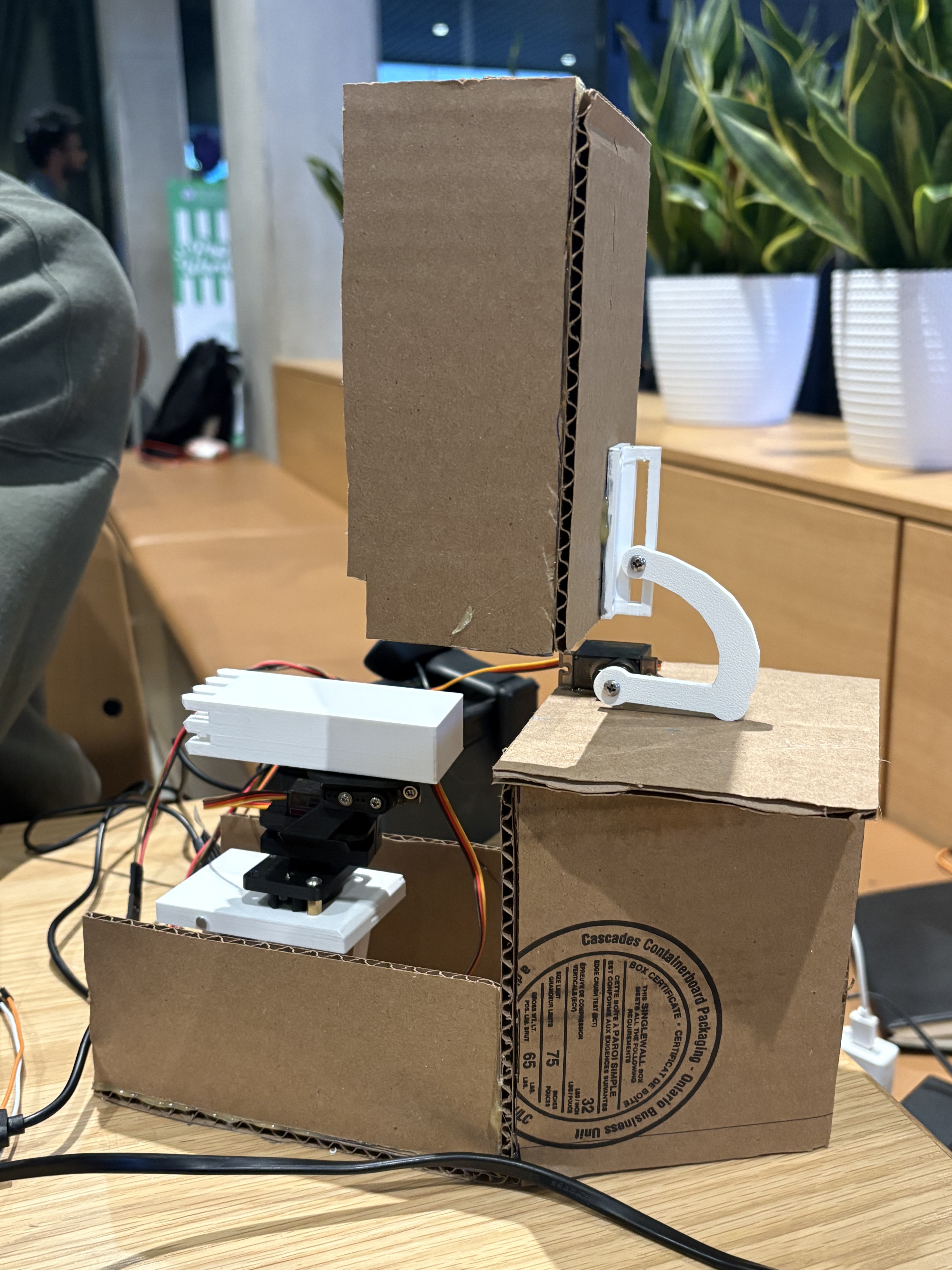
Full system with enclosure(before final touches!)
-
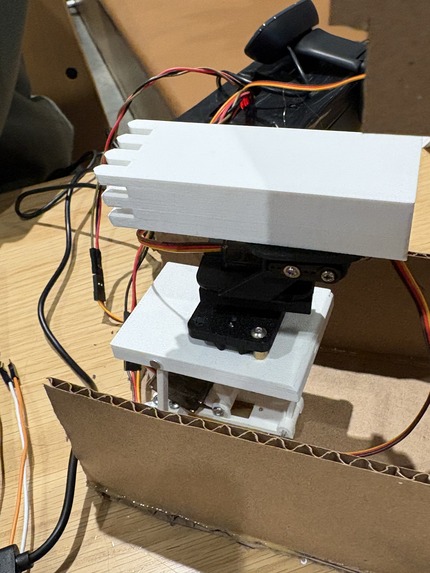
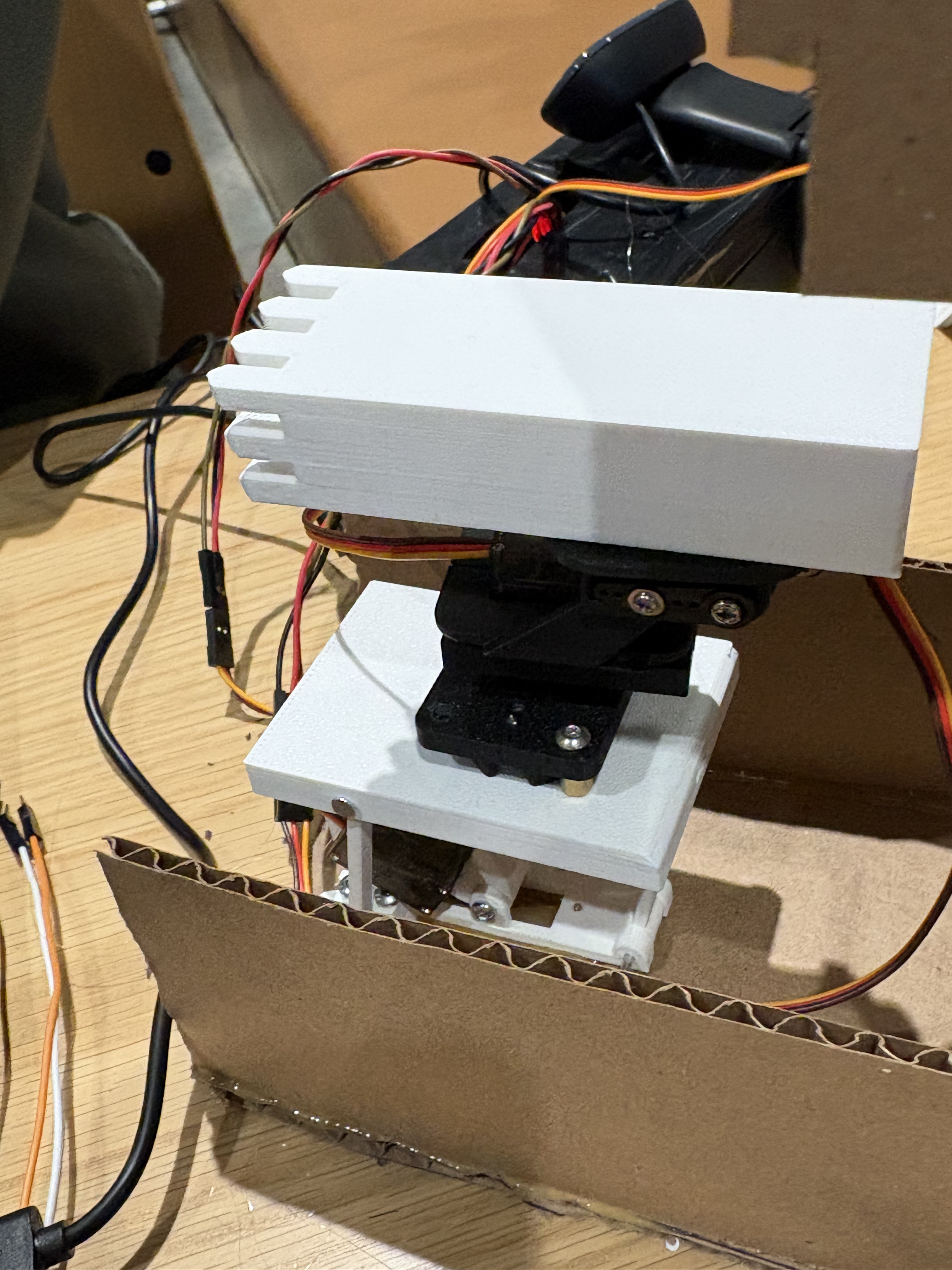
Close up of the turret system
Inspiration
A slightly absurd concept for building a self-contained robotic turret became a full-scale robotics project almost immediately.
Our goal was to examine the potential of working with computer vision, real time processing and mechanical motion in one physical response-based system. The inspiration came from both deployable robotics and automated defense systems, so we took on the challenge to create a fully functional mini drone tracking turret which could be hidden until deployment was desired.
Also, we thought it would be fun.
What it does
FALCON is a QNX-powered robotic turret designed to autonomously detect, deploy, and track aerial targets using computer vision.
The system combines a Raspberry Pi 5 running QNX with a motorized deployment platform and a two-axis pan-tilt mechanism.
When a target is detected, the intended sequence begins by activating the deployment mechanism, raising a concealed turret from its enclosure. Once deployed, the pan-tilt assembly is designed to follow the target's movement using information from the computer vision system.
Rather than physically engaging targets, FALCON uses a non-functional turret model to demonstrate how real-time perception can translate into coordinated robotic movement.
The result is a compact proof of concept that brings together autonomous tracking, embedded computing, and mechanical actuation.
How we built it
FALCON combines embedded software, computer vision, electronics, and mechanical engineering.
At the centre of the system is a Raspberry Pi 5 running QNX, which handles camera acquisition and provides the computing platform for computer vision and system coordination.
For the mechanical deployment system, we assembled a 3D-printed miniature lifting platform driven by an MG90S servo. An Adafruit Feather M0 communicates with a PCA9685 PWM controller over I²C to generate the servo control signals.
We developed calibration firmware to establish the platform's retracted and deployed positions, control its movement speed, and reduce mechanical stress on the lifting mechanism.
A separate pan-tilt mechanism carries a miniature dummy turret, providing the physical platform for visual target tracking.
The enclosure was divided into two compartments: one housing the Raspberry Pi and supporting electronics, and another containing the deployment platform and turret. We combined 3D-printed mechanical components with lightweight enclosure materials to reduce manufacturing time.
Our final integration connects the QNX-based vision software with the embedded actuation system to coordinate deployment and tracking.
Challenges we ran into
One of our biggest challenges was translating our mechanical concept into a working physical system within the hackathon's time constraints.
The deployment mechanism proved particularly difficult. We encountered servo stalling, limited angular travel, gear engagement problems, and difficulties establishing repeatable starting positions.
We also experienced unexpected power distribution issues with our PCA9685 controller. Although the board communicated correctly over I²C, the servo wasn't receiving adequate power. After troubleshooting with a multimeter, we isolated the problem to the board's servo power path and developed an alternative connection.
Mechanical calibration presented another challenge. We had to determine appropriate servo operating limits while accounting for friction, mechanical stops, and the tendency of the printed gear connection to wear under repeated movement.
Manufacturing was equally challenging. Our initial enclosure design required approximately ten hours of printing, forcing us to reconsider the enclosure architecture and adopt a more practical approach using lightweight materials.
Accomplishments that we're proud of
We're proud that we managed to transform an ambitious idea into a functioning electromechanical prototype within a single hackathon.
We successfully assembled and actuated a 3D-printed lifting mechanism, integrated the Feather M0 with the PCA9685, and calibrated the platform to operate between repeatable deployment positions.
We also brought up QNX on the Raspberry Pi 5 and achieved camera image acquisition, establishing the foundation for the computer vision system.
Another major accomplishment was adapting our design under pressure. Rather than abandoning the project when our original mechanical and enclosure concepts became impractical, we simplified the architecture while preserving the core functionality.
What we learned
FALCON taught us that integrating hardware and software is considerably more complicated than developing either independently.
We learned how servo control depends not only on PWM signals but also on mechanical loading, power delivery, gear engagement, and careful calibration.
We also gained practical experience working with QNX on the Raspberry Pi 5 and interfacing embedded controllers with electromechanical systems.
The project reinforced the importance of modular system design, especially when multiple team members are developing different subsystems simultaneously.
Perhaps our biggest takeaway was understanding when to simplify. Sometimes the best engineering decision isn't to build the most elaborate mechanism, but to find the simplest implementation that reliably accomplishes the goal.
What's next for Falcon Turret
Our immediate priority is completing and refining the integration between computer vision, deployment sequencing, and pan-tilt tracking.
Beyond the hackathon, we'd like to develop a more compact enclosure, improve mechanical reliability, and replace temporary wiring with a custom PCB.
We also plan to explore limit switches and position feedback to improve deployment repeatability, alongside more advanced computer vision algorithms for smoother and more accurate tracking.
Built With
- 3dprinting
- allheart
- qnx
- raspberry-pi

