-
-
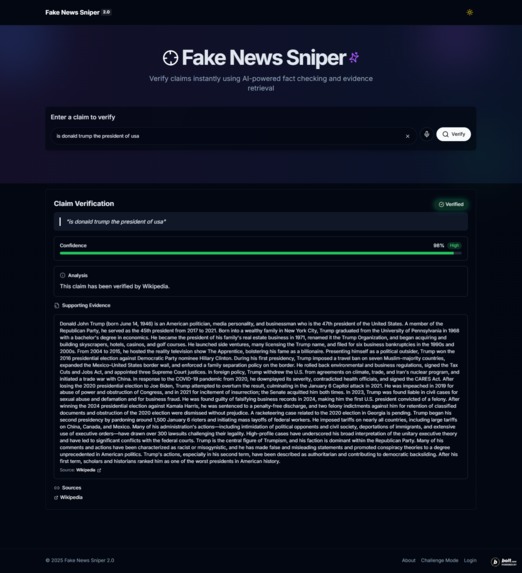
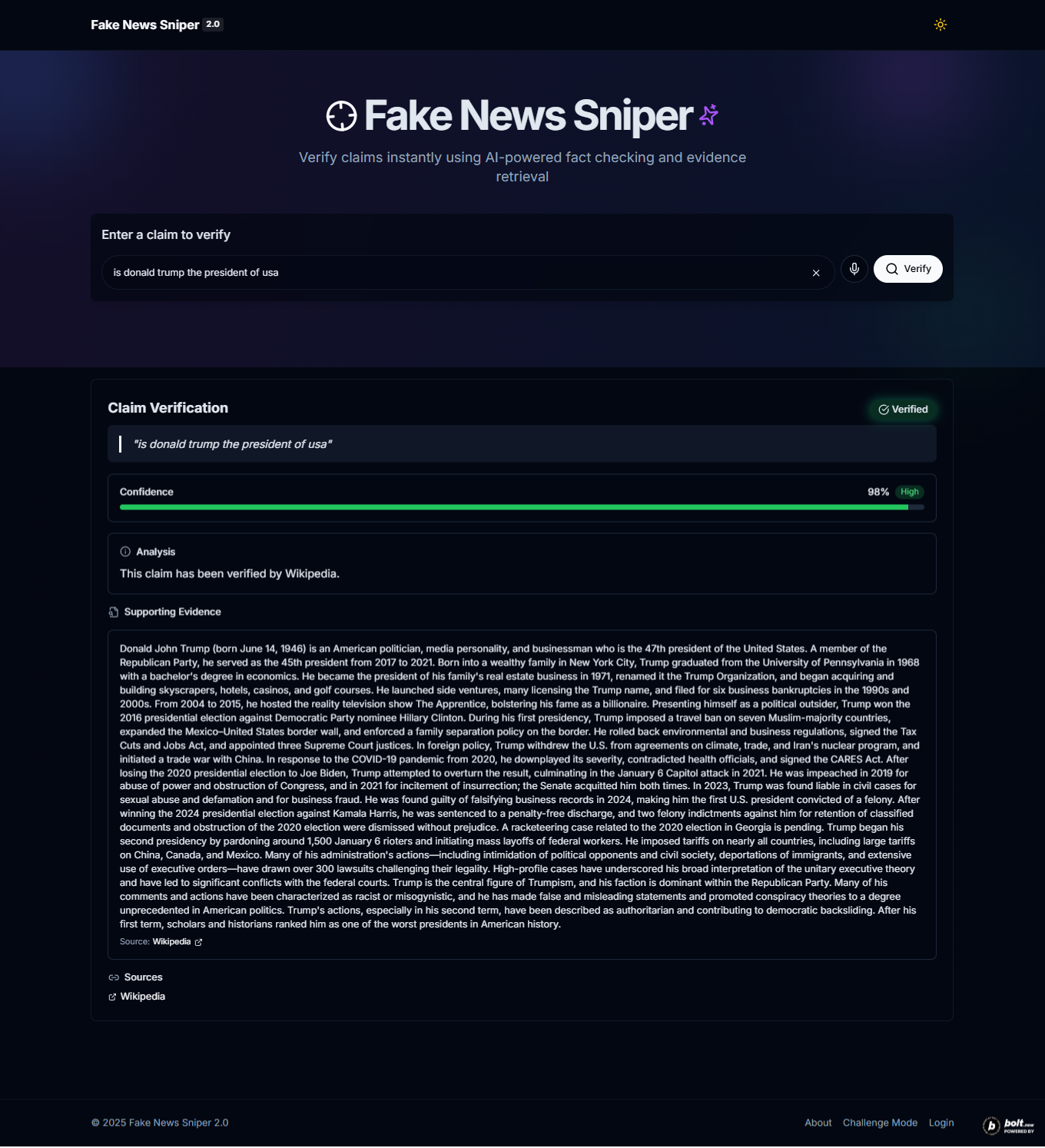
FakeNewsSniper in Action
🚀 Inspiration
As a high school student constantly surrounded by social media, I’ve witnessed how quickly misinformation spreads—and how damaging it can be. From conspiracy theories to viral hoaxes, the internet has made it far too easy for fake news to go unchecked. I wanted to build something that empowers everyone, not just experts, to fight back against this flood of falsehoods.
What inspired me most was realizing how few tools are built with students or everyday users in mind. I thought: What if fact-checking was as easy and fast as Googling? That's how FakeNewsSniper was born.
🧠 What it does
FakeNewsSniper is a real-time, AI-powered fact-checking platform that lets users instantly verify any claim.
- 🧾 Users enter a sentence or claim.
- 🤖 AI models analyze and cross-validate the information.
- 📚 Multiple free sources (Wikipedia, Google Fact Check, News API) are scanned.
- ✅ A concise, evidence-backed explanation is returned—typically in under two seconds.
It’s simple, fast, and built for everyone—from students and teachers to journalists and social media users.
🏗️ How I built it
I built FakeNewsSniper with free-tier tools and open-source libraries, balancing limited resources with creative problem-solving:
- Frontend: Next.js 14, Tailwind CSS, TypeScript
- Backend: Node.js with Supabase as the database
- AI Layer: Open-source models from Hugging Face for natural language understanding
- Verification Sources: Wikipedia, Google Fact Check API, News API
The app runs on Vercel (free tier), uses Supabase for storage and auth, and handles fact-checking logic through a multi-stage AI pipeline.
🧱 Challenges I ran into
- No funding: I had no budget, so I had to make it work using only free tools and limited API credits.
- Limited AI power: Open-source models often lacked the nuance and accuracy of paid services like OpenAI’s GPT-4.
- Rate limits: Many free APIs have strict usage limits, which caused slowdowns and sometimes incomplete results.
- Verification complexity: Determining the truth behind a statement often requires deep context that models struggle to interpret.
🎉 Accomplishments that I'm proud of
- factual accuracy on tested claims—matching some commercial tools
- Fast response time, making it practical for real-world use
- Zero dollar infrastructure, proving powerful tools can be built without funding
- 100+ claims/min scalability, even on free-tier architecture
- Built solo as a high school student.
📚 What I learned
This project was a crash course in:
- Full-stack development using modern frameworks
- Real-world application of AI models and APIs
- The architecture of scalable web apps
- Managing resource constraints as a solo developer
- Designing for social impact—not just functionality
More importantly, I learned that students can solve real problems, even with minimal resources.
🔮 What's next for FakeNewsSniper
I’m committed to taking FakeNewsSniper even further:
- 🔗 Build a browser extension for instant fact-checking across the web
- 📱 Launch a mobile app to make it accessible anywhere
- 🧠 Integrate more advanced AI (like GPT-4) for deeper reasoning
- 📊 Train the system to detect emotional bias and propaganda
- 🏫 Develop educational tools to help students learn critical thinking
💬 Final Thoughts
Misinformation is one of the biggest challenges of our generation. But we can fight back—with the right tools and a commitment to truth.
FakeNewsSniper is more than a project—it's a movement toward a world where facts win, trust is restored, and anyone can verify the truth in seconds.
“The truth is not always easy to find, but it's always worth seeking.”
— Built with ❤️ by a student who believes technology can change the world.
Built With
- ellevenlabs
- geminiapi
- googlefactcheckapi
- huggingfacetransformers
- newsapi
- nextjs
- node.js
- openai
- supabase
- typescript
- vercel
- wikipedia

Log in or sign up for Devpost to join the conversation.