-
-

AI-Powered Misinformation Verification Architecture
-
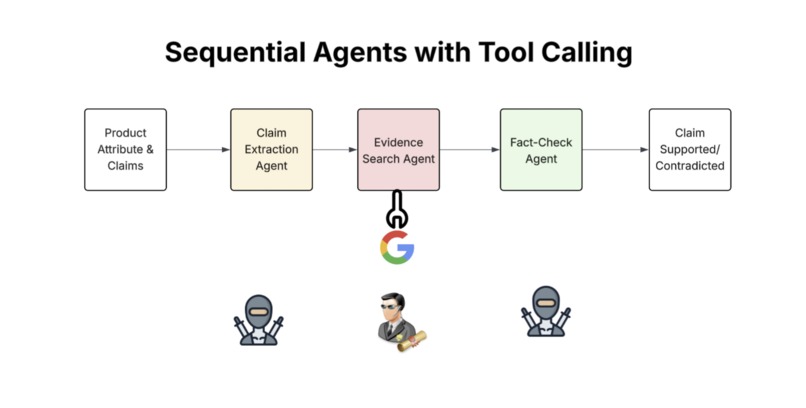
Sequential Agents with Tool Calling
-

FakeNewsOff - AI-Powered Misinformation
-
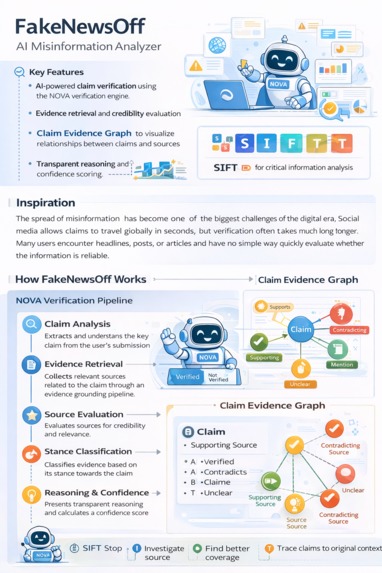
How FakeNewsOff Works
-
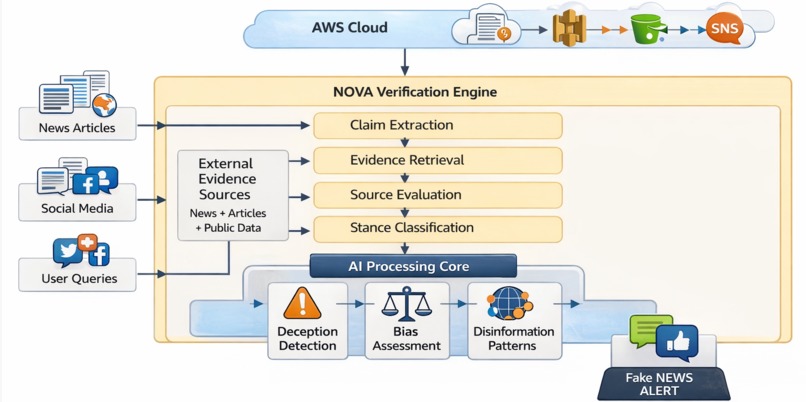
Building an Explainable AI Misinformation Analizer with Amazon Nova and Serverless aws AWS Architecture

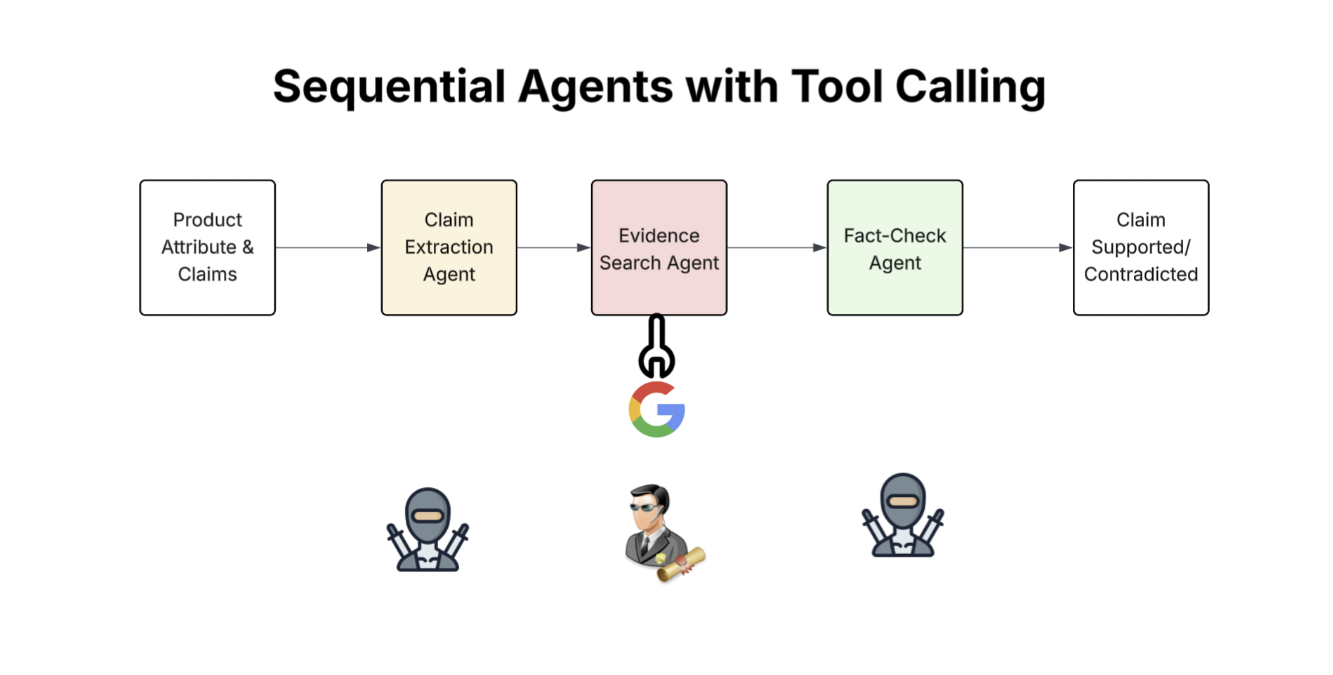


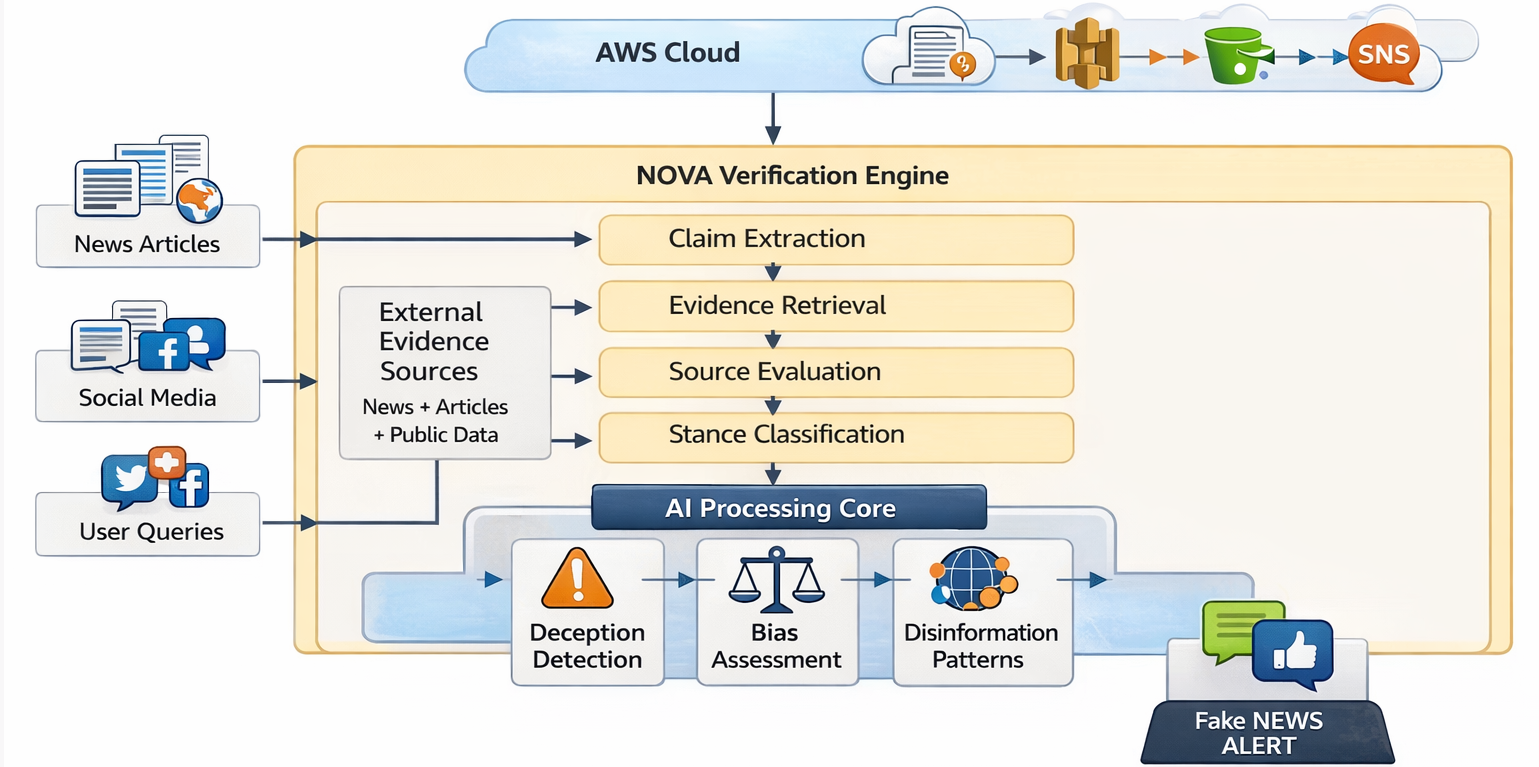
FakeNewsOff – AI Misinformation Analyzer
FakeNewsOff is an AI-powered platform that helps people analyze information and verify claims using evidence-based reasoning, adaptive retrieval, and transparent AI analysis.
At the core of the platform is NOVA, an intelligent verification engine that investigates claims, retrieves supporting evidence, evaluates source credibility, and produces explainable conclusions grounded in real-world information.
Instead of simply labeling information as true or false, FakeNewsOff allows users to:
inspect the evidence behind each conclusion
visualize how sources relate to a claim
understand how the AI reached its result
By combining AI reasoning, adaptive evidence retrieval, provider fallback orchestration, visual evidence mapping, explainable AI traces, and media literacy guidance, FakeNewsOff helps users make better decisions in an increasingly complex information environment.
Inspiration
The spread of misinformation has become one of the defining challenges of the digital era.
Claims can travel globally in seconds through social media, messaging platforms, and online publications, while verification often requires searching across multiple sources, evaluating credibility, and understanding context.
Many people encounter headlines, viral posts, or breaking developments every day without having simple tools to determine whether the information is reliable.
Existing solutions often provide basic labels or opaque AI classifications without showing how the conclusion was reached.
FakeNewsOff was created to address this problem by building a system that helps users investigate claims through transparent AI-assisted reasoning grounded in real evidence.
At the center of the platform is NOVA, an AI verification engine designed to:
investigate claims
retrieve evidence
evaluate credibility
produce transparent conclusions
Instead of asking users to blindly trust an AI verdict, FakeNewsOff allows them to see the evidence, inspect the process, and understand the reasoning path behind the analysis.
What It Does
FakeNewsOff allows users to submit a claim, headline, article, or piece of text they want to verify.
The NOVA verification engine processes the input through a structured verification pipeline designed to reveal the relationship between the claim and the available evidence.
Claim Understanding
The system identifies and normalizes the central factual claim that requires verification.
To improve robustness, FakeNewsOff includes typo-tolerant normalization so the platform can recognize variations in entity names and spelling.
Example:
Ronald Regan → Ronald Reagan
This improves evidence retrieval even when users submit imperfect queries.
Intelligent Multi-Query Retrieval
FakeNewsOff uses multi-query evidence retrieval to expand a claim into multiple meaningful searches instead of relying on a single query.
For example, a claim like:
Russia Ukraine war latest news
can generate variants such as:
Russia Ukraine war latest news
Russia Ukraine war
Russia Ukraine war fact check
Russia Ukraine war evidence
Russia Ukraine war verification
Russia Ukraine Reuters BBC AP
This dramatically improves evidence recall and resilience across providers.
Adaptive Provider Retrieval Chain
To support real-world reliability, FakeNewsOff uses a staged evidence provider architecture.
Evidence providers include:
Mediastack
GDELT
Serper.dev
The pipeline performs:
provider querying
normalization
deduplication
ranking
response packaging
frontend visualization
This architecture ensures the system continues investigating a claim even if a provider fails or returns limited coverage.
Resilient Retrieval Architecture
External information providers can throttle, fail, or temporarily return incomplete results.
FakeNewsOff addresses this through a resilient retrieval architecture that includes:
provider fallback orchestration
provider cooldown logic
short-term evidence caching
graceful degraded mode
transparent provider diagnostics
This allows the platform to remain operational even when external services are unstable.
Source Credibility Evaluation
Retrieved sources are evaluated using multiple signals:
domain credibility
contextual relevance
cross-source agreement
recency
The ranking system also includes domain diversity controls that prevent the results from being dominated by a single website.
Evidence Stance Classification
Each source is analyzed to determine its relationship to the claim:
supports the claim
contradicts the claim
mentions the claim
unclear relationship
This allows users to understand how sources align with the statement, not just whether sources exist.
NOVA-Based Evidence Filtering
FakeNewsOff uses Amazon NOVA models through Amazon Bedrock to filter and evaluate evidence relevance.
The evidence filter attempts NOVA-based scoring first.
If model filtering becomes unavailable or fails, the system automatically switches to pass-through mode, preserving usable evidence instead of discarding it.
This evidence preservation architecture ensures that:
retrieved evidence is never silently lost
the system continues operating during model failures
the evidence graph remains renderable
This design makes the platform production-safe and resilient.
AI Reasoning and Confidence Score
After evidence collection, NOVA synthesizes the available information and produces:
a conclusion
a confidence score
Confidence reflects factors such as:
evidence availability
source credibility
agreement across sources
completeness of retrieved coverage
Instead of rigid binary labels, the system communicates how strongly the available evidence supports the conclusion.
Claim Evidence Graph
FakeNewsOff includes a Claim Evidence Graph, a visual map showing how sources relate to the claim.
The graph allows users to see:
supporting evidence
contradicting evidence
contextual reporting
diversity of sources
This makes complex information landscapes easier to interpret.
Explainable AI Trace
Transparency is a core principle of FakeNewsOff.
The platform exposes an Explainable AI Trace showing each stage of the analysis pipeline:
claim framing
query generation
evidence retrieval
evidence filtering
credibility assessment
stance classification
verdict generation
response packaging
Each stage includes status and timing metadata so users can understand how the analysis was performed.
Critical Thinking Guidance
FakeNewsOff integrates the SIFT framework, a well-known media literacy method:
Stop
Investigate the source
Find better coverage
Trace claims to the original context
This encourages users to actively evaluate information instead of passively consuming it.
How We Built It
FakeNewsOff was designed as a cloud-native AI verification platform with a modular architecture.
Backend
The backend includes:
AWS Lambda for serverless claim analysis
Amazon API Gateway for request handling
multi-query evidence retrieval
staged provider orchestration
Mediastack integration
GDELT integration
Serper.dev fallback integration
evidence caching and cooldown logic
ranking and domain diversity controls
Amazon Bedrock integration using Amazon NOVA models
structured JSON outputs for explainable responses
This architecture is resilient, scalable, and production-oriented.
Frontend
The frontend was built using:
React
Vite
Claim Evidence Graph visualization
Explainable AI Trace panel
interactive exploration of retrieved sources
SIFT critical thinking guidance
The goal was to make misinformation analysis visual, transparent, and accessible.
Why the Architecture of FakeNewsOff Is Unique
FakeNewsOff was designed not simply as a claim-checking tool, but as a resilient AI verification architecture capable of operating reliably in real-world information environments.
Most misinformation detection systems rely on single-model classification pipelines that take an input and produce a verdict. While these systems can work in controlled environments, they often fail when:
external information sources are unavailable
APIs throttle or return incomplete coverage
AI models reject evidence due to strict filtering
retrieval pipelines collapse when one stage fails
FakeNewsOff approaches the problem differently.
Instead of relying on a single AI decision, the system implements a multi-stage evidence investigation architecture designed to preserve information flow and remain operational under uncertainty.
Evidence-First Verification Pipeline
The platform follows an evidence-first verification strategy.
Rather than immediately asking an AI model to judge a claim, FakeNewsOff first gathers a diverse set of sources and builds a structured evidence set.
The pipeline includes:
Claim understanding Multi-query expansion Multi-provider evidence retrieval Source normalization and deduplication Credibility evaluation Evidence stance classification AI synthesis and verdict generation
This design ensures that the AI reasoning stage operates on top of real evidence rather than speculation.
Adaptive Multi-Provider Retrieval
A key innovation in FakeNewsOff is its adaptive retrieval architecture.
Instead of depending on a single information provider, the system orchestrates multiple sources:
Mediastack GDELT Serper.dev
If one provider fails, the system automatically falls back to the next provider in the chain.
Additional safeguards include:
provider cooldown logic query diversification evidence normalization domain diversity controls
This makes FakeNewsOff significantly more resilient than systems that rely on a single data source.
Evidence Preservation Architecture
A critical design principle of FakeNewsOff is evidence preservation.
During development we discovered that some AI filtering steps could accidentally remove all retrieved evidence when a model failed or returned overly strict filtering decisions.
To solve this, we introduced an Evidence Preservation Invariant:
If evidence is successfully retrieved, it must never disappear later in the pipeline.
The system therefore includes:
pass-through fallback when AI filtering fails neutral scoring fallback for filtered evidence degraded state flags for transparency pipeline invariants that enforce evidence preservation
This ensures that retrieved evidence remains visible to users even if downstream AI components partially fail.
Explainable AI by Design
FakeNewsOff was built with transparency as a primary goal.
Instead of hiding the reasoning process inside a single AI output, the platform exposes a structured analysis pipeline through the Explainable AI Trace.
This trace shows each stage of the verification process:
claim interpretation query generation provider retrieval evidence filtering credibility evaluation stance classification verdict synthesis
Users can inspect how the AI reached its conclusion rather than being asked to blindly trust the result.
Visual Evidence Mapping
To make complex information landscapes easier to understand, FakeNewsOff includes a Claim Evidence Graph.
This visual system allows users to quickly identify:
which sources support a claim which sources contradict it which sources provide context
Instead of reading a list of articles, users can see how the information ecosystem around a claim is structured.
Production-Resilient AI Design
FakeNewsOff was engineered to behave like a production-grade system rather than a prototype.
The architecture includes:
serverless cloud infrastructure provider fallback orchestration graceful degraded mode evidence preservation safeguards diagnostic logging across the pipeline
These features ensure that the platform remains operational even when external dependencies fail.
A Platform for Investigating Information
Ultimately, FakeNewsOff is designed not just to label claims, but to help people investigate information intelligently.
By combining:
AI reasoning adaptive retrieval evidence visualization transparency media literacy guidance
the platform encourages a new approach to information analysis — one where users can explore evidence, understand context, and make informed decisions.
Challenges We Ran Into
One of the biggest challenges was ensuring the system remained explainable rather than becoming a black-box classifier.
Many misinformation tools provide a verdict without showing evidence or reasoning.
FakeNewsOff was designed to expose the entire analysis pipeline.
Another major challenge involved building a reliable evidence retrieval system despite provider failures.
We solved this through:
multi-query retrieval
staged provider fallback
provider diagnostics
caching
domain diversity ranking
evidence preservation safeguards
We also discovered that model-specific filtering dependencies could cause evidence to disappear. This led us to redesign the filtering stage with NOVA-based scoring plus pass-through fallback, ensuring evidence is never silently lost.
Accomplishments That We're Proud Of
Designing NOVA as a transparent AI verification engine
Building a full end-to-end misinformation analysis platform
Implementing multi-query retrieval for stronger evidence coverage
Creating a resilient provider orchestration system
Building a Claim Evidence Graph for visual explanation
Implementing an Explainable AI Trace pipeline
Adding provider diagnostics and graceful degraded mode
Replacing model-specific dependencies with resilient NOVA filtering
Deploying the system with a serverless cloud architecture
What We Learned
Misinformation analysis is not only a technical problem — it is also a trust and usability problem.
People need:
transparency
inspectable evidence
understandable reasoning
Combining:
AI reasoning
structured evidence retrieval
resilient provider orchestration
visual explanation
media literacy guidance
creates a much stronger verification experience.
We also learned that production-grade reliability is as important as model intelligence.
A system that depends on external providers must be designed to gracefully survive failures.
Why FakeNewsOff Matters – Real-World Impact
In modern society, nearly every major decision depends on information.
People make decisions about:
elections
public health
financial markets
international conflicts
humanitarian response
public safety
But information spreads faster than it can be verified.
False or misleading claims can influence public opinion, distort financial decisions, and create confusion during crises.
FakeNewsOff addresses this by combining:
transparent AI reasoning
adaptive multi-query retrieval
credibility evaluation
evidence diversity controls
explainable traces
real evidence inspection
The platform encourages a shift from passive information consumption to active verification.
How FakeNewsOff Could Help During Elections, Wars, and Global Crises
During elections, misleading claims about candidates, procedures, or results can spread quickly across social media. FakeNewsOff helps users retrieve credible reporting and understand how sources relate to the claim.
During wars or geopolitical conflicts, misinformation often becomes part of information warfare. FakeNewsOff helps distinguish between verified reporting, conflicting narratives, and unsupported claims.
During public health emergencies, misinformation about treatments or risks can cause real harm. FakeNewsOff surfaces relevant evidence and explains how conclusions are formed.
During disasters or humanitarian crises, rumors can spread quickly. Evidence retrieval and source mapping help users identify trustworthy information faster.
FakeNewsOff does not replace human judgment.
It strengthens it.
What’s Next for FakeNewsOff
Future development will focus on expanding both capability and real-world impact.
Planned improvements include:
additional evidence providers
stronger historical claim retrieval
browser extension for real-time verification
richer evidence graph interaction
improved credibility signals
multilingual support
deeper source provenance analysis
continuous claim monitoring
The long-term vision is to build tools that help people verify information before believing or sharing it, contributing to a healthier global information ecosystem.
Built With
- ai-reasoning
- amazon-api-gateway
- amazon-nova
- aws-lambda
- claim-evidence-graph-visualization
- cloud-computing
- css3
- evidence-grounding-pipeline
- explainable-ai
- gdelt
- html5
- javascript
- json
- mediastack
- node.js
- react
- rest-api
- serper.dev
- serverless-architecture
- sift-framework
- typescript
- vite

Log in or sign up for Devpost to join the conversation.