-
-
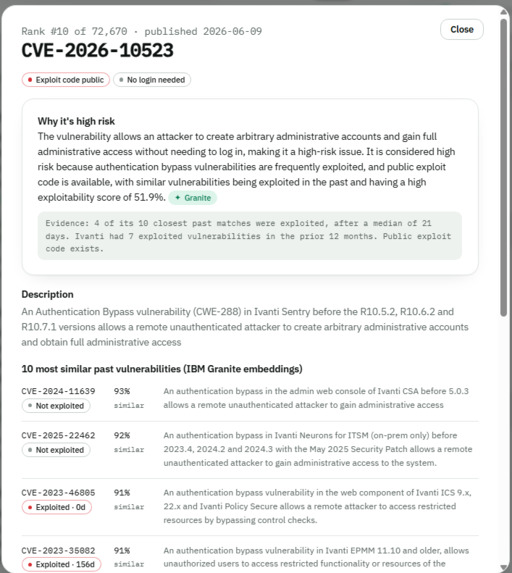
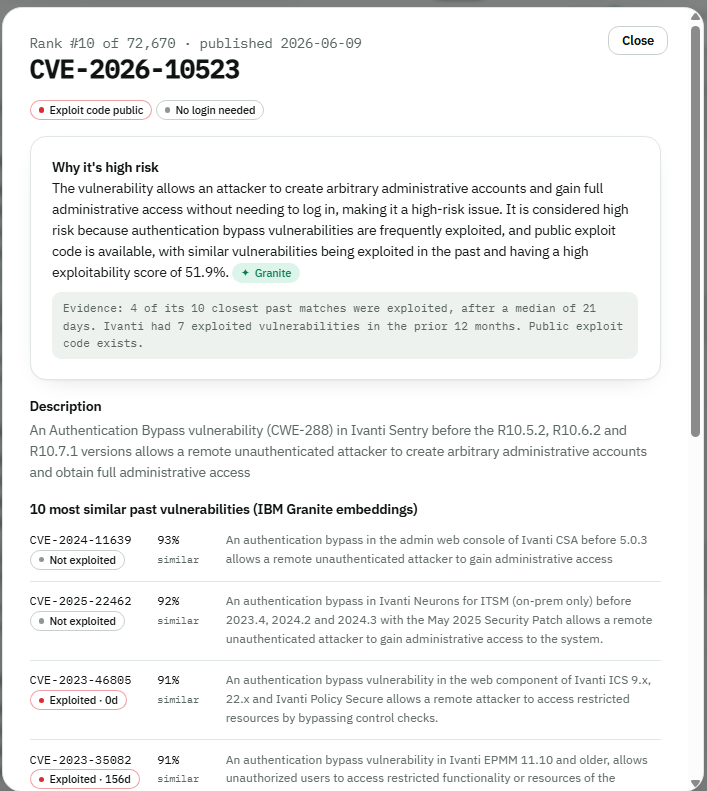
CVE popup, with 10 most similar past flaws
-
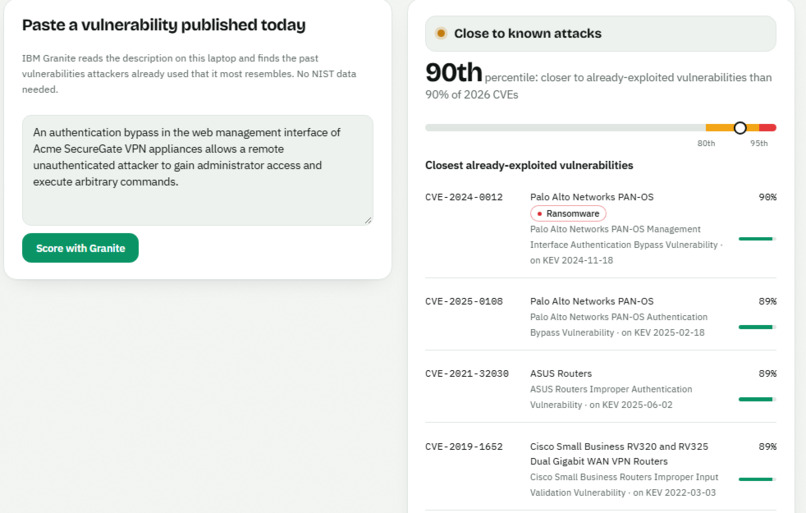
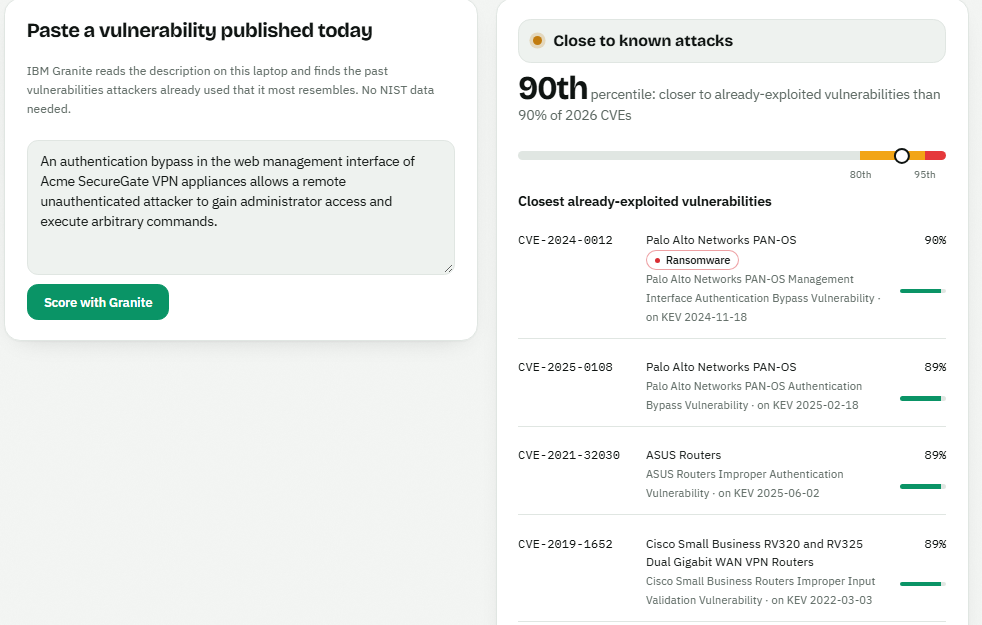
Score a new CVE, relate to past CVEs
Inspiration
We went into this track not knowing much about cybersecurity, and one stat stuck with us: over 92,000 security flaws were published in 2026 alone, and NIST (the US agency that reviews them) hasn't gotten to more than half. A lot of security tools lean on NIST's scores, so a flaw NIST hasn't reviewed yet can sit near the bottom of their lists. Hackers obviously don't care about that.
We kept thinking about who that hurts the most: the IT person at a school or a hospital who has to figure out what to patch this week, with no security team behind them. So we asked: can we tell them what's actually dangerous on day one, starting with just the description that every flaw comes with?
What it does
Blindspot ranks new security flaws by how likely hackers are to actually use them, and tells you why in plain English.
- You type in the software you use (Fortinet, Ivanti, Microsoft Exchange), pick how many fixes you can handle a week, and it gives you your to-do list for the week, most urgent first.
- The top 100 picks comes with a reason, like "4 of the 10 most similar past flaws got attacked, a median of 3 weeks after they came out."
- You can paste in a brand-new flaw description and it shows you which real past attacks it looks like, live.
- There's also a ranked list of all 72,670 flaws from 2026 that you can search or download.
One thing we thought was pretty surprising: every one of the 75 flaws attacked in our 2024–25 test years has a NIST review today, while 15–35% of all flaws from those years still don't. NIST reviews attacked flaws first, so its review tends to come after the attack, not before.
How we built it
We used IBM Granite for the AI part:
- Granite Embedding read every flaw description since 2015 (330k+ of them). For any flaw, we could then find the most similar older ones and check how many got hacked. This ended up being one of the strongest signals in our whole model.
- Granite 4.0 Micro writes the plain-English explanations from the evidence we give it.
On top of that, we built a prediction model in Python that also looks at things like "has this company been hacked a lot before?" and "is there public hacking code for this already?" We trained it on 2022–2025, where we already know which flaws got attacked.
To make sure we weren't fooling ourselves, we tested on past years. We pretended it was 2024 (then 2025), trained Blindspot only on the years before, and had each method pick its top 500 out of that year's ~30,000 new flaws. Here's how many of the flaws that really got attacked each method caught (higher is better):
| How the flaws were ranked | Replaying 2024 | Replaying 2025 |
|---|---|---|
| Most severe first (what most people do) | 0 of 27 | 5 of 48 |
| Industry "attack likelihood" score | 4 of 27 | 8 of 48 |
| Public hacking code first | 8 of 27 | 17 of 48 |
| Blindspot | 8 of 27 | 21 of 48 |
| Blindspot, day-one info only | 8 of 27 | 14 of 48 |
The website is a Flask backend with a plain HTML/JS frontend, so it runs on any of our laptops.
Our 2026 top 500 is submitted, and our README lists every data column we used and left out.
Challenges we ran into
- Getting Granite to run. We signed up for IBM watsonx, but our region didn't have the Granite chat model. So we ended up running it on one of our gaming PCs instead, squished down to fit on a 6 GB graphics card.
- Not much to learn from. In each year we tested, only 22 to 48 flaws ended up on the official "attacked" list, so we had to be careful not to get excited about results that were just luck.
- Our laptops don't have GPUs. We did all the heavy lifting on a PC and packed the results into a small file so the demo runs on regular laptops.
Accomplishments that we're proud of
- Matching or beating the standard approaches on past years (a tie in 2024, 21 vs 17 in 2025)
- Flagging attacked flaws a median of 30 days before the official alert.
- If NIST had worked through 2025 in our day-one order, about half the attacked flaws would have come up in the first 5% of its queue, versus 29% going by severity.
- Catching how much the NIST data leaks and turning it into one of our findings: using those columns would have inflated our results by a third.
- Explanations that actually show the evidence instead of just spitting out a number.
- Getting IBM Granite to run fully on our own machines.
What we learned
- "Most severe" and "most likely to get hacked" aren't the same thing. Ranking by severity caught literally zero real attacks in 2024's top 500.
- A two-sentence description says a lot about a flaw if you have an AI that can actually read it.
- With this kind of data, when you knew something matters just as much as what you knew. A lot of our time went into making sure the model never saw the future.
- An honest result is worth more than a flashy one.
What's next for Blindspot
- Score every flaw the day it comes out and send an alert when one hits software you use.
- Let teams import their real software list instead of typing it in.
- Turn it into something existing security tools could plug into as an early warning.
Built With
- css3
- flask
- html5
- hugging-face
- ibm-granite
- javascript
- python


