Inspiration
In the digital era, misinformation spreads faster than ever. Fake news can cause panic, harm reputations, and even influence public opinion. I wanted to create a quick, reliable, and accessible tool to detect potential misinformation — something both journalists and the general public could use instantl
What it does
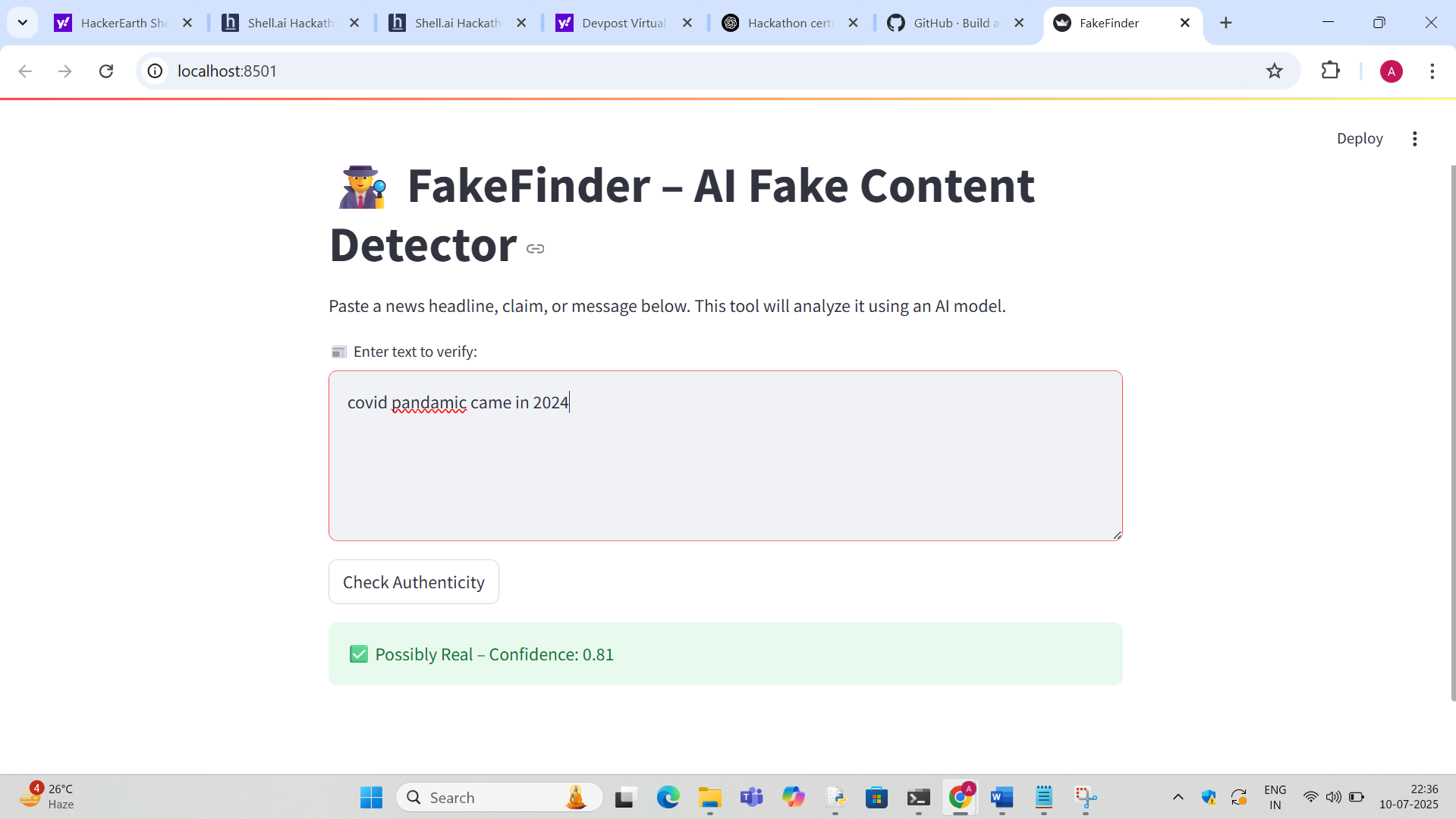
FakeFinder is a lightweight web application that detects the likelihood of a statement or article being fake using Natural Language Processing (NLP) and Zero-Shot Classification. -Users paste any text or news snippet. -The system analyzes its context and predicts whether it’s real, fake, or needs verification. -Results are instant and include a confidence score.
How we built it
-Frontend: Streamlit for a fast, interactive interface. -Backend: HuggingFace Transformers with pre-trained BERT/BART models for Zero-Shot Classification. -Data Processing: Tokenization, stopword removal, and lemmatization for cleaner input. -Deployment: Hosted via Streamlit Cloud for easy public access.
Challenges we ran into
-Reducing model inference time for real-time predictions. -Handling ambiguous statements where even humans can’t agree. -Balancing accuracy with accessibility for non-technical users.
Accomplishments that we're proud of
-Built a functional MVP in under 48 hours during Hackfinity. -Successfully integrated HuggingFace models into a user-friendly web app. -Received positive feedback from testers on UI simplicity and speed.
What we learned
-Fine-tuning large language models for specific tasks. -Deploying ML models to production-ready web apps quickly. -The importance of UX in making AI tools approachable.
What's next for FakeFinder
-Support for multiple languages. -Fact-check API integration for live verification. -Browser extension for instant news checks while browsing.

Log in or sign up for Devpost to join the conversation.