
Inspiration
In today’s fast scrolling world, misinformation spreads faster than facts, especially through social media and messaging platforms. We observed how easily fake news creates panic, confusion, and division. Many people forward information without verifying it. This inspired us to build a simple tool that encourages users to pause, verify, and share responsibly.
What it does
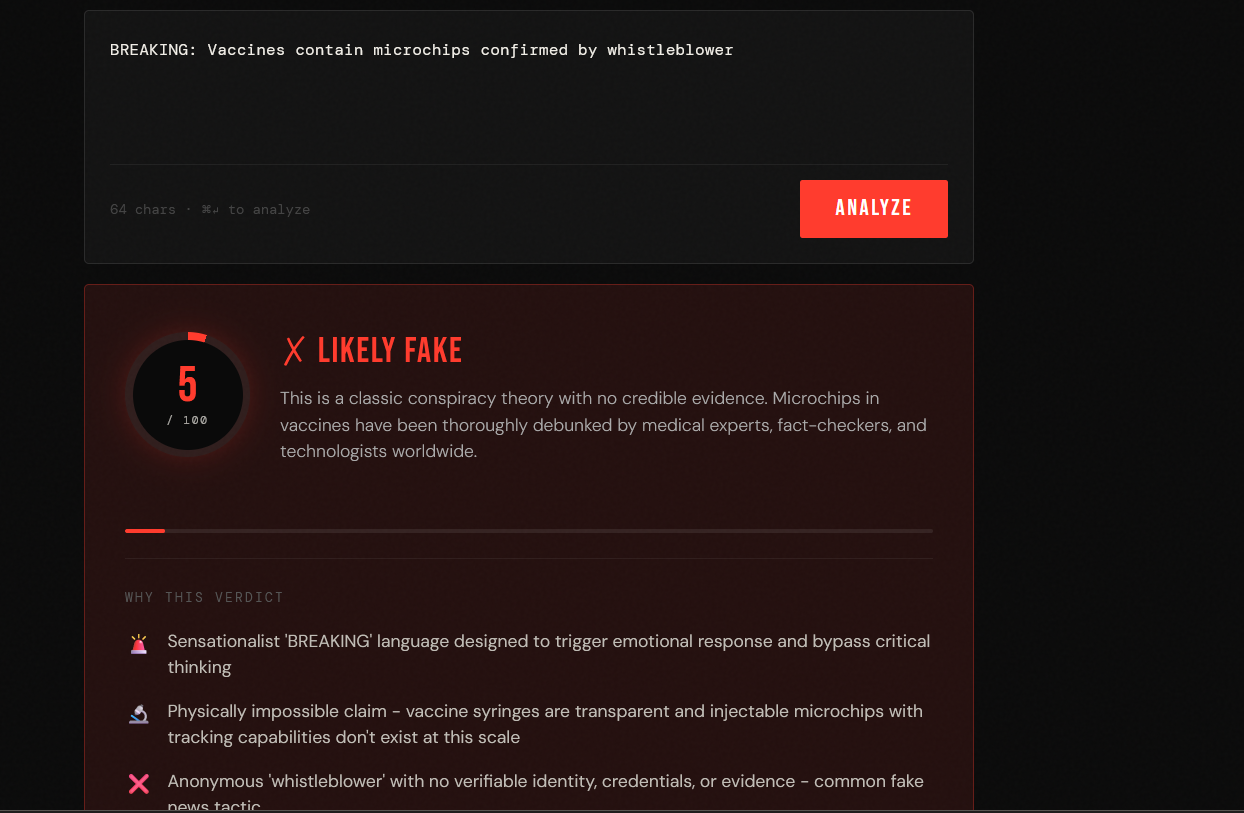
Fake News Detector analyzes news articles, headlines, or social media messages and provides:
A credibility score
A fake or real likelihood classification
Key explanations showing why the content may be misleading
The goal is not only detection but also awareness and responsible digital behavior.
How we built it
We built the project using:
Frontend: React for a clean and interactive user interface
Backend: Node.js with Express
AI and NLP: A natural language processing model to analyze writing patterns, sentiment, and suspicious keywords
Dataset: A labeled dataset of real and fake news articles for training and testing
The model processes the input text, extracts features, runs classification, and returns a confidence score to the frontend in real time.
Challenges we ran into
Finding a reliable and balanced dataset
Reducing false positives where real news was flagged incorrectly
Making the explanations understandable instead of too technical
Optimizing performance to ensure fast response time during live demo
Accomplishments that we're proud of
Successfully building a working end to end pipeline within hackathon time limits
Achieving consistent and reasonable prediction accuracy
Creating a clean and user friendly interface
Adding explainability instead of giving only a binary result
What we learned
The importance of clean and balanced data in machine learning
How small biases in training data can affect predictions
The value of explainable AI in building user trust
Effective teamwork and time management under pressure
What's next for Fake news detector
Adding URL based analysis instead of only text input
Integrating browser extension support
Expanding language support beyond English
Improving accuracy using advanced transformer models
Partnering with educational institutions to promote digital literacy

Log in or sign up for Devpost to join the conversation.