Fake News Detector Project
Inspiration
The inspiration behind the Fake News Detector project stemmed from the growing concern surrounding misinformation and its impact on society. With the rise of social media and online news platforms, distinguishing between credible and fake news has become increasingly challenging. Recognizing the need for a tool to help users identify potentially false information, I decided to embark on the journey of creating a Fake News Detector.
What I Learned
Throughout the development of the project, I gained valuable insights into natural language processing (NLP) techniques, machine learning, and data preprocessing. Understanding how to analyze and extract features from textual data, as well as the importance of model evaluation metrics, were key learnings in this process.
How I Built the Project
- Data Collection: I gathered a diverse dataset containing both real and fake news articles. The dataset was crucial for training and evaluating the model.
- Data Preprocessing: Cleaning and preprocessing the textual data involved tasks such as tokenization, removing stop words, and handling missing values. This step aimed to ensure the quality of the input data for the machine learning model.
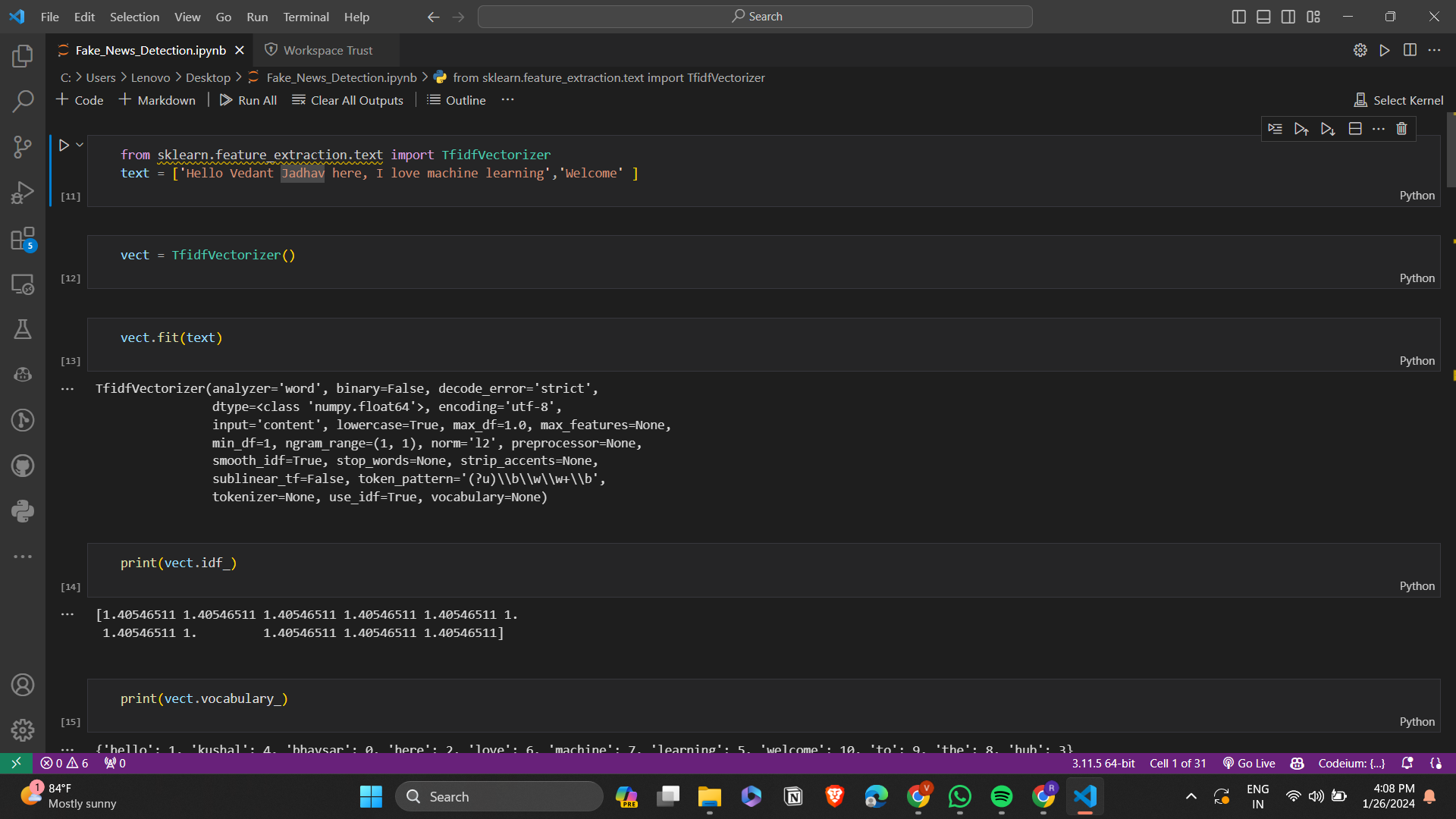
- Feature Extraction: I employed techniques like TF-IDF (Term Frequency-Inverse Document Frequency) to convert the text data into numerical features that could be used for training the model.
- Model Selection: After experimenting with various machine learning algorithms, I chose a suitable model for the task. Common choices include logistic regression, support vector machines, or more advanced models like neural networks.
- Training the Model: Using the labeled dataset, I trained the selected model. This involved feeding the preprocessed data into the model and adjusting parameters to optimize performance.
- Evaluation: To assess the model's effectiveness, I used metrics such as accuracy, precision, recall, and F1 score. Cross-validation techniques were employed to ensure the model's robustness.
- Integration: Once satisfied with the model's performance, I integrated it into a user-friendly interface. This interface allowed users to input a news article, and the system would provide a prediction regarding its authenticity.
Challenges Faced
- Imbalanced Dataset: Balancing the dataset, which often contains more real news samples than fake ones, posed a challenge. Techniques such as oversampling the minority class or using specialized algorithms were employed to address this issue.
- Fine-tuning the Model: Achieving the right balance between overfitting and underfitting required iterative adjustments to the model's hyperparameters. This process was time-consuming but essential for optimal performance.
- User Interface Design: Creating an intuitive and accessible user interface presented its own set of challenges. It was crucial to ensure that the tool was user-friendly and could be utilized by individuals with varying levels of technical expertise.
In conclusion, the Fake News Detector project was a rewarding journey that enhanced my skills in machine learning, natural language processing, and user interface design. The experience underscored the importance of addressing misinformation in today's digital age and the role technology can play in promoting information accuracy.
Built With
- .csv
- jupyter
- machine-learning
- python

Log in or sign up for Devpost to join the conversation.