-
-

Newt: digital assistant and trainer for fake news detection
-
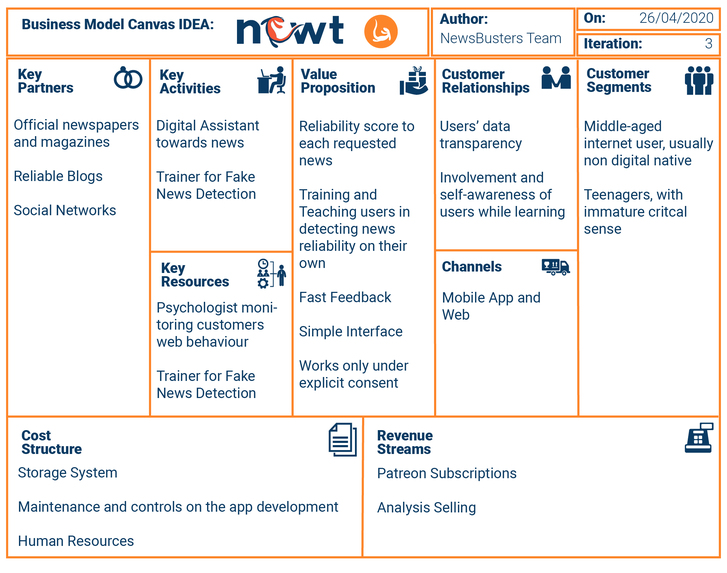
Business Model Canvas
-
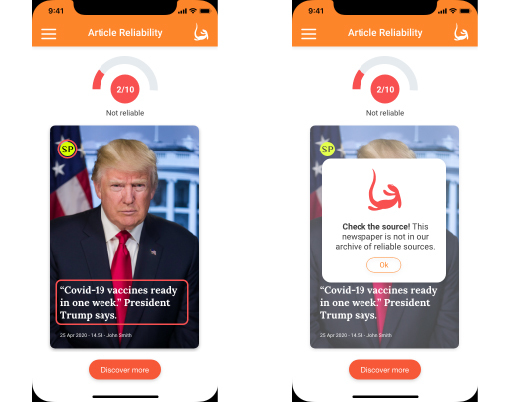
News ranking with tips
-
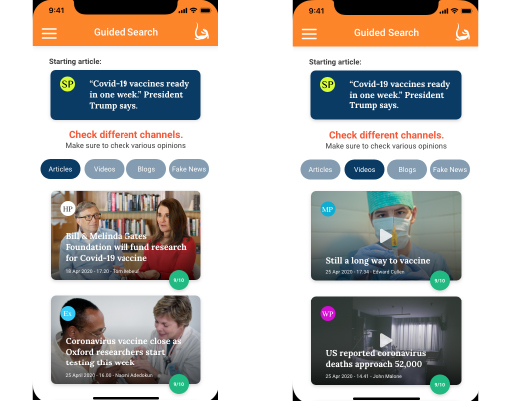
Automatic source comparison
-
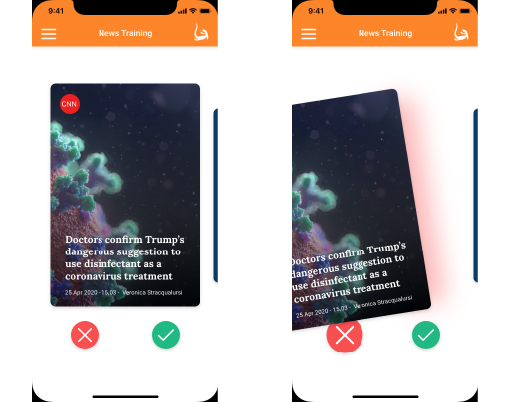
Training game
-
The Hacking Team

Inspiration
“Sleeping next to chopped onions will absorb the virus”, the expert says.
It took us less than 10 seconds to recognize that this is a fake. But we can’t always be there for you to tell you that.
Or can’t we?
Recently the attention to fake news is increasing and a lot of sophisticated algorithms and tools are used to detect and mitigate them. However, a large part of the population is not aware of these tools and still believes in unreal and unfounded news, especially in times of crisis when fear and irrationality lead to an increased fake news spreading.
Our project aims at assisting people in this difficult task, providing them with a simple and user friendly way to
train themselves in recognizing fake information and becoming more and more skilled in this task.
The solution: Newt
Newt is an app designed to be your digital assistant and trainer while surfing Facebook Home.
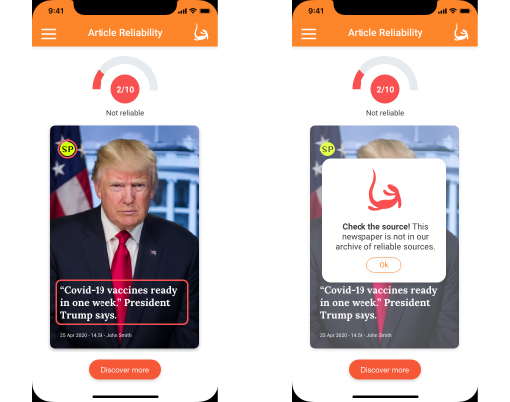
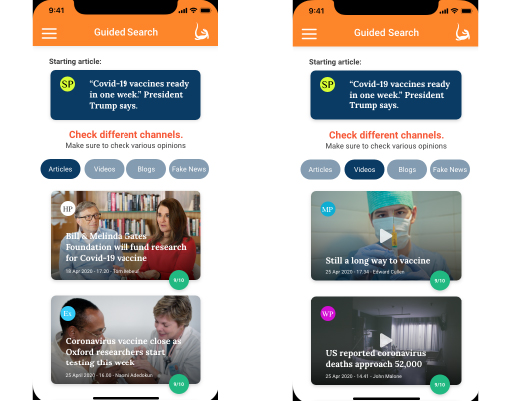
Share with it some suspicious news simply through Facebook sharing button. The app will tell you how reliable this content is and why, through some useful and practical tips. If you want to learn more on the topic, it will suggest you related articles, videos and blogs, easing your research.
Improve your detection skills with challenges suited for you, do your best and become fake-news-proof.
Feel safe: Newt works only under your consent.
What’s new in Newt?
There are many fact checking sites that heavily rely on human work to provide deep fake news analyses. On the other hand, there are highly scalable fake news recognition algorithms but they can sometimes provide numbers with no meaning.
Newt candidates itself to be a good balance between these two behaviours. Based on automatic news checking, it is able to process a larger number of news providing you with some reasons behind the classification process.
This is just the beginning of a much bigger training process for the user. They will be offered more certified communication channels on that topic. This will help the inexperienced users to perform research on the web. Also experienced users might benefit from the screening of the articles Newt provides.
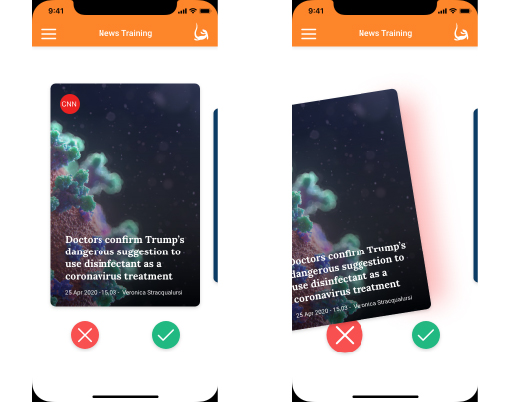
Such training also involves a sort of game. Here users can judge by themselves already classified news, having immediate feedback on the answers. They will also be asked to explain the reasons of their choice, letting us know what to improve in our training program. From the users’ point of view this is helpful because they are challenged in a controlled environment, where they can face fake news and quickly see whether they are true or not.
Through this game we would be able to collect data of improvements and weakness of users, which will help us understand whether the training process has been effective. They will eventually be ranked into levels and the game will induce them to perform deeper analysis on the news proposed.
Newt assistance can be helpful everyday, but it becomes particularly useful during times of crisis. Coronavirus has confirmed a lack of rationality in our behaviour. Indeed, fear can lead people to search for answers, even if not reliable.
Our app will help them stay with their feet on the ground and not let fear take over.
What’s behind Newt
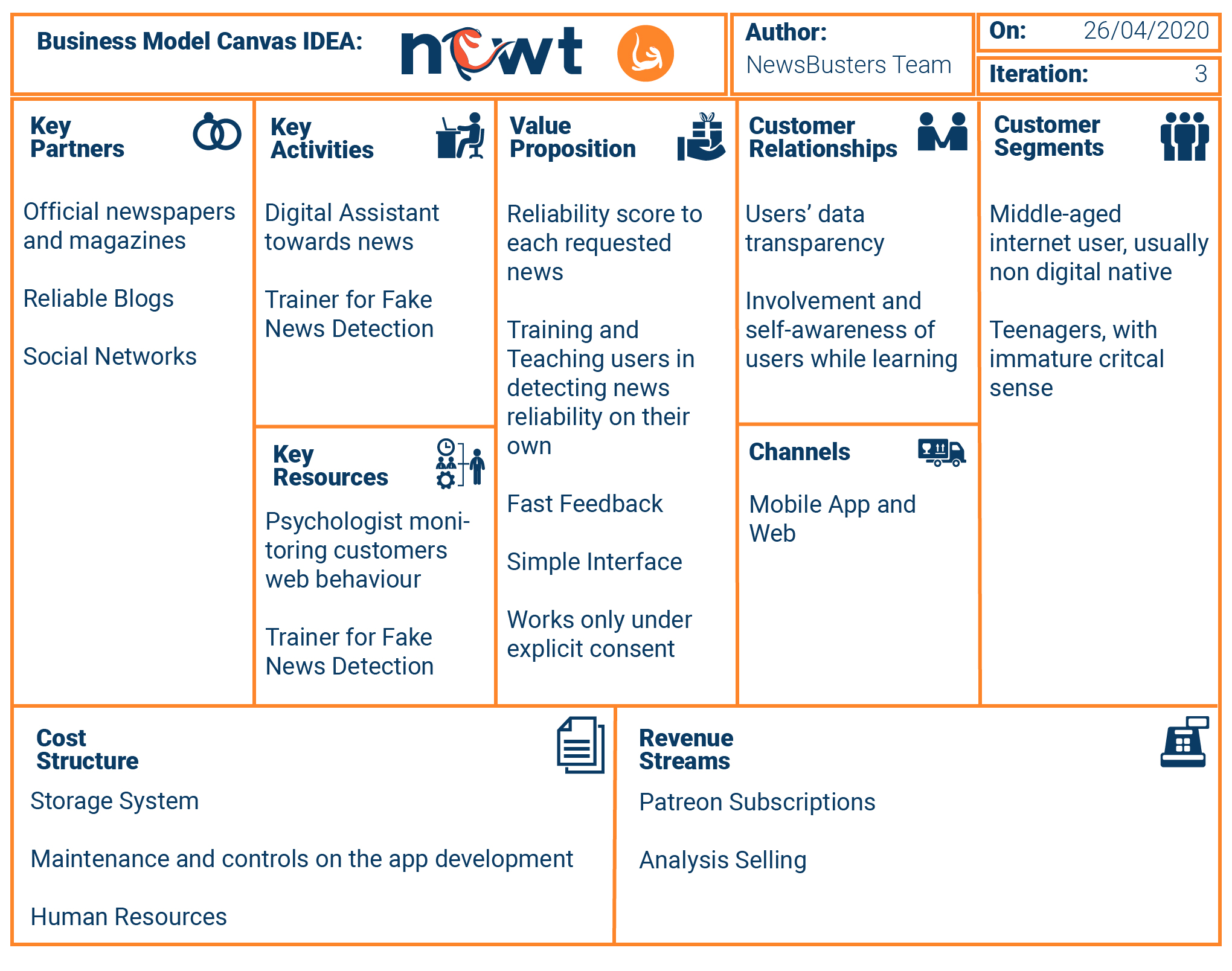
In this paragraph we will go into a more detailed and technical explanation about Newt. For what concerns the Business Model Canvas we propose, it can be found in the image gallery in our DevPost page.
Regarding the core of the app, the learning process algorithm is based on the evaluation of the reliability rate of the news. The features that will be used are listed below.
From the text content of the post, we will collect title, date and a brief description. Using topics classification, the keywords in the article will be detected. This will trigger the next phase, automatizing the search of related news. Along with that, further information will be collected, such as length, punctuation and global text structure.
Being it a post, it will come along with the interactions generated from the news. The algorithm will take into account the Facebook Reactions together with the comments of other users. These will be studied with a sentiment analysis. Furthermore, some of its sharing scheme will be considered to track whether the post has been shared by suspicious pages.
Particular attention will be devoted to the source of the news. In our prior knowledge, some official communication channels will be defined reliable. While performing several analyses, we will update the reliability rank of the sources for a better performance of the fake-news detection algorithm.
The aforementioned features will be used to build a training dataset for a fake news classification algorithm. To train this machine, we need to know a-priori the actual reliability of a given news. To do so, we will rely on already classified news available in fact checking websites. Once the algorithm is ready, we will be then capable of predicting fresh news, i.e. those given as input to Newt.
Our aim is to explain the reasons behind the classification, hence we display to the user the most relevant features in the decisional process. These will be the tips which will guide the users in the learning process.
This whole concept has been developed from scratch during this hackathon. We focused on studying the overall feasibility of the solution including data collection, safeguard of users’ privacy, algorithms for text and sentiment analysis. Without data, the definition and implementation of the algorithm would be premature and unrealistic. Based on literature and experience, so far we are in favour of SVM algorithms and Deep Learning techniques.
What’s next for Newt
Newt is a completely new and innovative tool and will need further developments. First of all it should be extended to deal with all types of links, not only Facebook posts. We also plan to tackle problems related to WhatsApp chains, with a copy-paste feature from text that the user can exploit. Furthermore, to try and make it more appealing to the public, we are thinking of implementing some sort of reward system in the game part of the app.
Built With
- adobe-xd





Log in or sign up for Devpost to join the conversation.