Inspiration
One day, while scrolling through social media, I came across a viral post that was later revealed to be completely false. It had already influenced thousands of people before being debunked. This incident made me realize how quickly misinformation spreads and inspired me to build a tool that can detect fake news efficiently and accurately.
What it does
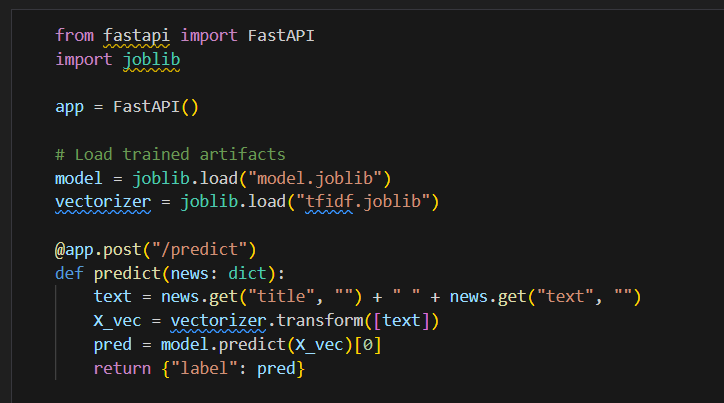
Our Fake News Detection tool uses Natural Language Processing (NLP) and a fine-tuned transformer model to classify news articles as real or fake. The system analyzes the textual content, checks linguistic patterns, and uses trained datasets to make predictions with high accuracy.
How we built it
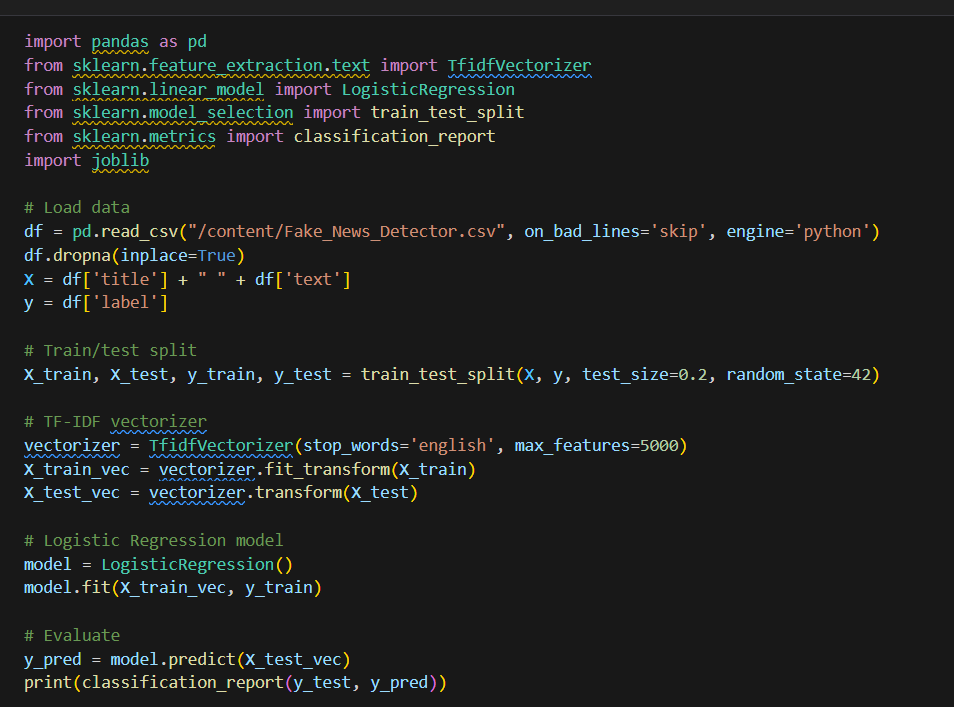
We built the project using Google Colab for model development and training, and GitHub for version control and collaboration. We preprocessed separate real and fake news datasets, tokenized the text, and fine-tuned a RoBERTa model for binary classification.
Challenges we ran into
Achieving higher accuracy while minimizing false positives and negatives Handling imbalanced datasets and cleaning noisy data Dealing with long training times on large datasets Ensuring the model generalizes well to real-world data
Accomplishments that we're proud of
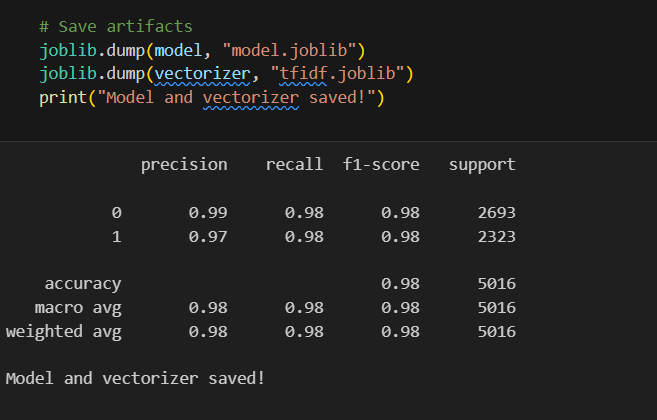
We successfully created a stable and efficient model capable of detecting fake news with impressive accuracy. Integrating everything smoothly and deploying our workflow through GitHub was also a proud moment.
What we learned
We learned how to handle large datasets, fine-tune NLP models, collaborate effectively using GitHub, and regularly update our model for better performance.
What's next for FAKE NEWS DETECTION
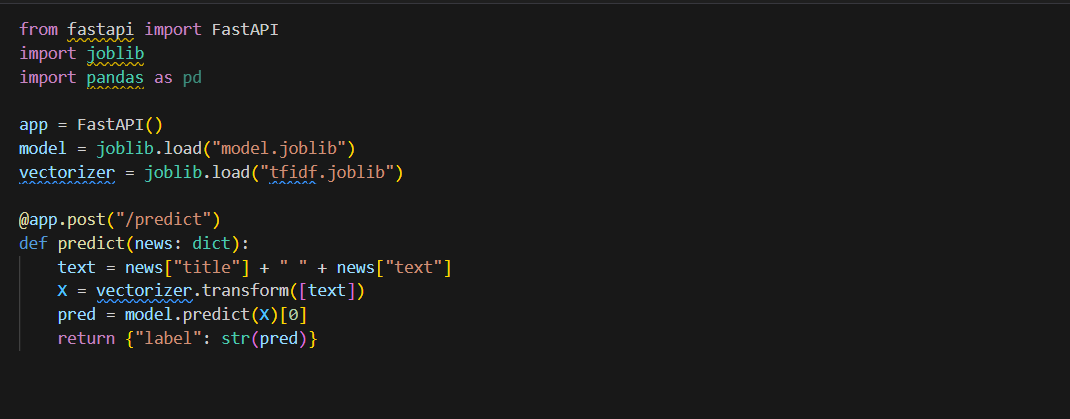
Integrate a browser extension that flags fake news in real time Develop a multilingual model to detect misinformation across languages Implement a fact-checking API that provides source verification Deploy the model as a web application accessible to the public
