-
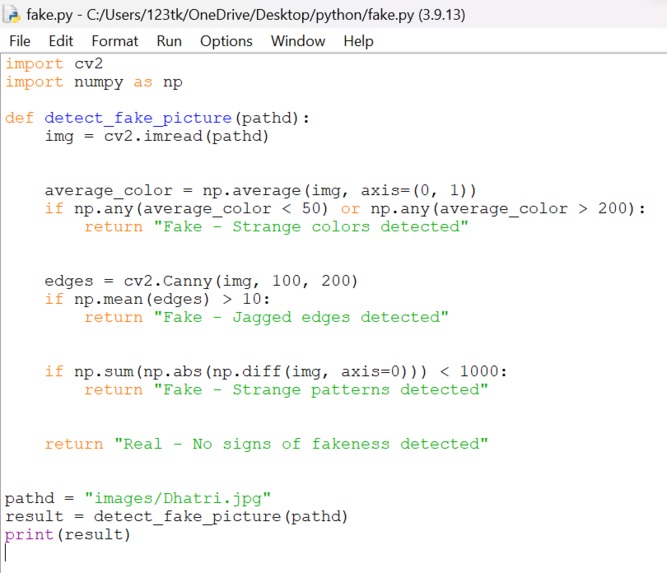
code
Inspiration
Recently, there have been numerous instances of phony images becoming viral on social media, and we've also observed that many individuals suffered greatly as a result of their phony images going viral online. Our inspiration and motivation for this endeavor came from this particular situation.
What it does
It determines whether an image is fraudulent or not when it is uploaded by taking these factors into consideration : colors of the image, edges of the image, patterns of the image.
How we built it
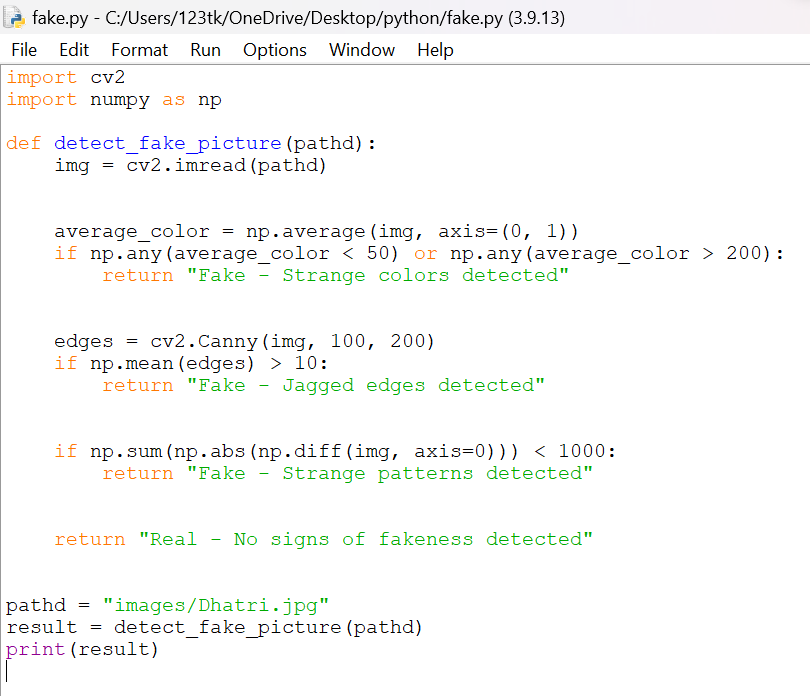
The included Python code introduces a method called detect_fake_picture, whose purpose is to examine pictures for indications of falsity. The function reads an image given by its path (pathd) by using the OpenCV library. Subsequently, it utilizes multiple image analysis methods to detect possible indications of altered or counterfeit photos. By determining the image's average color and looking for any channels with values outside of the range of 50 to 200, it first looks for the presence of unusual hues. The program then looks for jagged edges in the image using the Canny edge detection algorithm. There may be jagged edges present if the mean of the edges that were found is more than 10. The function also computes the sum of absolute differences along the vertical axis to look for odd patterns. In the event that this total is fewer than 1000, anomalous patterns may be present. Based on the recognized features, the function provides a suitable message, such as "Fake - Strange colors detected" or "Real - No signs of fakeness detected." The function is then applied to an example image, "Dhatri.jpg," via the given code, which then prints the analysis that is obtained.
Challenges we ran into
Implementing and using the provided image detection code for our project has posed several challenges that we'd like to discuss. First off, there may be a bit of confusion when determining which colors or patterns the algorithm deems to be "strange" due to the subjective nature of image analysis. It has been difficult to fine-tune the parameters for edge detection and other computations since it takes effort to achieve the ideal balance for various image types. Furthermore, the algorithm's efficiency may be limited due to its dependence on a restricted range of detection approaches, which may not account for sophisticated modification techniques. The project has become increasingly challenging due to problems with picture compressing artifacts, algorithm performance, and adaptability to different types of image material. Maintaining a balance between both sensitivity and specificity to reduce false positives is a continuous process. We are currently involved in ongoing testing, efficiency, and investigation of possible enhancements, including using machine learning methods, to strengthen the reliability and resilience of our image modification detection system in various situations and image kinds.
Accomplishments that we're proud of
As students participating in the hackathon, we've achieved several milestones that fill us with pride. Successfully completing our project within the tight timeframe speaks to our collective ability to set goals, manage time effectively, and deliver a functional solution. Our project's innovative approach to addressing a real-world problem showcases our creativity and problem-solving skills, providing a sense of accomplishment. Throughout the hackathon, we learned how to acquire and improve technical skills, mastering new programming languages, and gaining proficiency with various tools. The effective collaboration within our diverse team, comprised of individuals with different skills and backgrounds, highlights our teamwork and communication abilities. Overcoming unexpected challenges during the hackathon underscored our adaptability and collective problem-solving prowess. Actively engaging with the hackathon community and continuing to develop and learn beyond the event contribute to our ongoing journey of growth and accomplishment. In essence, the hackathon has been a collective venture that has enriched our skills, fostered teamwork, and provided a platform for shared achievements in the dynamic world of technology.
What we learned
As student participants in the hackathon, the experience was incredibly enriching and eye-opening for us. The workshops on Git Copilot and the GitHub Student Developer Kit provided practical insights into collaborative coding, equipping us with valuable resources for our ongoing projects. Engaging with fellow participants allowed us to make new friends and learn about diverse projects and innovative ideas. The hackathon was not just about coding challenges; it was a holistic journey into the tech industry, where we gained industry insights, explored new technologies, and discovered the importance of open collaboration. The exposure to real-world challenges, coupled with the supportive community, fostered our personal and professional growth. Overall, the hackathon was an invaluable opportunity for us to immerse ourselves in the dynamic world of technology.
What's next for Fake Image Detector
Fake video detector and fake profile detector. Additionally, we're working to create an attendance system that prevents fraud and proxy.

Log in or sign up for Devpost to join the conversation.