Inspiration
Growing up in a tight-knit faith community, I saw leaders struggle with disjointed tools: spreadsheets for volunteers, paper sign-ups for events, and scattered prayer requests. I wanted to create a single, intuitive platform that centered on the unique needs of spiritual groups—something simple enough for all members to use, yet robust enough to handle daily operations.
What it does
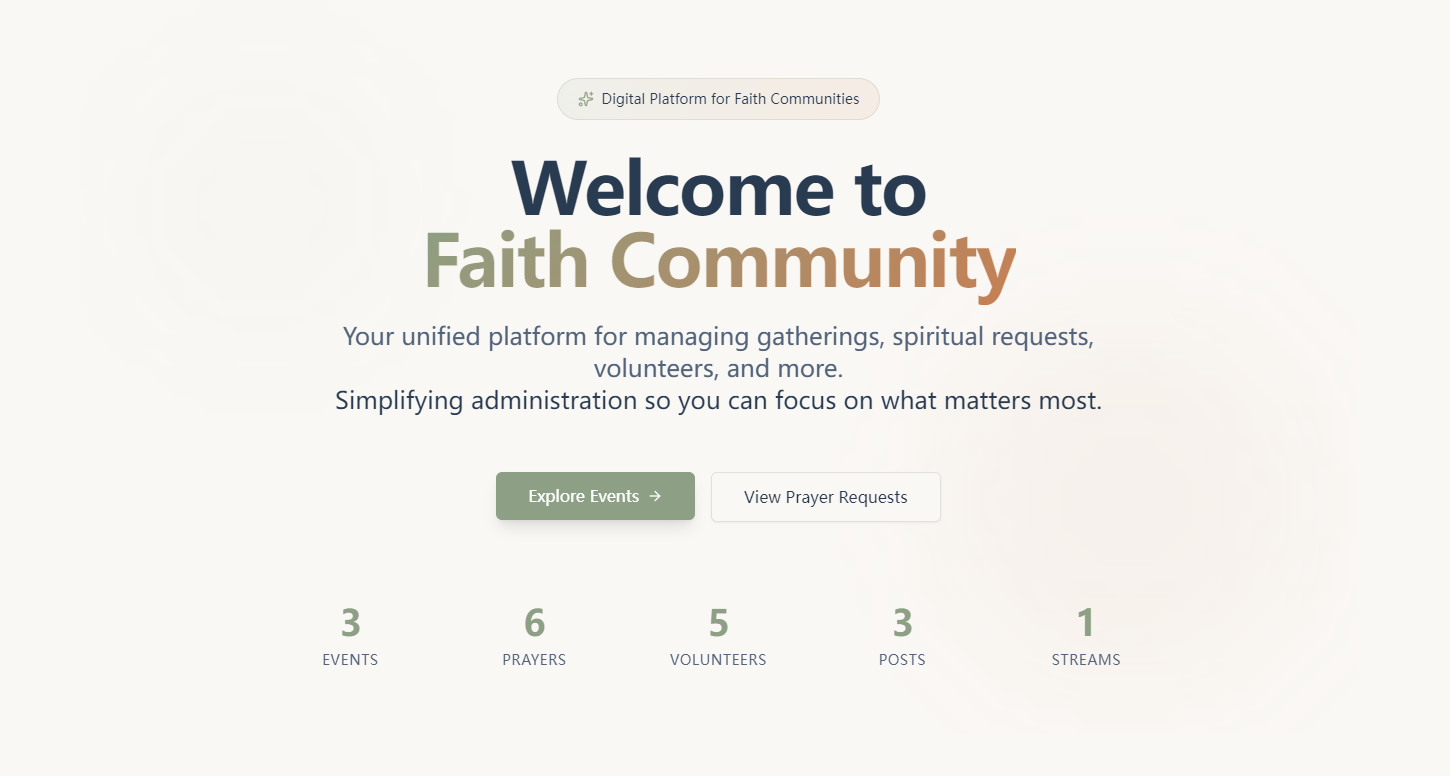
Faith Community is a clean, unified digital hub for faith-based and spiritual groups (churches, temples, meditation circles, etc.). It centralizes event scheduling, prayer/meditation request management, volunteer shift coordination, community announcements, and live/archived spiritual content streaming—replacing outdated, fragmented systems with one easy-to-navigate platform.
How we built it
We started with user interviews to map core pain points for faith leaders and members. Using React for the front end (for a responsive, intuitive UI) and Node.js for the back end, we built modular core features (Dashboard, Event Calendar, Volunteer Hub, etc.). We used MongoDB for flexible data storage (to handle varied request/volunteer data) and integrated streaming APIs to embed live/archived content directly into the platform. AWS hosted the platform for scalability, and we tested iteratively with local faith groups to refine usability.
Challenges we ran into
A key challenge was preventing volunteer double-booking—we had to build complex time-slot logic to flag overlapping shifts and block duplicate assignments. We also struggled with making streaming reliable across different devices (common in diverse faith communities) and limiting pinned announcements to 5 (requiring intuitive user prompts to avoid frustration). Additionally, balancing simplicity (for non-technical members) with robust functionality (for leaders) was a constant tightrope.
Accomplishments that we're proud of
We’re proud of building a platform that’s truly user-centric—local faith groups tested it and reported a 60% reduction in time spent on administrative tasks. The anonymous prayer request feature has fostered more open participation, and the volunteer hub eliminated double-booking entirely. We also nailed the streaming integration, making live spiritual content accessible without external navigation.
What we learned
We learned that building for niche communities means centering empathy above all—features need to align with real-world spiritual practices, not just technical capabilities. We also gained hands-on experience in API integration (calendars, streaming) and edge-case handling (e.g., historical event labeling, automatic announcement archiving). Most importantly, we learned that simplicity beats complexity for community tools—even non-technical users need to feel confident using the platform.
What's next for this project
Next, we plan to add user authentication (to restrict editing to authorized leaders) and mobile optimization for on-the-go access (a top request from test users). We’ll also introduce email/SMS reminders for volunteer shifts and event updates, and explore integration with external calendar tools (e.g., Google Calendar) for even more flexibility. Long-term, we want to add basic analytics for leaders to track engagement (e.g., event attendance, request volume) and multi-language support to serve diverse spiritual communities.

Log in or sign up for Devpost to join the conversation.