-
-

Judging
-
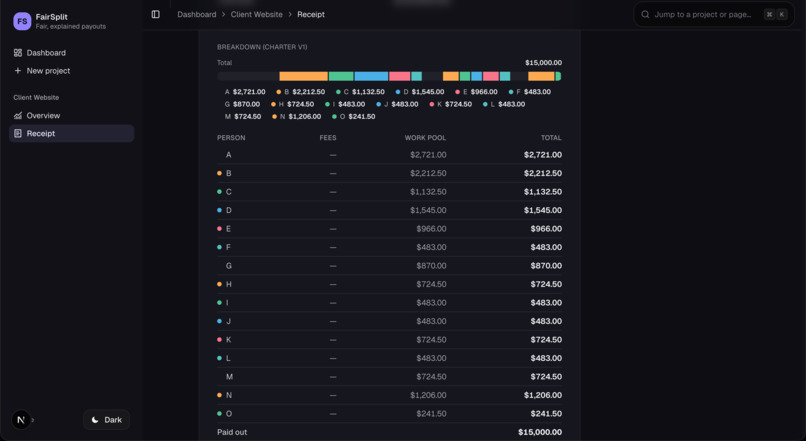
Receipt
-

Judging
-
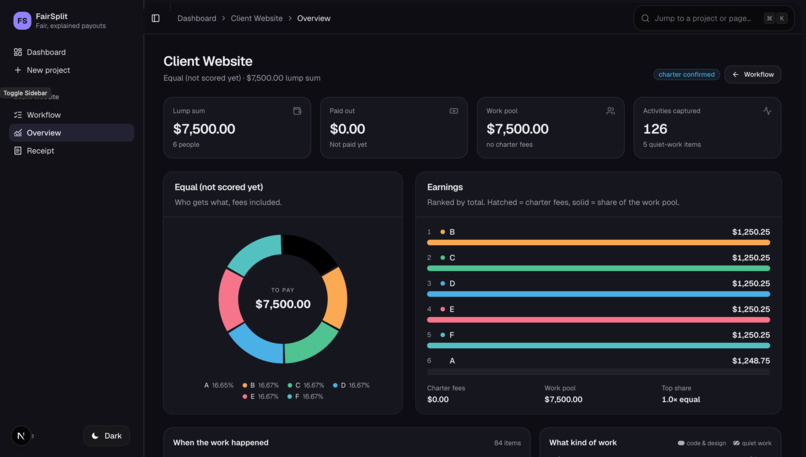
Overview after Payment
-
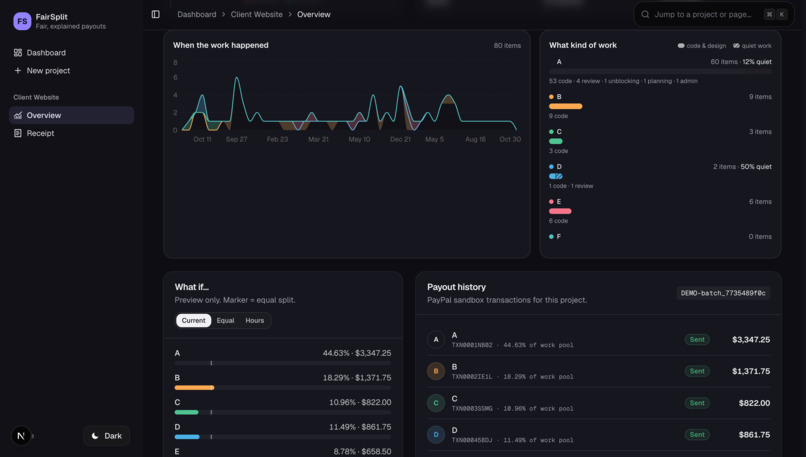
Overview after Payment
-
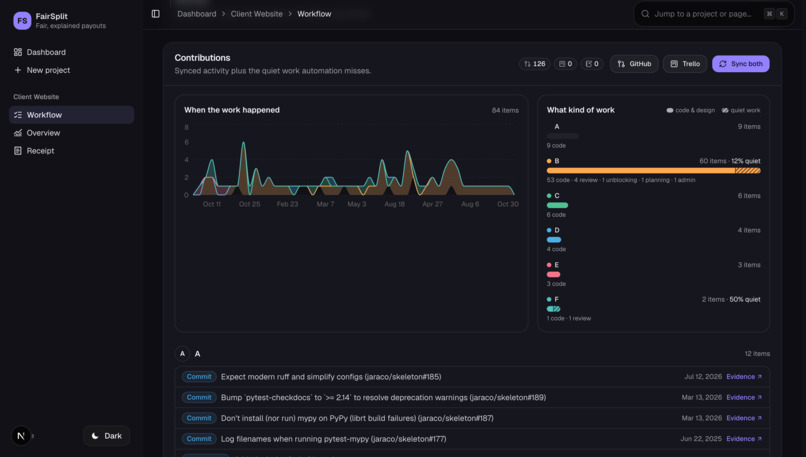
Split based on Contributions
-
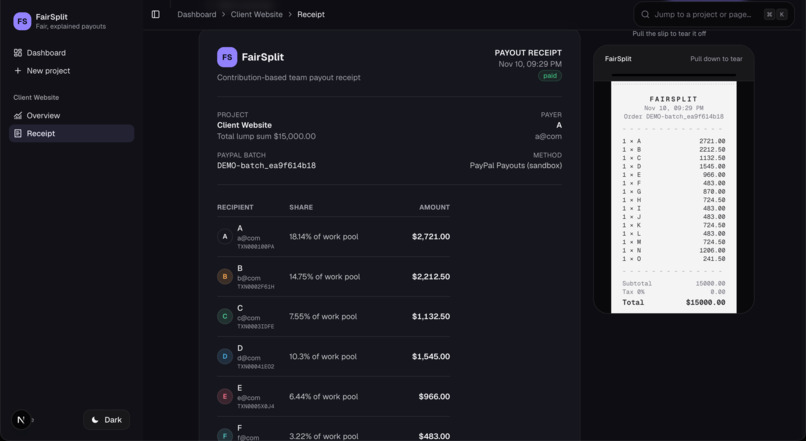
Receipt
-
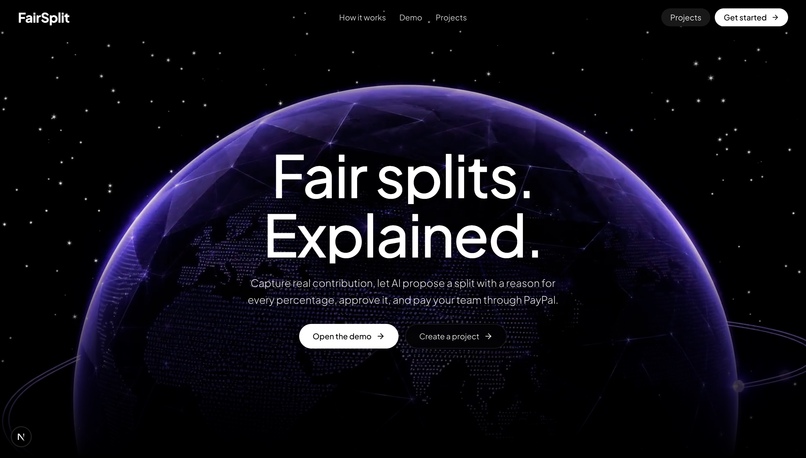
Landing Page
-

Split based on Contributions
-

Landing Page
-
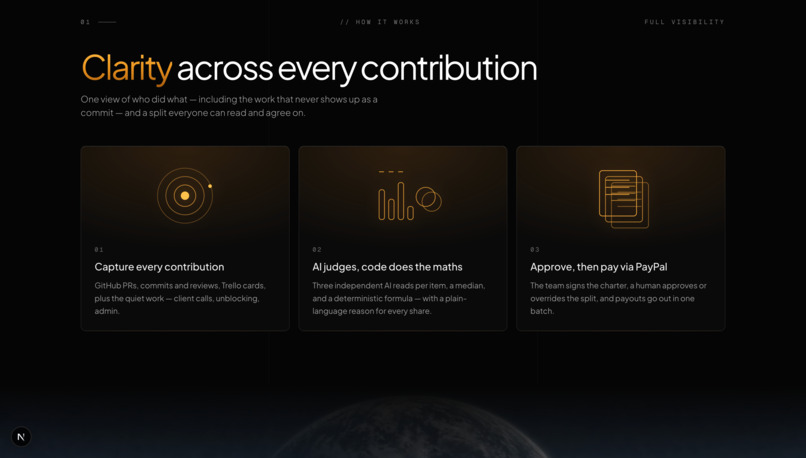
Landing Page

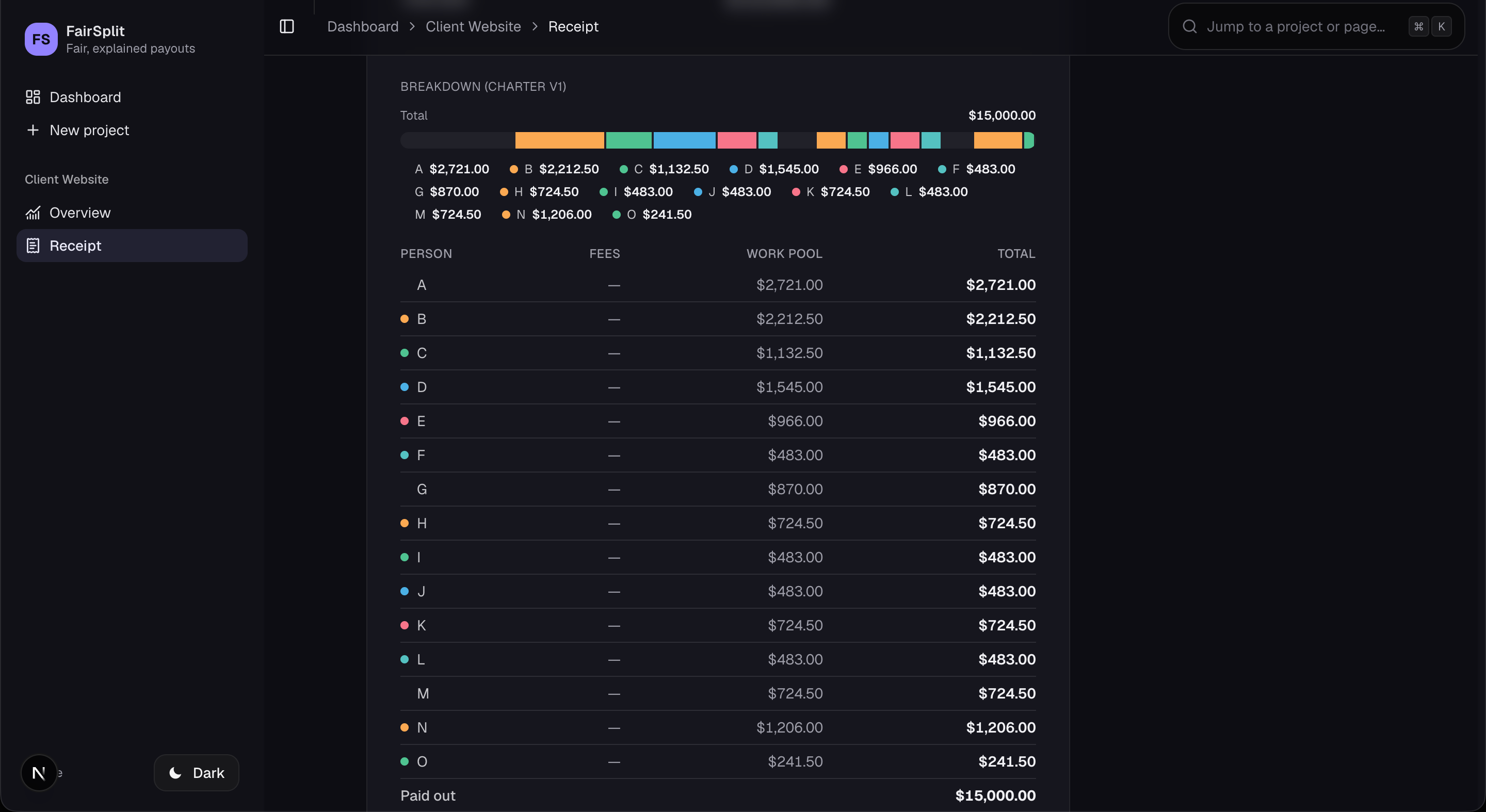



FairSplit — the story
Why I built this
I've been on both sides of an awkward payout.
The project ends, the money lands, and someone says "so... how do we split this?" And then you watch the quiet people in the room start losing immediately. The person who reviewed everyone's PRs and caught the bad ones. The person who took the client call that killed a three-week detour. The person who answered "I'm blocked" at 2 a.m. — none of that is in the repo. GitHub shows commits, and commits are all the evidence anyone looks at.
So the "fair" options are all fake. Equal split is unfair to whoever carried it. Hours punish fast people. Lines of code — you already know how that game gets played.
I had two ideas going in, and honestly one of them was wrong.
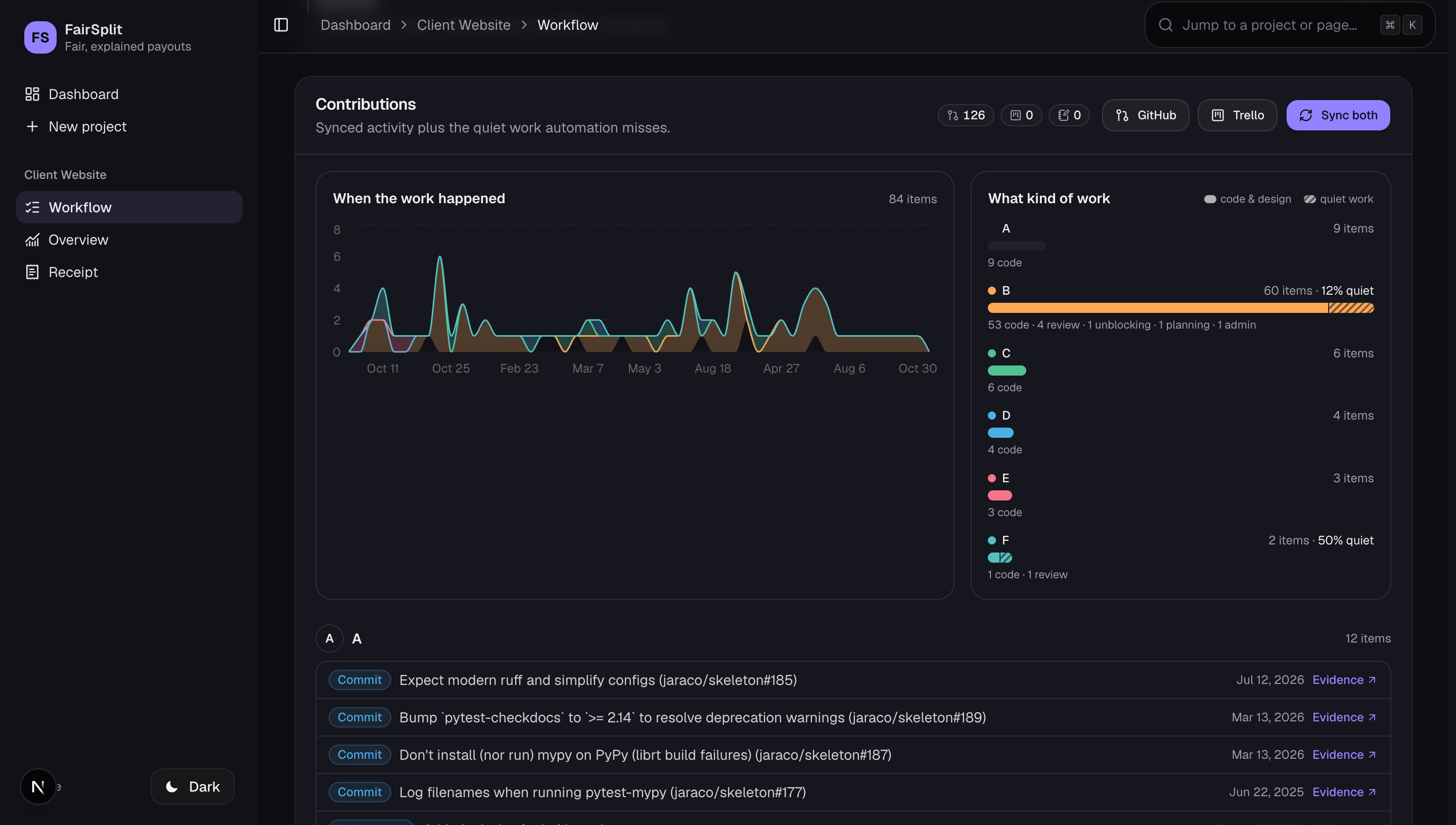
The first: if quiet work is the problem, capture it. Sync GitHub and Trello for the loud work, but let people log the client calls, the unblocking, the admin — with evidence.
The second idea — the wrong one — was "then let AI decide the split." I got about a day into that before it felt gross. Imagine a black box telling three teammates "the AI says you get 43%." Doesn't matter if it's right. It's dead on arrival. Nobody trusts that, and they shouldn't.
So I flipped the architecture: the AI judges the work, the code does the math, and a human pulls the trigger. The model never says a number. It never touches a cent. It just reads evidence and gives opinions, and every opinion gets checked before it's used.
That's FairSplit.
What it actually does
You set up a charter first — who gets a finder fee, who gets a lead fee, both carved off the top. Everyone has to confirm it before scoring unlocks, and if you edit it later, the version bumps and everyone re-confirms. I stole this from how constitutions work: agree on the rules before anyone knows their share, and suddenly the rules are much easier to agree on.
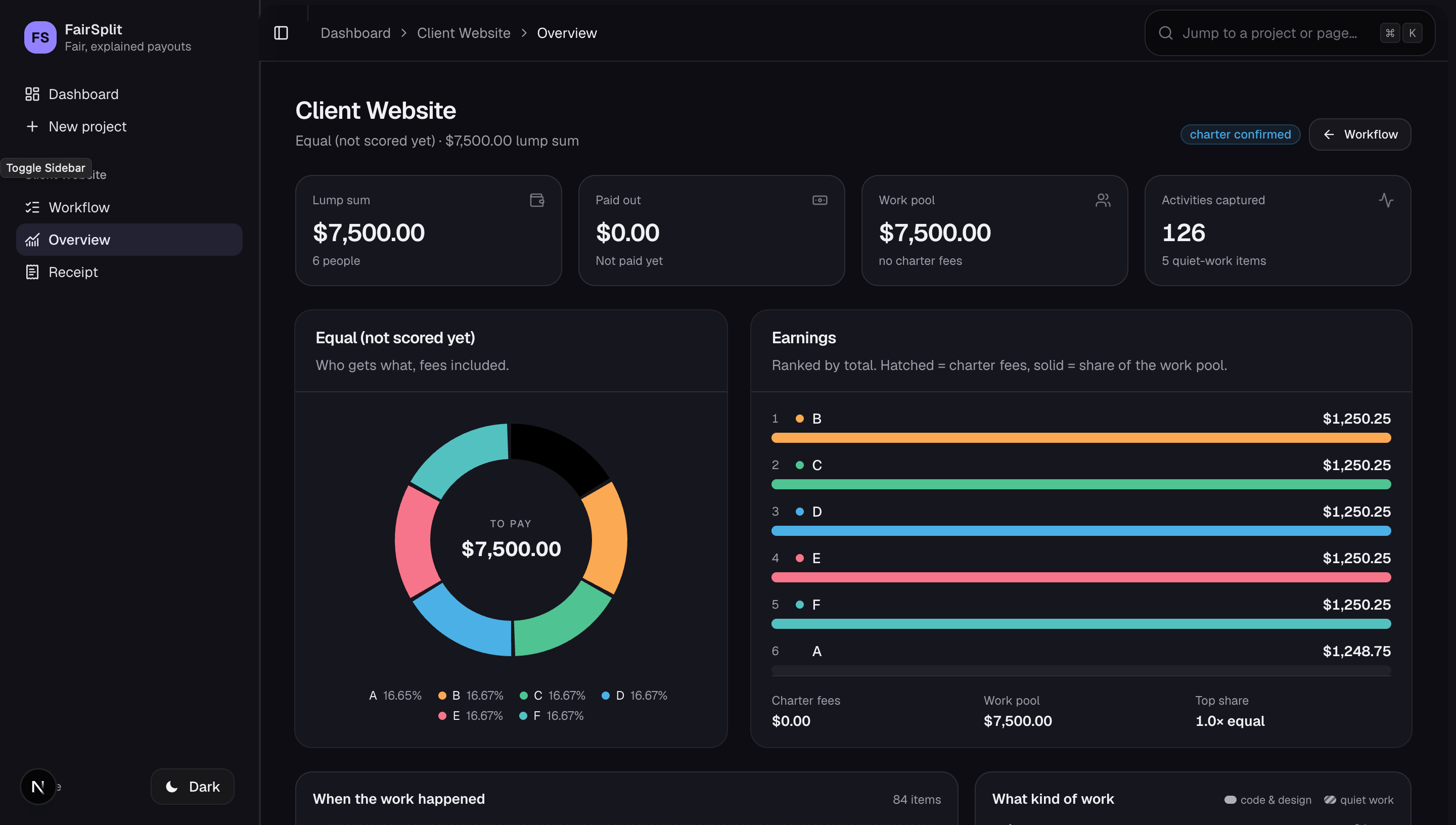
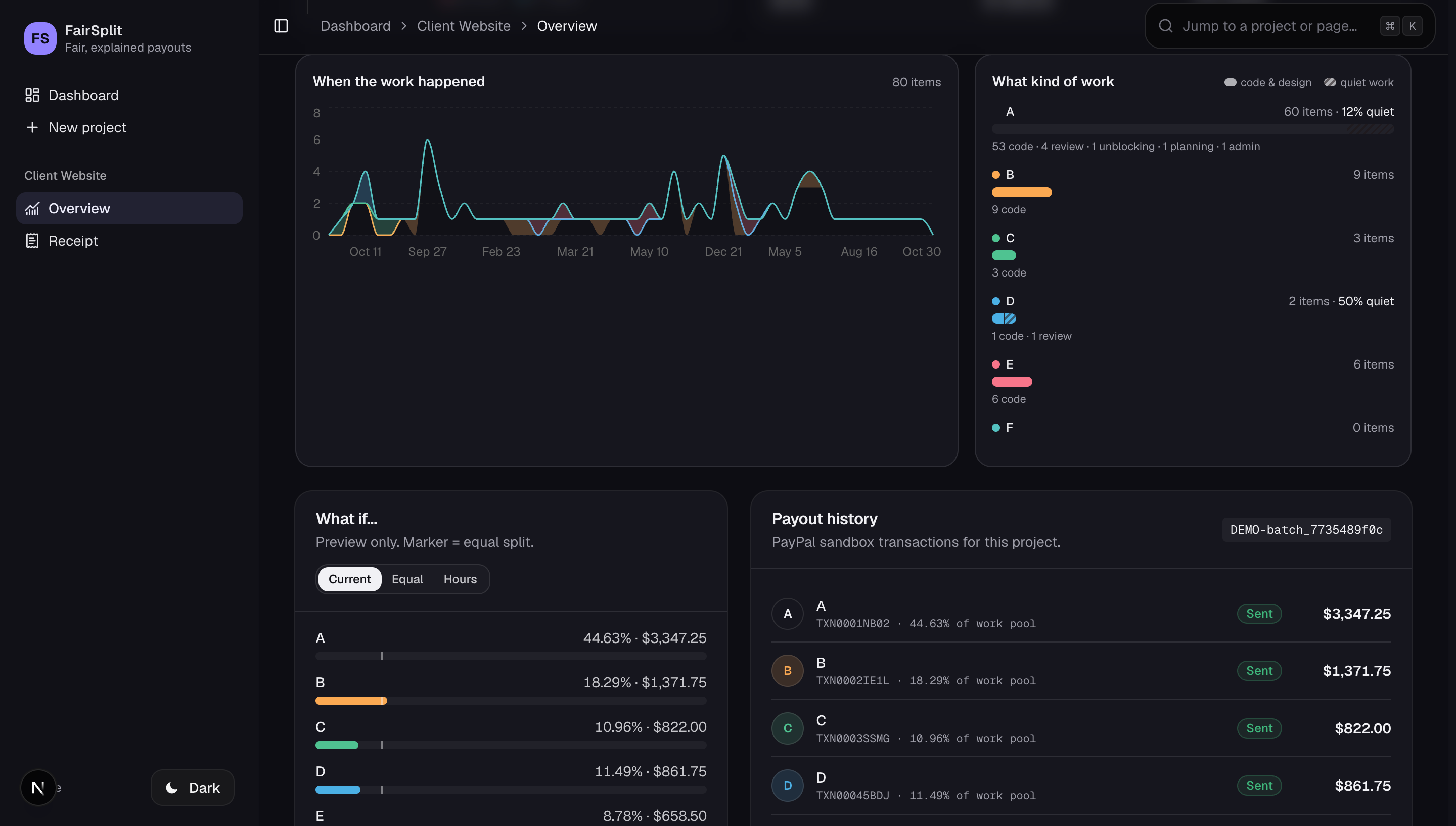
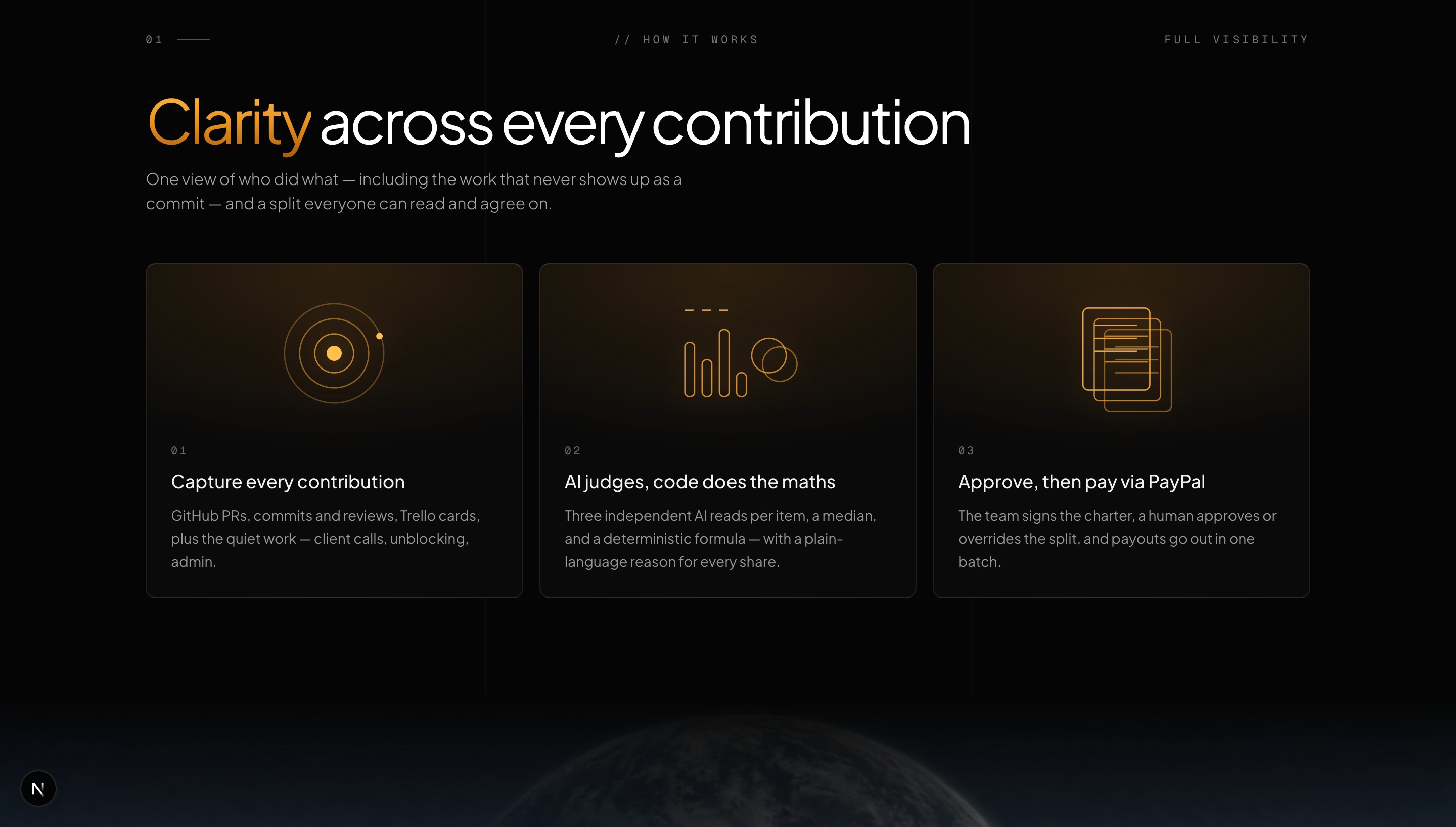
Then you sync contributions (GitHub PRs, commits, reviews; Trello done-cards) and hand-log the quiet stuff. Hit "Score with AI" and you get a split of the work pool — each share with a plain-language reason, impact/complexity bars, and evidence chips you can click through to the actual PR.
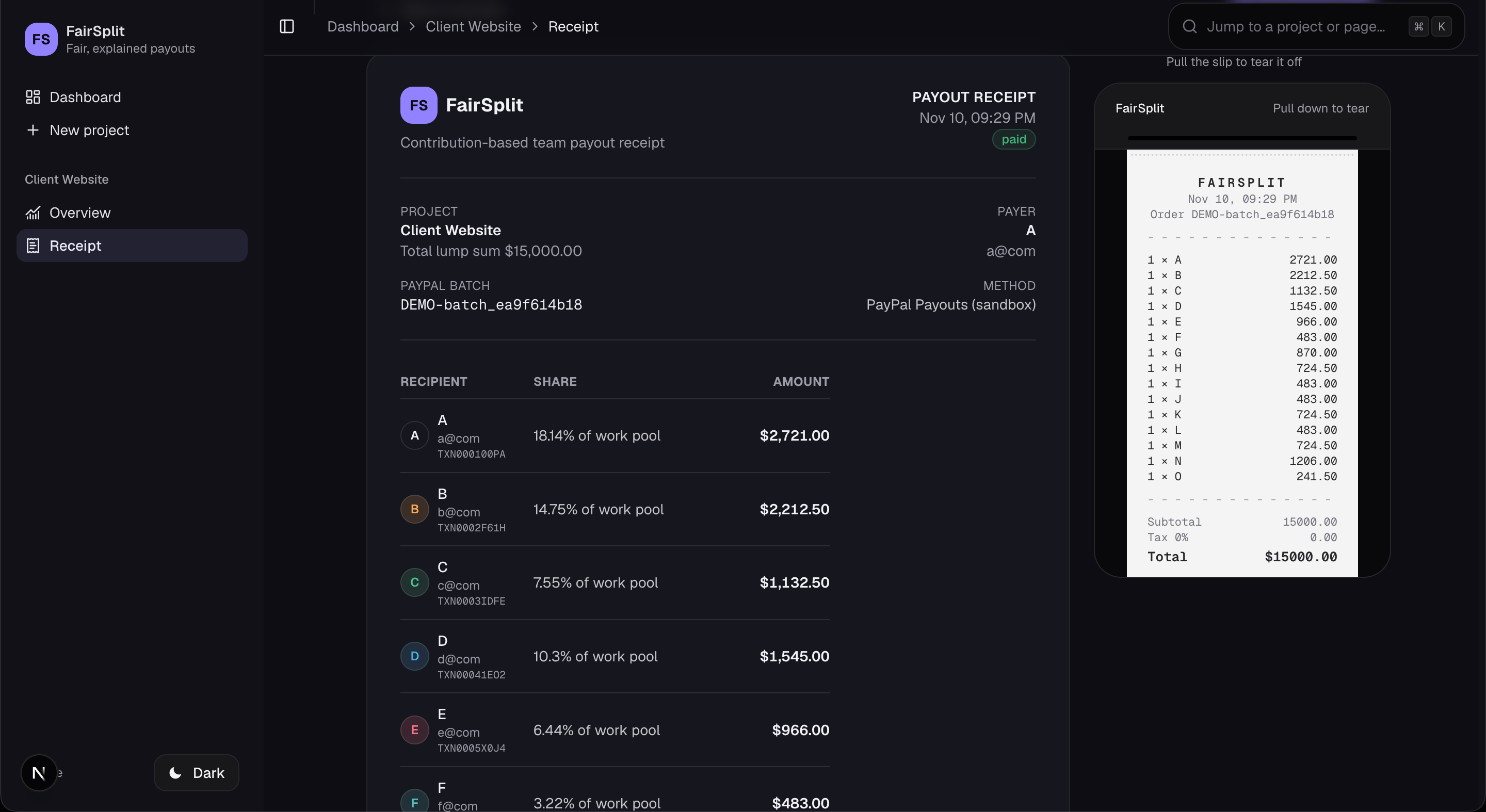
A human reviews it, drags any share around (edited ones get pinned, the rest rescale so it always totals 100%), and then one click pays everyone through a PayPal batch. Batch ID, per-person transaction IDs, printable receipt. Done.
There's also a live equal/merit/hybrid/hours toggle so the team can argue about philosophy instead of personalities. That turned out to be the feature people play with the most.
How I built it
Next.js 16, TypeScript, Tailwind v4, Recharts, OpenAI, PayPal sandbox Payouts. No database, no auth — the whole thing runs in memory, seeded with a demo project ($3,000, three people), because it needed to survive a 3-minute live demo on conference wifi that may not exist.
The scoring pipeline is where all the actual thinking went. It's five steps:
Normalize. Merge GitHub, Trello and manual entries into one clean list. Commits fold into the PR that shipped them, so nobody gets double-counted for the same work. Merge commits and whitespace-only changes get dropped — but I surface the counts in the UI rather than silently binning them, because silently disappearing data is exactly how you lose trust. Anything I can't attribute to a team member goes to an "unassigned" tray instead of me guessing.
Judge. This is the only place the model has opinions. Per contribution it returns a category, impact (1–5), complexity (1–5), and a ≤20-word rationale. The trick: I run it three times and take the median per item (majority vote on category). One model run is an opinion. Three runs and a median starts being a measurement.
Compute. Pure, boring, deterministic math. Each item's value:
$$v = \text{impact} \times \text{complexity} \times w_{\text{category}}$$
Then per person I sum values per category through a square root:
$$S_i = \sum_k \sqrt{V_{i,k}}$$
That sqrt is my favorite line in the codebase. $\sqrt{10} + \sqrt{10} > \sqrt{20}$ — so doing solid work across five different categories beats spamming twenty items in one. You can't game it by volume. Merit share is $S_i / \sum S_j$, hybrid blends $0.7$ merit + $0.3$ hours, and fees come off the top first ($\text{total} = \text{finder} + \text{lead} + \text{work pool}$), so the model's numbers only ever divide the work pool.
The exact same compute code runs on the server and in the browser. That's why the what-if toggle is instant — and why the client and server can never disagree about the math.
Explain. The model writes the prose, but its evidence citations get filtered against the IDs that actually exist. If it cites a contribution that isn't real, it doesn't ship.
Confidence. Since the model is non-deterministic, I compare merit shares across the three runs. If someone's share moves more than 5 points run-to-run, the split gets flagged "lower confidence" and shows the range. I really like this part — instead of pretending the number is truth, the UI tells you exactly which share is soft.
Money is integer cents end to end, with percentages in basis points, both distributed by largest-remainder (floor everything, hand the leftovers to the biggest fractional parts). PayPal-wise it's OAuth client credentials then one POST /v1/payments/payouts batch — and if the sandbox is down, it falls back to a clearly-marked simulated receipt instead of dying on stage.
The bugs that taught me things
My first split summed to $2,999.99. I rounded each percentage to two decimals, multiplied, rounded again — and watched the total drift. Classic. It's the same apportionment problem that comes up in proportional representation, and the fix is a hundred years old: largest-remainder method. Everything integer, everything reconciles to the cent. The payout endpoint now literally refuses to send money if the lines don't add up to the project total.
The model lied to me, constantly. Category labels like "pr" and "implementation" (not in my taxonomy). Impact scores of 7 on a 1–5 scale. Evidence IDs for contributions that don't exist. At some point I stopped treating model output as text and started treating it like user input in a form: validate, clamp, reconcile against what I actually sent, reject the run on garbage. There's a whole synonym table mapping the labels the model reaches for onto my seven categories. The judge module is a trust boundary, full stop.
Same project, three runs, three different splits. For a weather app, fine. For money, no. The median ensemble fixed most of it, and the confidence step turned the rest into a feature — you see the range instead of a confident lie.
Editing one share broke the others. First version of the review screen: you type 45%, and I rescale everything else proportionally — including the share someone had carefully set five minutes earlier. The fix is pinning: edited shares lock, only the unlocked remainder rescales, and rounding drift lands on the biggest unlocked row so it still totals exactly 100.
The stack fought me. Next 16, Tailwind v4 and Base UI are all different from what my hands remembered. render props instead of asChild. A render-time random class in a sidebar component caused hydration mismatches at 2 a.m. before I understood why. The answer was boring: actually read the docs in node_modules/next/dist/docs instead of assuming.
What I'm proud of
The hidden contributor flag. When someone's merit share beats their raw activity-count share by 8+ points and over half their value is quiet work, the UI calls them out by name. That's the person the raw numbers would've short-changed — the whole reason I started this thing.
Also: the demo runs with zero API keys and zero network, because "DEMO_MODE" replays canned judgments through the real formula. Same math, identical every time, no russian roulette on stage. And every number on screen traces back through the formula to evidence you can click on.
What I learned
The big one: in a money workflow, the model's job isn't to produce numbers — it's to produce judgments with receipts. Once I drew that line, everything got easier. Failures degrade into fallbacks instead of wrong payouts. The same math runs everywhere. You can audit any share down to the PR it came from.
Also — how you show uncertainty matters as much as reducing it. Three runs and a median made the numbers stable, but showing the disagreement range is what made them feel honest.
And honestly, the demo constraint saved the product. Every fallback I built so the 3-minute demo couldn't die made the real flow harder to break.
What's next
A real database, production PayPal, per-member payout acceptance instead of one approver — and pulling in more quiet-work sources: Slack threads, Figma comments, meeting notes, all through the same normalize → judge → compute pipeline. The quiet work is out there. It's just not in the repo yet.
Built With
- github
- next.js
- openai
- payouts
- paypal
- react
- tailwind
- trello
- turback-via-@tailwindcss/turbopack)-+-react-19.3-typescript-5-?-strict
- typescript
