App upgraded
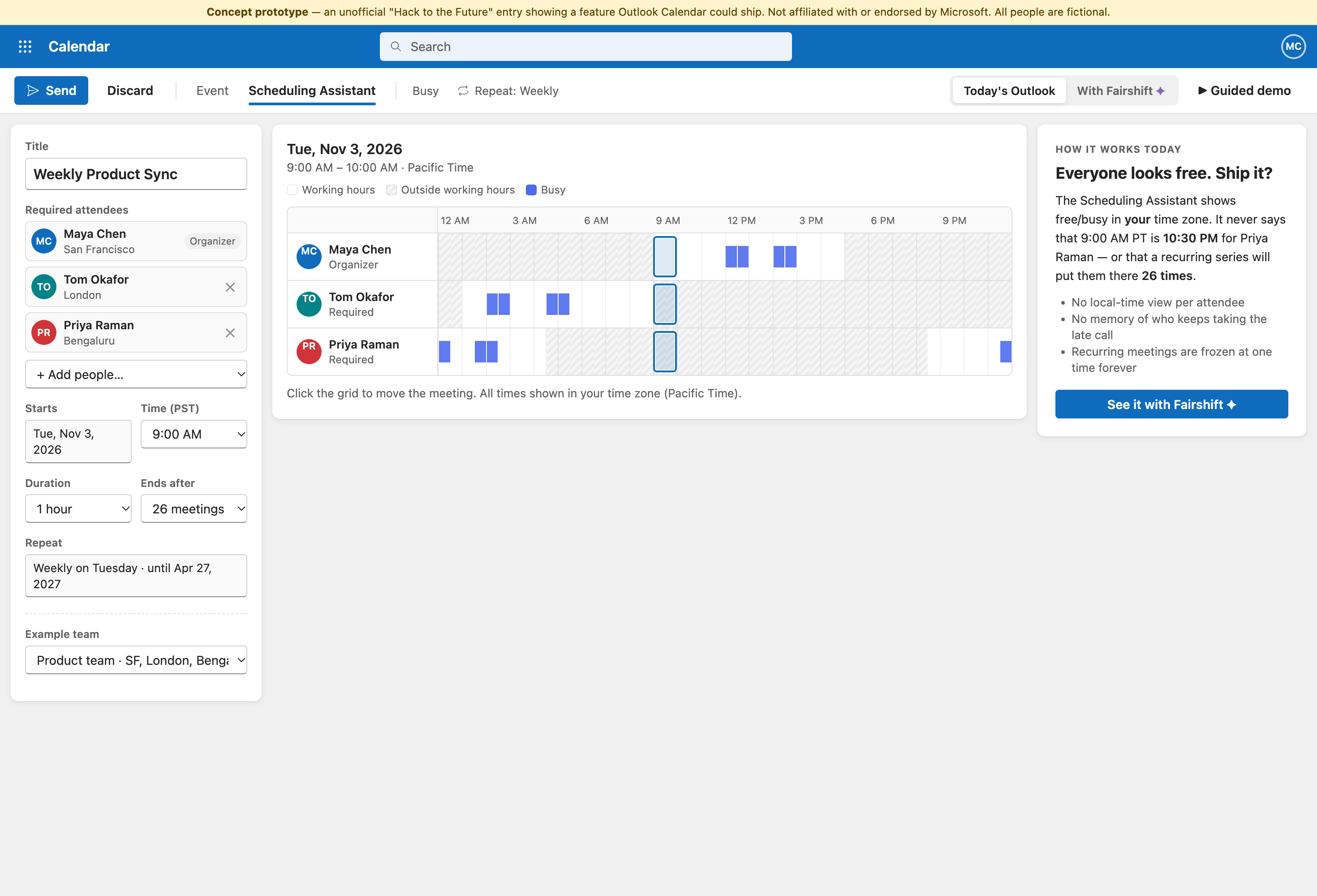
Microsoft Outlook: Calendar → Scheduling Assistant. The new feature, Fairshift, adds a Rotate time fairly option for recurring meetings.
The problem
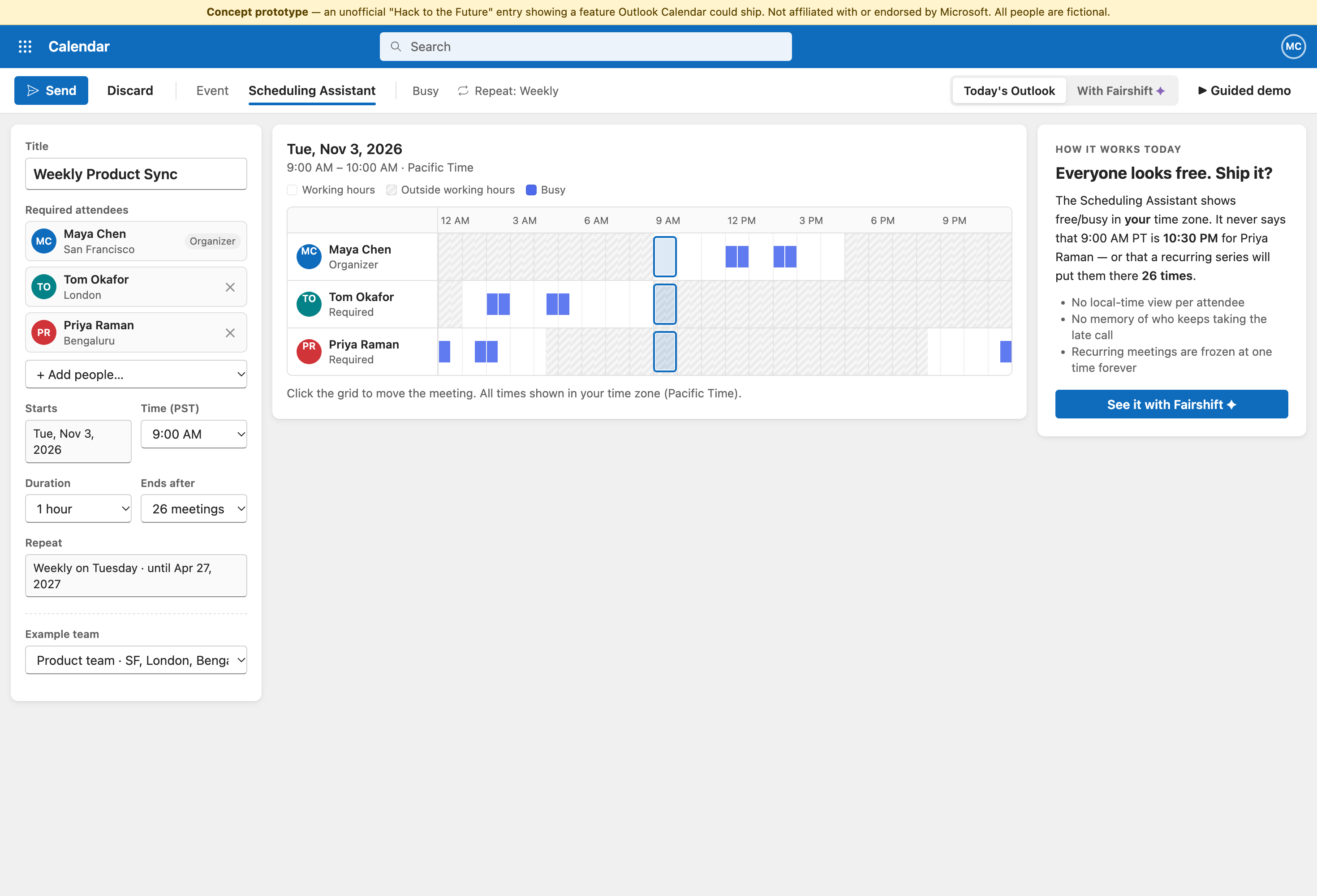
Global teams book recurring meetings at a time that suits headquarters, so the same people (often in India or APAC) join at 10 PM or 6 AM every week, for months. Outlook's Scheduling Assistant shows free/busy in the organizer's time zone. For a recurring series, nothing tracks who keeps absorbing the inconvenience, and nothing shares it.
Before → After
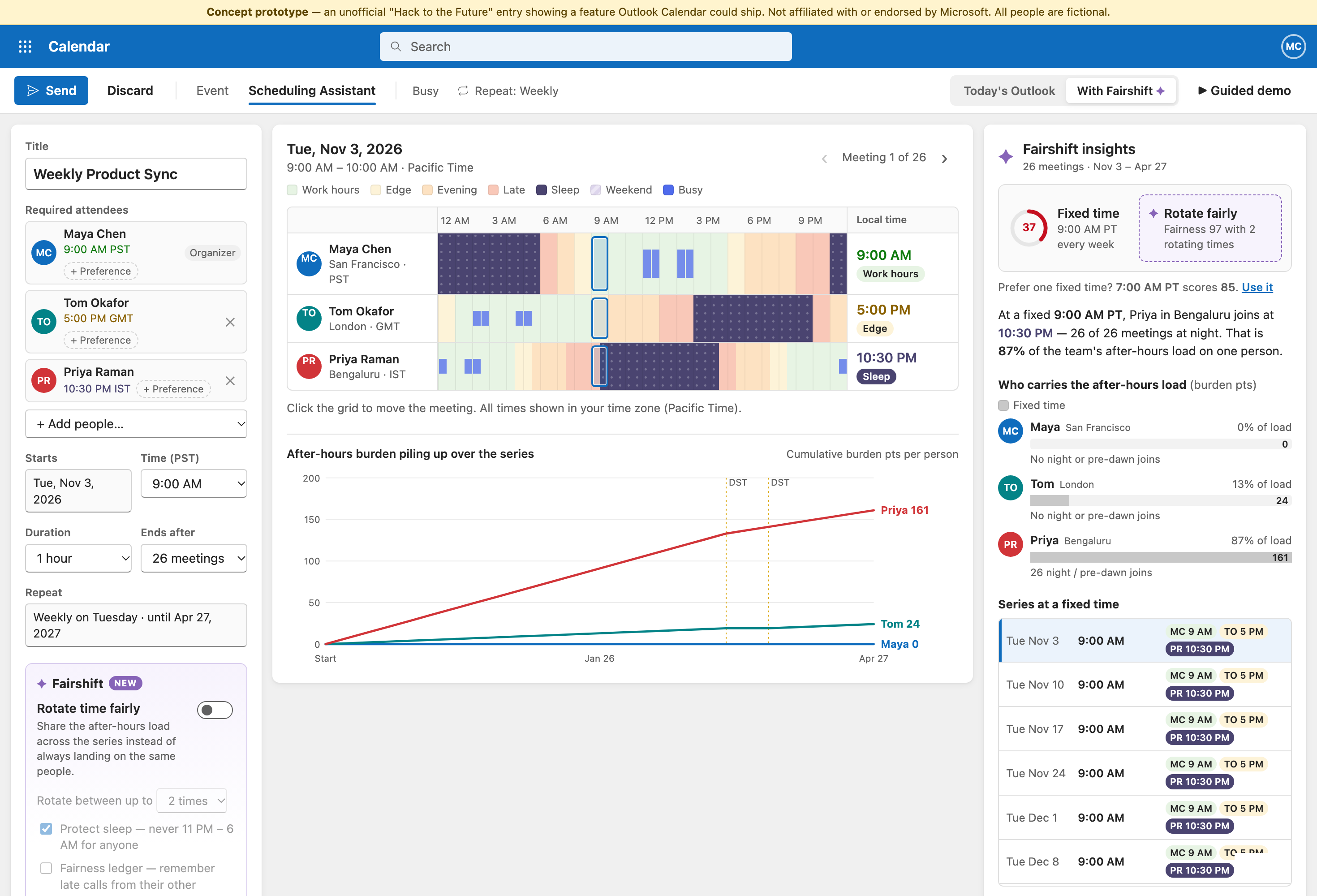
Before (Outlook today): Maya in San Francisco books a weekly sync at 9:00 AM PT. Everyone shows as free. Nothing tells her it's 10:30 PM for Priya in Bengaluru, 26 weeks in a row.
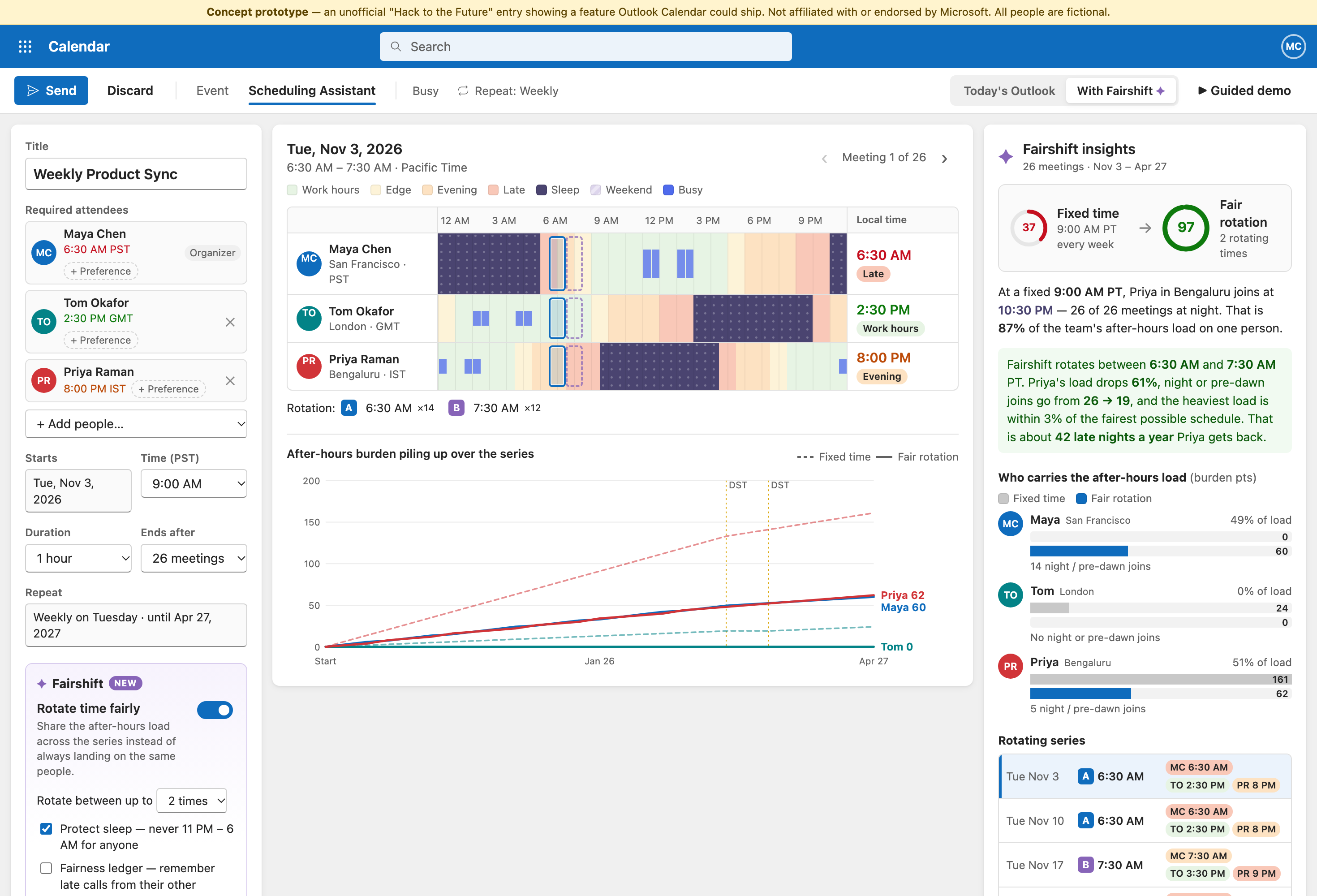
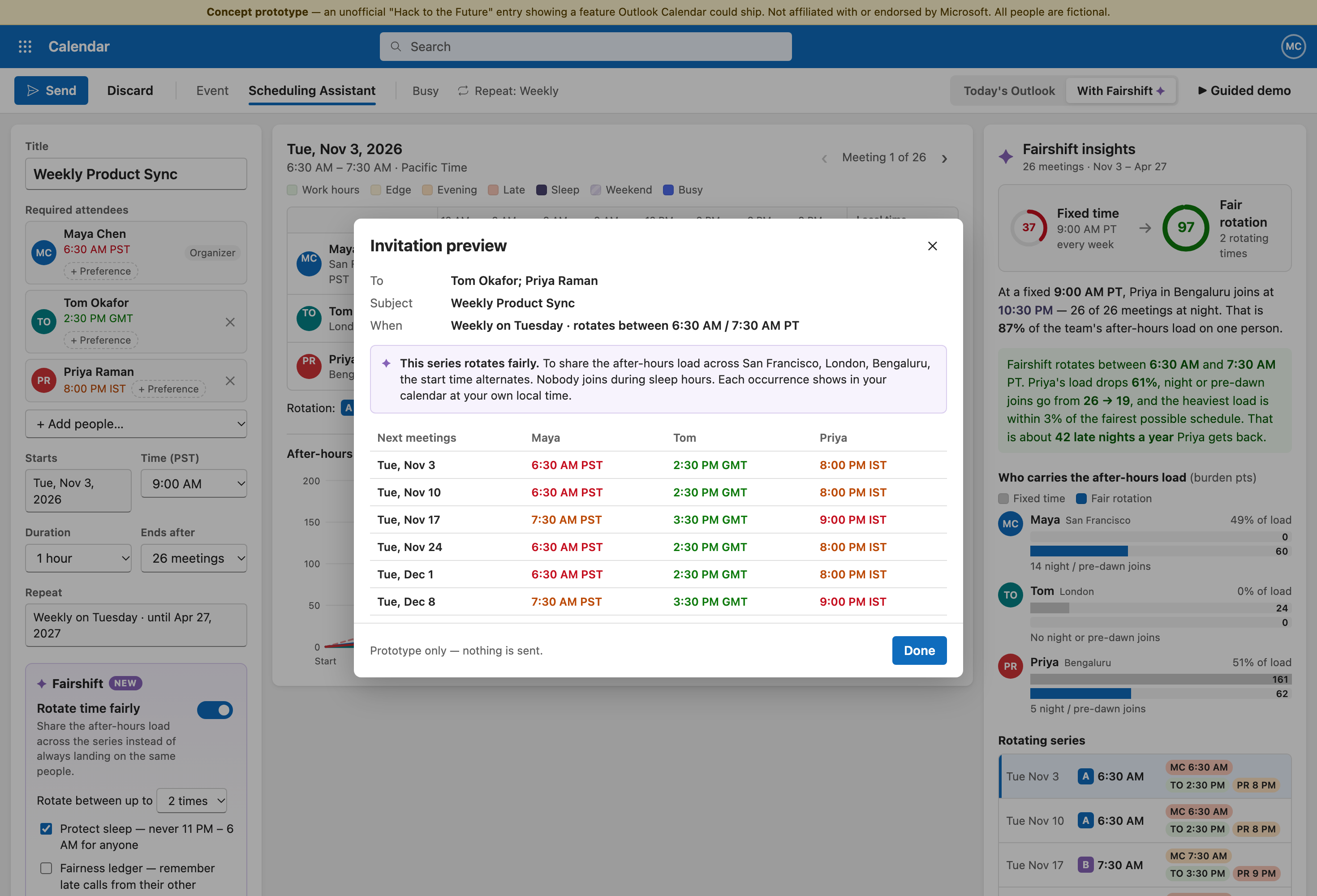
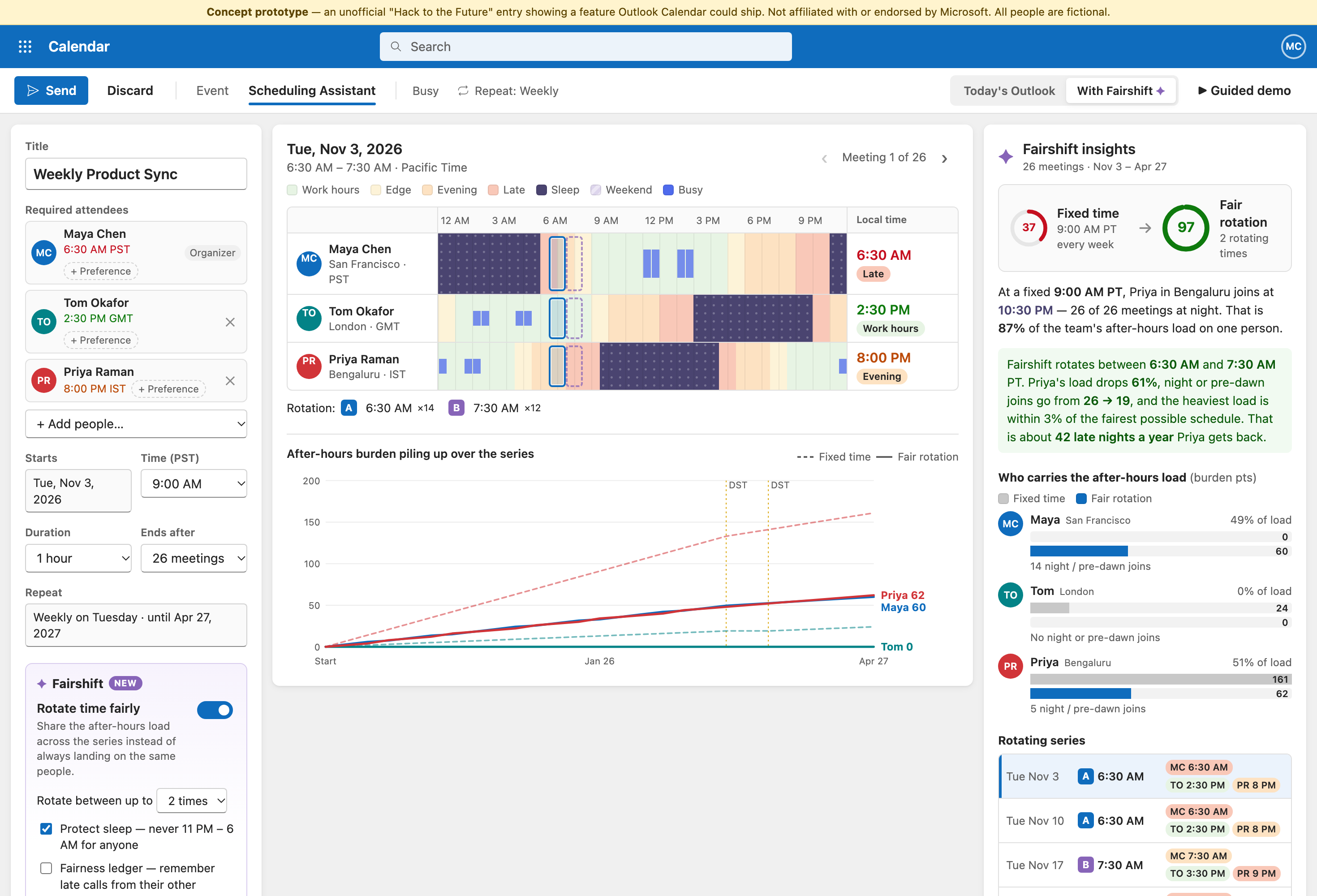
After (with Fairshift): Every row is painted in that person's own local time, and Fairshift shows that Priya carries 87% of the team's after-hours load (fairness 37). With one switch, the series alternates between 6:30 and 7:30 AM PT. Fairness rises to 97, Priya's load drops 61% (about 42 late nights a year back), and nobody is ever scheduled in their sleep hours.
Inspiration
I'm in India, and for many people here "the global sync" means a 10:30 PM call every week. Nobody chose that on purpose. The organizer picked a sensible time in their own zone, the Scheduling Assistant showed everyone as free, and the series repeats forever. Outlook already knows everyone's time zone and working hours; it just never does the maths across the whole series.
What it does
- Local-time lens: each attendee's row is coloured by their own local time (work, edge, evening, late, sleep, weekend), including date-line weekends: Friday afternoon in the US is Saturday in Sydney.
- Burden and fairness scores for the whole recurring series, per person.
- Rotate time fairly: one switch plans a series that rotates between up to 3 times, so the after-hours load is shared.
- Protect sleep: nobody is ever booked between 11 PM and 6 AM.
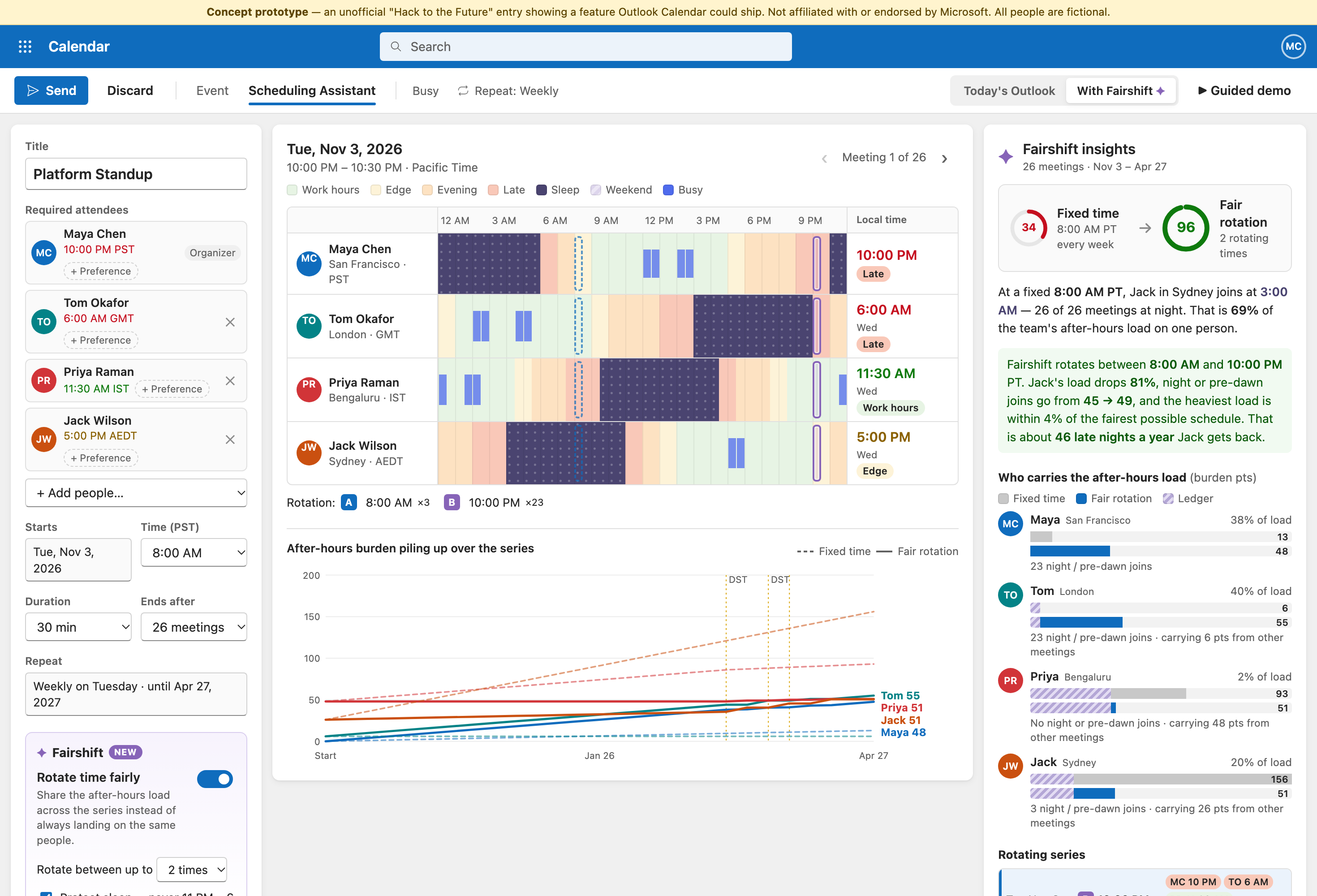
- Fairness ledger: remembers late calls people already take in other meetings, and spares them.
- Early bird / night owl preferences: a 7 AM call costs an early bird less than a 9 PM one.
- Best single time: if you don't want a rotating series, Fairshift still suggests the fairest fixed time.
- DST-aware: the US, UK and India change clocks on different dates, so every occurrence is re-scored.
- Self-explaining invite listing each attendee's local time, a before/after toggle, and a 9-step guided demo.
How I built it
A dependency-free JavaScript engine converts every candidate time into each attendee's wall-clock time with the browser's Intl time-zone database, per occurrence, in 15-minute slices. Each attendee's burden over the series is:
$$B_i = \sum_{\text{meetings}} \; \sum_{\text{15-min slices}} w(\text{local time}) \cdot \Delta t$$
where the weight per hour is 0 in working hours, 1 just outside them, 2 in the evening or early morning, 4 late at night or at weekends, and 10 during sleep hours.
The planner tests every half-hour of the day, keeps only the Pareto-optimal times, tries every rotation of 1–3 times, and assigns each meeting so as to minimise
$$J = \max_i B_i + 0.35 \sum_i B_i$$
This is minimax: it protects the person carrying the most first, then reduces total after-hours time. The fairness score compares the heaviest load with the best this planet allows:
$$\text{Fairness} = 100 \cdot \frac{B^\star}{\max_i B_i}, \qquad B^\star = \min_{\text{rotations}} \max_i B_i$$
The full search takes about 10 ms in the browser. The UI is a Fluent-inspired recreation of Outlook's event composer and Scheduling Assistant in vanilla HTML, CSS and JavaScript, with 8 engine tests on Node's built-in test runner.
The demo video is generated by a script: it drives the real app in headless Chrome over the DevTools protocol, the voiceover comes from the open-source Kokoro-82M TTS model, and ffmpeg combines them. I built the project with Claude Code (Claude Opus 5.5) as my AI pair-programmer.
Challenges I ran into
- Defining "fair". Pure equality (Gini) would inconvenience the person in the middle time zone for no benefit to anyone. I switched to minimax and measured fairness against the best achievable schedule, because some burden is unavoidable given where people live.
- Time zones. DST changes on different dates, India's half-hour offset and the date line meant every occurrence had to be computed individually. A fixed offset table would have been quietly wrong half the year.
Accomplishments that I'm proud of
- Fairness 37 → 97 for a US/UK/India team, and 34 → 96 for a four-city follow-the-sun team with the ledger on.
- Zero sleep-hour meetings, with the organizer sharing the early starts.
- It uses only data Exchange already has, so it could really ship.
What I learned
Time-zone fairness is a problem across the whole series, not a single meeting. Once people can see their burden next to everyone else's, the conversation becomes easy.
How Outlook could ship it
Everything Fairshift needs is already in Microsoft Graph:
mailboxSettings.workingHoursfor each attendee's time zone and working hoursgetSchedule/findMeetingTimesfor free/busy- recurring events with modified occurrences, which can store a rotating series
Rollout would be in three steps:
- Ship the local-time lens as a read-only overlay.
- Add Rotate time fairly as an opt-in toggle in Targeted Release.
- Connect the fairness ledger to Viva Insights' after-hours data, visible only to the organizer and each attendee.
Unofficial concept prototype. Not affiliated with or endorsed by Microsoft. All people shown are fictional.

Log in or sign up for Devpost to join the conversation.