-
-
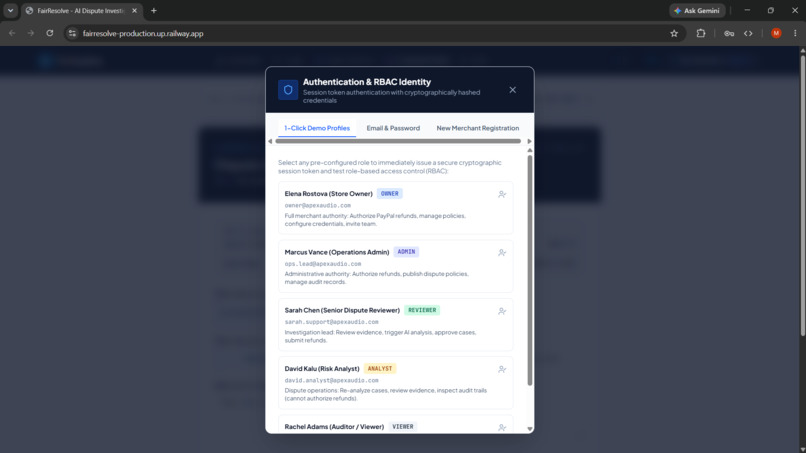
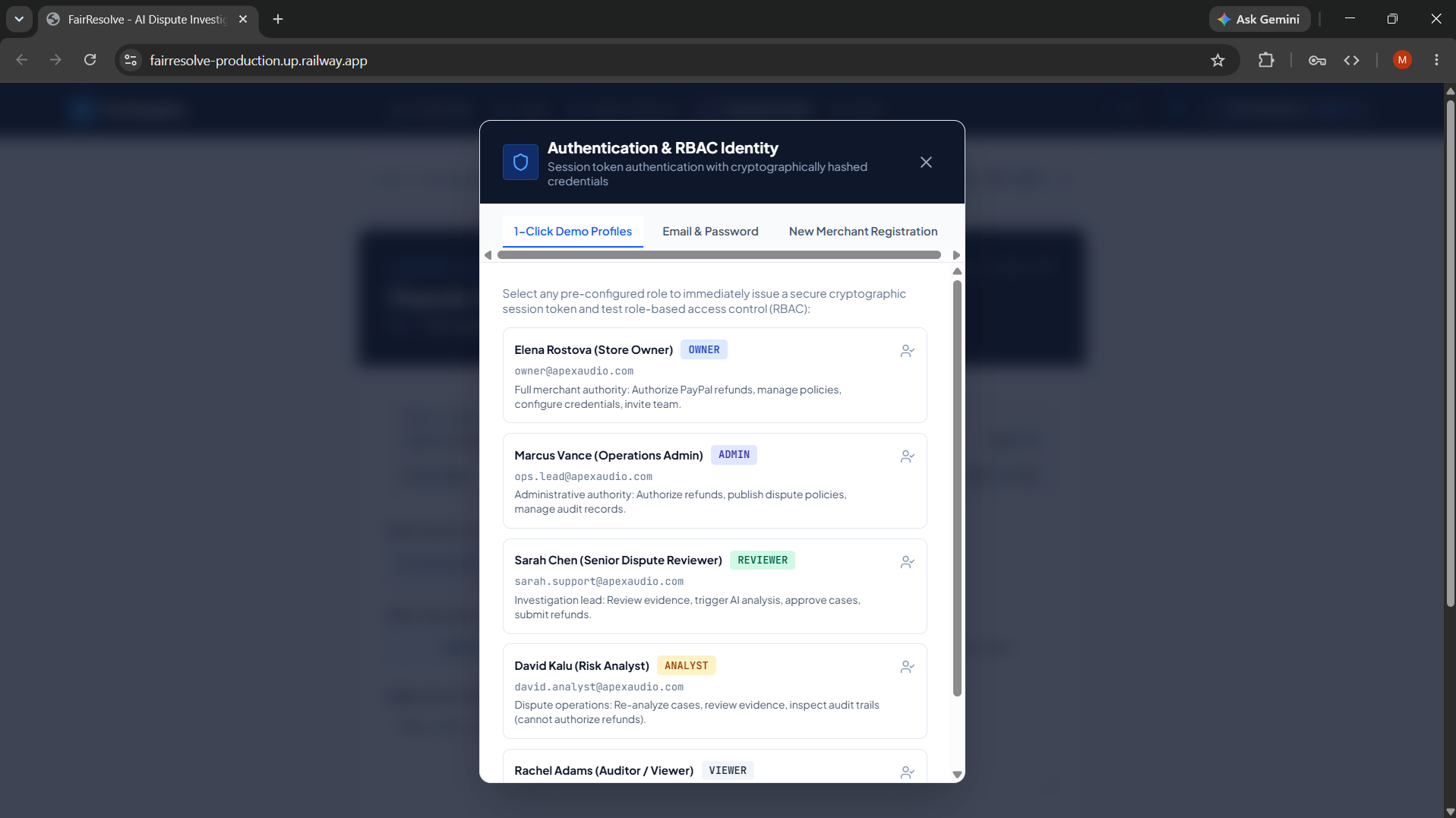
Authentication and Role page
-
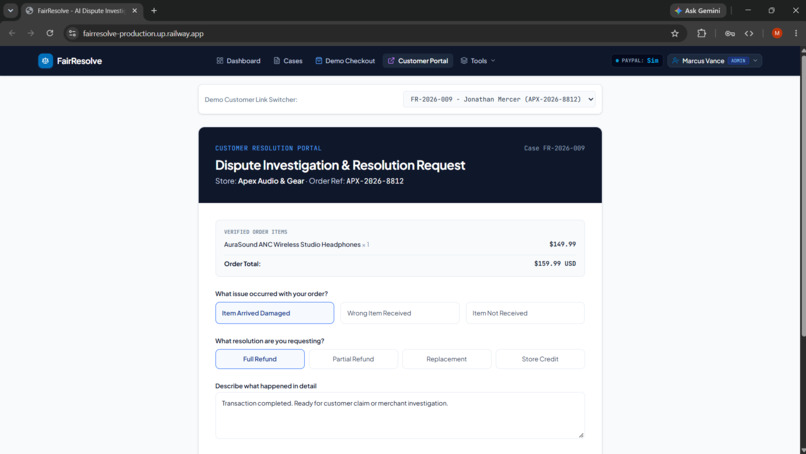
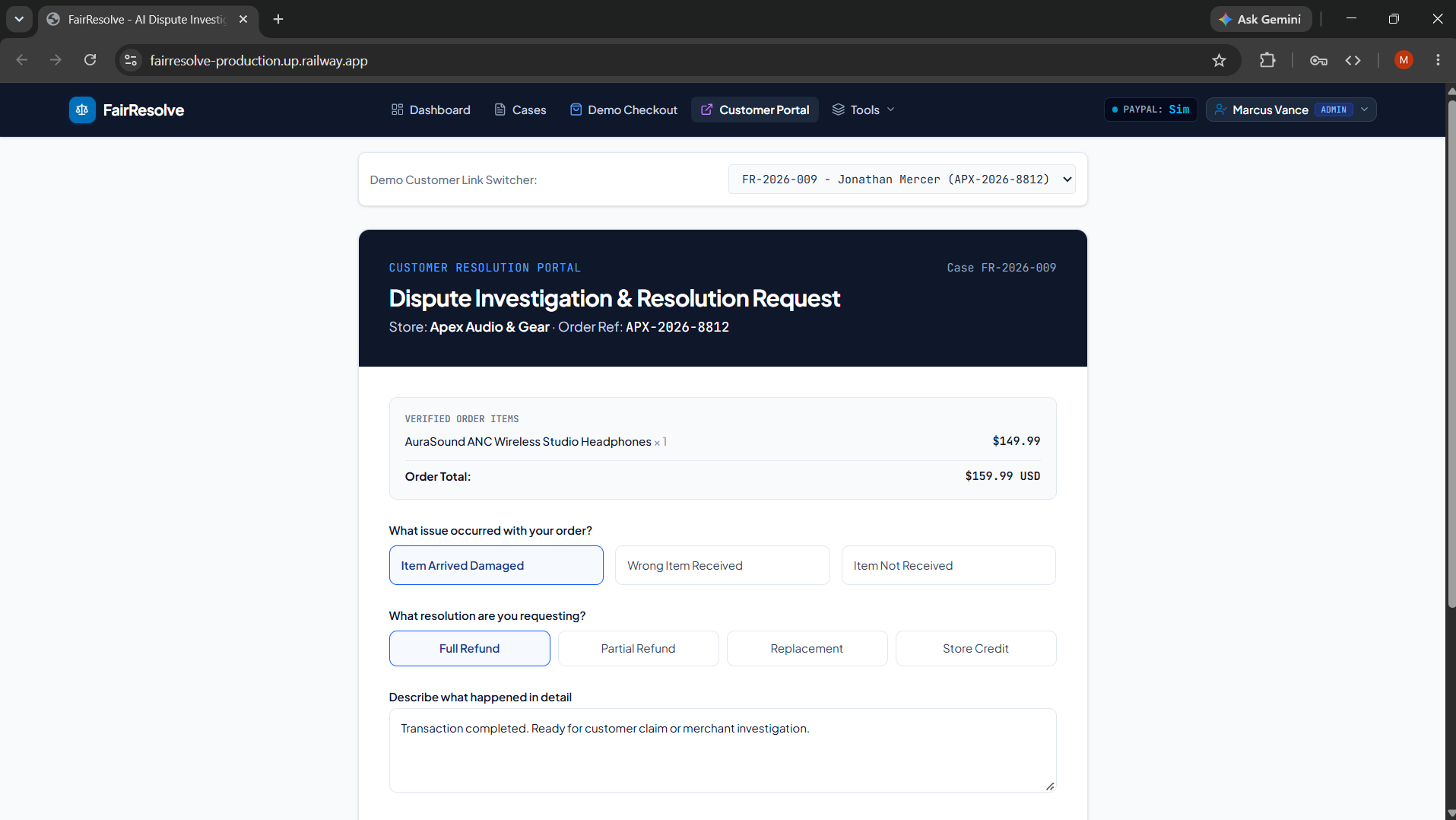
Customer Portal page
-
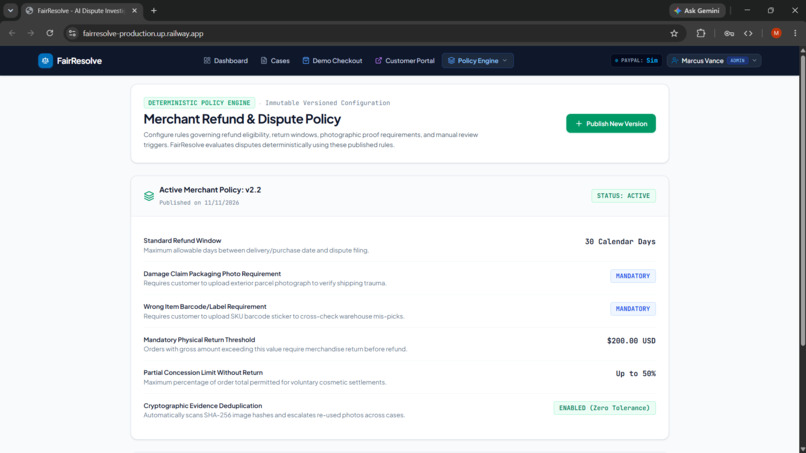
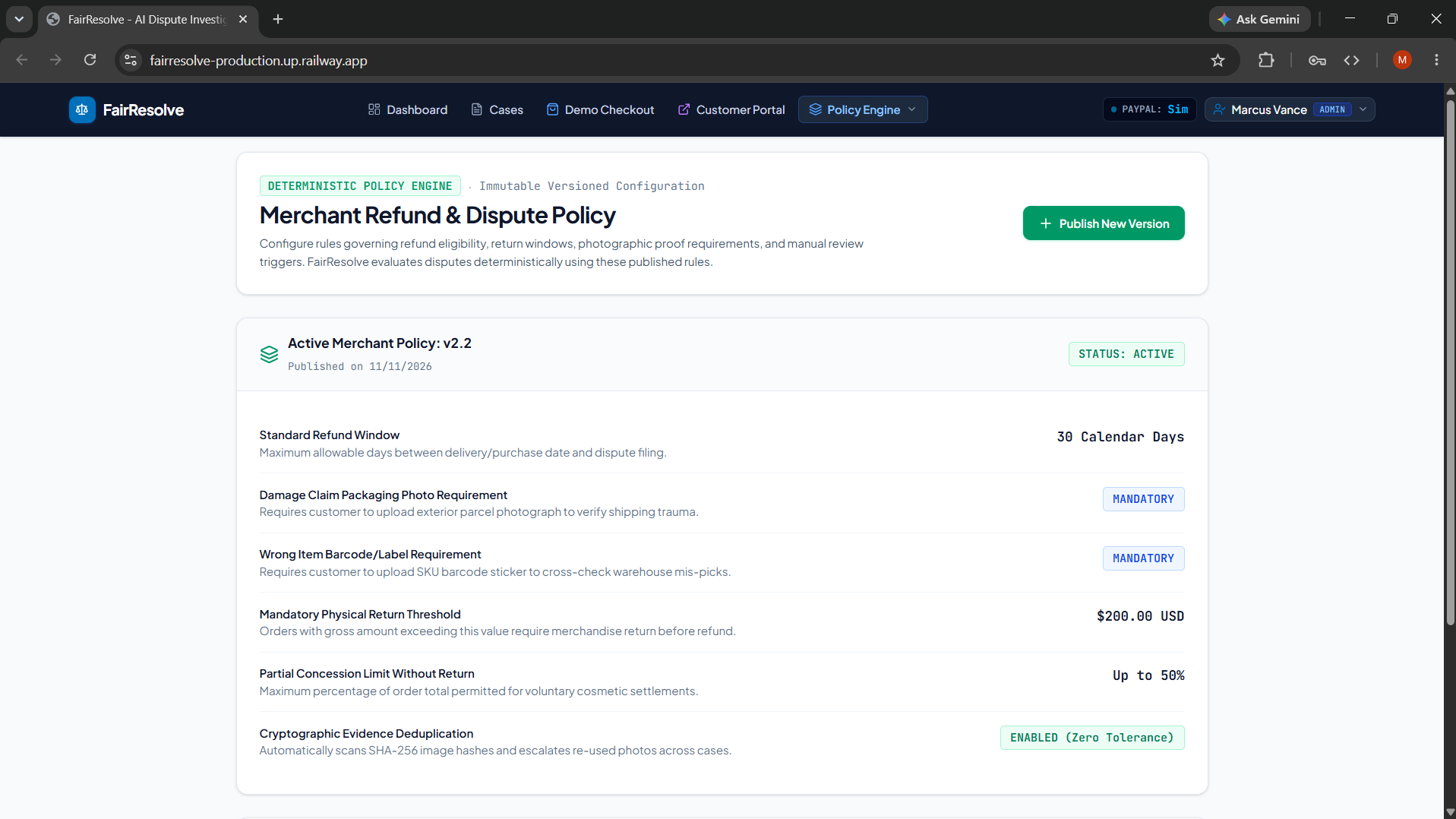
Policy Engine page
-
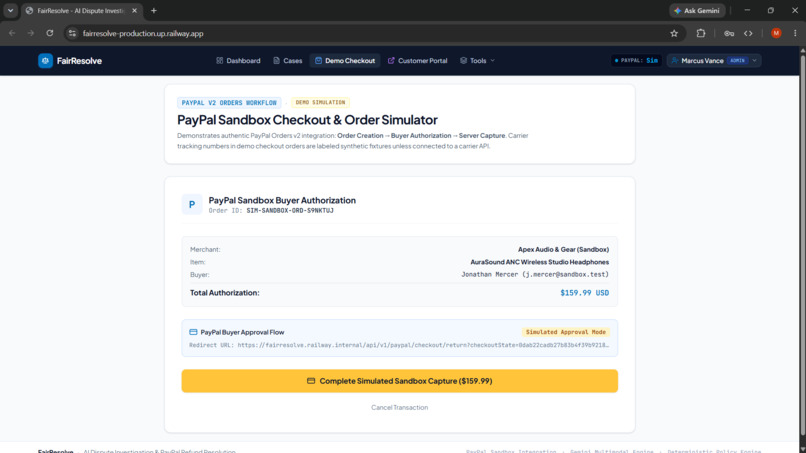
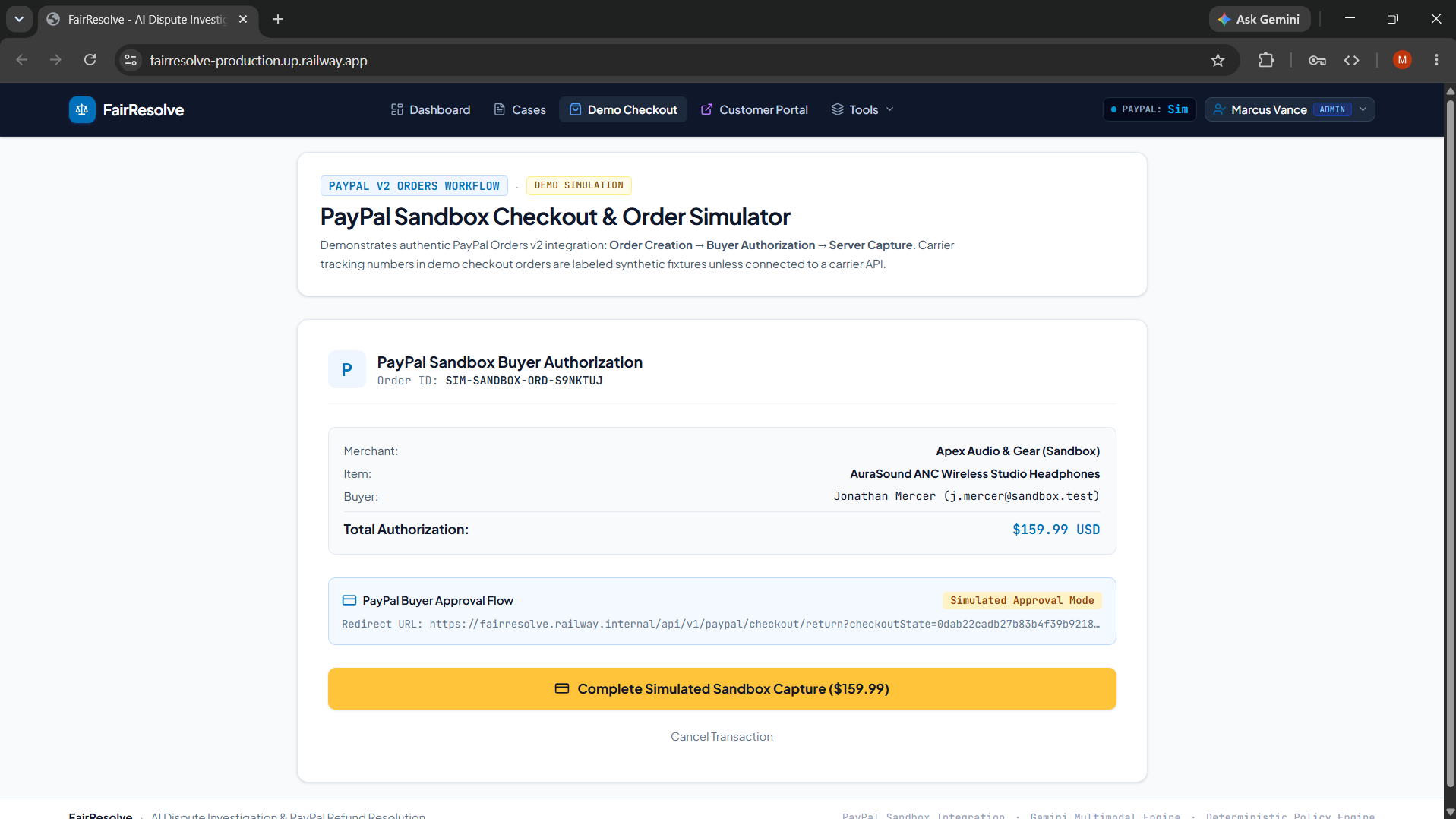
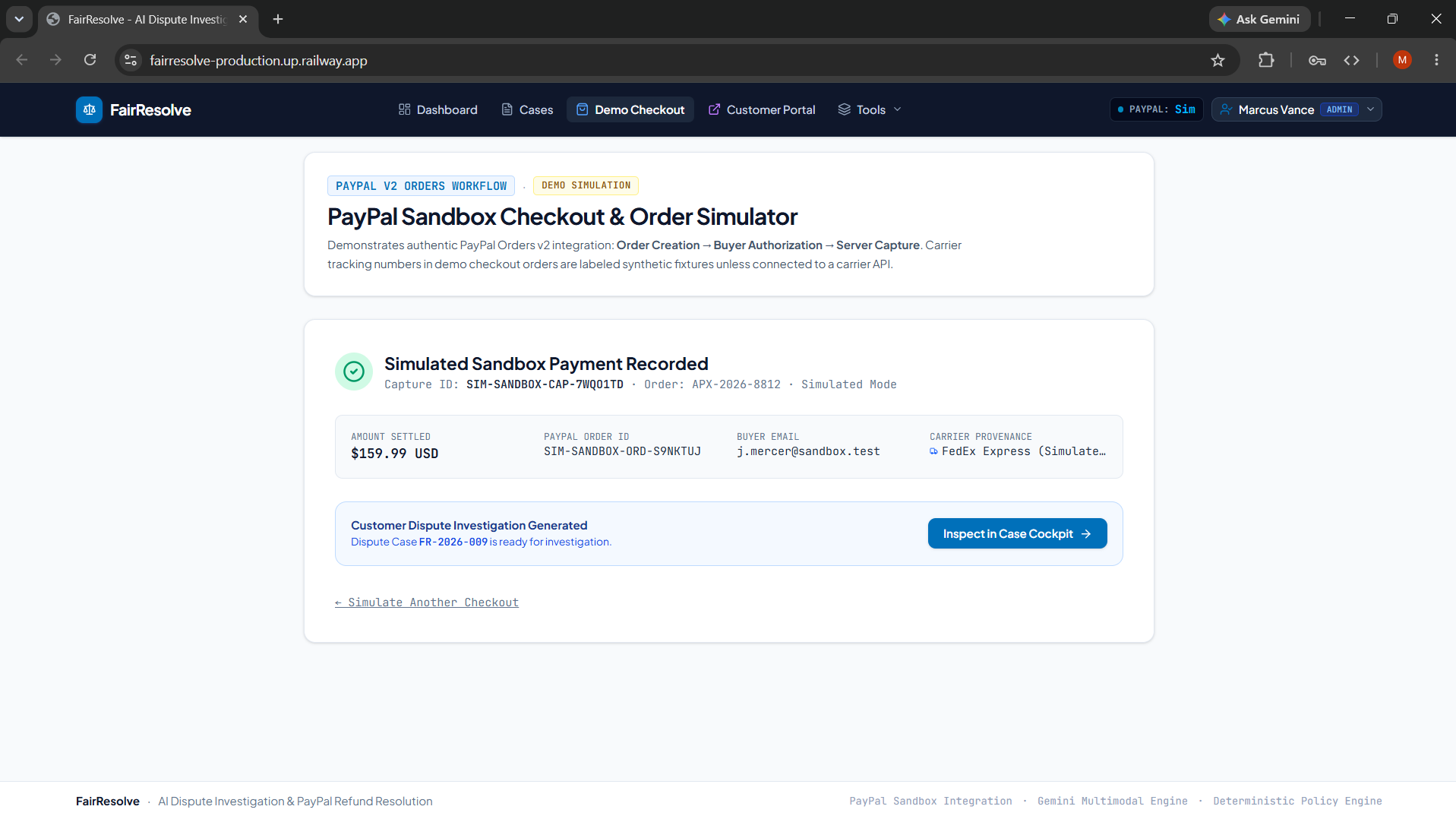
PayPal Sandbox CheckOut 2
-
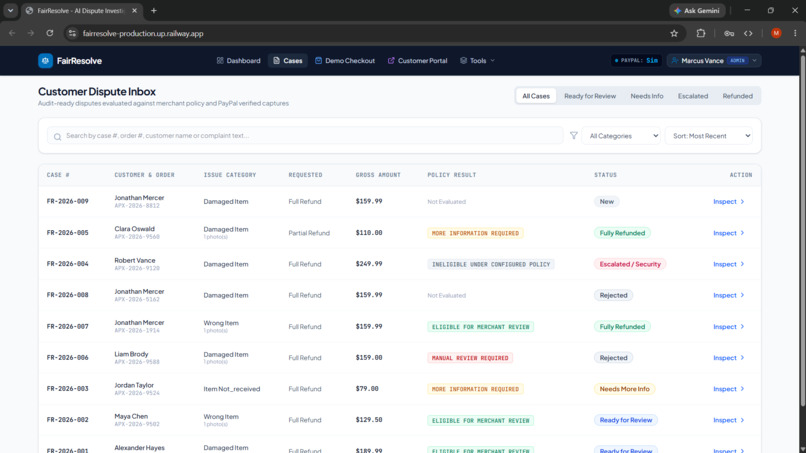
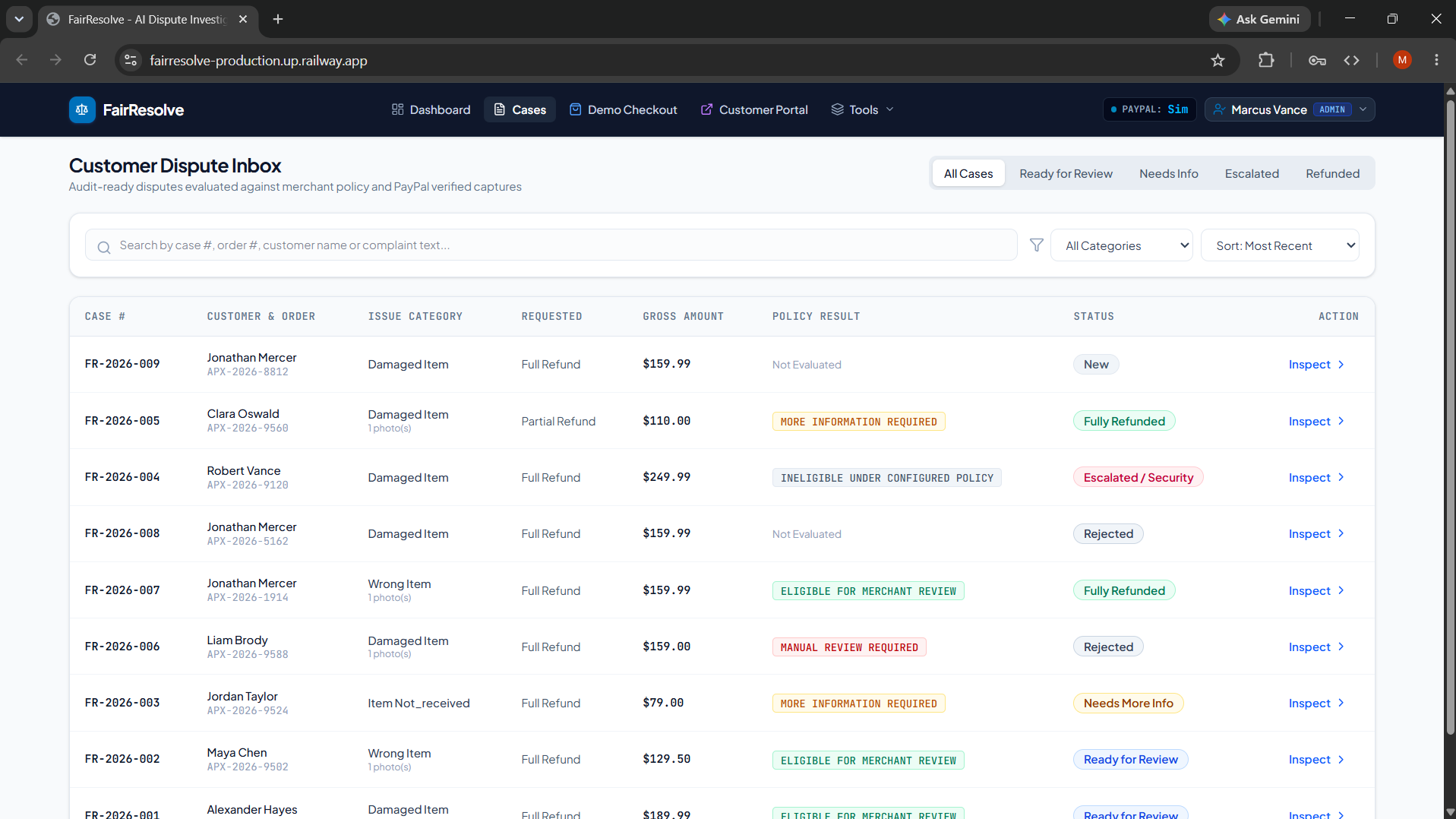
Cases page
-
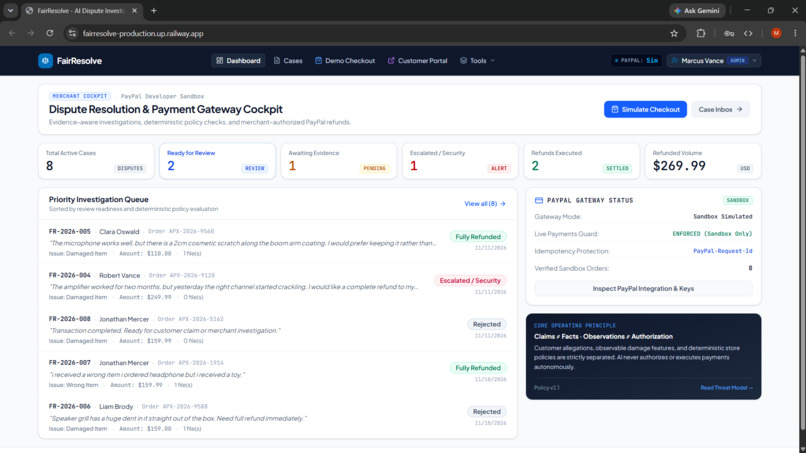
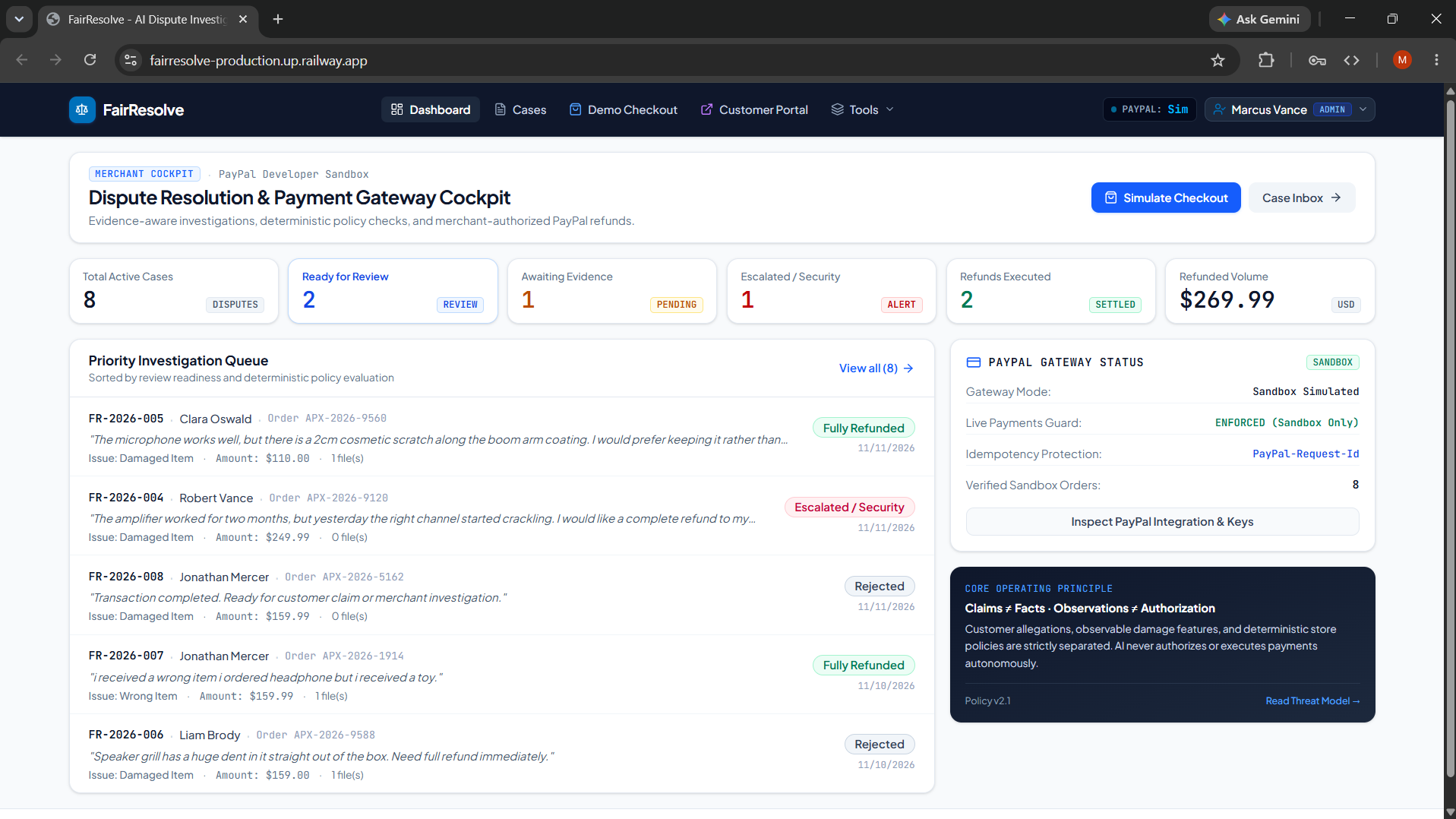
DashBoard page
-
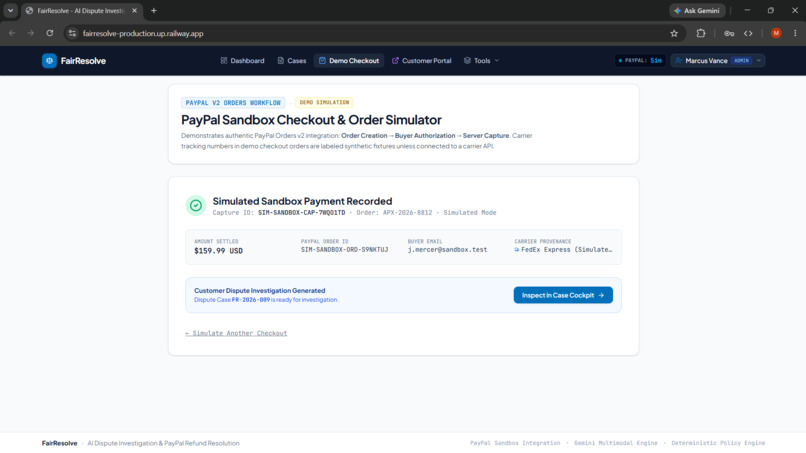
PayPal Sandbox CheckOut 1
-
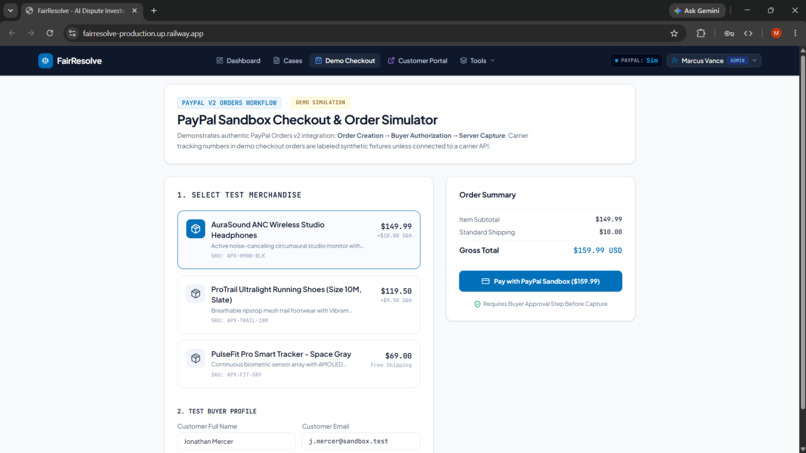
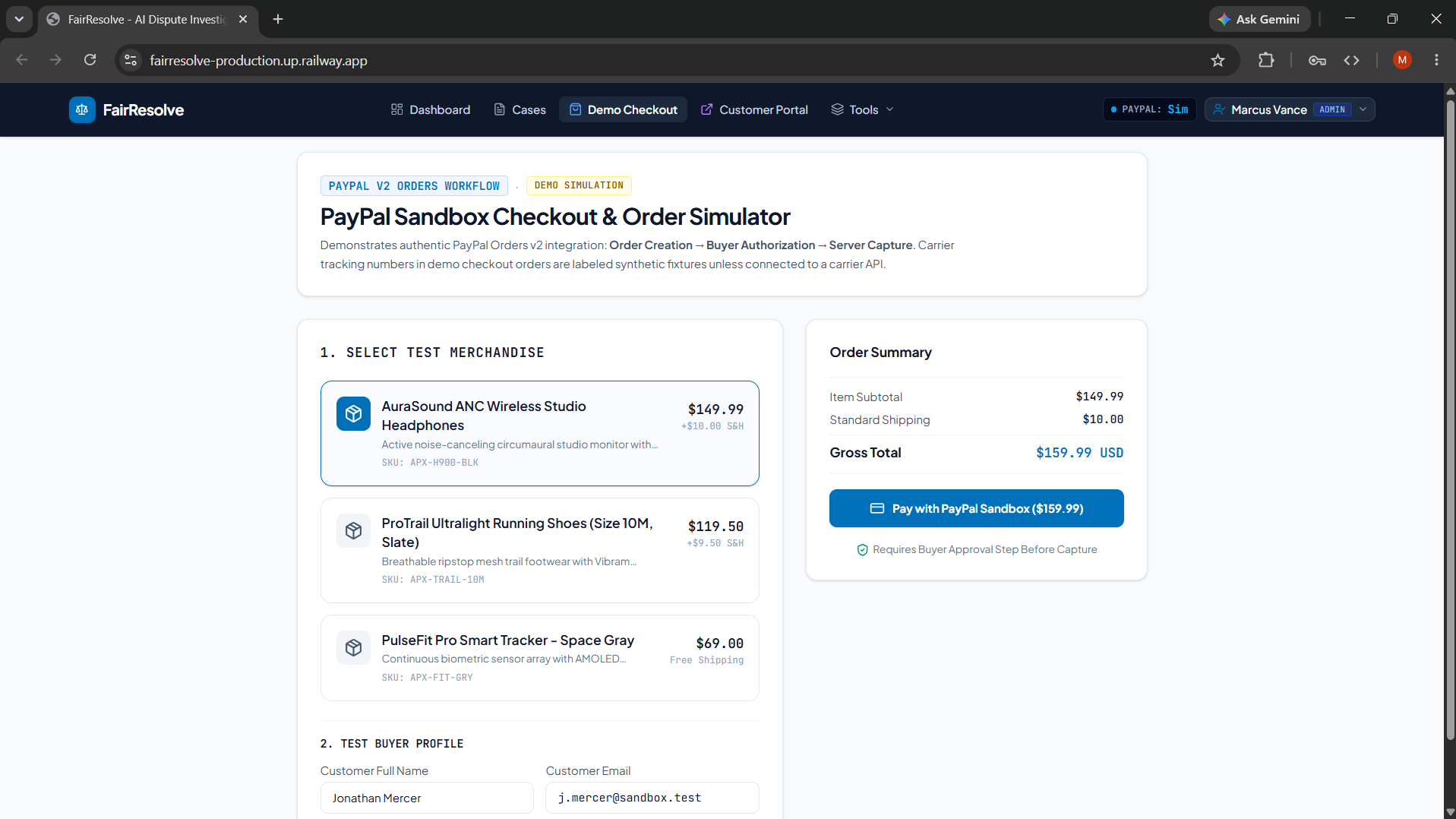
Demo Checkout page
-
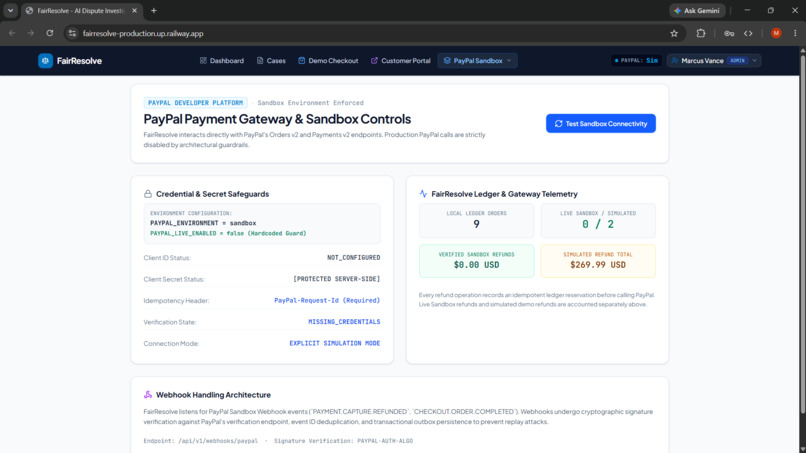
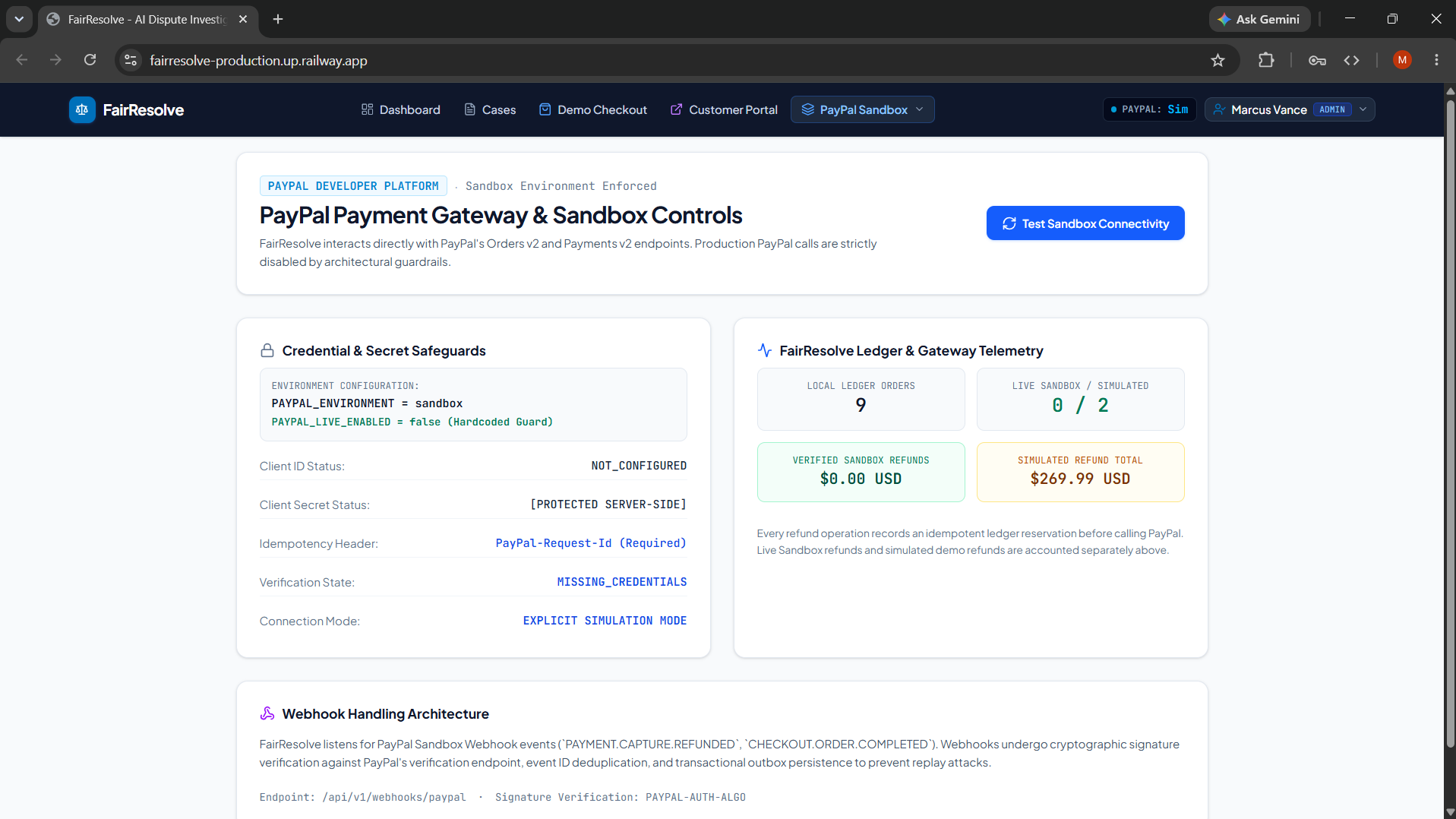
PayPal Sandbox
Inspiration
Online payment disputes can be frustrating for both customers and merchants. Customers want fair outcomes, while merchants need to protect themselves against fraudulent claims and unjustified refund requests.
For small online businesses, investigating disputes often involves manually reviewing customer complaints, checking order information, collecting evidence, and interpreting refund policies. This process can be time-consuming, inconsistent, and difficult to manage without a dedicated support team.
We built FairResolve to make dispute resolution more structured, transparent, and accountable by combining AI-assisted evidence analysis with deterministic policy evaluation and human decision-making.
What it does
FairResolve is an AI-powered merchant dispute and refund management platform designed to help small businesses investigate customer complaints and make fair, evidence-based refund decisions.
The platform brings the dispute lifecycle into one structured workflow:
- Dispute Submission: Customers can raise disputes involving issues such as damaged products, incorrect items, or orders not received.
- AI-Powered Evidence Analysis: Gemini helps extract relevant information from submitted evidence, identify inconsistencies, and highlight missing information.
- Policy-Based Evaluation: A deterministic policy engine evaluates the available evidence against configured refund rules and eligibility conditions.
- Human-Controlled Decisions: Merchants review the investigation and retain authority to approve, reject, request additional evidence, or escalate a dispute.
- Audit History: Important actions and decisions are recorded to support transparency and accountability.
- PayPal Integration Architecture: The platform is designed around PayPal refund workflows, with refund execution requiring authorized merchant approval.
FairResolve does not allow AI to independently authorize refunds. It supports human decision-makers rather than replacing them.
How we built it
We built FairResolve using a modular full-stack architecture that separates the user interface, dispute management logic, AI analysis, policy evaluation, and payment integration.
Frontend: React and TypeScript provide the merchant dashboard and customer-facing dispute workflow.
Backend: Python with FastAPI handles API requests, dispute processing, evidence management, and business logic.
Database: PostgreSQL with SQLModel manages structured dispute records, users, decisions, and audit information.
AI Integration: Google's Gemini model, accessed through the Google GenAI SDK, assists with evidence interpretation and structured information extraction.
Payment Integration: The architecture incorporates the official PayPal Python SDK for payment and refund workflows.
Decision Engine: Refund eligibility is evaluated using deterministic business rules rather than allowing the language model to make financial decisions.
We designed the system with role-based access, tenant isolation, secure evidence handling, auditability, and controlled refund authorization in mind.
For the recorded demonstration, we used Explicit Simulation Mode to demonstrate the workflow without claiming live PayPal transactions.
Challenges we ran into
One of our biggest challenges was designing an AI-assisted dispute system that could be useful without giving an AI model uncontrolled authority over financial decisions.
We addressed this by separating AI-based evidence interpretation from deterministic refund eligibility evaluation and merchant authorization.
Other challenges included:
- Evidence Reliability: Handling incomplete, unclear, or inconsistent customer-submitted evidence.
- Decision Consistency: Ensuring refund eligibility follows predefined business rules instead of unpredictable AI-generated decisions.
- Financial Safety: Designing refund workflows that require explicit merchant authorization.
- System Security: Considering role-based permissions, tenant isolation, secure evidence storage, and audit trails.
- Payment Integration: Designing a PayPal-compatible refund workflow while maintaining a clear separation between simulated demonstrations and actual payment execution.
Balancing AI capabilities with reliability, accountability, and financial safety was one of the most important engineering challenges of the project.
Accomplishments that we're proud of
We are proud to have developed FairResolve as more than a simple AI chatbot. It is a structured dispute management platform that connects evidence analysis, business rules, merchant decision-making, and payment workflow architecture.
Our key accomplishments include:
- Designing an end-to-end dispute resolution workflow.
- Integrating Gemini-assisted evidence interpretation.
- Separating AI analysis from deterministic refund decisions.
- Designing human-controlled refund authorization.
- Creating a structured audit history for accountability.
- Developing a modular architecture for future PayPal integration and production expansion.
Most importantly, we built the system around a principle we believe is essential in fintech: AI can assist decisions, but financial authority must remain accountable.
What we learned
Through building FairResolve, we learned that integrating AI into financial workflows requires much more than generating intelligent responses.
We gained practical experience in designing AI-assisted workflows, building backend APIs, structuring databases, integrating external services, and separating probabilistic AI outputs from deterministic business logic.
We also learned the importance of security, auditability, authorization, and transparent system behavior when building fintech applications.
Our biggest takeaway was that responsible AI is not just about what a model can do, but also about what it should never be allowed to do independently.
What's next for FairResolve
Our next goal is to move FairResolve closer to production readiness.
Planned improvements include:
- Completing and validating live PayPal Sandbox refund integration.
- Strengthening evidence verification and fraud-risk indicators.
- Improving AI analysis accuracy and handling uncertain evidence.
- Expanding configurable merchant refund policies.
- Adding more advanced analytics and dispute-resolution insights.
- Improving webhook processing, reconciliation, and payment workflow reliability.
- Conducting broader security, performance, and integration testing.
We envision FairResolve becoming a reliable dispute-resolution assistant that helps online merchants make faster, more consistent, and more transparent decisions while keeping financial control in human hands.
Built With
- fastapi
- gemini
- genai
- paypal
- postgresql
- python
- react
- restapi
- sdk
- sqlmodel
- typescript
