-

Transparent AI report card with fairness audit, making evaluation decisions explainable and accountable.
-

Bias-aware evaluation engine that explains scoring decisions and detects unfair assessment patterns in real time.
-

End-to-end ethical AI interview system combining evaluation, explainability, and fairness auditing in a single interface.


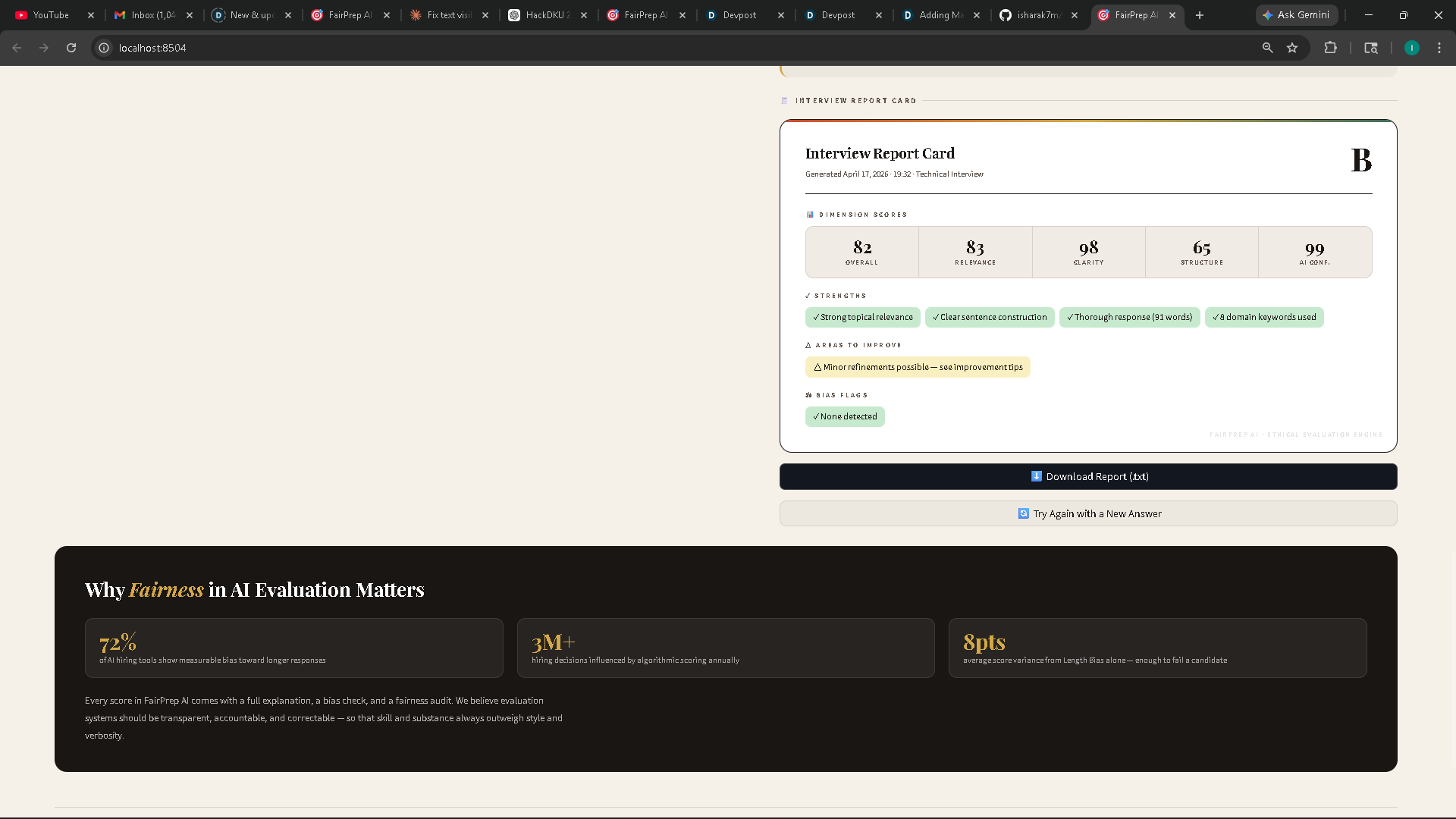
Inspiration: Modern hiring systems often lack transparency and fairness. Candidates invest significant time preparing for interviews, yet feedback is usually vague and inconsistent. More importantly, subtle biases—such as favoring longer or more structured answers—can influence evaluation, even when the actual content quality is similar. This raised a critical question: Can an AI system not only evaluate answers, but also evaluate the fairness of its own evaluation? FairPrep AI was built to explore this idea.
What it does: FairPrep AI is an ethical AI-powered interview coach that simulates interview scenarios and evaluates candidate responses across three dimensions: relevance, clarity, and structure. Unlike traditional systems, it does not operate as a black box. It provides:
- Transparent scoring with clear explanations
- Bias detection to identify unfair evaluation patterns
- A fairness audit system that re-evaluates answers under different conditions
- A bias demonstration mode that visually shows how similar-quality answers can receive different scores This allows users to understand not just how they performed, but also how they were evaluated.
How we built it: The system was designed with a focus on explainability and practical usability. Frontend: Streamlit for rapid, interactive UI development Backend: Python Evaluation Engine: Keyword-based relevance scoring Sentence structure and readability analysis Heuristic-based scoring for clarity and organization Bias Detection: Identifies patterns such as length bias and content–structure imbalance Fairness Audit: Simulates alternative scoring models and compares results Instead of relying on complex black-box models, we used structured logic and lightweight NLP techniques to ensure that every decision made by the system is interpretable.
Challenges we ran into: One of the biggest challenges was defining and detecting bias in a measurable way. Bias in interviews is often subtle and context-dependent, so we had to translate it into observable signals such as score imbalances and evaluation inconsistencies. Another challenge was balancing simplicity with effectiveness. We wanted the system to feel intelligent and impactful without relying on heavy machine learning models, especially within limited development time. Finally, presenting the concept clearly was a challenge. It was important to ensure that users and judges could immediately understand how bias occurs and how the system addresses it.
What we learned: This project highlighted that building ethical AI is not just about improving accuracy, but about ensuring transparency, fairness, and accountability.
We learned that: Explainability builds trust more effectively than complexity Even simple systems can demonstrate meaningful insights if designed thoughtfully Evaluating AI systems themselves is just as important as building them Accomplishments that we're proud of Designing a system that evaluates both answers and the fairness of evaluation Building a bias demonstration mode that makes abstract concepts visually clear Creating a clean, interactive interface that feels like a real product Delivering a complete, end-to-end solution within limited time What's next for FairPrep AI: Future improvements could include:
- Real-time speech and tone analysis
- Multilingual support for broader accessibility
- Data-driven bias calibration using real interview datasets
- Integration with hiring platforms to support fairer evaluation practices
Ethical Considerations: FairPrep AI is built around responsible AI principles: Fairness: Detects and mitigates evaluation bias Transparency: Clearly explains how scores are generated Accountability: Audits its own evaluation process Privacy: Avoids storing sensitive user data
At its core, the system reinforces a simple idea: AI should not just evaluate people, it should do so responsibly and transparently.

