-
-
Problem Overview
-
Working of
-
Architecture
Inspiration
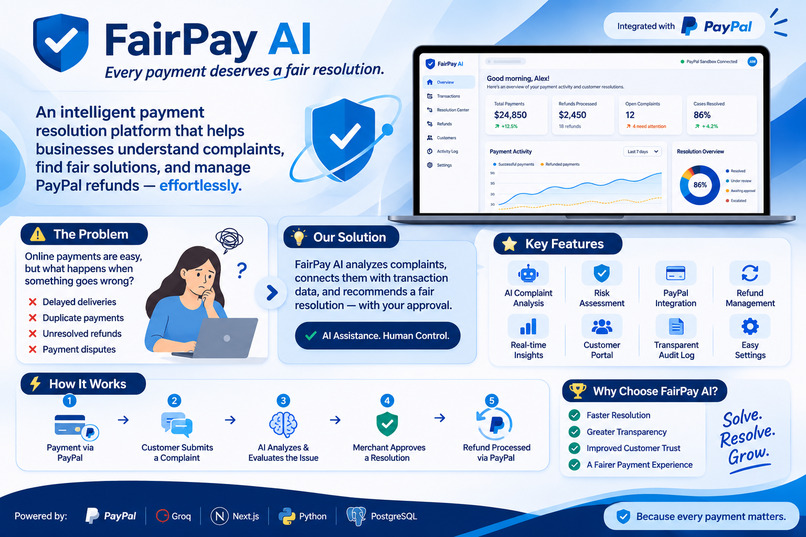
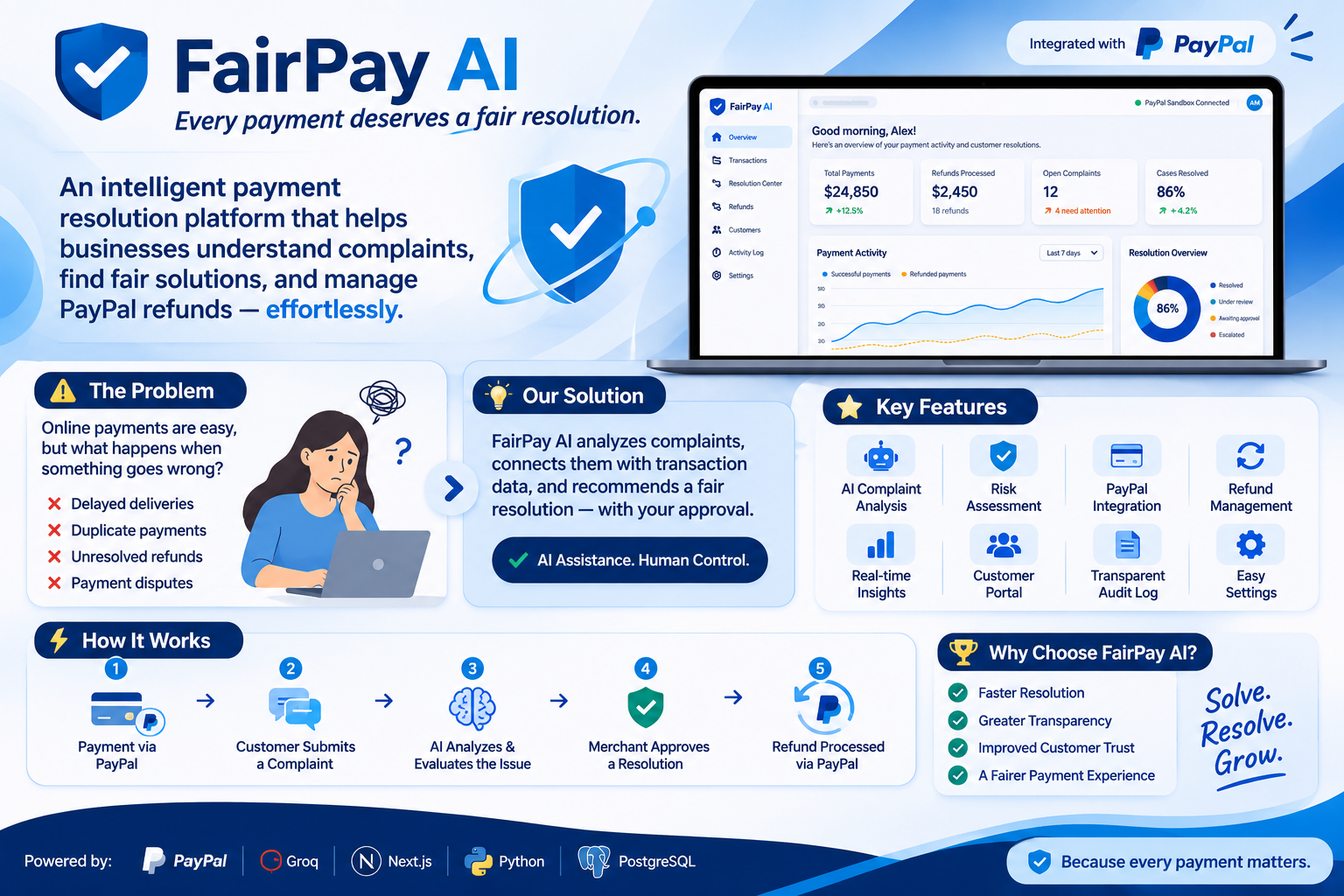
Online payments have made shopping convenient, but what happens when something goes wrong after a customer has paid? An order might never arrive, a customer might get charged twice, or a refund might take longer than expected. For small businesses, handling these situations can become difficult when payment details, customer complaints and order information are scattered across different places.
We started thinking about how AI could make this process easier, not by replacing human decisions, but by helping businesses understand problems and respond more effectively. That idea inspired us to build FairPay AI — a platform focused on making payment resolution simpler, faster and fairer for both merchants and customers.
What it does
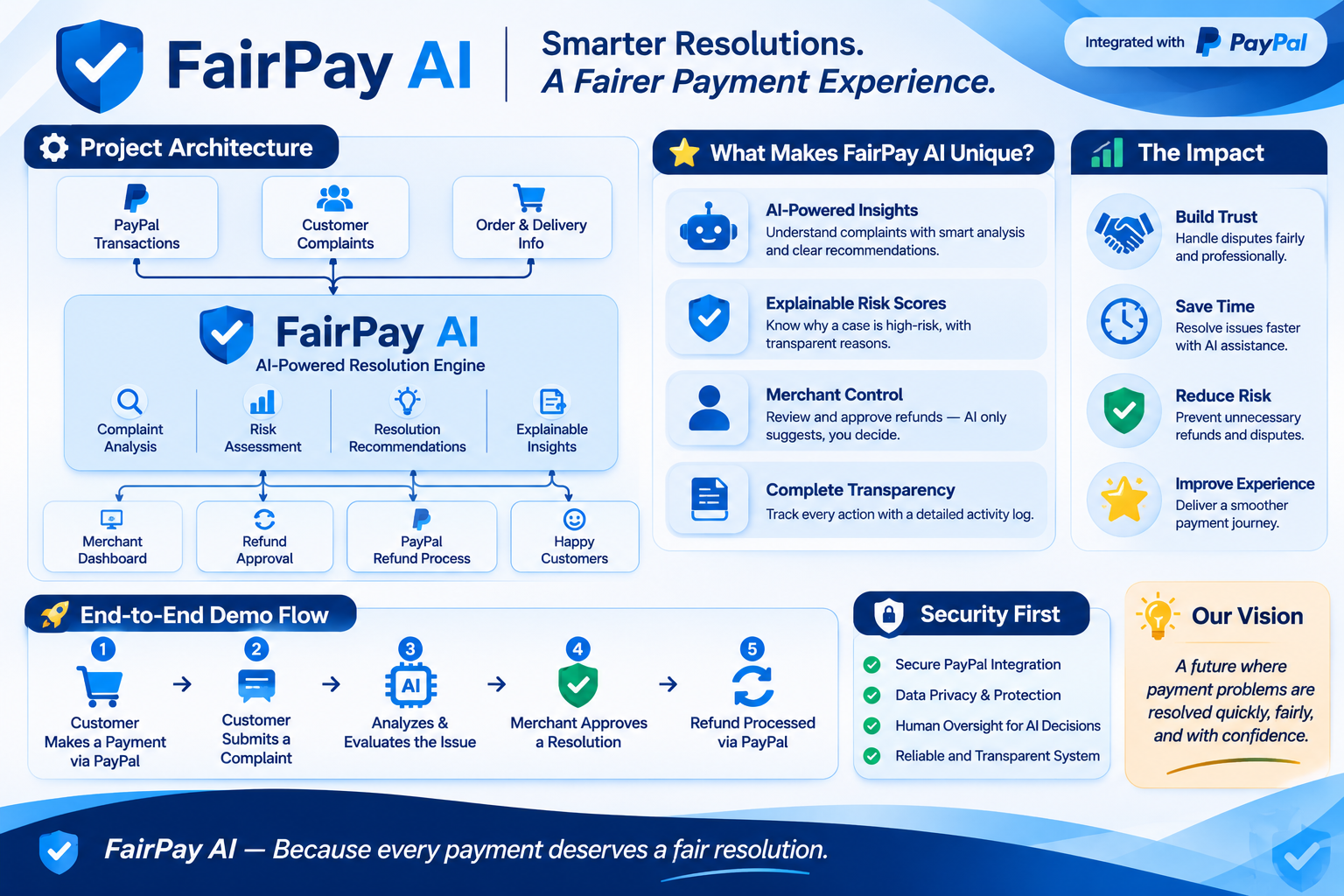
FairPay AI is an AI-powered payment resolution platform designed to integrate with PayPal.
It helps merchants:
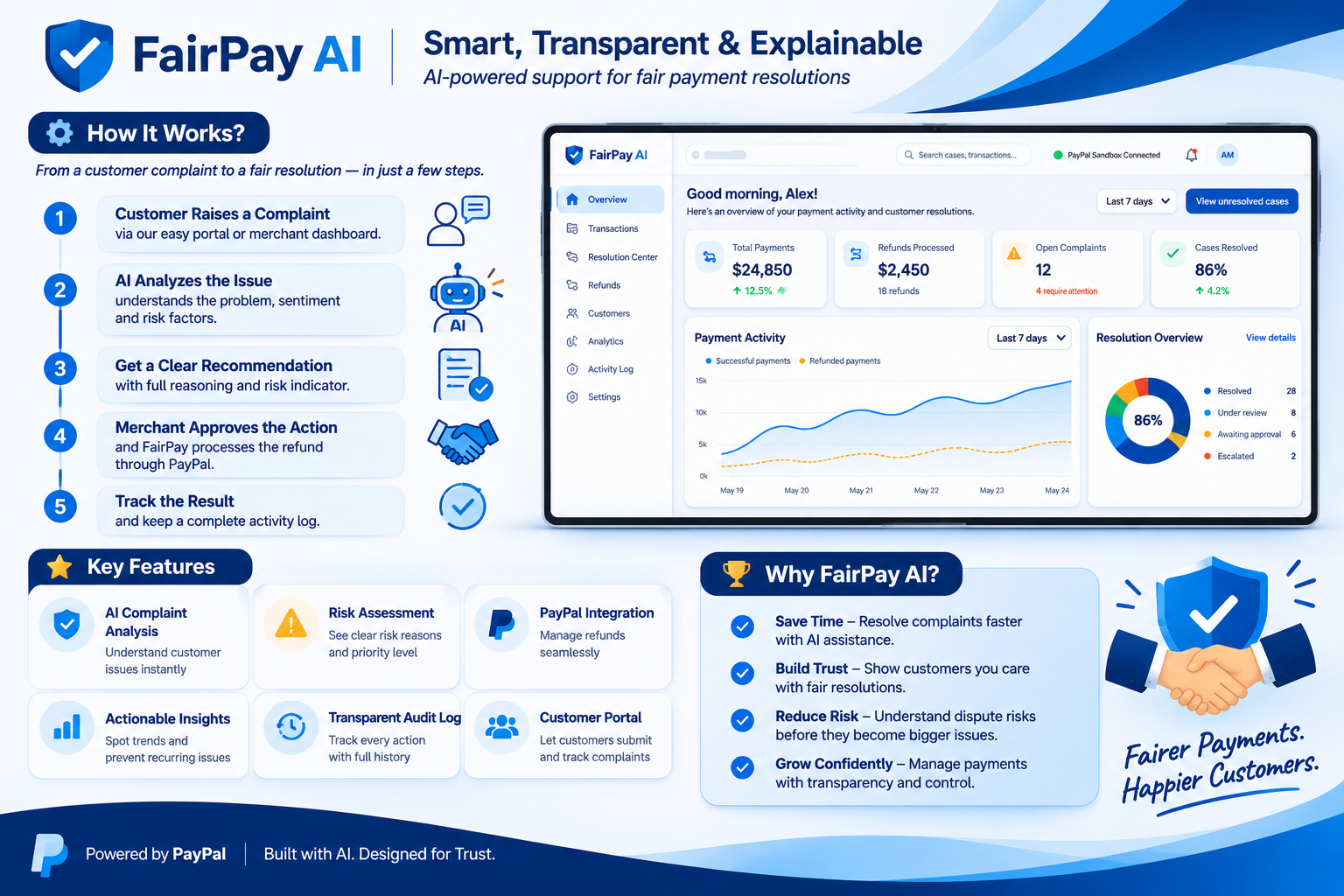
- View and manage PayPal transactions in one dashboard.
- Receive and organize customer payment complaints.
- Analyze complaints to identify the issue, customer sentiment and urgency.
- Understand potential dispute risks through explainable risk indicators.
- Gather relevant transaction, order and customer communication evidence.
- Receive AI-generated suggestions for suitable resolutions.
- Review, edit, approve or reject refund recommendations.
- Submit merchant-approved refunds through PayPal.
- Track refund progress and maintain an activity history.
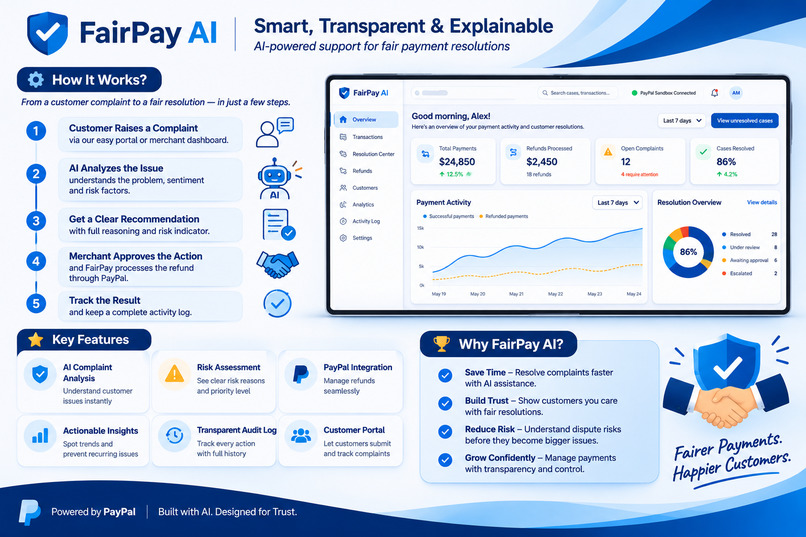
A key part of FairPay AI is that AI assists with decisions but does not make financial decisions independently. The merchant remains in control and must approve a refund before it is submitted.
How we built it
We designed FairPay AI around a simple merchant workflow: understand the complaint, review the evidence, consider the recommendation and take action.
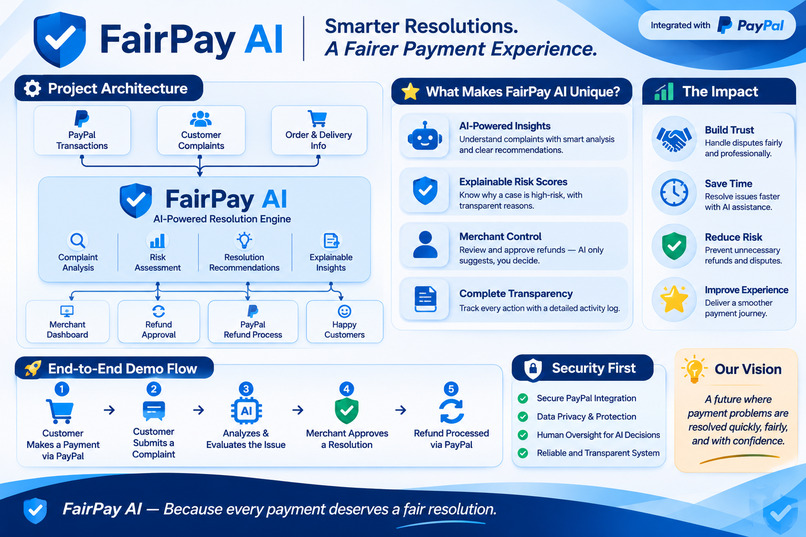
Our planned technology stack includes:
- Frontend: React, Next.js and TypeScript for a responsive and easy-to-use dashboard.
- Backend: Python FastAPI for transaction management, complaint processing and refund workflows.
- Payment Integration: PayPal Developer Sandbox for payment creation, capture and refund testing.
- AI: Groq-powered language models for complaint classification, sentiment analysis, summarization and resolution recommendations.
- Risk Assessment: A transparent rule-based scoring system that explains the factors behind each risk indicator.
- Database: PostgreSQL for storing transaction references, complaints, customer information and resolution records.
We began with the frontend experience, designing the Overview Dashboard, Transactions page, AI Resolution Center and Refund Management interface. We are working towards connecting these screens with the backend and PayPal Sandbox to demonstrate the complete workflow.
Challenges we ran into
One of our biggest challenges was deciding how much responsibility AI should have in a financial application. We wanted AI to provide useful recommendations without allowing it to approve refunds or make decisions that could directly affect someone's money.
Another challenge was understanding the limitations of payment data. PayPal can provide transaction information, but delivery updates and customer support conversations must come from the merchant's own systems. Combining these sources reliably is an important part of our approach.
We also had to consider how to prevent incorrect or duplicate refunds, validate refundable balances and make the approval process clear.
Finally, designing an interface that is powerful enough for merchants but simple enough for someone without technical knowledge required careful attention to the user experience.
Accomplishments that we're proud of
We are proud of turning a common but often overlooked problem in online payments into a practical AI-powered solution.
Some aspects we are particularly proud of are:
- Designing a unified dashboard for transactions, complaints and refunds.
- Creating an AI Resolution Center that explains why a complaint needs attention instead of displaying only a risk score.
- Keeping merchants in control of refund decisions through an approval-based workflow.
- Bringing payment information and complaint evidence together to support more informed decisions.
- Prioritizing transparency, accountability and customer experience alongside automation.
Most importantly, we are building FairPay AI with the intention of solving a real business problem rather than creating another generic AI chatbot.
What we learned
Through this project, we are learning that building an AI-powered financial application involves much more than connecting a language model to a frontend.
We have gained a better understanding of payment workflows, API integration, AI-assisted decision-making, risk assessment, data validation and the importance of secure financial operations.
We also learned that AI recommendations need to be understandable and supported by evidence, especially when they influence decisions involving money. Human oversight is not just an additional feature; it is an essential part of responsible automation.
What's next for FairPay AI
Our next goal is to complete the end-to-end working workflow.
We plan to:
- Complete the PayPal Sandbox integration for creating, capturing and refunding payments.
- Connect the frontend with our FastAPI backend and database.
- Implement AI-powered complaint classification and resolution recommendations.
- Add explainable risk indicators using verified transaction and merchant-provided order information.
- Implement merchant approval, refund validation and duplicate-refund protection.
- Add PayPal webhook handling to track payment and refund updates.
- Test the complete customer complaint-to-refund journey.
- Explore integrations with merchant order management and customer support systems.
In the longer term, we hope to make FairPay AI useful for businesses of different sizes by supporting more payment-related issues, improving resolution insights and making customer communication more transparent.
Our vision is simple: make resolving payment problems as smooth and trustworthy as making the payment itself.

