-
-
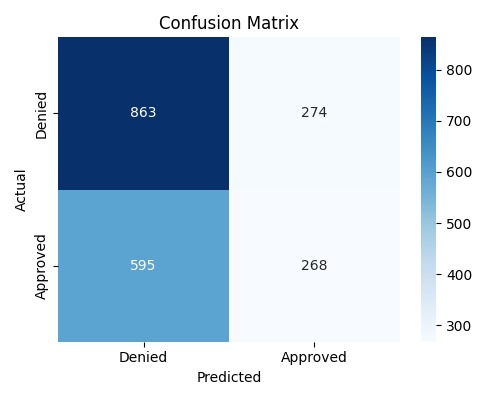
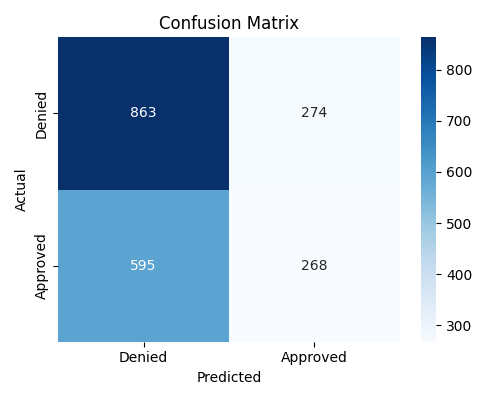
Confusion Matrix showing the model’s loan approval predictions versus actual outcomes, highlighting correct and incorrect classifications.
Inspiration
The increasing reliance on machine learning in financial lending has brought both opportunities and risks. While algorithms can streamline loan approvals, they can also perpetuate or amplify existing biases, leading to unfair outcomes for certain groups. Inspired by the need for transparency and fairness in AI, we set out to build a tool that not only detects but also helps mitigate bias in loan approval models. Our goal is to empower both developers and end-users to understand, visualize, and address bias in financial decision-making systems.
What it does
FairLoan: ML Bias Detection & Mitigation in Financial Lending is a web-based application that analyzes loan approval models for potential bias, particularly across gender lines. The tool allows users to:
- Upload or use sample loan datasets
- Analyze model predictions and error rates by demographic groups
- Visualize key metrics such as approval rates, confusion matrices, and SHAP summary plots
- Interactively explore how different features impact model decisions and fairness
How we built it
We started by exploring and preprocessing a real-world loan dataset in a Jupyter notebook (loan_bias_analysis.ipynb). We performed exploratory data analysis to uncover patterns and potential sources of bias. After training a machine learning model to predict loan approvals, we evaluated its performance and analyzed error rates by gender.
To make our analysis accessible, we built a Streamlit web application (streamlit_app.py). The app loads the trained model and dataset, provides an interface for users to input new data, and displays predictions alongside bias analysis visualizations. We used SHAP values to interpret model decisions and highlight any disparities in feature importance across groups.
The project is fully open-source and can be run locally or deployed for broader access.
Challenges we ran into
- Data Quality: Handling missing or imbalanced data required careful preprocessing to ensure fair analysis
- Bias Measurement: Quantifying bias in a meaningful way was challenging, especially when balancing accuracy and fairness
- Model Interpretability: Making complex model explanations accessible to non-technical users required thoughtful visualization and UI design
- Deployment: Ensuring the Streamlit app worked seamlessly across different environments and with various dataset sizes took significant testing and optimization
Accomplishments that we're proud of
- Successfully identified and visualized gender-based bias in loan approval predictions
- Built an interactive, user-friendly web app that democratizes access to bias analysis tools
- Integrated SHAP-based interpretability, making model decisions transparent and actionable
- Created clear, informative visualizations (approval rates, confusion matrix, SHAP plots) to communicate findings effectively
What we learned
- Bias is subtle — Even well-performing models can harbor hidden biases that only become apparent through careful analysis
- Transparency matters — Visual explanations and open-source tools are crucial for building trust in AI systems
- User experience is key — Making technical concepts accessible through intuitive interfaces greatly increases the impact of fairness tools
- Continuous vigilance — Bias detection and mitigation is an ongoing process, not a one-time fix
What's next for FairLoan
- Expand Bias Metrics: Incorporate additional fairness metrics (e.g., equal opportunity, disparate impact) and support for more demographic groups
- Automated Mitigation: Integrate bias mitigation algorithms to suggest or apply corrections automatically
- Wider Dataset Support: Enable users to analyze their own datasets with minimal setup
- Deployment: Host the app online for public access and feedback
- Community Engagement: Collaborate with researchers, financial institutions, and advocacy groups to refine and expand the tool’s capabilities
Built With
- and-backend-logic-jupyter-notebook-?-for-data-exploration
- csv
- jupyternotebook
- machine-learning
- matplotlib
- numpy
- pandas
- preprocessing
- python
- scikit-learn
- seaborn
- shap
- streamlit

Log in or sign up for Devpost to join the conversation.