-
-
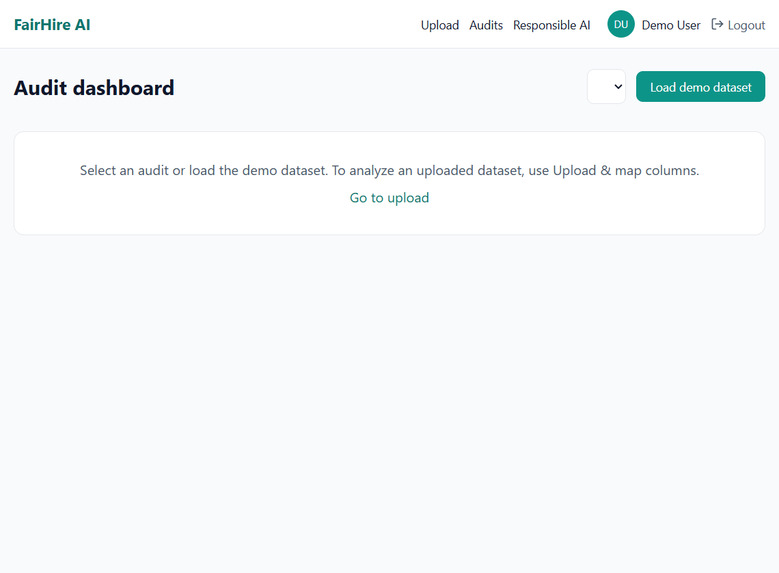
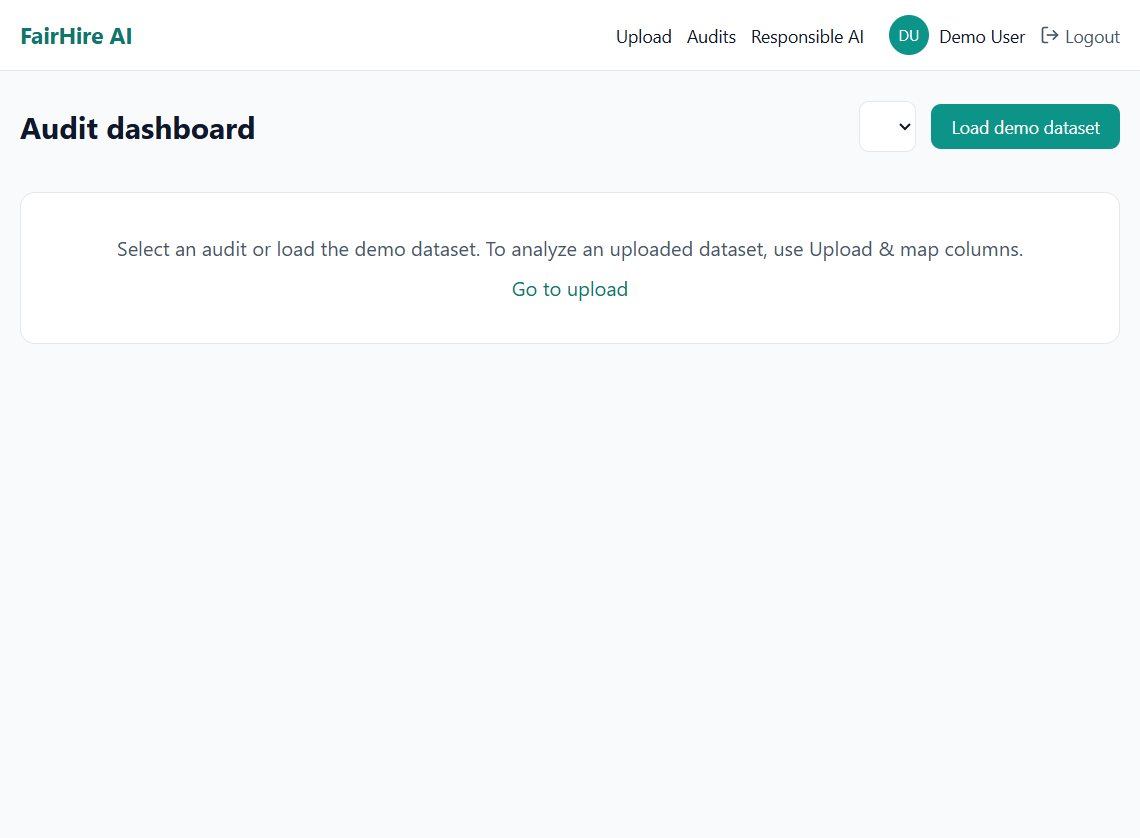
Dashboard
-
thumbnail
Inspiration
I wanted to build something that addresses an important question: Are AI-powered hiring tools treating everyone fairly?
Hiring decisions can have a huge impact on people's lives, but when algorithms are involved, unfair patterns can be difficult to notice. I wanted to create a tool that makes these patterns easier to identify, measure, and understand instead of simply talking about AI bias.
FairHire AI is especially motivated by the barriers that historically underrepresented communities, including Black applicants, may face in automated hiring. It is designed to help people investigate potential disparities, not to make hiring decisions or claim that a single metric proves discrimination.
What I Learned
Building FairHire AI taught me several important lessons:
Fairness has multiple dimensions. Different metrics measure different aspects of fairness, and improving one metric does not guarantee that every outcome is fair.
Data quality is essential. Missing values, unclear labels, and small sample sizes can affect results. Reporting these limitations is just as important as calculating the metrics.
Explainability matters. Numbers alone are not enough. People need clear explanations of what the results mean and what they should investigate next.
Security must be built in from the start. Protecting user accounts and uploaded datasets is essential when working with potentially sensitive information.
How I Built It
I built FairHire AI using a modern frontend and a Java backend, with Firebase Authentication for secure user sign-in.
Technology Stack
Frontend: React, TypeScript, Vite, Tailwind CSS, Recharts, and Lucide icons.
Backend: Java 25, Spring Boot 3.4.x, Maven, and Bean Validation.
Authentication: Firebase Authentication with email/password and Google Sign-In.
Testing: JUnit 5.
Data Analysis: Java-based CSV processing and fairness metric calculations.
How It Works
Upload a dataset: Users upload a CSV file containing hiring outcomes or load a synthetic demonstration dataset.
Validate the data: The system checks for missing values, invalid labels, and data-quality issues, reporting exclusions instead of silently ignoring them.
Measure fairness: It calculates selection rates and compares outcomes across demographic groups.
Explain the findings: The dashboard presents potential disparities with clear explanations, sample sizes, and limitations.
Test mitigation strategies: Users compare baseline outcomes with a documented experimental approach and review the resulting trade-offs.
Generate a report: Users can export their findings to support further investigation and human review.
Fairness Metrics
For a demographic group (g), the selection rate is calculated as:
[ p_g = \frac{s_g}{n_g} ]
where (s_g) is the number of selected applicants and (n_g) is the number of applicants in that group.
The difference between the highest and lowest group selection rates is:
[ \Delta = \max_g(p_g)-\min_g(p_g) ]
These metrics help highlight differences in hiring outcomes. However, a disparity alone does not establish why it occurred or prove discrimination.
Mitigation Experiments
FairHire AI includes a simulator for exploring how hiring outcomes change under a documented merit-score threshold parity experiment. It compares baseline results with experimental outcomes and highlights changed decisions and potential trade-offs.
The purpose is to support investigation, not to assume that equal selection rates automatically mean a hiring process is fair.
Challenges I Faced
As a solo developer, I had to balance technical complexity with the time available.
Authentication: Integrating Firebase Authentication required handling Google Sign-In, protected routes, session persistence, and backend token verification.
Data quality: Incomplete records and small demographic groups required explicit warnings and careful handling.
Responsible explanations: I needed to make sure the application explained potential disparities without presenting assumptions as facts.
Scope management: Rather than adding too many features, I focused on the main workflow: upload, analyze, explain, simulate, and report.
These challenges helped me understand that building responsible AI tools requires more than implementing an algorithm. It also requires thoughtful design, reliable calculations, privacy safeguards, and clear communication.
What's Next
I would like to extend FairHire AI with additional fairness metrics, stronger statistical uncertainty analysis, more mitigation methods, and improved audit visualizations. I also want to explore feedback from community advocates and responsible AI practitioners to make the tool more useful in real-world settings.
Closing
FairHire AI is my attempt to make AI fairness easier to investigate and understand. By combining measurable results, transparent explanations, documented experiments, and privacy-conscious design, I hope to help people identify potential problems in automated hiring before those patterns go unnoticed.
The goal is simple: make hiring outcomes easier to examine, question, and improve—without pretending that fairness can be reduced to a single number.
Built With
- apache-commons-csv
- firebase-admin-sdk
- firebase-authentication
- html5
- java
- junit-5
- lucide
- maven
- react
- recharts
- rest-api
- spring-boot
- tailwind-css
- typescript
- vite


Log in or sign up for Devpost to join the conversation.