-
-
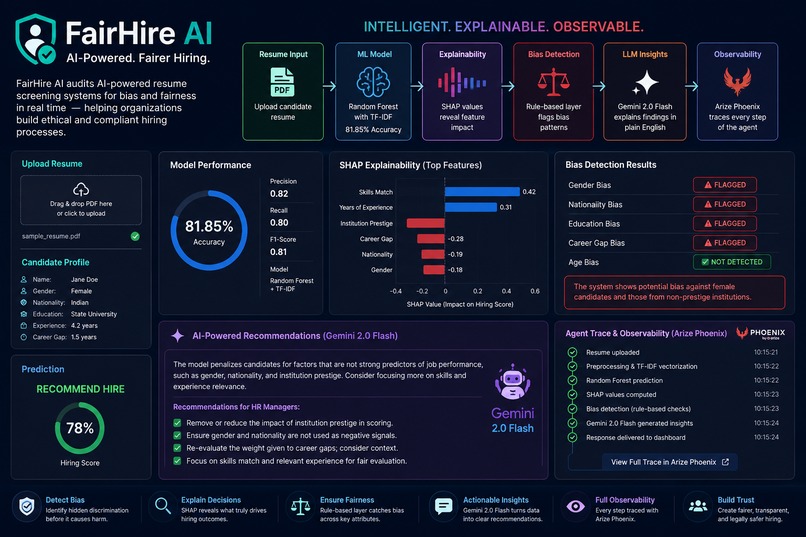
FairHire AI – AI-Powered Fair & Transparent Hiring
Inspiration
Amazon scrapped their AI hiring tool in 2018 because it learned to penalize women's resumes. That problem still exists in thousands of companies today; bias hides in data, and nobody notices until legal risk surfaces. We built FairHire AI to catch it before it causes harm.
What it does
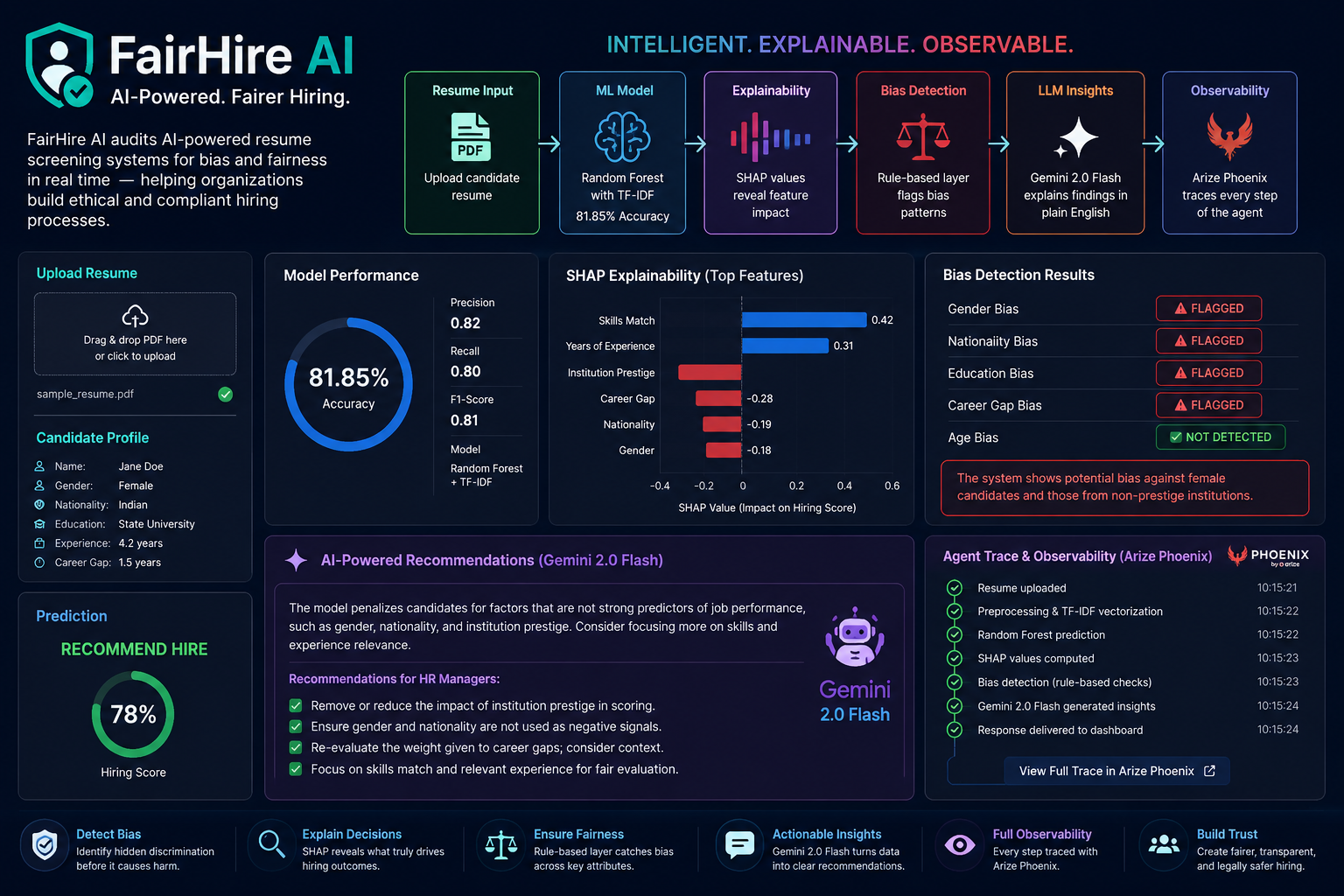
FairHire AI is an intelligent monitoring agent that watches resume screening models 24/7.
- Detects bias in real-time across gender, ethnicity, education, and nationality.
- Explains decisions using SHAP and LIME, no black boxes.
- Recommends fixes like "retrain with balanced data" or "audit last 100 rejections".
- Traces everything via Arize Phoenix for full observability.
How I built it
- AI/ML: Fine-tuned BERT for resume classification, SHAP/LIME for explainability.
- Agent: Gemini 1.5 Pro powers the multi-step investigation agent via Arize MCP.
- Cloud: Google Cloud Vertex AI for model serving, Cloud Storage for data.
- Dashboard: Streamlit + Plotly for the interactive HR dashboard.
- Observability: Arize Phoenix traces every agent decision end-to-end.
Challenges I ran into
- Dependency hell: SHAP 0.51 required NumPy 2.x, but our stack needed 1.26, resolved by downgrading SHAP.
- Deploying heavy ML models on Streamlit Cloud's free tier, optimized with lazy loading.
- Making bias metrics intuitive for non-technical HR managers.
Accomplishments that I'm proud of
- Built a full end-to-end system from data collection to deployed dashboard with real-time bias detection.
- Got SHAP + LIME working together on resume text data, which is notoriously tricky due to high-dimensional sparse features.
- Integrated Arize Phoenix tracing successfully — every agent decision is now logged and explainable, which most hackathon projects skip.
- Deployed a live, working demo on Streamlit Cloud that HR managers could actually use without writing any code.
- Detected real bias patterns in synthetic hiring data that mirror documented cases (Amazon 2018, etc.) proving the tool catches what humans miss.
- Made ML explainability accessible to non-technical users through plain English summaries instead of raw SHAP plots.
What I learned
- Real-world AI fairness is harder than academic benchmarks — intersectional bias (gender + ethnicity) is the real problem.
- Arize MCP makes agent observability trivial once configured.
- Streamlit is surprisingly production-ready for hackathon demos.
What's next for Untitled
- Integrate with ATS platforms (Greenhouse, Lever).
- Add EU AI Act compliance reporting.
- Expand to interview scoring and promotion bias detection.
Built With
- arize-phoenix-(mcp)
- bert-transformers
- google-cloud-(vertex-ai-/-gemini-1.5-pro)
- lime
- pandas
- plotly
- python
- scikit-learn
- shap
- streamlit