-
-
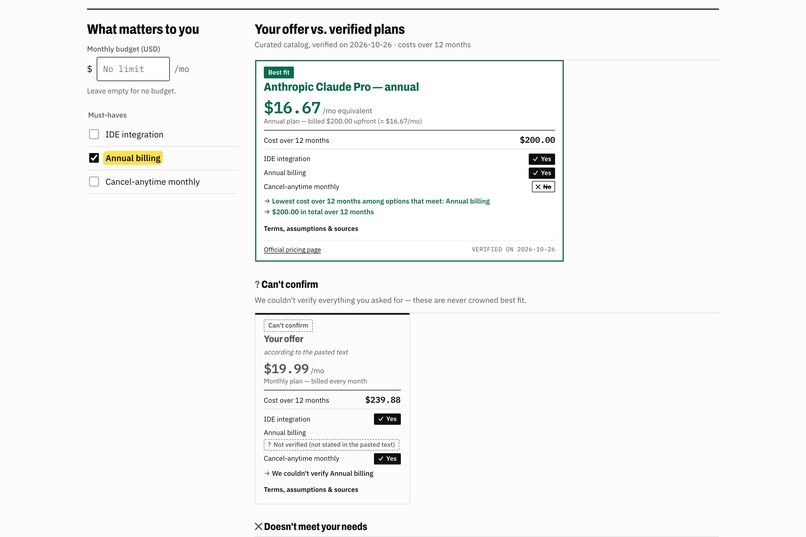
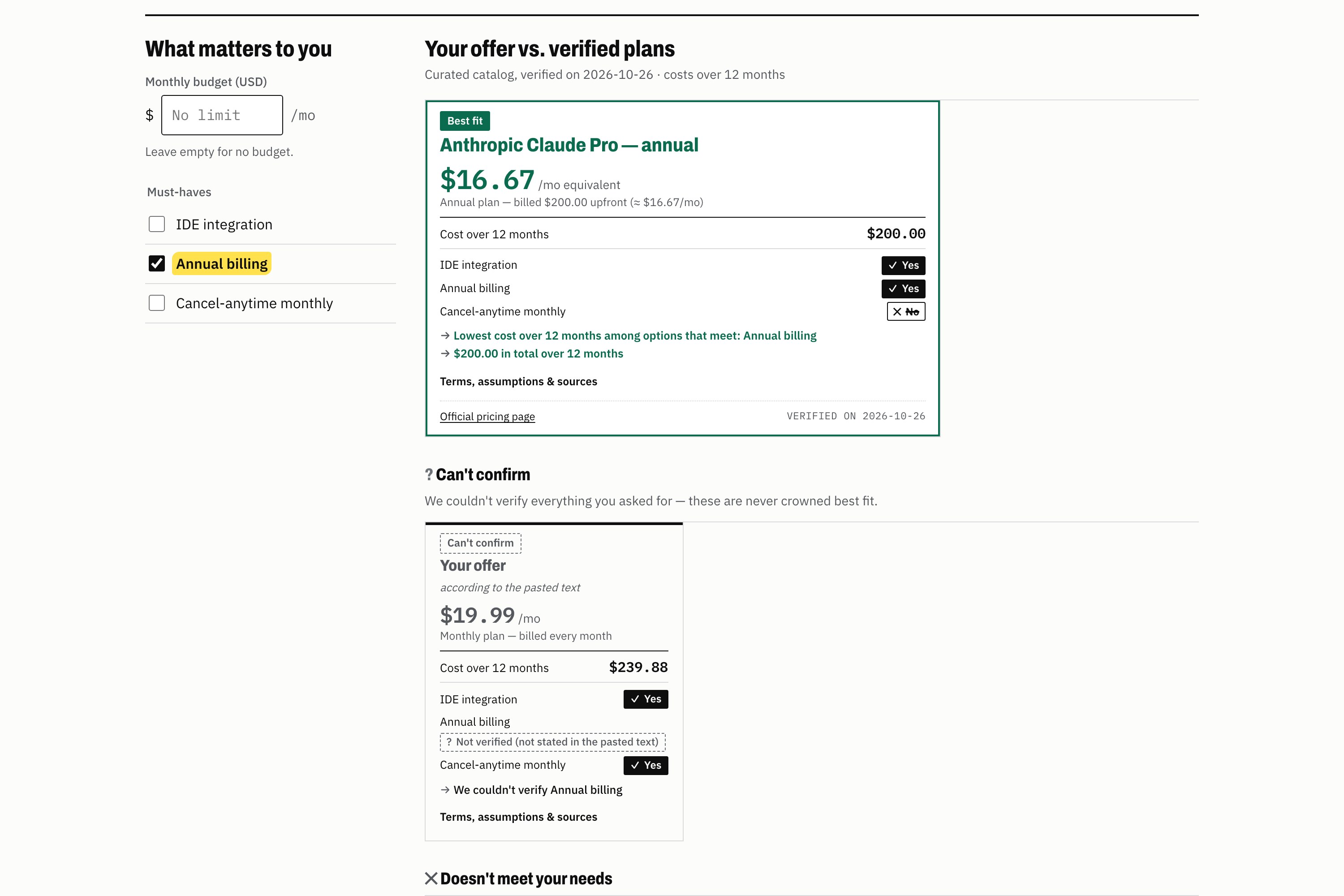
When checking "Annual billing": Annual Claude Pro becomes the Best fit, along with its reasons.
-
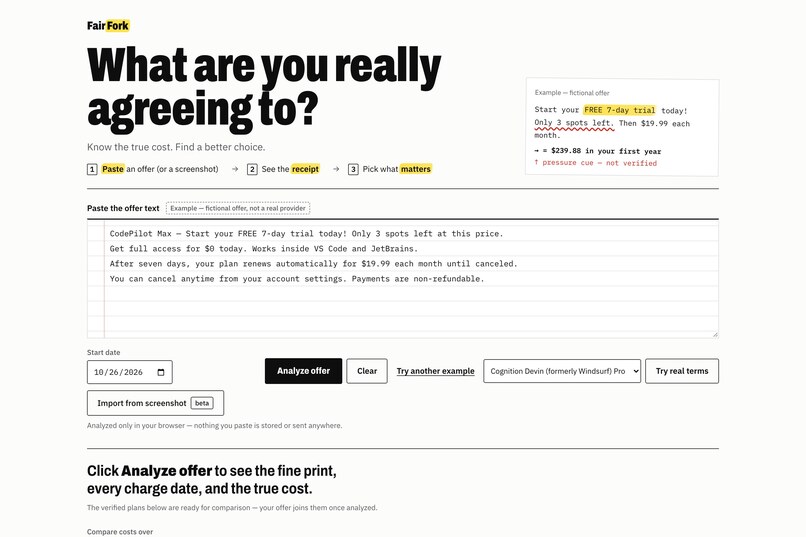
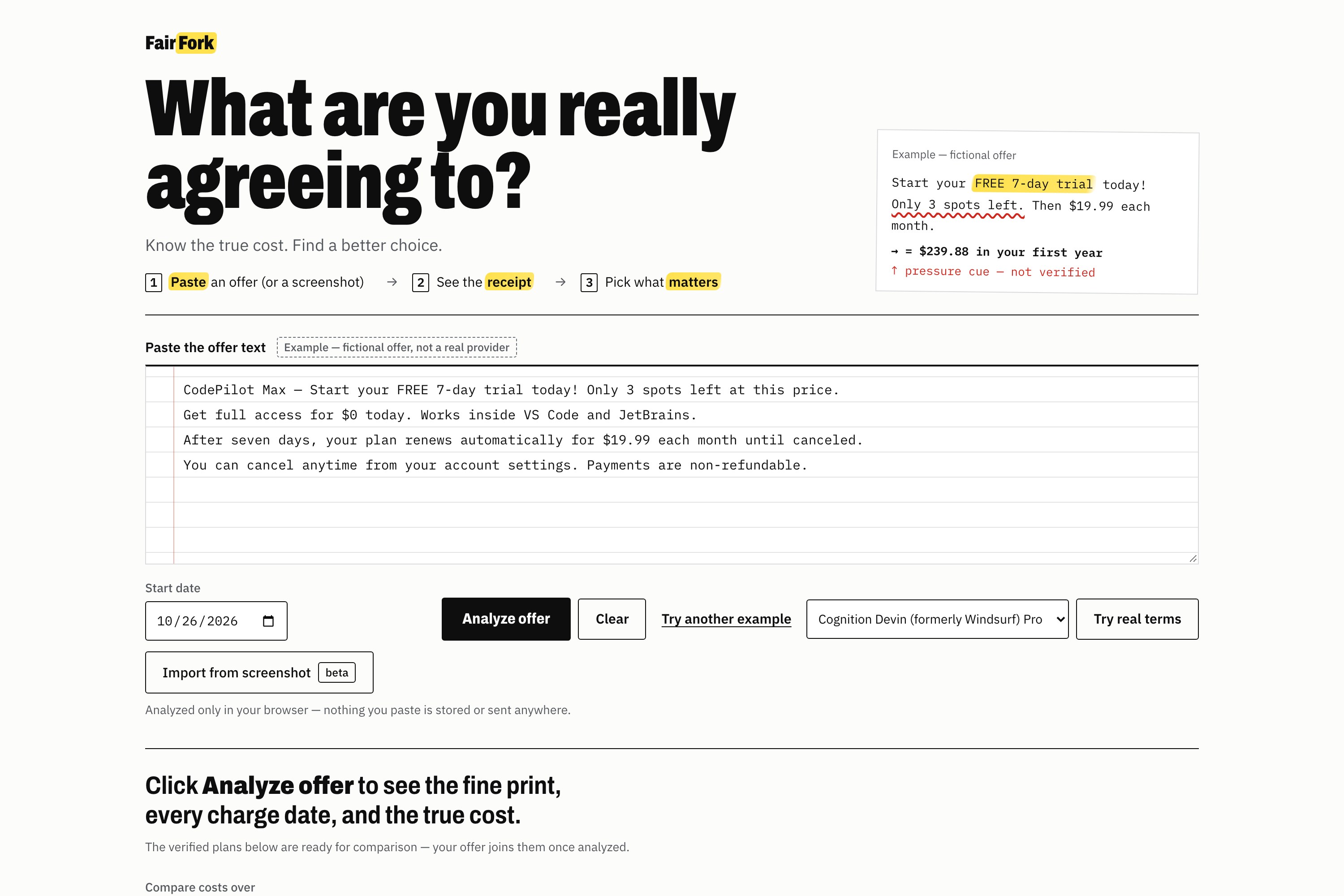
The cover: "What are you really agreeing to?", the 3 steps, and the annotated sample.
-
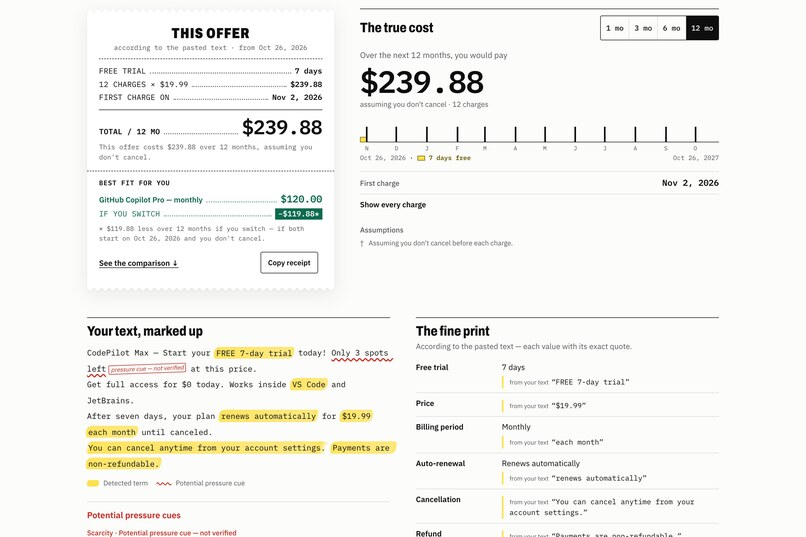
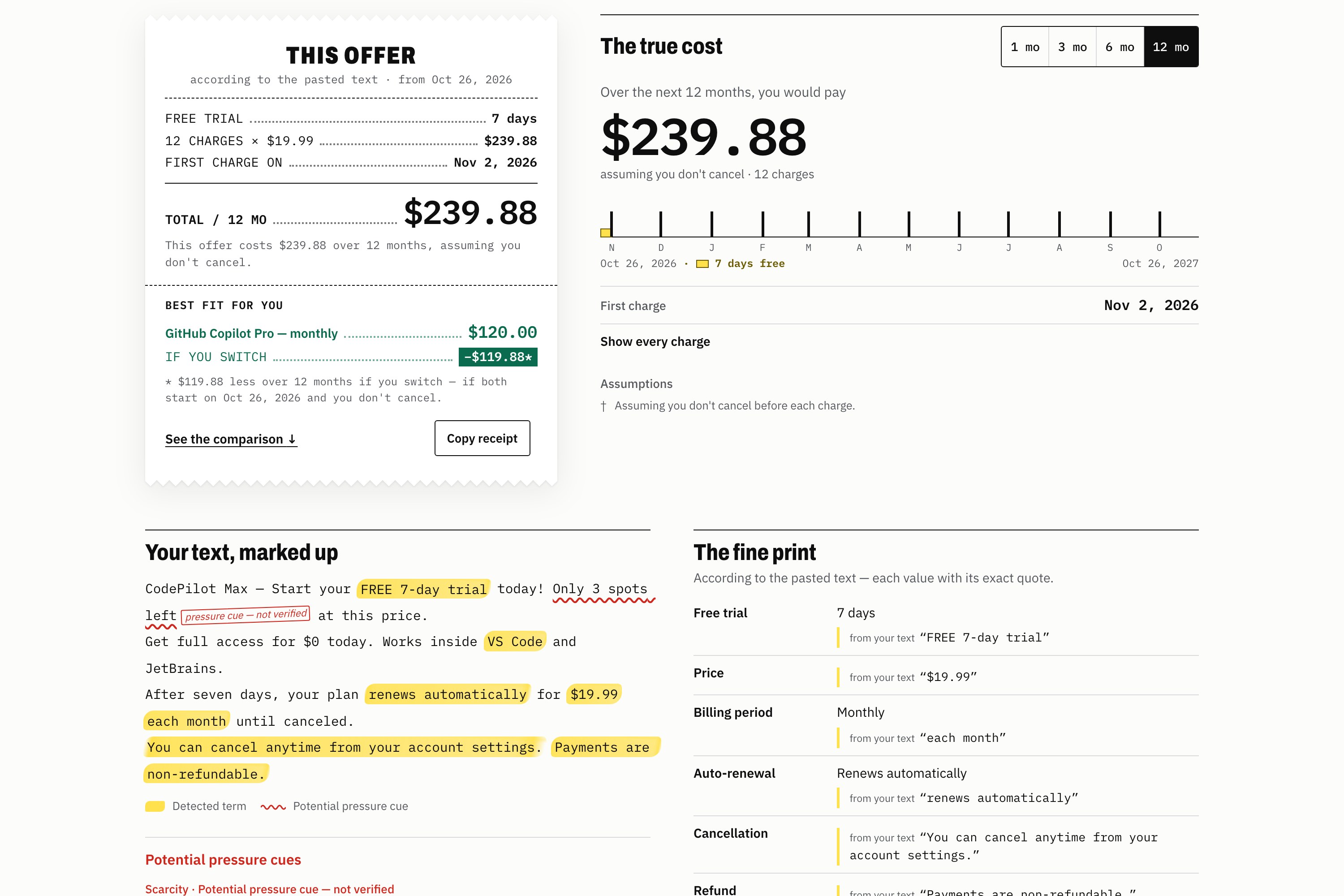
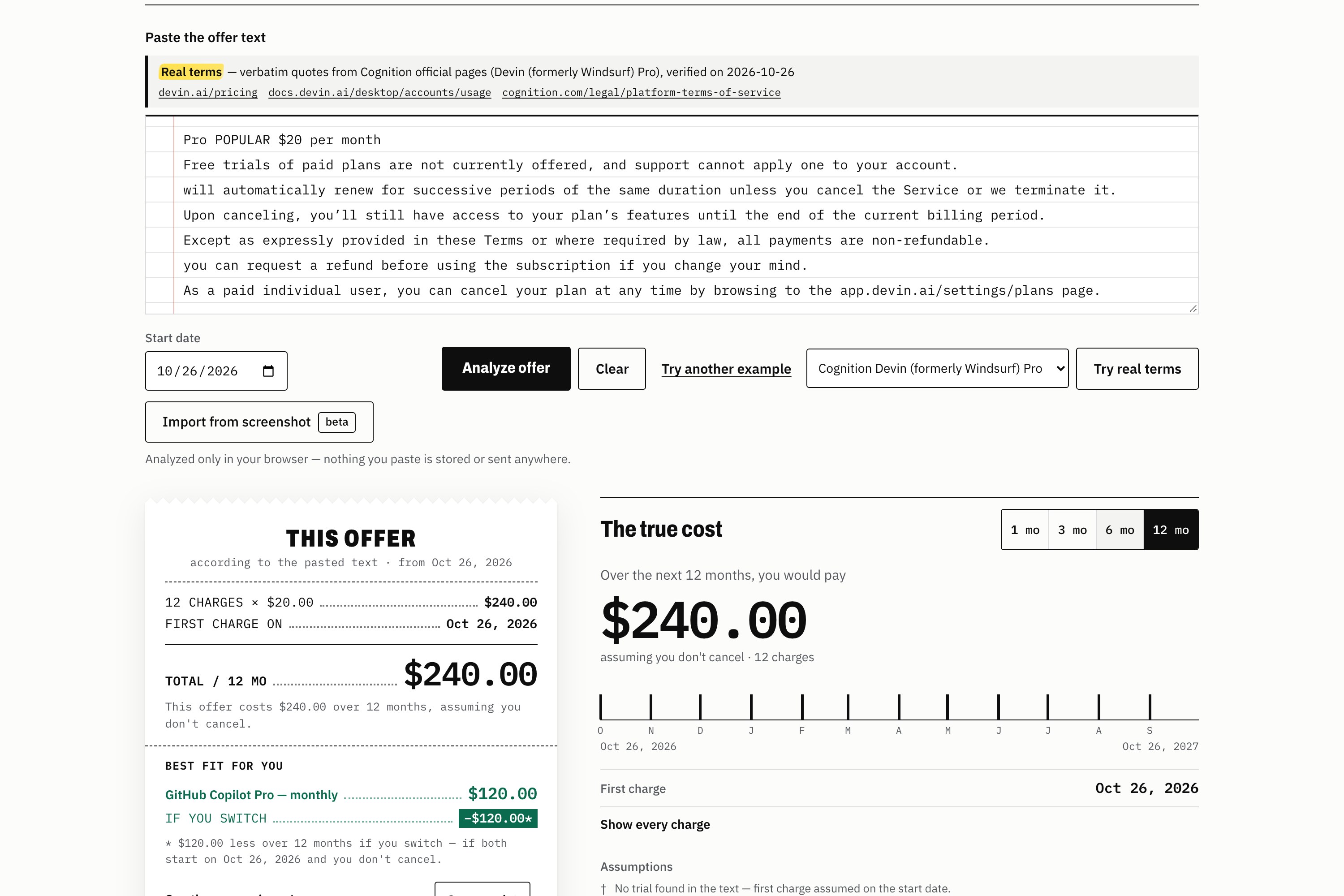
The receipt: ($239.88 to Best fit $120.00, -$119.88), the timeline, and the text with the markings and pressure signal.
-
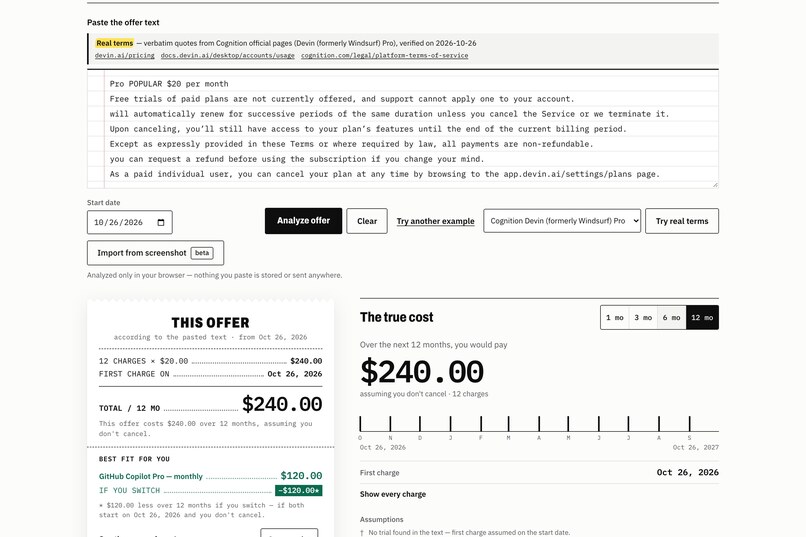
"Try real terms": direct quotes from official pages with their sources and the $240.00 receipt.
-
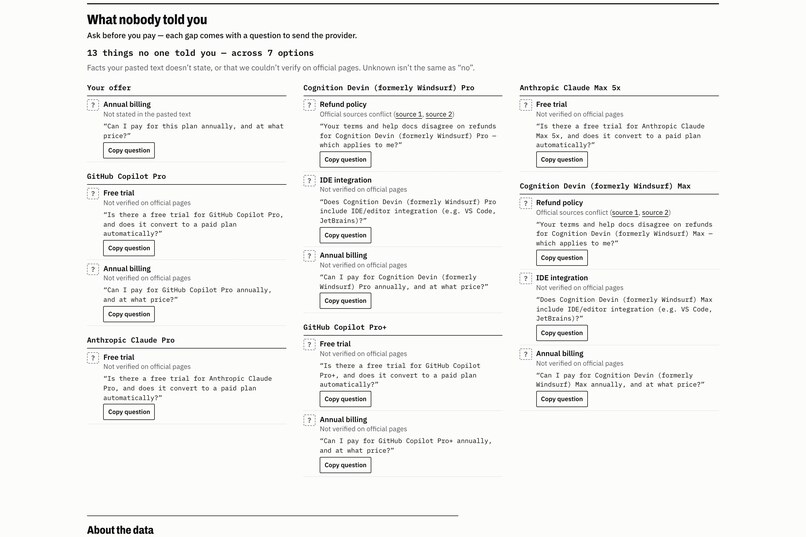
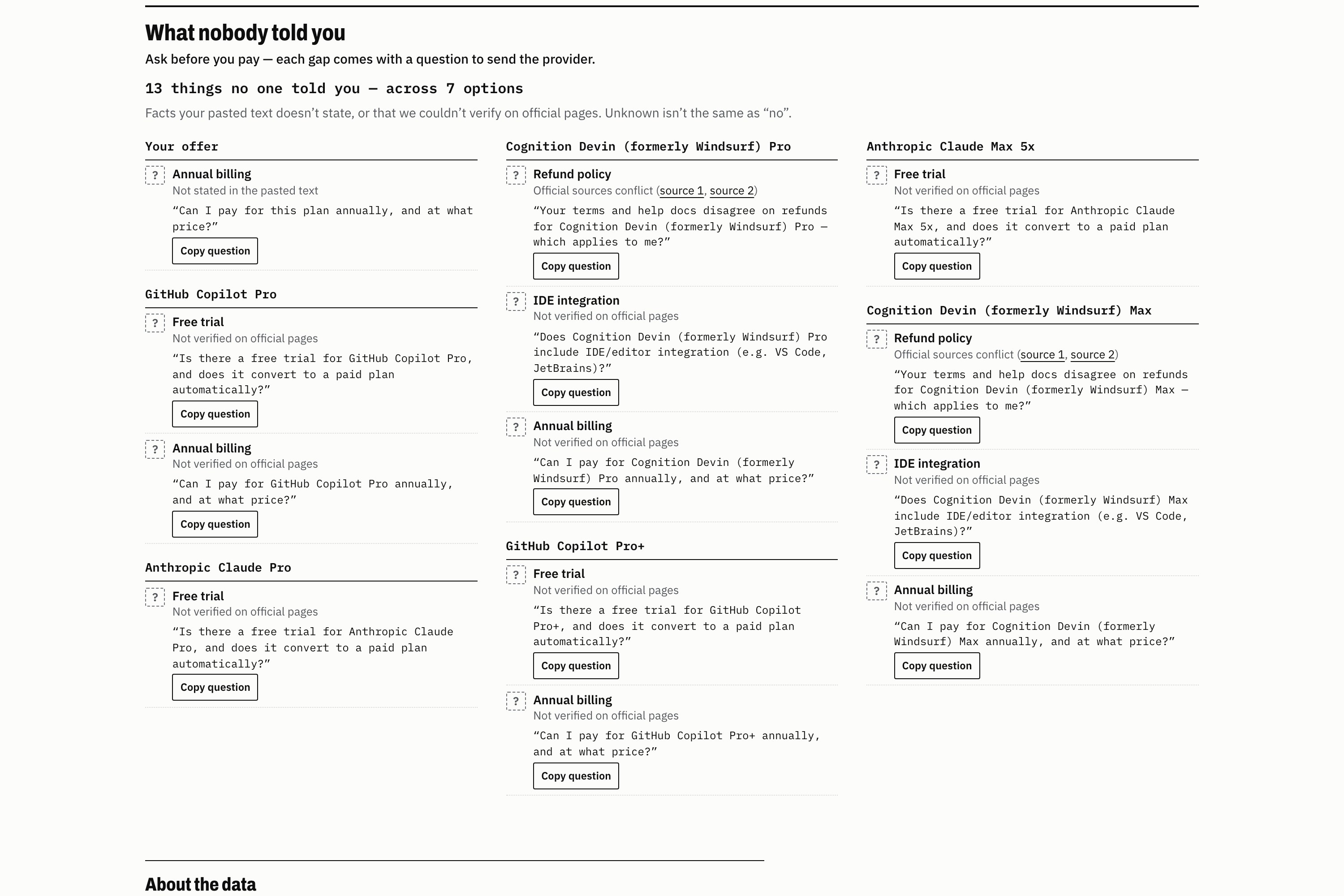
The unknowns panel: each with its own question to copy.
Inspiration
Today, there are so many applications and subscription services that choosing the right one can become complicated. Many companies have long terms and conditions that most people simply don't have the time or patience to read completely.
The problem is that important information can be hidden in those conditions, such as automatic renewals, cancellation restrictions, or limitations you might not notice until you've already paid.
I also realized how time-consuming it can be to compare different services. You have to visit multiple websites, read what each plan includes, and figure out whether you're actually getting what you need.
That's what inspired me to create FairFork: a way to simplify this entire process and help people make better decisions before paying for another subscription.
What it does
FairFork helps users understand what they're really paying for when choosing a subscription.
You can paste the text of an offer or import a screenshot, and FairFork analyzes the information to identify important details such as pricing, free trials, automatic renewals, cancellation conditions, and refund policies.
It also calculates how much the subscription could cost over 1, 3, 6, or 12 months, making it easier to understand the actual financial commitment.
But FairFork doesn't stop there.
It compares the offer against a curated catalog of subscription plans, allowing users to set their budget and select the features that matter most to them. The application then explains which available option best fits those requirements and why.
One feature I particularly like is how FairFork handles missing information. Instead of making assumptions, it tells you what couldn't be verified and even suggests questions you can ask the provider before paying.
The goal is simple: save time, avoid overlooking important conditions, and make decisions based on what you actually need rather than simply choosing the most popular or attractive option.
How I built it
I developed FairFork using Claude Code and AI subagents, following the six stages of the Devpost Learn Skill Pack.
I started with a detailed project plan explaining what I wanted to build, the problem I wanted to solve, and how I imagined the application working.
During development, I used subagents to work on different parts of the project, including subscription analysis, cost calculations, plan comparisons, interface development, and testing.
The application was built using React, TypeScript, Vite, and Vitest. I also incorporated Tesseract.js to extract text from screenshots directly in the browser.
My role throughout the process was to define the vision, review the results, make decisions, test features, and request improvements whenever something didn't match what I wanted.
The project also includes 226 automated tests to help verify its functionality.
Challenges I ran into
One of the biggest challenges was the development process itself.
Following the Skill Pack meant reviewing and approving each stage before moving forward. Although it helped organize the project, it also required more time than I initially expected.
Another challenge was the design.
AI tools can generate functional applications quickly, but their designs often look generic. I didn't want FairFork to feel like just another AI-generated dashboard.
I wanted something with its own identity, so I requested several design changes until we reached the final concept inspired by a marked-up contract, using highlighted text, annotations, and a receipt-style presentation.
We also encountered technical problems while testing screenshot imports and interpreting certain prices and subscription conditions. These issues required additional testing and adjustments.
Accomplishments that I'm proud of
I'm proud that FairFork became a functional application rather than just an idea.
It can analyze subscription conditions, calculate costs, compare verified alternatives, and explain why certain options may be better suited to a user's needs.
I'm especially happy with the final design because it feels closer to what I originally imagined.
Another accomplishment was improving the reliability of the application through testing, including handling missing information without inventing answers.
Seeing everything working together after the different development stages was one of the most satisfying parts of the project.
What I learned
One of the biggest things I learned is how much detailed instructions can improve the development process when working with AI agents.
Having a clear plan from the beginning makes it easier to organize the work, reduce confusion, and move faster.
But I also learned that giving instructions at the beginning isn't enough.
Reviewing the results and making improvements throughout development is just as important, especially when it comes to design.
AI can build something functional very quickly, but your own decisions and feedback are what help turn that result into something that actually reflects your vision.
What's next for FairFork
My long-term vision is to turn FairFork into a much more universal comparison platform.
I would like users to be able to compare almost any type of subscription or service without having to visit dozens of websites and manually read every plan's terms and conditions.
Another feature I'd love to explore is identifying equivalent features between different providers, even when companies use different names to describe similar functionality.
Ultimately, I want FairFork to help people choose the option that truly fits their needs, not necessarily the cheapest, the most popular, or the one with the best-looking website.
The idea is to make comparing services simpler, faster, and more transparent for everyone.
Built With
- claude-code
- css
- github
- html
- react
- tesseract.js
- typescript
- vite
- vitest

Log in or sign up for Devpost to join the conversation.