-
-
FairDeal UI
-
Fair Deal
Inspiration
Pricing in the modern world is broken. You never really know if you're getting a fair deal, retailers use dynamic pricing, contracts are buried in jargon, and second-hand markets have no single source of truth. Most people just guess, or give up. I wanted to build something that felt like texting a smart, well informed friend who could instantly tell you: "Yeah, that's overpriced, here's why."
What it does
FairDeal AI is a single-page AI-powered tool with four analysis modes:
- Price Check Paste a product name and price (or a product URL) and get an instant Deal Score out of 10, fair market price range, red flags, and a 30-day Deal Score Trend chart showing how the deal has changed over time.
- Contract Scanner Paste any contract or T&C text and get a plain-English breakdown of red flags: auto-renewals, binding arbitration, hidden fees, one-sided cancellation terms with an overall risk rating of Low, Fair, or High.
- Object Value Describe any second-hand item and get an estimated market value range, a fairness verdict on a quoted price, and where to buy or sell it.
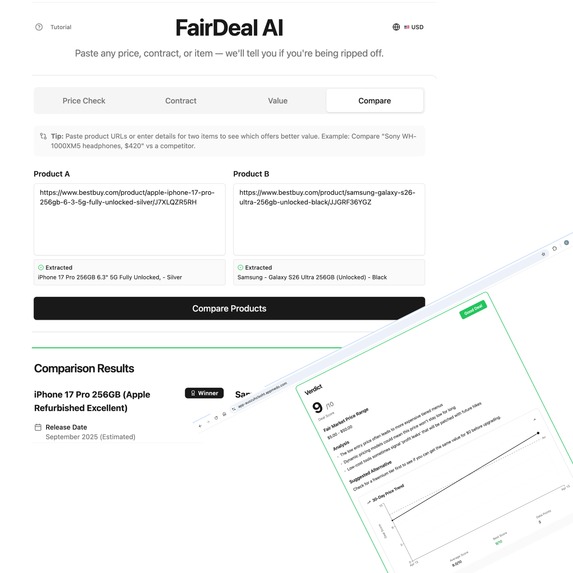
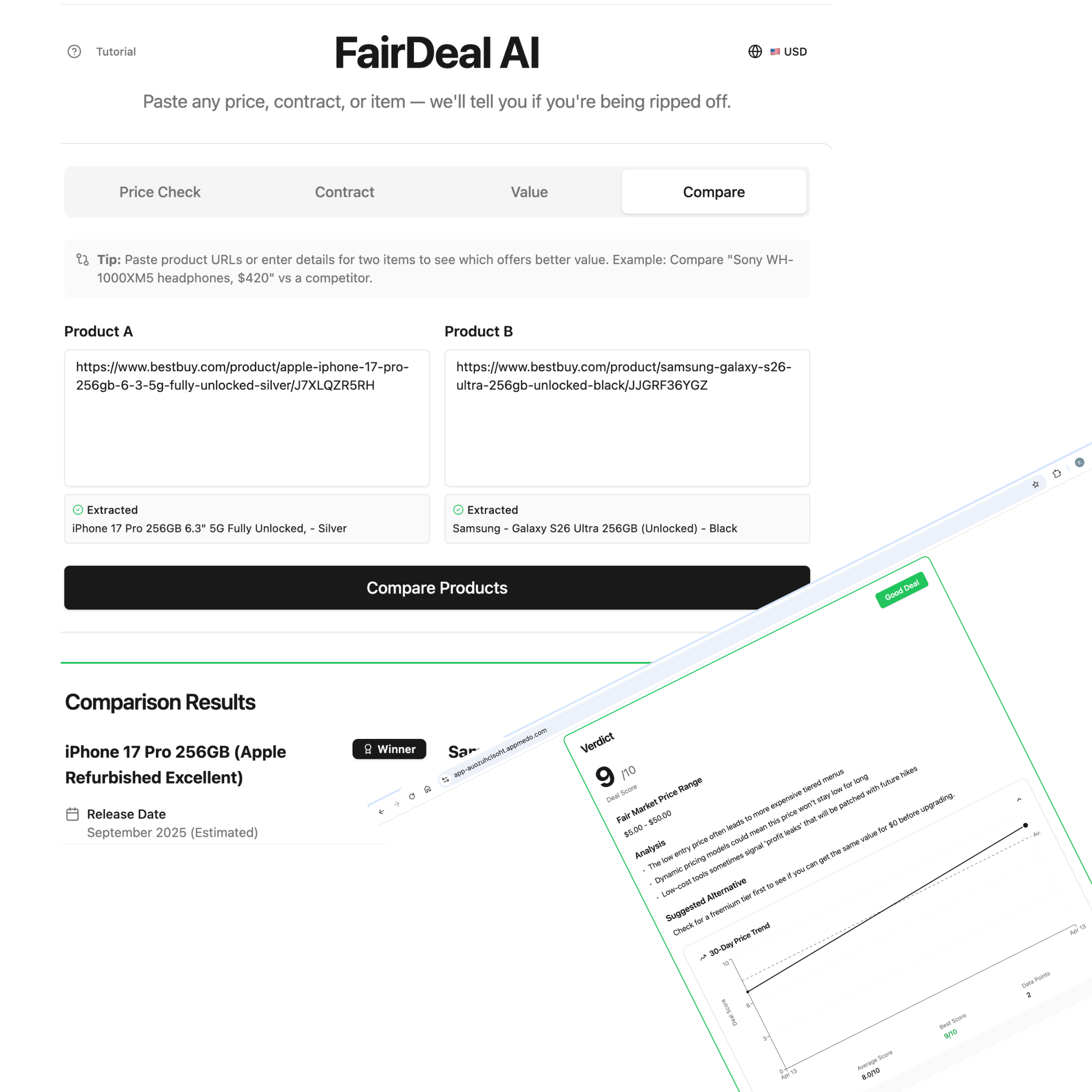
- Compare Enter two products side-by-side and get a full comparative analysis: release dates, launch prices, price depreciation timelines, value scores, and a clear winner recommendation. Every result includes a country-aware Contextual Tip and can be shared via a shareable link or saved as a PNG image. ## How we built it The whole app was built using MeDo without writing a single line of code manually. Before touching MeDo at all, I spent time writing a detailed requirements document defining the four modes, the color-coded verdict system (green/amber/red), the Deal Score Trend chart logic, edge cases, placeholder text, and business rules for things like scraping failures and unverifiable products. That document became the prompt. I fed it into MeDo as a structured description and it generated the full-stack application: the React frontend with tab navigation and responsive card layout, the AI analysis logic, and the verdict card rendering. From there I iterated through MeDo's chat interface refining the UI, tuning the AI tone to sound conversational rather than corporate, and progressively adding features like the 30-day Deal Score Trend line chart, the country-aware Contextual Tip system, and the client-side shareable link encoding. The approach was: write the vision clearly first, let MeDo build the foundation, then iterate fast. ## Challenges we ran into The Deal Score Trend chart was the hardest piece. Getting MeDo to generate a dynamically color-coded line chart green for scores 7–10, amber for 4–6, red for 0–3 with a "Best Time to Buy" annotation required several rounds of iteration. The chart also needed to degrade gracefully when historical pricing data was unavailable, which meant carefully specifying every fallback state. The country-aware Contextual Tip was another challenge. Getting the AI to produce tips that felt genuinely local and relevant referencing jurisdiction-specific consumer rights, local resale platforms, VAT considerations rather than just appending a country name to a generic sentence took deliberate prompt engineering. Edge case handling across all four modes also required explicit work. Scraping failures, unverifiable products in Compare mode, empty inputs, malformed share links none of these handled themselves. Each one had to be defined upfront so MeDo could wire up the right fallback messages. ## Accomplishments that we're proud of The Compare mode came out better than expected. Getting a split verdict card with per-item panels, price depreciation timelines from launch to present, value scores, and a clearly highlighted winner all generated from two product names feels genuinely useful in a way that most price tools aren't. ## What we learned The biggest lesson was that prompt structure is everything. A vague description gives you a vague app. Writing a proper requirements document first with specific color codes, placeholder text, edge cases spelled out in a table, and explicit business rules gave MeDo enough context to produce something genuinely close to the vision on the first pass rather than requiring a rebuild from scratch. MeDo also works best when the app is AI-behavior-heavy rather than UI-heavy. FairDeal AI is essentially an AI reasoning engine with a clean wrapper exactly the kind of app the platform is designed for. Trying to push it toward complex custom UI interactions is where you'd hit friction; leaning into the AI output side is where it shines. ## What's next for fairdeal The most requested feature would be image upload for object identification point your camera at something and get an instant valuation. That's the natural next step for Object Value mode. Beyond that: browser extension support so the Deal Score appears directly on Amazon and eBay product pages without leaving the site, a deal alert system that monitors a product and notifies you when the score crosses a threshold you set, and a multi-language support. The core insight that people deserve a trusted, instant second opinion on any purchase scales well beyond the four modes in this release.
Built With
- baidu-ai-(ernie)
- google-search-(ai-powered-web-grounding)
- javascript
- medo
- react
- tailwind-css

Log in or sign up for Devpost to join the conversation.