-
-
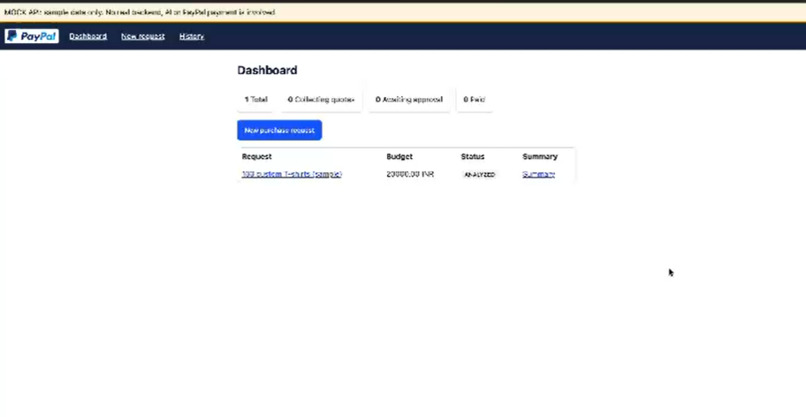
Dashboard
-
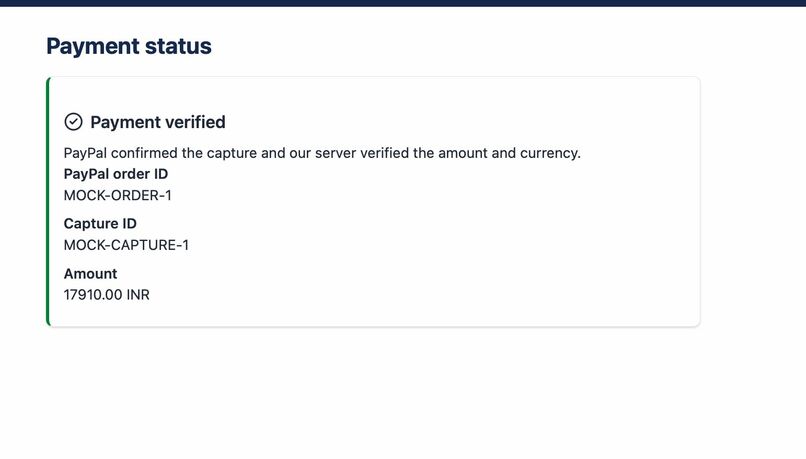
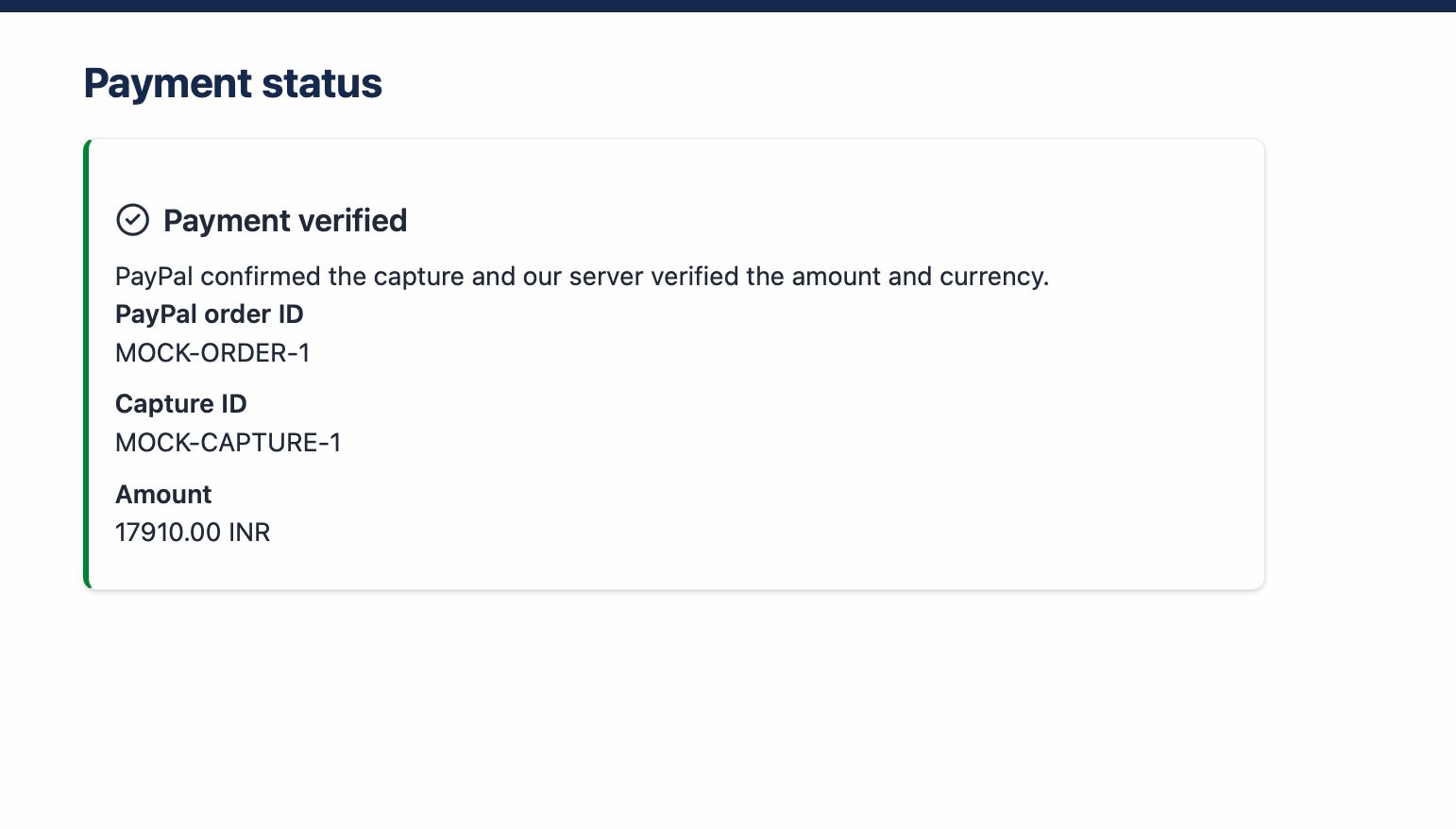
Payment received
-
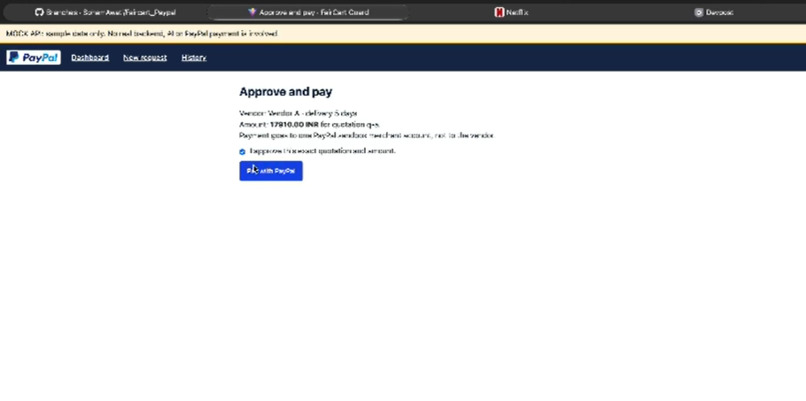
Payment option
-
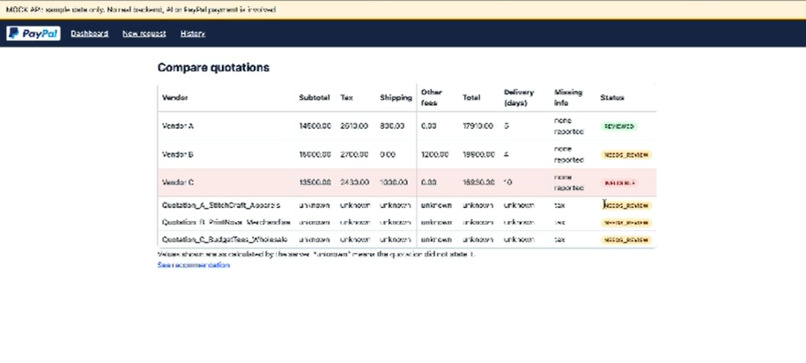
Status
-
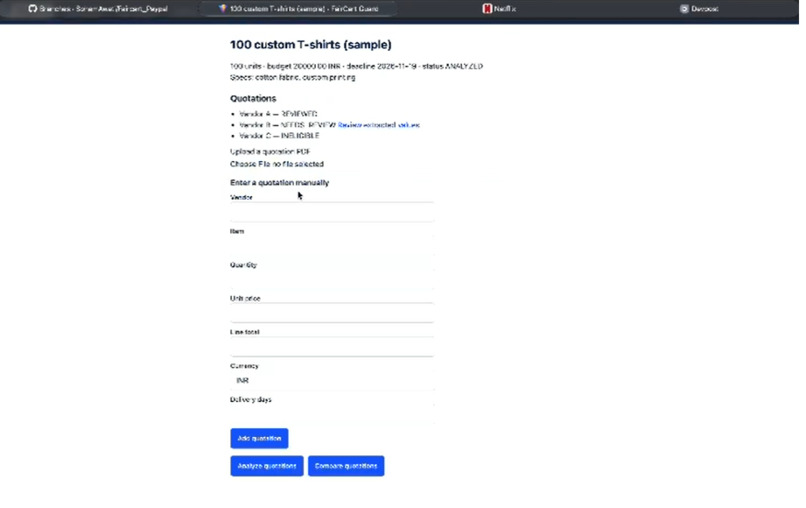
Form
-
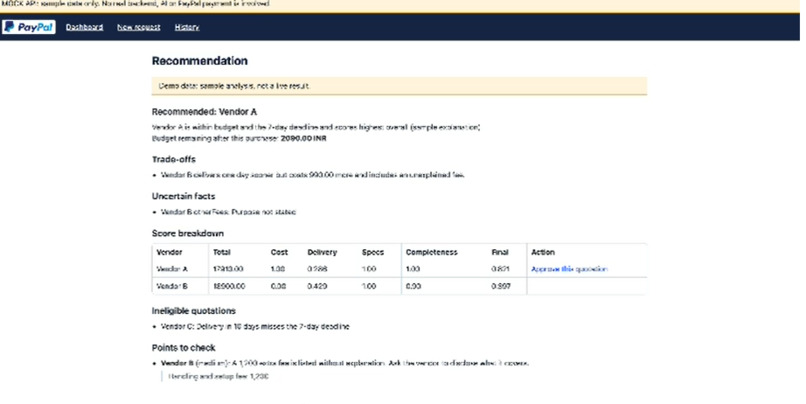
Summary
-
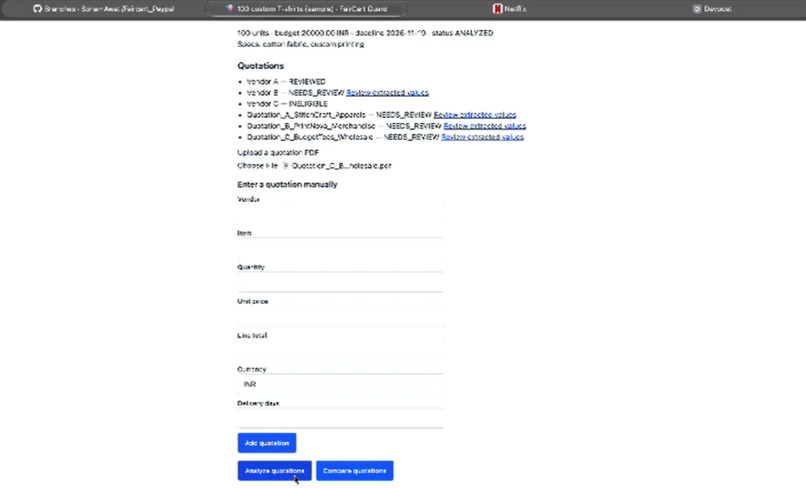
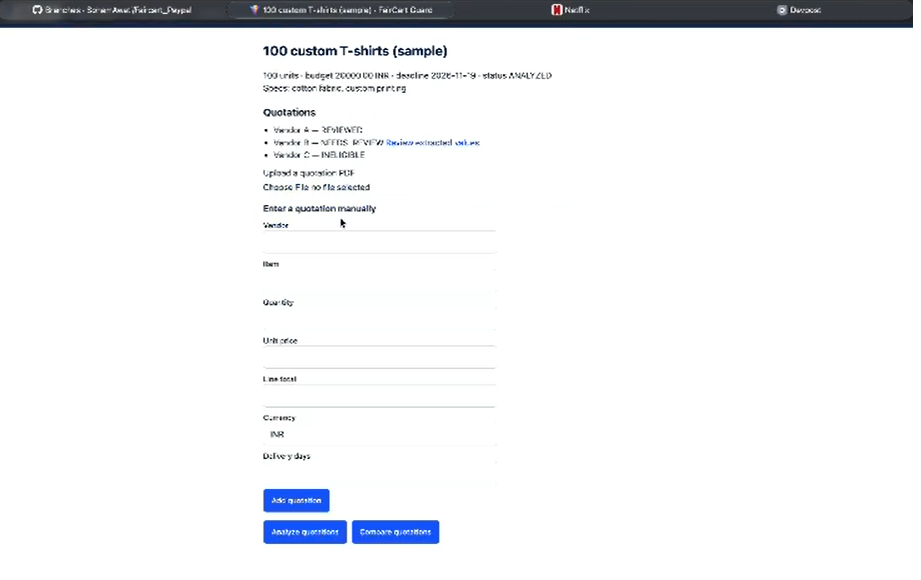
Quotations uploaded
Inspiration
In procurement, choosing the cheapest quotation doesn't always mean getting the best deal. Vendors may include hidden charges, unclear pricing, or delivery timelines that don't meet purchasing requirements. Comparing multiple quotations manually is time-consuming and can lead to costly decisions.
We were inspired to build FairCart Guard, an AI-powered procurement assistant that helps organizations make smarter, more transparent and policy-compliant purchasing decisions. We wanted to explore how AI agents and PayPal payment infrastructure could work together to make procurement safer and more trustworthy.
What it does
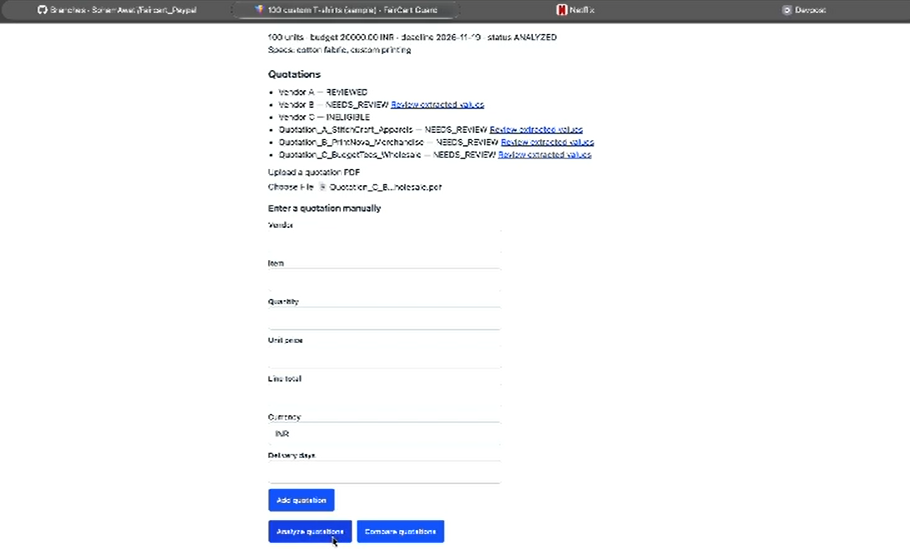
FairCart Guard is an AI-powered procurement decision and payment platform that analyzes vendor quotations and helps buyers identify the best purchasing option.
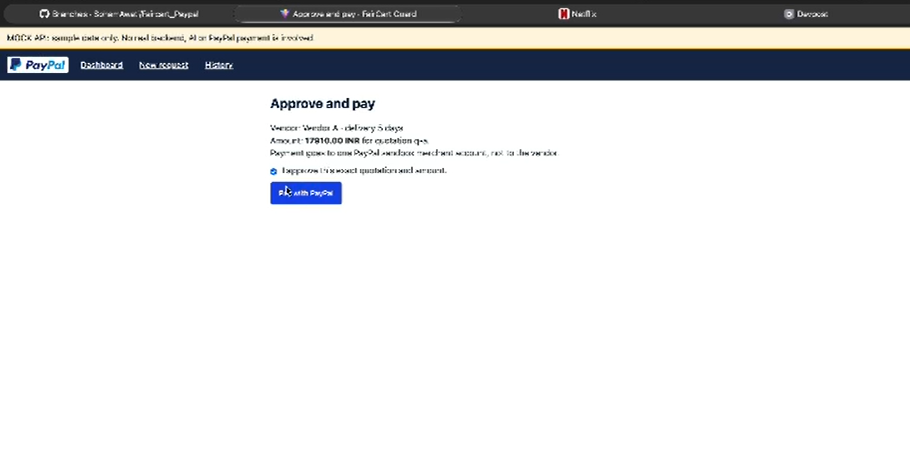
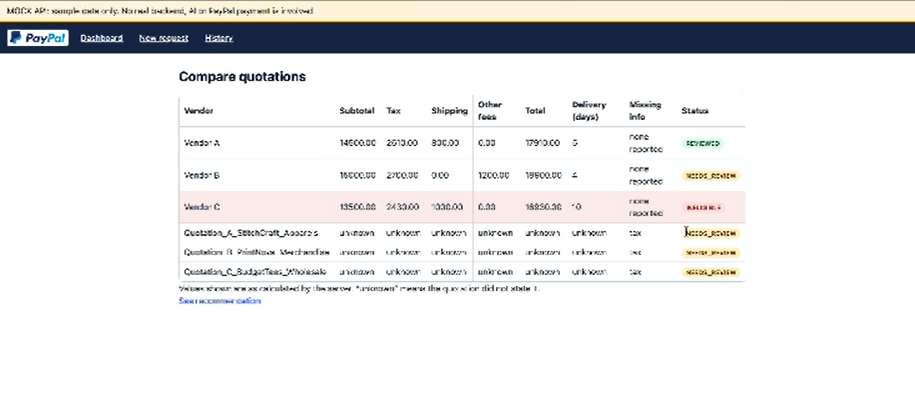
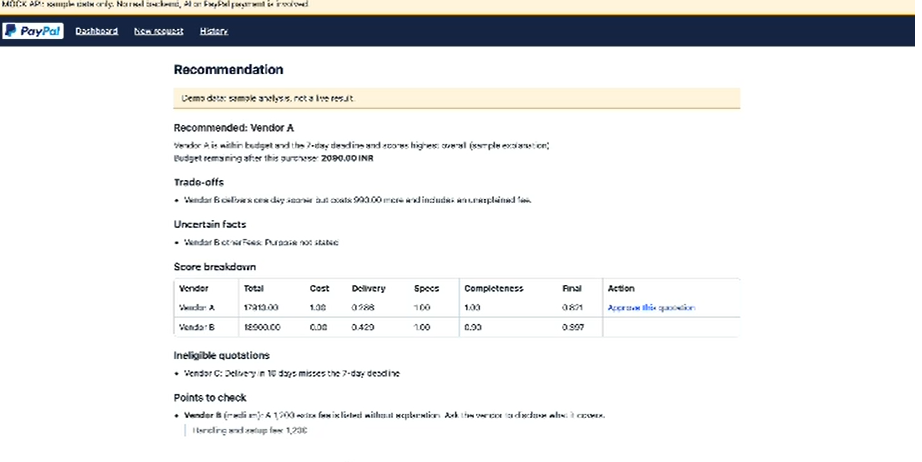
Key features include: • AI-powered quotation analysis: Analyzes multiple vendor quotations and compares pricing, delivery timelines and other purchasing factors. • Hidden charge detection: Identifies additional fees, unexpected costs and unclear pricing. • Policy compliance: Checks quotations against predefined purchasing rules, budget limits and delivery requirements. • Intelligent recommendations: Recommends the most suitable vendor based on overall value, transparency and compliance rather than simply selecting the lowest price. • Explainable decisions: Provides clear explanations and score breakdowns so buyers understand why a quotation is recommended or rejected. • PayPal Sandbox integration: Supports creating PayPal orders, buyer approval and backend payment capture with transaction verification. • Payment tracking: Maintains payment status and transaction references to provide a transparent purchase history.
How we built it
We built FairCart Guard using a modular architecture consisting of a frontend, backend, AI decision-making component and PayPal payment integration.
The AI agent analyzes vendor quotations, identifies hidden charges, evaluates purchasing policies and generates explainable recommendations.
The backend manages procurement data, quotation records, approval workflows and payment operations. PayPal Orders v2 is used to create Sandbox payment orders, redirect buyers for approval and capture payments through the backend.
We also designed payment verification and webhook handling to ensure that payment status is based on verified transaction information rather than frontend assumptions.
Our technology stack includes:
• Frontend: React and TypeScript • Backend: Node.js and Express • Database: PostgreSQL with Prisma ORM • AI: LLM-powered agent for quotation analysis and decision-making • Payments: PayPal Sandbox and Orders v2 API • Payment events: PayPal Webhooks • Validation: Zod • Deployment: Render and GitHub Actions
Challenges we ran into
One of our biggest challenges was designing an AI agent that could do more than simply compare prices. It needed to understand purchasing requirements, identify hidden charges and explain its decisions.
Integrating PayPal Sandbox was another challenge. We had to coordinate order creation, buyer approval, backend capture and transaction verification while ensuring that duplicate payment requests would not result in duplicate captures.
We also had to establish a clear separation between AI-driven recommendations and actual payment execution. The AI recommends purchasing decisions, while the backend controls and verifies payment operations.
Coordinating the frontend, backend, AI component and payment integration into one consistent workflow was another important engineering challenge.
Accomplishments that we're proud of
• Building an AI-driven procurement workflow that focuses on transparency and purchasing compliance. • Designing an intelligent quotation comparison system that considers more than just the lowest price. • Identifying hidden charges and delivery-policy violations before a purchase decision. • Integrating PayPal Sandbox into the procurement payment workflow. • Designing a backend-controlled payment process with transaction verification and duplicate-capture protection. • Bringing AI-powered decision-making and digital payments together in one practical application.
What we learned
Through FairCart Guard, we learned how AI agents can be applied to real-world business workflows rather than just conversational applications.
We gained experience in designing explainable AI recommendations, integrating third-party payment APIs, managing asynchronous payment events and building secure backend payment workflows.
Most importantly, we learned that trustworthy automation requires more than intelligent recommendations. It also requires validation, transparency, human approval and reliable transaction verification.
What's next for FairCart Guard
We envision expanding FairCart Guard into a complete AI-powered procurement ecosystem.
Future improvements include: • Integrating more vendor platforms and procurement systems. • Supporting multiple currencies and advanced budget management. • Improving AI-based fraud detection and quotation anomaly analysis. • Introducing vendor reliability and historical performance scoring. • Expanding PayPal integration for more advanced payment and transaction workflows. • Exploring PayPal Agent Toolkit capabilities for secure, controlled agent interactions. • Supporting automated purchase tracking, reporting and analytics.
Our long-term goal is to make procurement smarter, safer and more transparent through the combination of AI-powered decisions and trusted digital payments.
Built With
- ai-agents
- artificial-intelligence
- express.js
- large-language-models
- node.js
- paypal
- paypal-orders-api
- paypal-webhooks
- postgresql
- prisma-orm
- python
- react
- rest-api
- typescript

