-
-
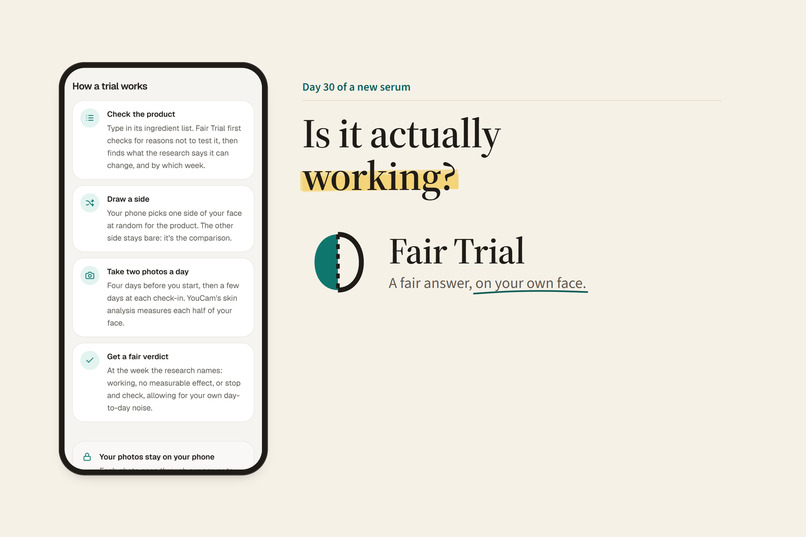
Fair Trial tests a skincare product on one half of your face and keeps the other bare; YouCam's Skin Analysis reads both in the same photo.
-
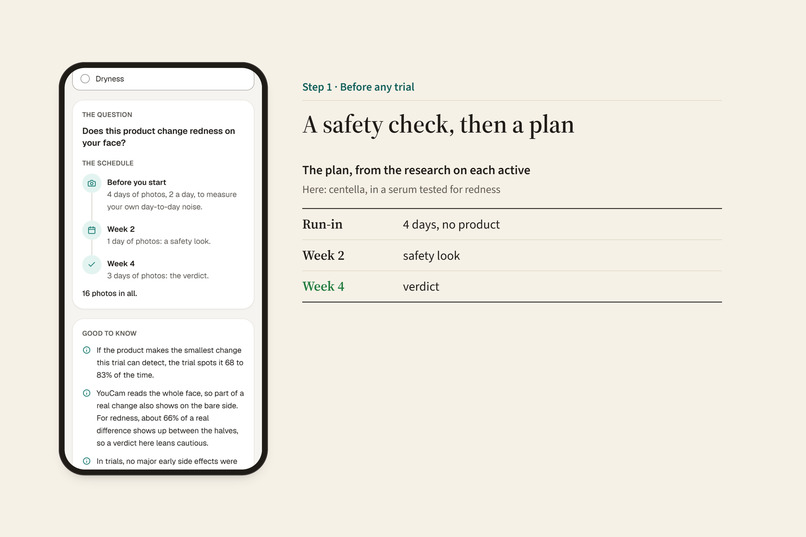
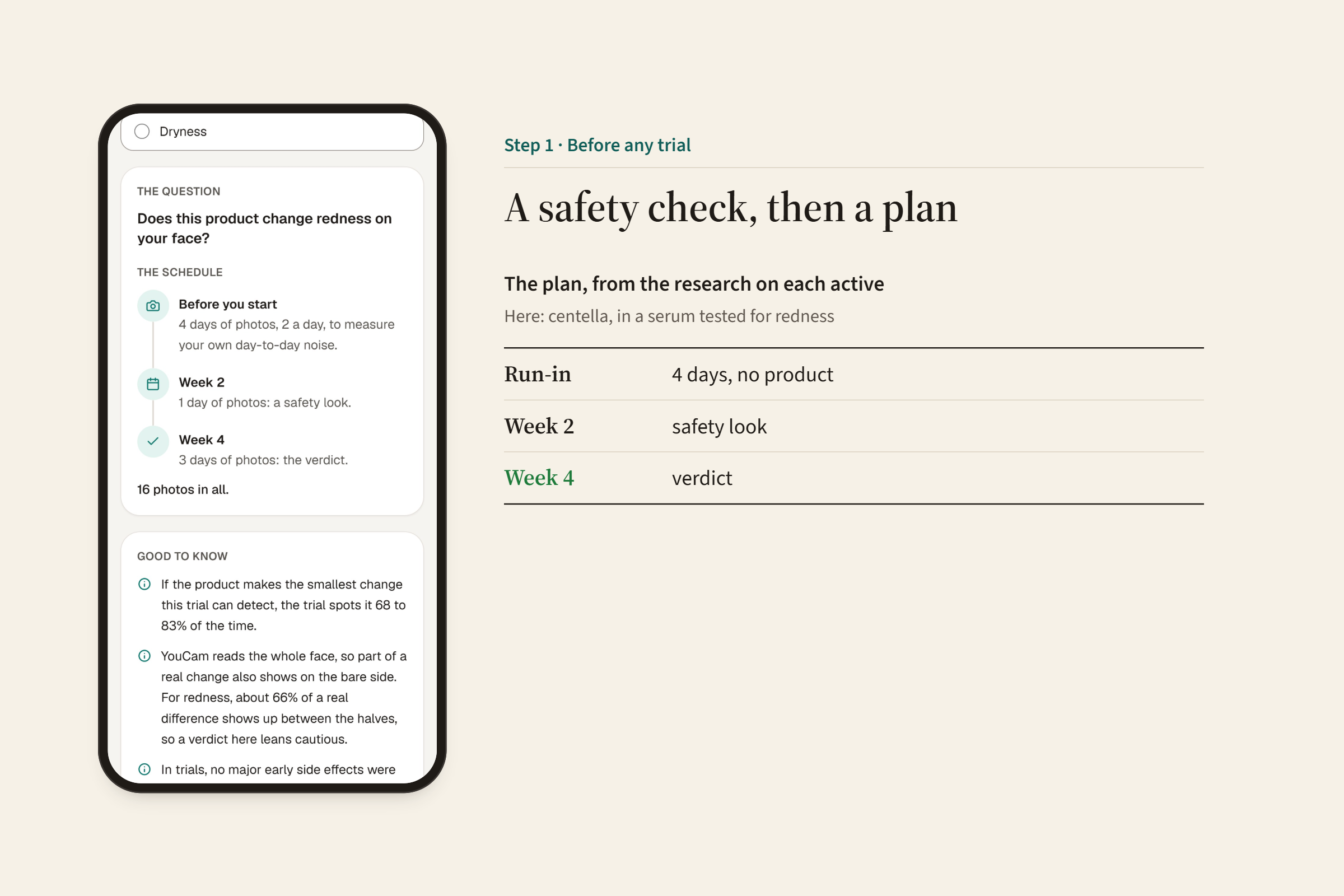
First a safety check, then a plan from the research on the product's actives: what it can change, and by which week.
-
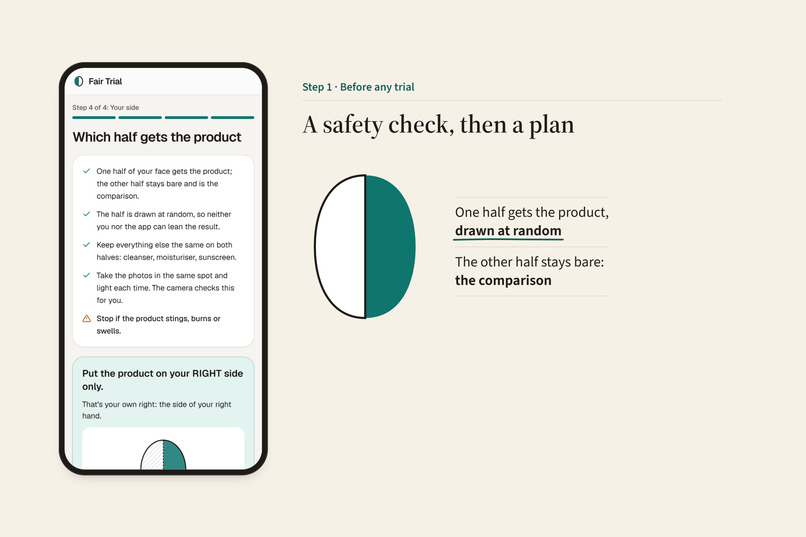
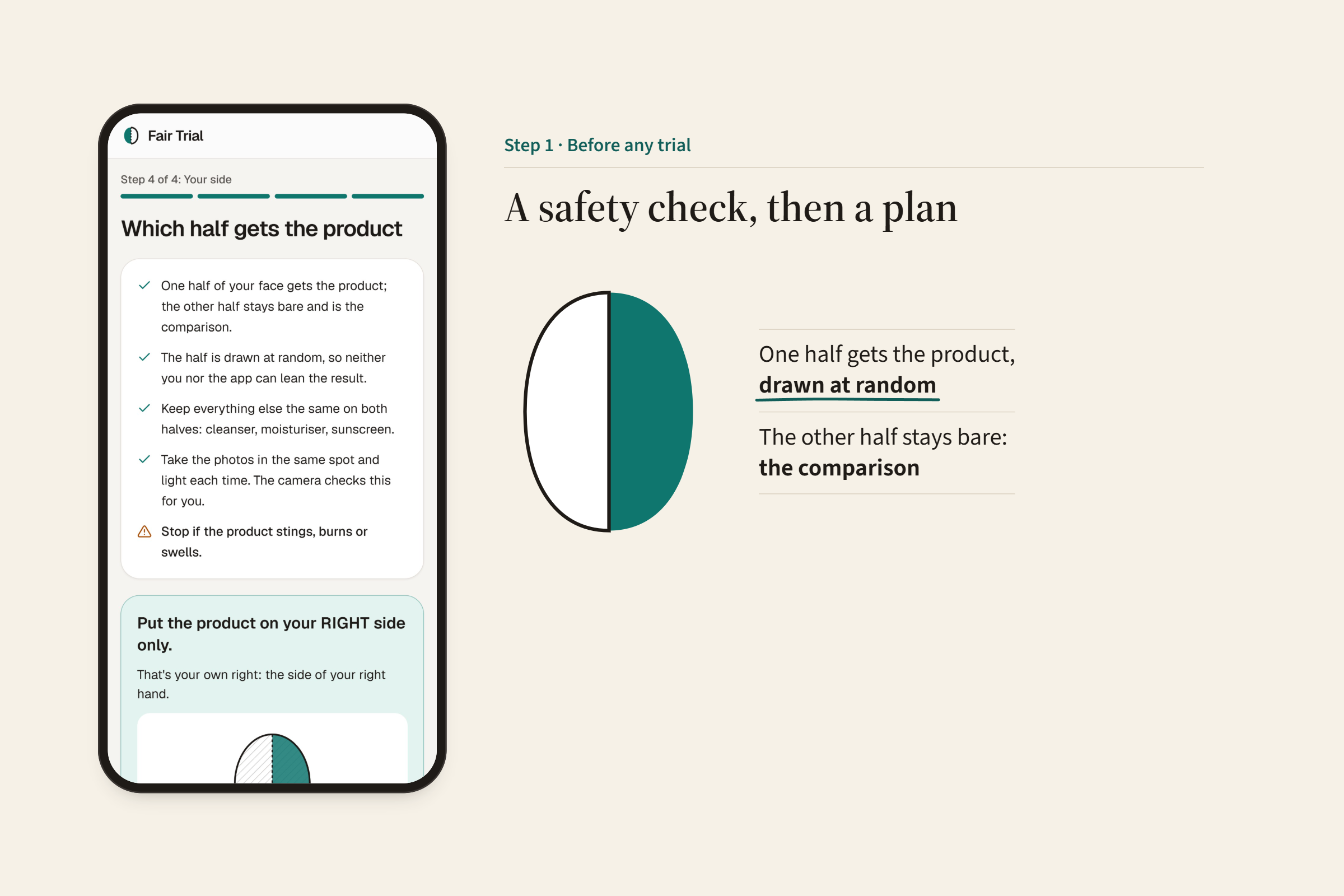
The phone draws the product half at random. The other half stays bare as the comparison.
-
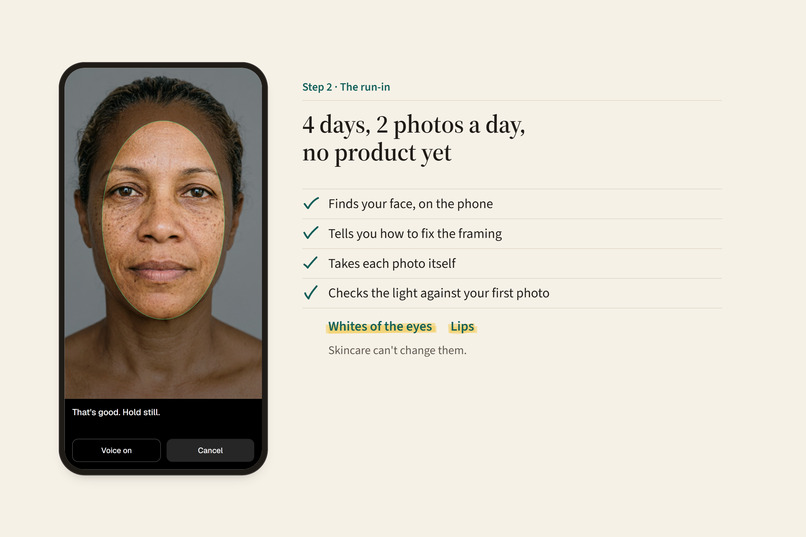
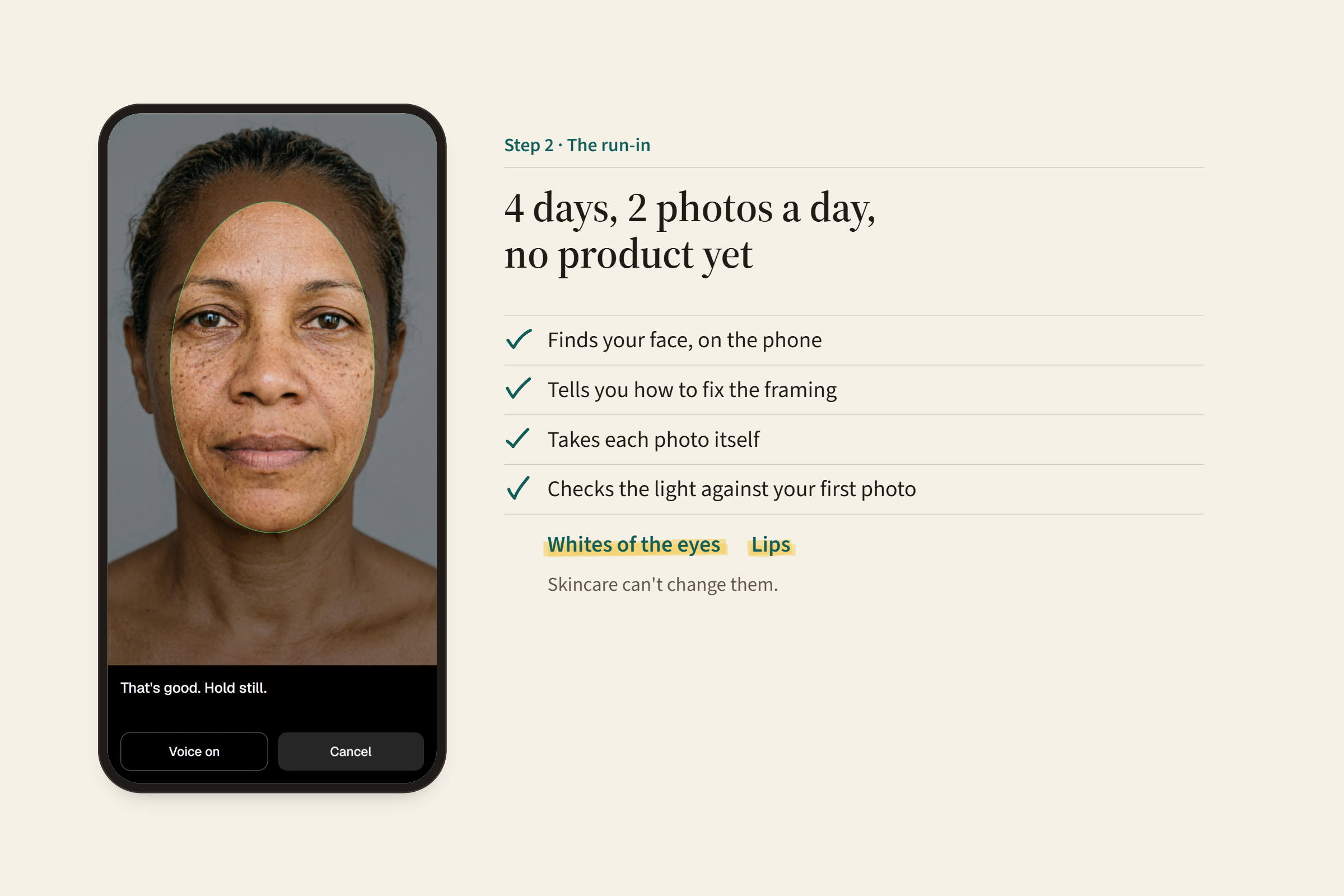
The camera finds the face, says the one thing to fix and takes each photo itself, checking the light against the first photo.
-
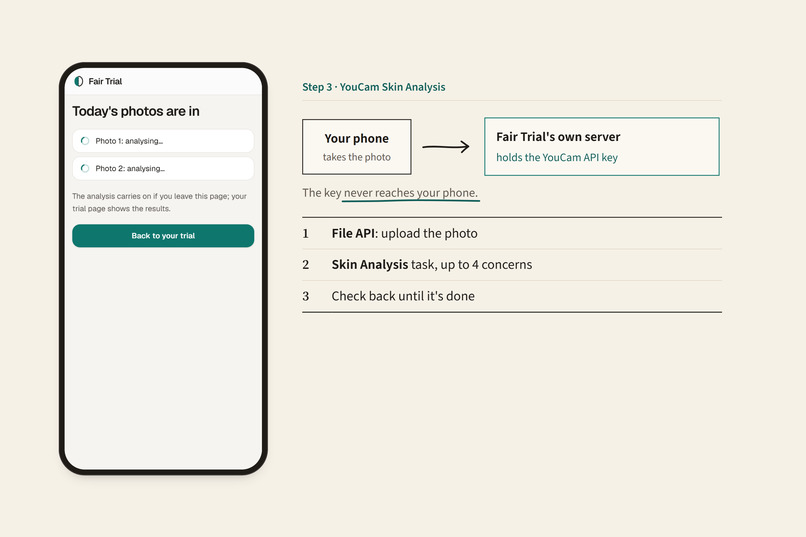
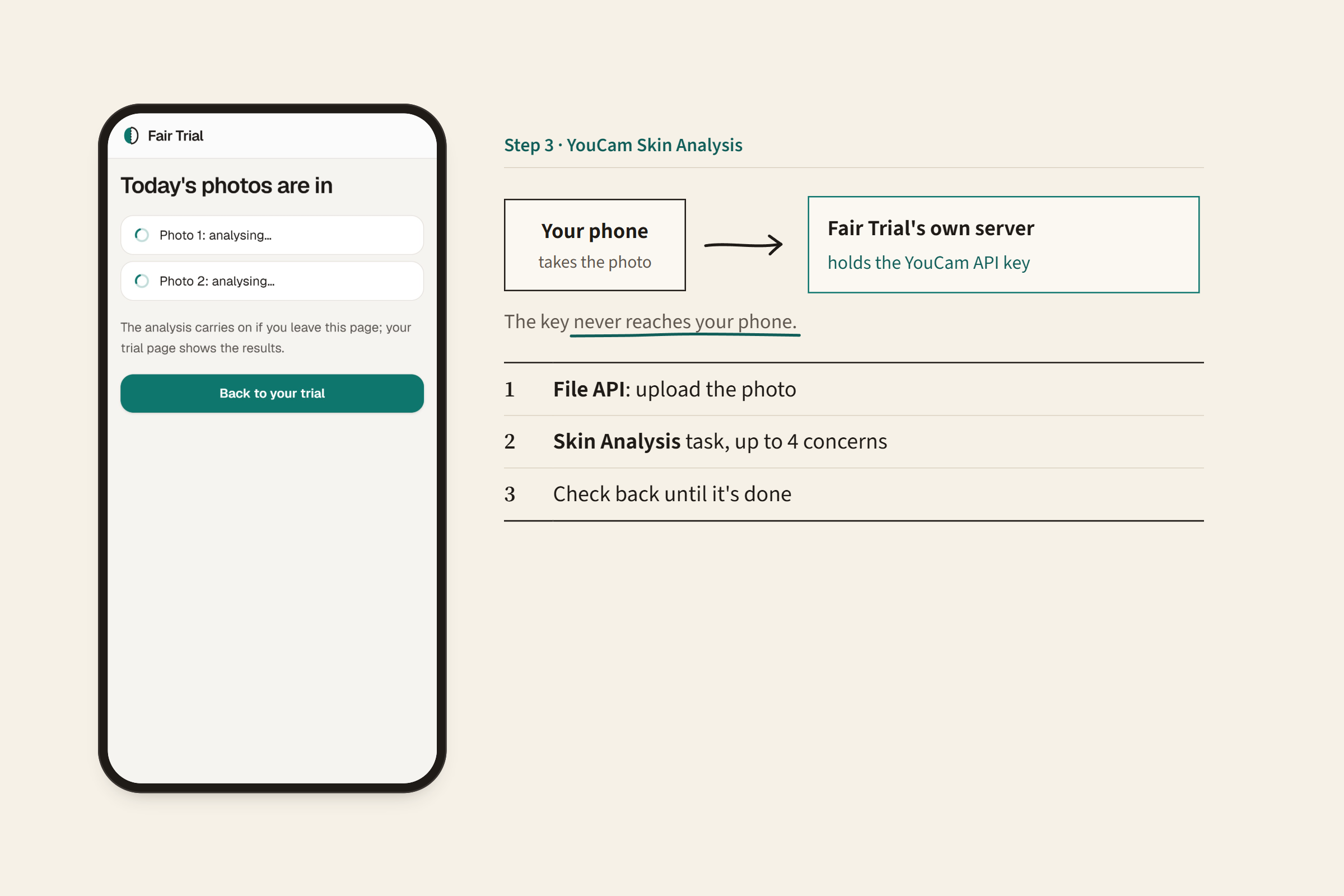
Each photo goes to Fair Trial's server, which holds the YouCam key: a File API upload, then a Skin Analysis task.
-
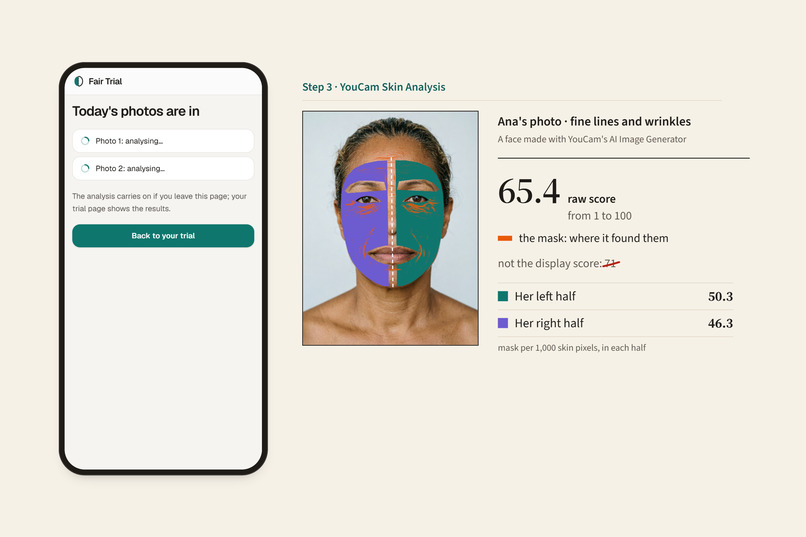
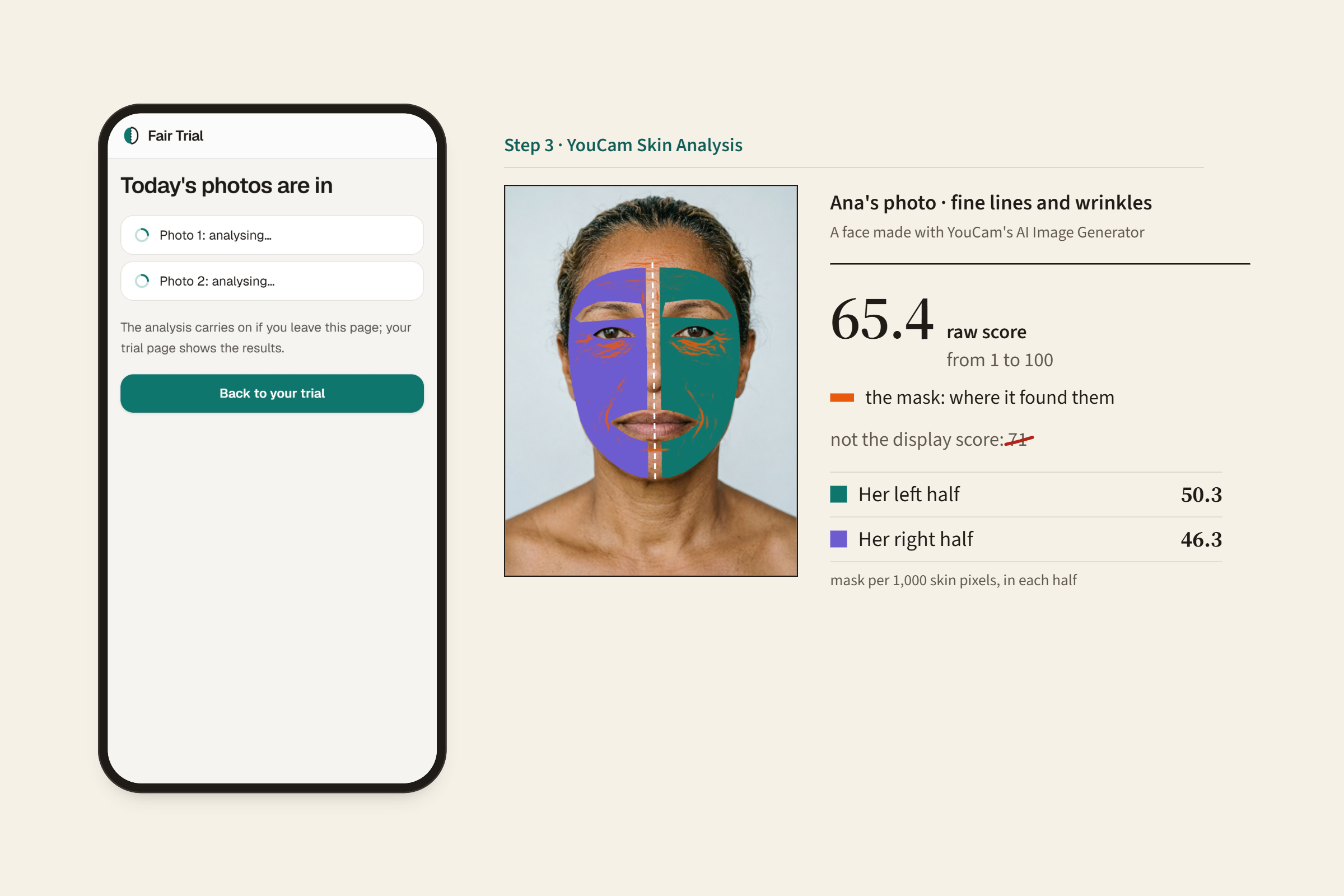
Fair Trial uses YouCam's raw score, not the display score, and splits each mask at the facial midline: one reading per half.
-
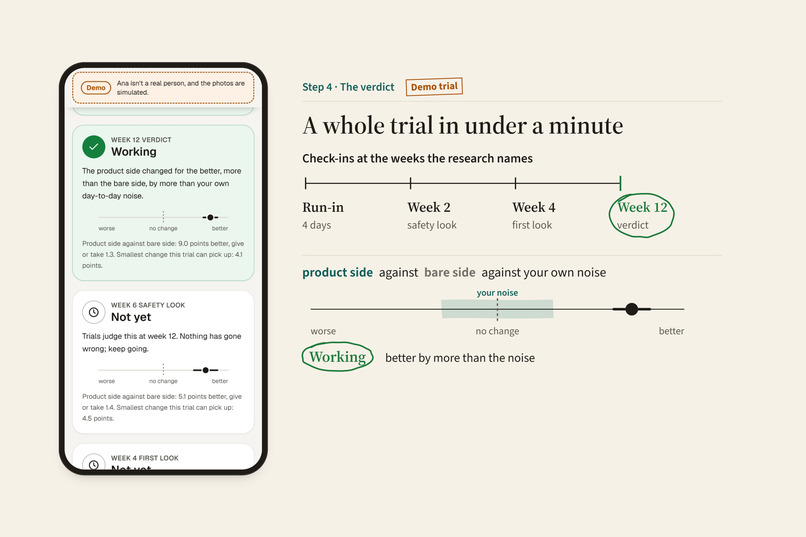
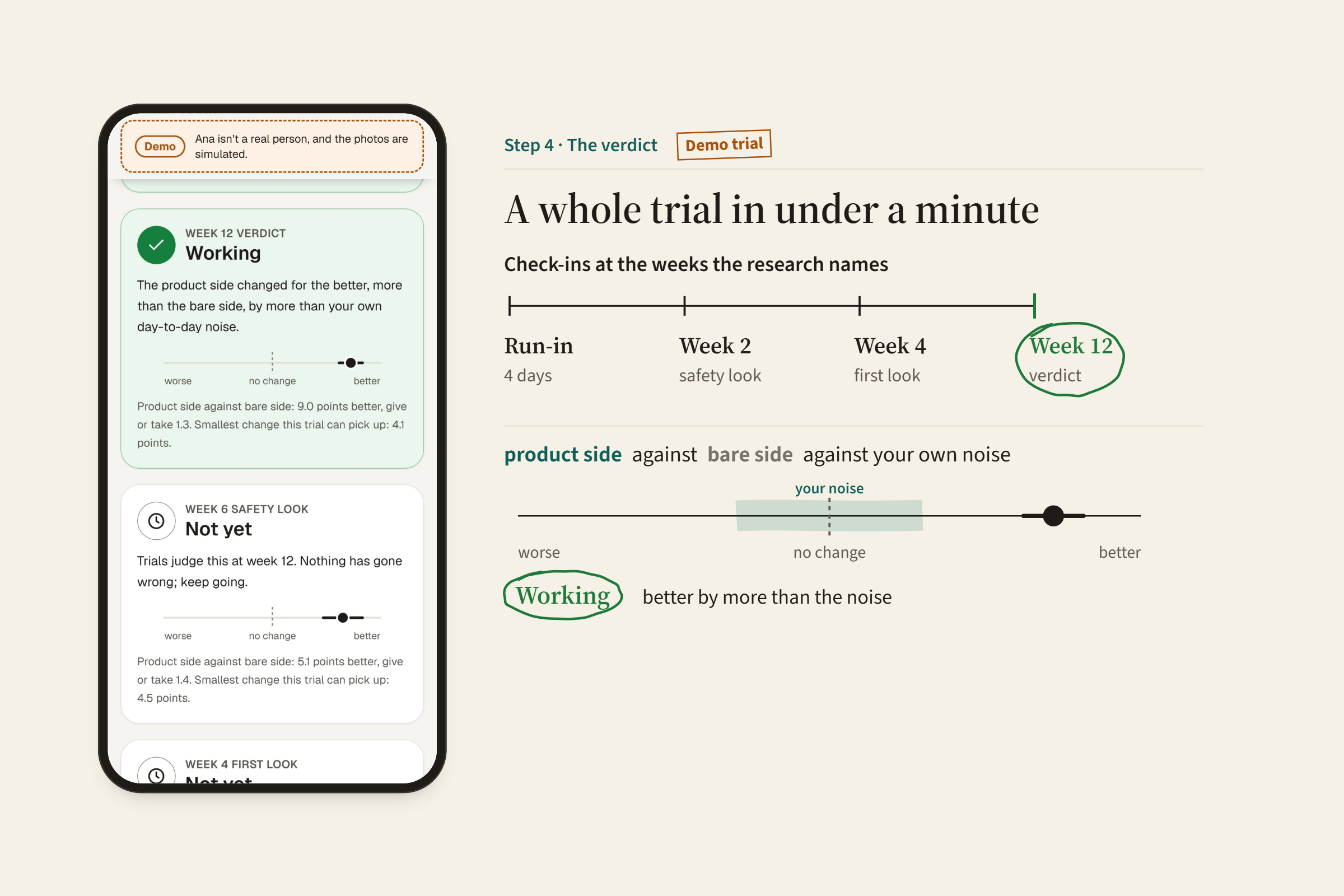
Working only when the product half beats the bare half by more than your own day-to-day noise. Shown on the demo trial.
-
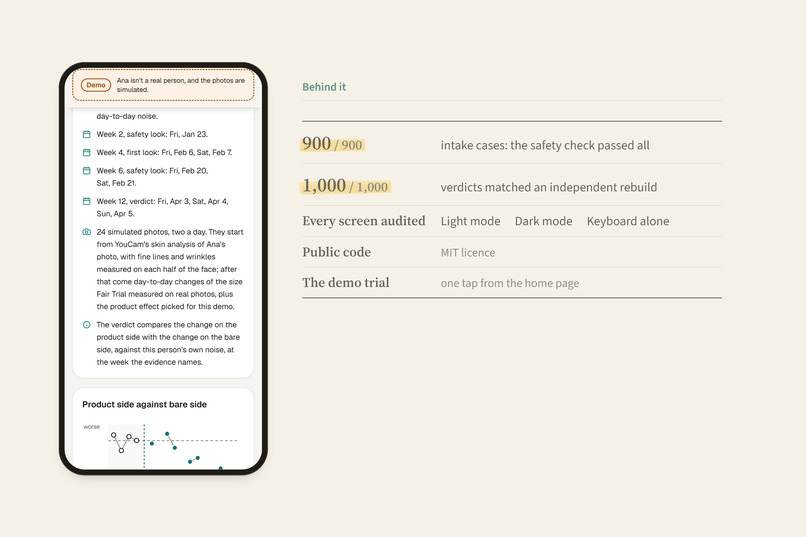
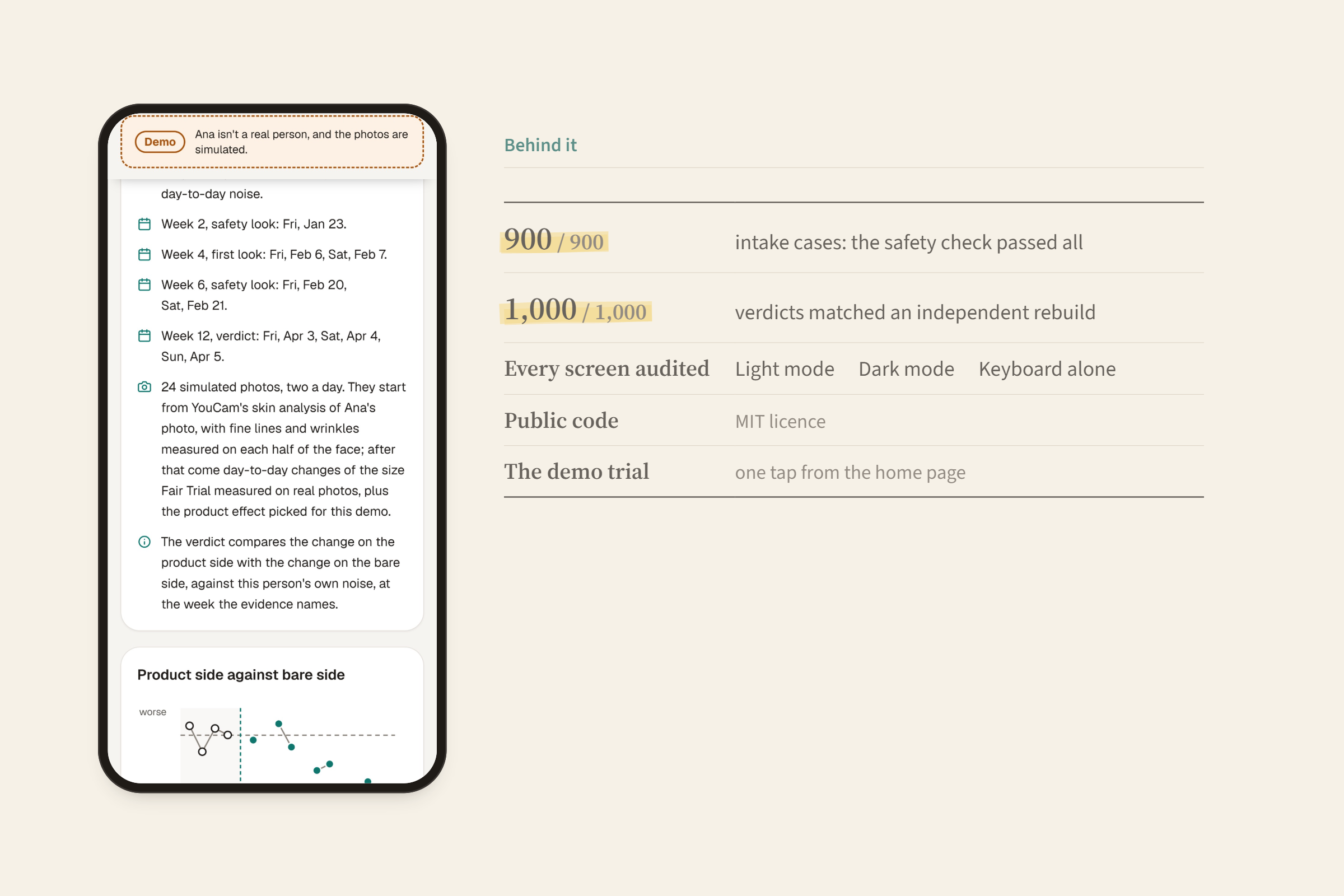
Behind it: the safety check passed 900 of 900 intake cases, and the verdict engine matched an independent rebuild on 1,000 of 1,000.
-
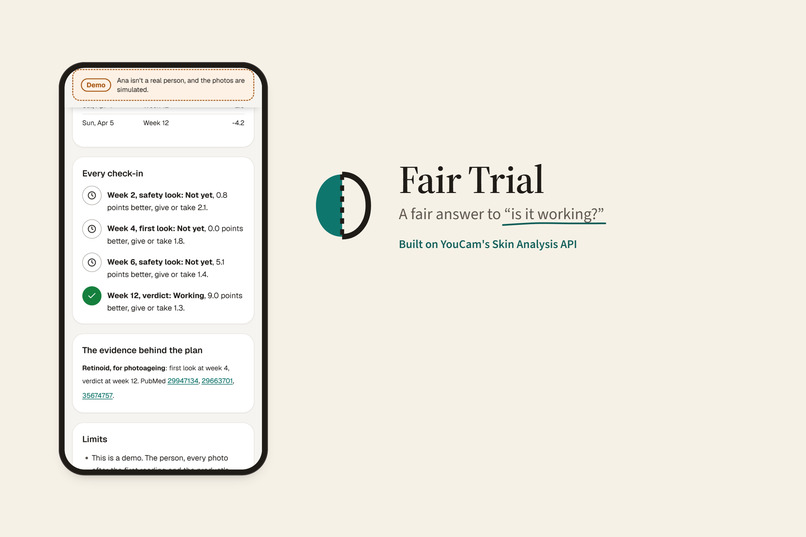
The demo trial plays a whole trial in under a minute on the live site, analysing nothing and spending no units.
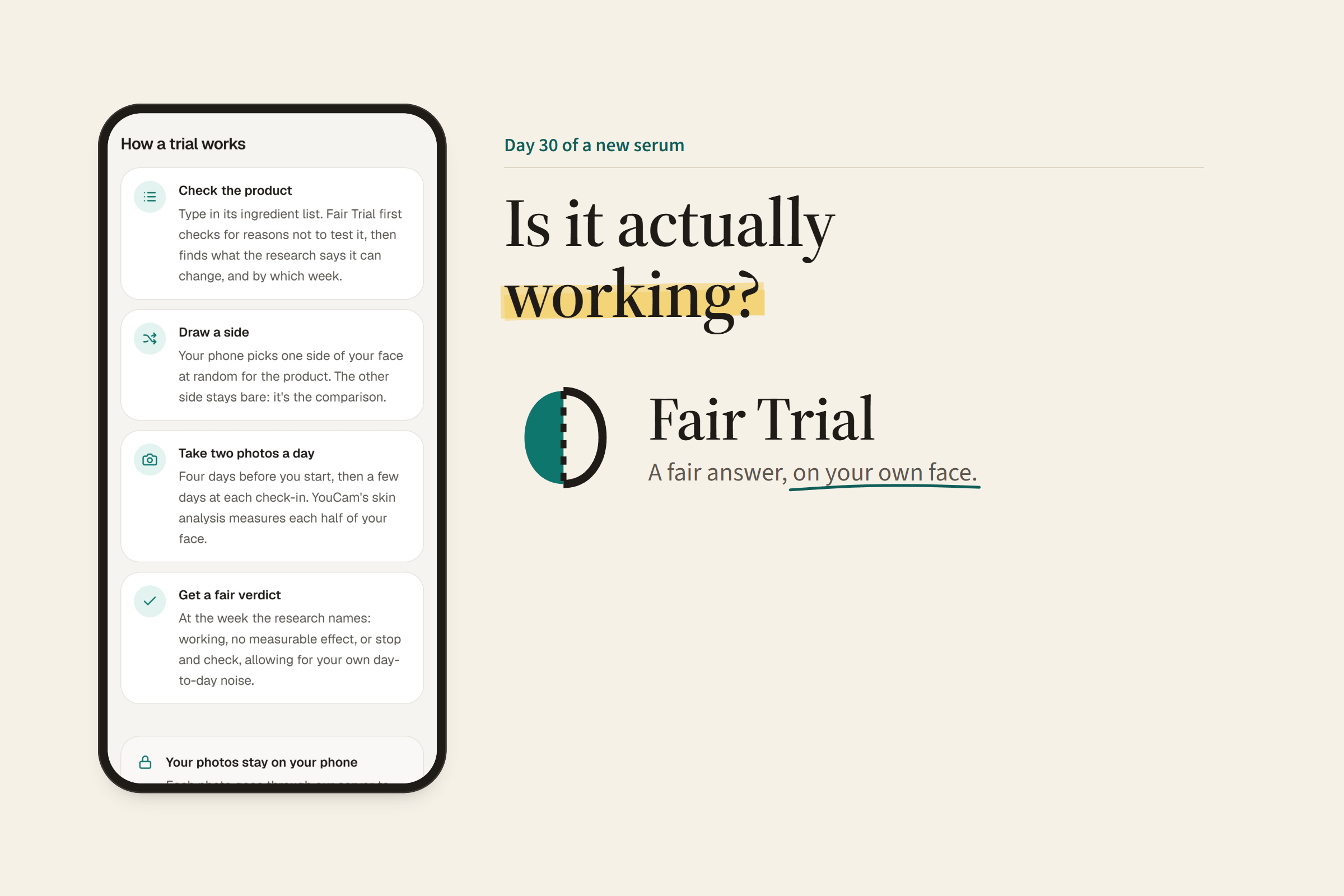
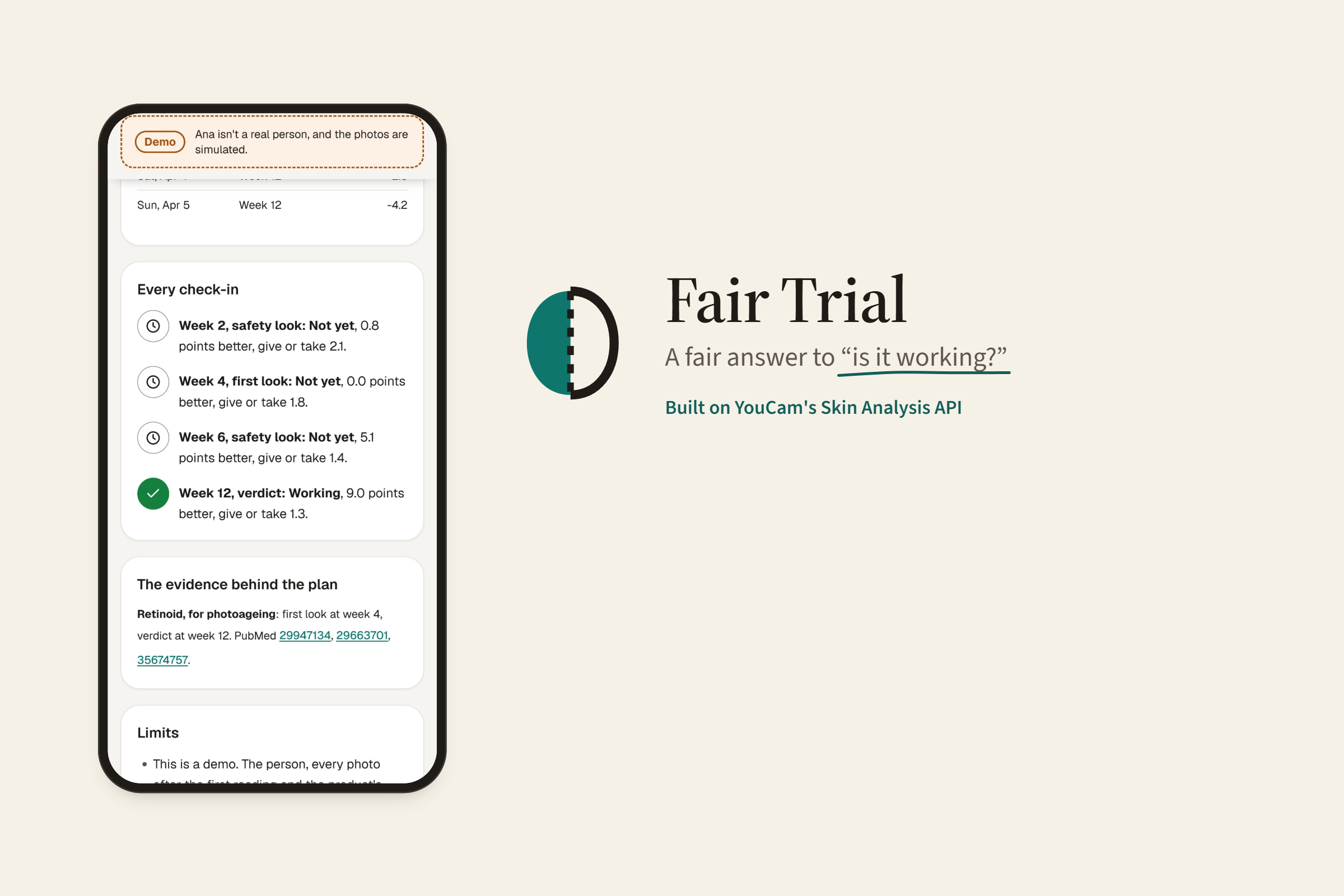
Is your skincare actually working? A mirror can't tell you, and neither can a before-and-after photo, because the light, the camera and your skin change from one day to the next anyway. Fair Trial answers the way a split-face skin trial does, on your own face. The product goes on one half and the other half stays bare. YouCam's Skin Analysis measures both halves in the same photo, so whatever reaches both halves alike cancels out, and only a difference beyond your own day-to-day noise counts.
Watch a whole demo trial in under a minute, no photos needed: https://fair-trial.vercel.app/demo
Inspiration
People pay for a serum, use it for a month and judge it in the mirror. But the face in the mirror changes from day to day with nothing applied: the light, the angle, a short night. A mirror can't separate that from what the product did.
Skin research has a design for exactly this: the split-face trial, where one half of the face gets the product and the other half is the comparison. We wanted that on a phone, judged against how much each person's own readings move. YouCam's Skin Analysis gave us the instrument: a raw score and a mask for each concern, from one photo.
What it does
- Checks the product first. A few questions and the ingredient list. Medicines, and anything a doctor or pharmacist should see first, get no trial. Neither does sunscreen. Otherwise the planner reads the actives and plans the trial from published research: what it can change, the check-in weeks and the verdict week.
- Draws a side. The phone picks the product half at random. The other half stays bare as the comparison.
- Measures your own noise. Four days of photos, two a day, before the product starts. How much your readings move with nothing applied is your personal noise.
- Takes the photos itself. The camera finds the face on the phone, says the one thing to fix and takes each photo only when every check passes. It judges the light against your first photo, using the whites of your eyes and your lips, which skincare can't change.
- Gives a fair verdict. At each check-in, YouCam's Skin Analysis measures both halves. The verdict engine compares the change on the product half with the change on the bare half, against your noise: Working, Not yet, No measurable effect, Stop and check, Expected adjustment or Can't tell, with its numbers.
- Writes a certificate: the verdict, what was tested and how, every check-in and the limits. No photo appears on it.
A labelled demo plays a whole trial of a person who doesn't exist through the same trial screen, verdict engine and certificate. It analyses nothing and spends no units.
For shoppers: a fair answer to "is it working for me?" before buying the next bottle, with a safety check before any plan.
For retailers and brands: a way to let shoppers test a product fairly at home, and a certificate with numbers in place of a testimonial.
How we built it
The YouCam API. Every analysis goes through Fair Trial's own server, which holds the YouCam API key, so the key never reaches the phone.
- The server uploads the photo with the File API (
/s2s/v2.0/file), starts a Skin Analysis task (/s2s/v2.0/task/skin-analysis) for up to 4 concerns, and polls the task for the result. - Fair Trial keeps the raw score (1 to 100) and drops the display score. YouCam's docs say the display score is adjusted to look more favourable and works as a motivator, so it isn't a measurement.
- Each concern's mask comes back to the phone, which splits it at the facial midline it finds and measures each half.
- The free credit check (
/s2s/v1.0/client/credit) keeps live analysis above a unit floor. - For testing, YouCam's AI Image Generator made the synthetic people, and Skin Simulation made skin changes at set strengths, so every measurement could be checked against a change known in advance.
The app. Next.js and TypeScript, with photos and results kept on the phone, live on Vercel. The validation statistics ran in R. A claim linter in CI reads every text a person can see.
The method. Each part was a step with its bar written down before its test. The build was frozen, then scored once on a held-out set drawn by seed. Missed bars stay reported as missed.
Challenges we ran into
- YouCam reads the face as a whole. Part of a real change on one half shows up on the other half too. That never flipped a result's direction in our tests, but it shrinks differences, so verdicts on dark spots, oiliness, texture and redness lean cautious.
- Not every concern is steady enough. On repeat photos with nothing changed, of synthetic faces of all six Fitzpatrick skin types, 9 of 12 concerns could compare one half of the face with the other. Acne and radiance couldn't and pores were borderline, so a trial measures only those 9. YouCam found no redness on the type IV to VI faces. When YouCam finds that little of a goal, the trial page says a change can't be measured.
- Light can't be judged on the skin under test. Our first camera check judged light on the cheeks, and it would have rejected 14 of 48 true skin changes. It now judges light on the whites of the eyes and the lips, and accepts 48 of 48.
- Reading a label can't catch every medicine. The safety check sent 32 of 40 unseen prescription labels to a doctor or pharmacist, short of our bar of 40. So the app also asks directly whether the product was given as a medicine. On a final set of 42 unseen prescription labels, it referred 40 and turned the other 2 away as not ingredient lists, so none reached a trial. Three of 40 over-the-counter drug labels still would have.
- Expected irritation could hide harm. Retinoid trials expect irritation in the first weeks, so a worse reading then says Expected adjustment. A product that kept making skin worse could hide inside that window until the verdict week. Every plan with such a window now has a look 2 weeks after it, and a worsening more than 5 times the smallest change the trial can pick up reads Stop and check at once. In simulated trials, that look stops 85.7 to 98.3% of products that keep making skin worse.
Accomplishments that we're proud of
- Half-face measurement found the product side in 48 of 50 true changes, with 0 of 54 calls in the wrong direction.
- For a product that does nothing, the verdict engine says Working 1.0 to 4.2% of the time in all 100 noise scenarios we simulated. It catches an effect of the smallest size a trial can pick up 90.3 to 99.7% of the time.
- The planner found 55 of 55 actives in 40 real ingredient lists, with 0 false finds.
- The safety check passed all 900 intake cases, and the verdict engine matched an independent rebuild on 1,000 of 1,000 cases.
- The key appeared in 0 of 90 responses the browser received. All 46 screens were audited in light and dark mode, with 0 serious or critical accessibility findings, and every screen works by keyboard alone.
What we learned
- The raw score is the measurement. The display score is a motivator.
- Noise is personal, so the bar for Working has to be each person's own.
- Writing the bar down before the test kept us honest. A miss is a result too.
What's next
- A pilot with real people who consent, beside the synthetic ones.
- A Test it fairly button a shop could put beside a product.
- YouCam's HD analysis, to see whether finer masks lower the noise.
Built With
- axe-core
- github-actions
- indexeddb
- mediapipe
- next.js
- node.js
- playwright
- r
- react
- skin-analysis
- tailwindcss
- typescript
- vercel
- web-crypto-api
- webassembly
- youcam-api
