Inspiration
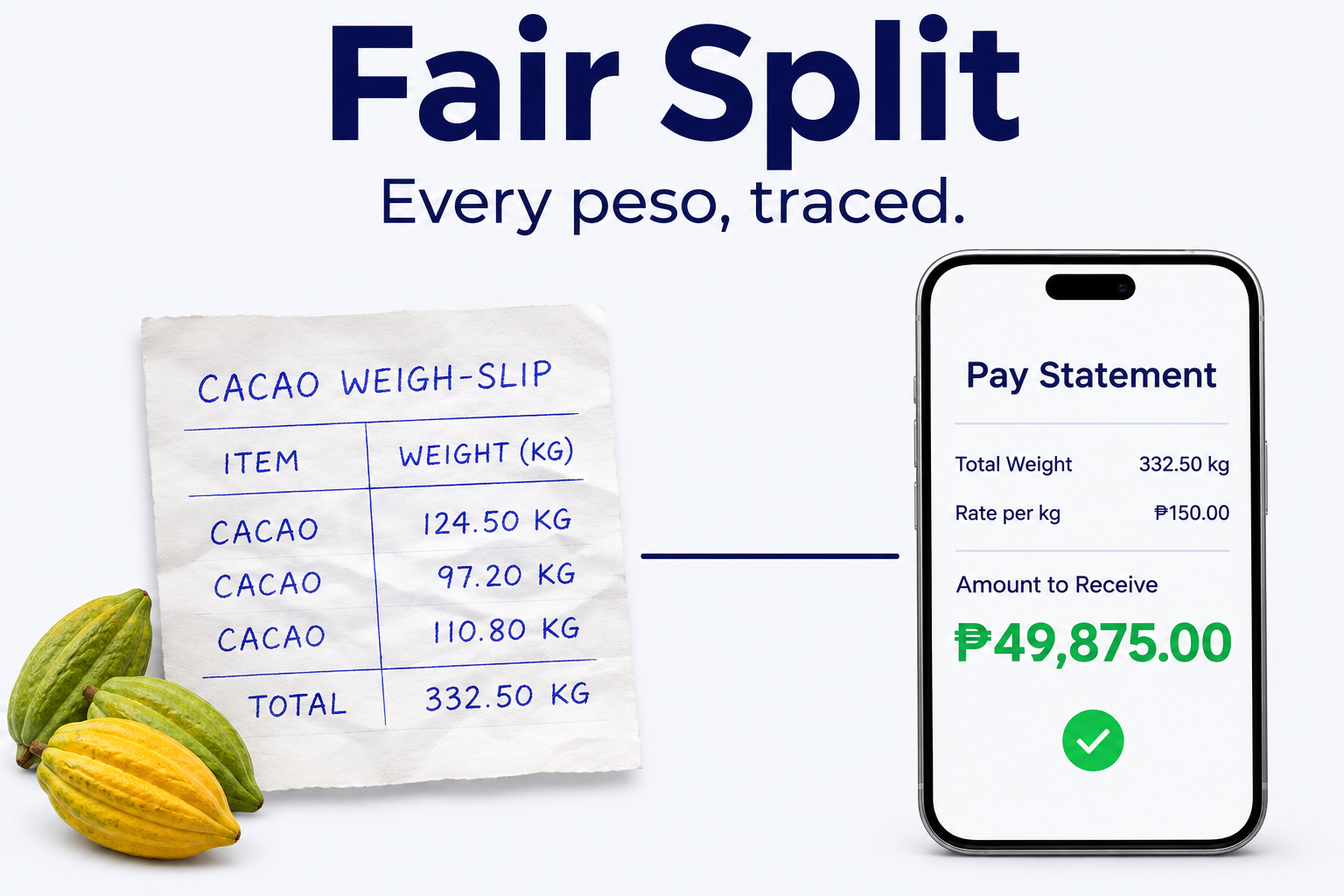
A cacao co-op's season of pay starts on paper. A clerk writes a weigh-slip for every delivery; months later one buyer pays one premium for the whole lot, and the treasurer splits it across dozens of members by hand. Most members cannot check their share, and the buyer cannot show that the premium reached them. Fairtrade's cocoa standard already asks producer organisations in Côte d'Ivoire and Ghana to give each member a receipt for the premium paid (requirement 4.3.4) and to record those payments digitally (4.3.5). In the Philippines, half of adults owned a formal financial account in 2025 (BSP, Consumer Finance and Inclusion Survey), so a payroll tool for a co-op there has to serve cash members as well as PayPal members.
What it does
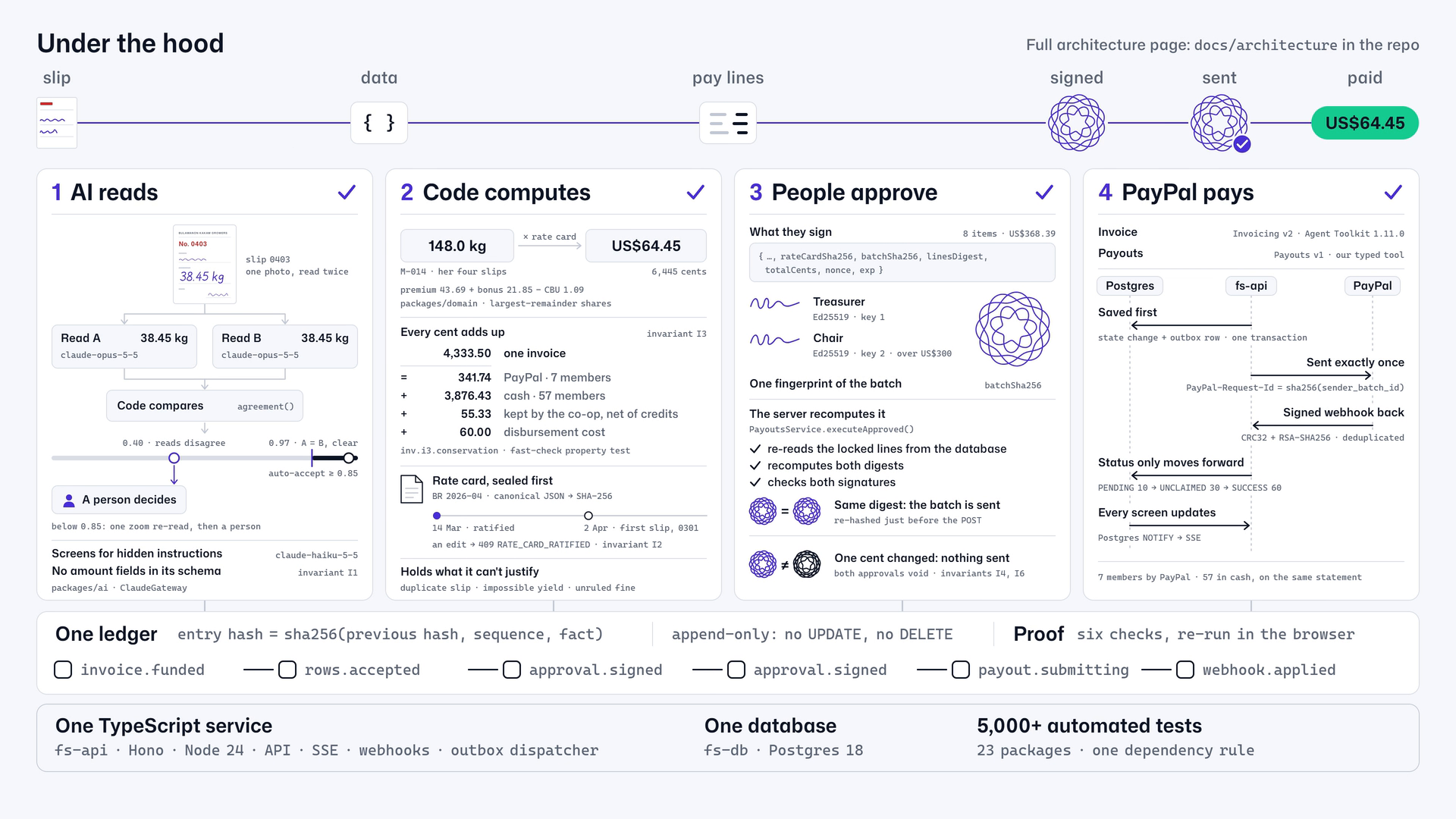
Fair Split is built around one synthetic season: Bulawanon Kakaw Growers MPC (Calinan, Davao City; 64 members) and its buyer, Lantern Bay Chocolate Co. of Oakland. The model reads paper; code computes; people approve; PayPal executes, here on the simulator.
- Rules before facts. The co-op's rate card (BR 2026-04) is ratified and hashed before the first slip. Editing it later is refused, citing the hash.
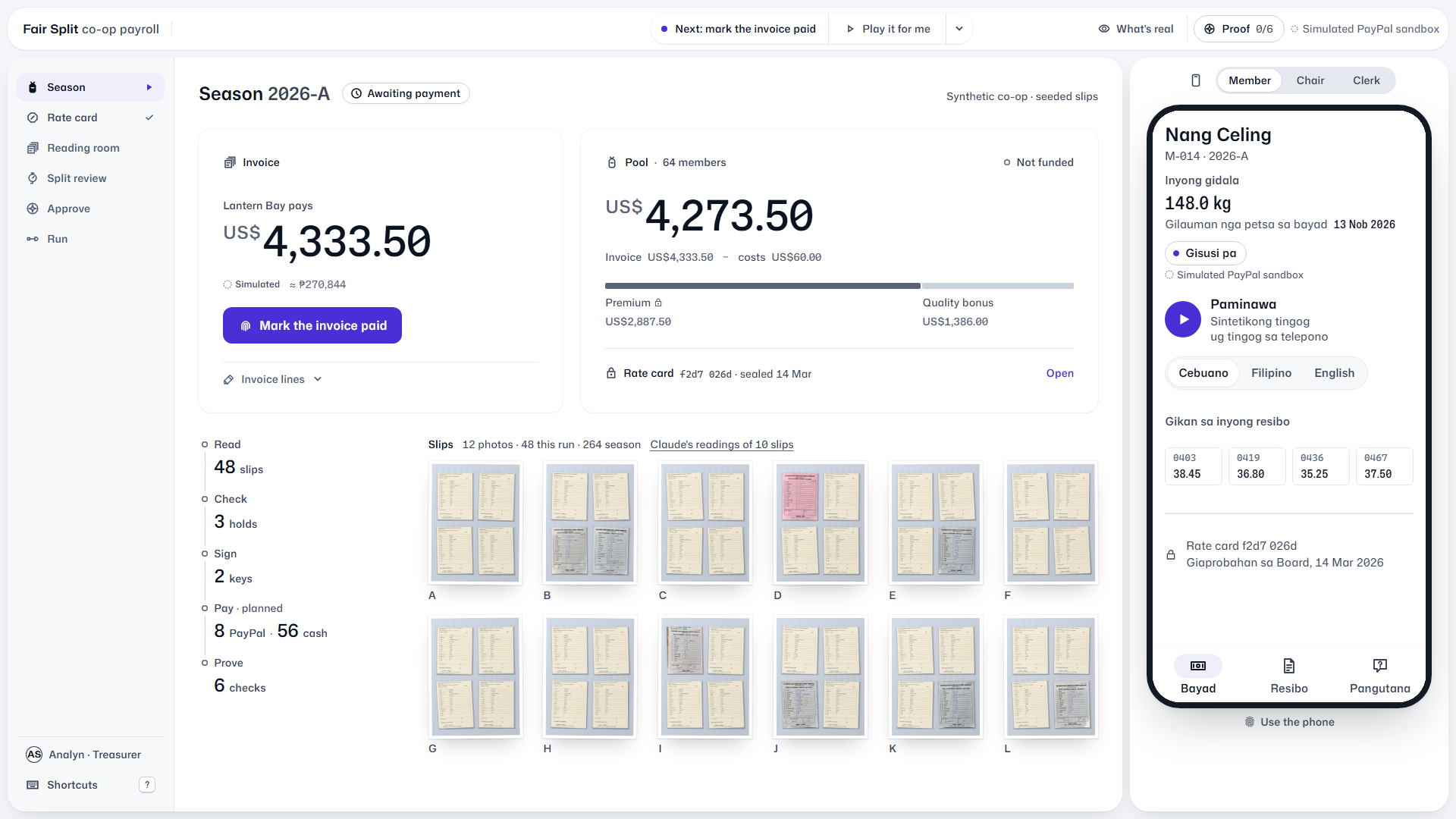
- Fund. Lantern Bay pays one invoice of US$4,333.50: premium US$2,887.50, quality bonus US$1,386.00 and disbursement costs US$60.00. Code computes the quote; the invoice is created and sent through PayPal's Agent Toolkit 1.11.0 on the simulated PayPal sandbox, with an AUTO_CANCEL rule, and the run is funded only when a fresh GET reads it paid. The invoice's line labels are a placeholder written with the seed: the audit agent that was meant to draft them is paused.
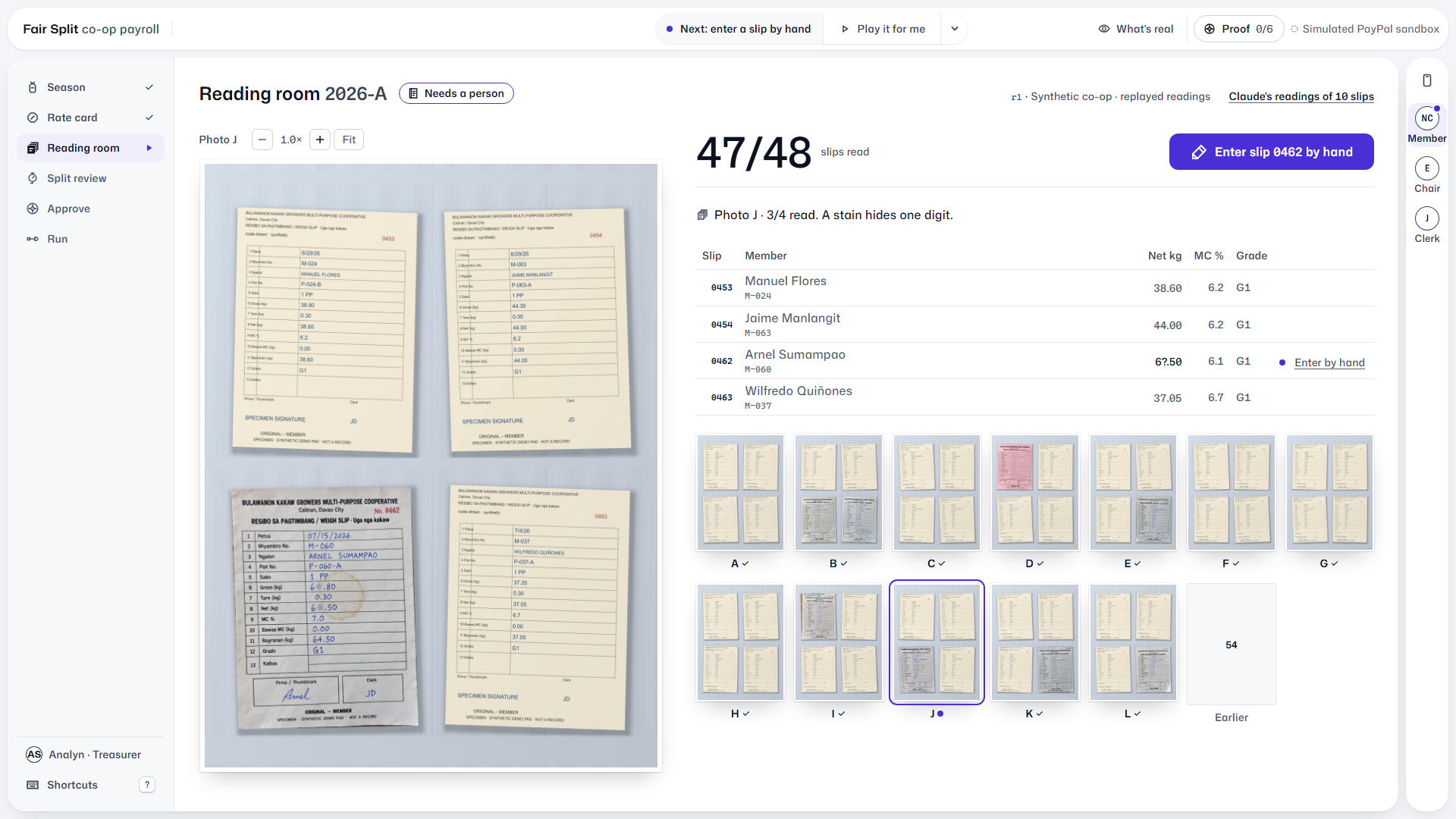
- Read. Claude is built to read every slip twice and send anything unsure to a person. In Judge Mode the 48 slips in 12 photos replay a labelled seed stand-in, not a Claude recording. Separately, R1 (a live run on 1 Nov 2026) put Claude on the 10 synthetic hero slips; the reading room exhibits its readings beside the stand-in, and its results are under Accomplishments.
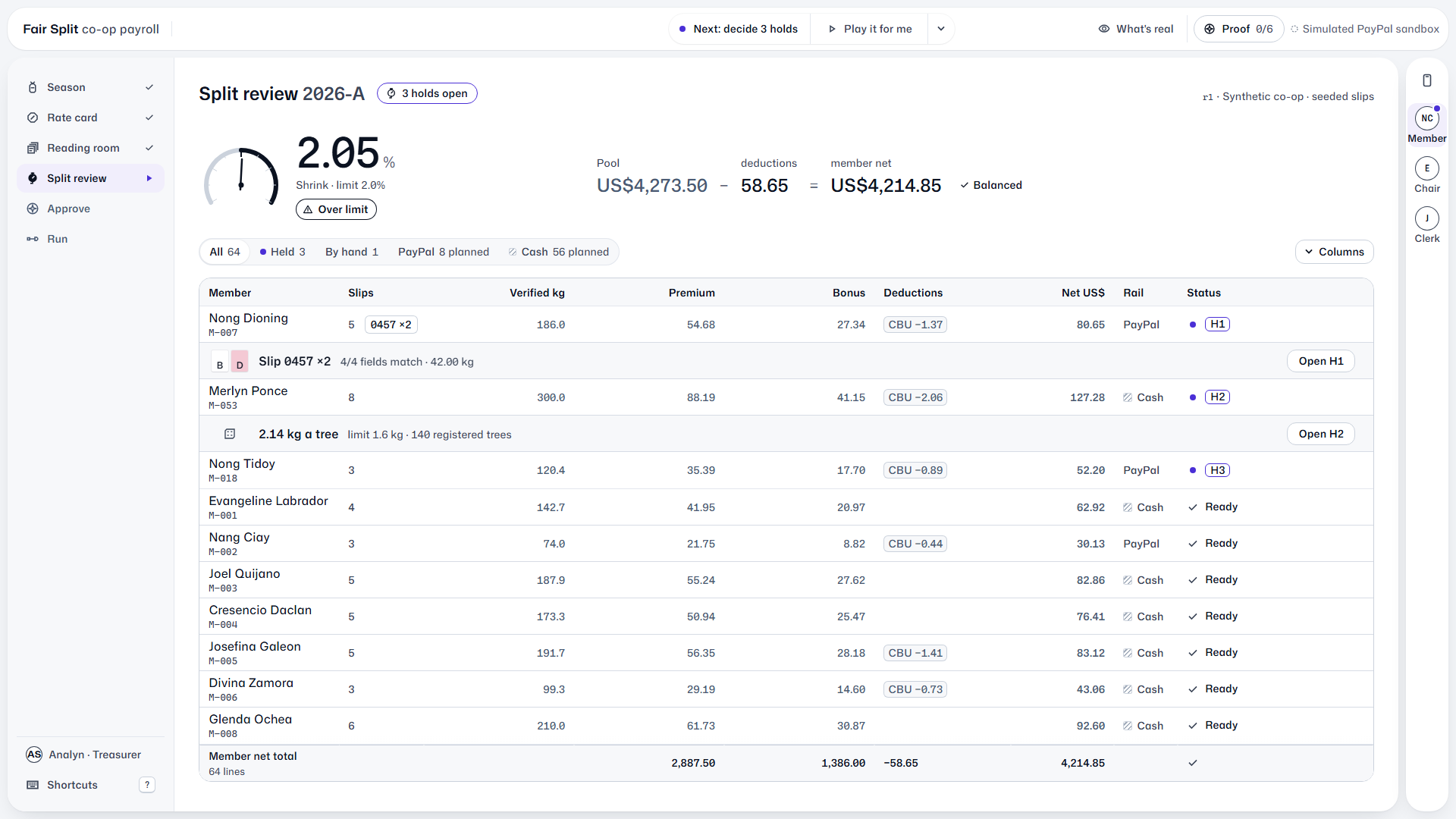
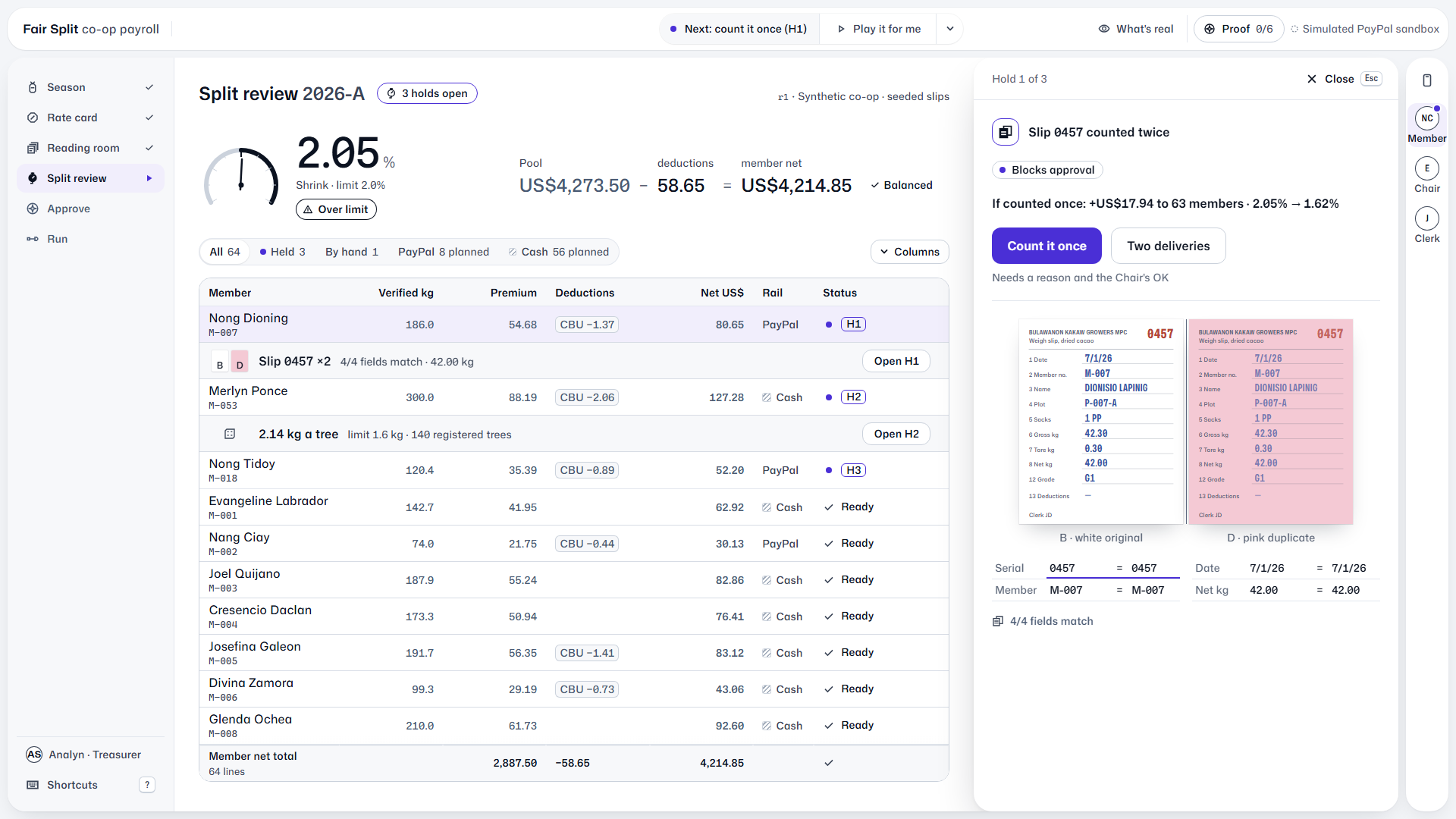
- Compute and hold. A deterministic engine computes all 64 lines in integer cents and holds what it cannot justify:
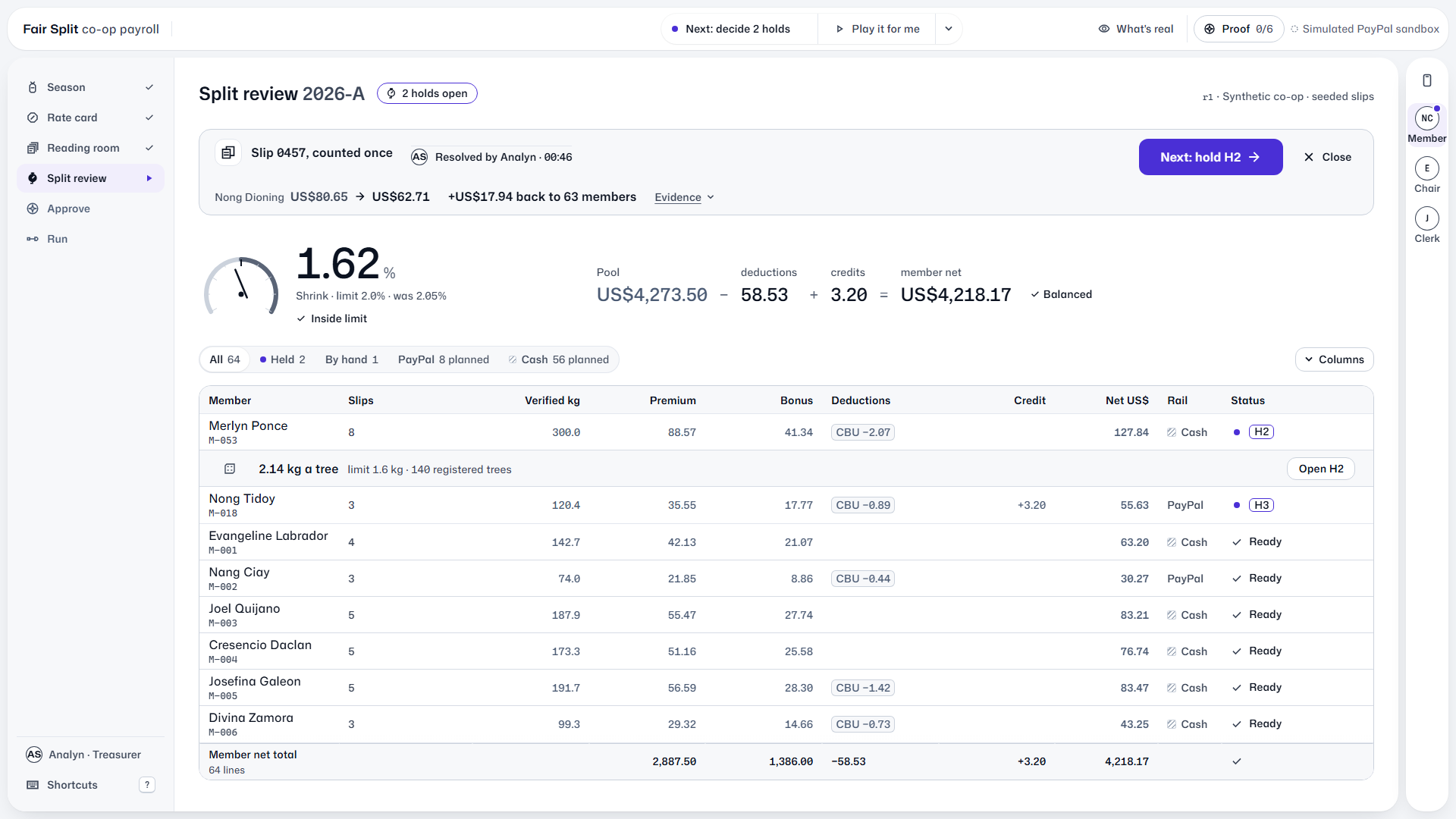
- H1: Slip 0457 is in two photos: the white original (B) and the pink duplicate (D). Counting both moves US$17.94 from 63 members to Nong Dioning and puts shrink at 2.05%, over the 2.0% limit.
- H2: Merlyn Ponce: 300.0 kg from 140 registered trees is 2.14 kg a tree. The limit is 1.6.
- H3: 'Multa (absent GA) ₱200' on slip 0458 matches no Schedule A rule. It was netted from Nong Tidoy's cash at the bodega, so it returns as a US$3.20 correction credit paid by the co-op, not from Lantern Bay's pool. Hauling ₱91.20 (R2) stays. In plain words: the fine for missing the general assembly is not in the ratified rules, so it comes back to him; the hauling charge is a ratified rule and stays.
- Slip 0462's stained digit is typed by a person, from the logbook.
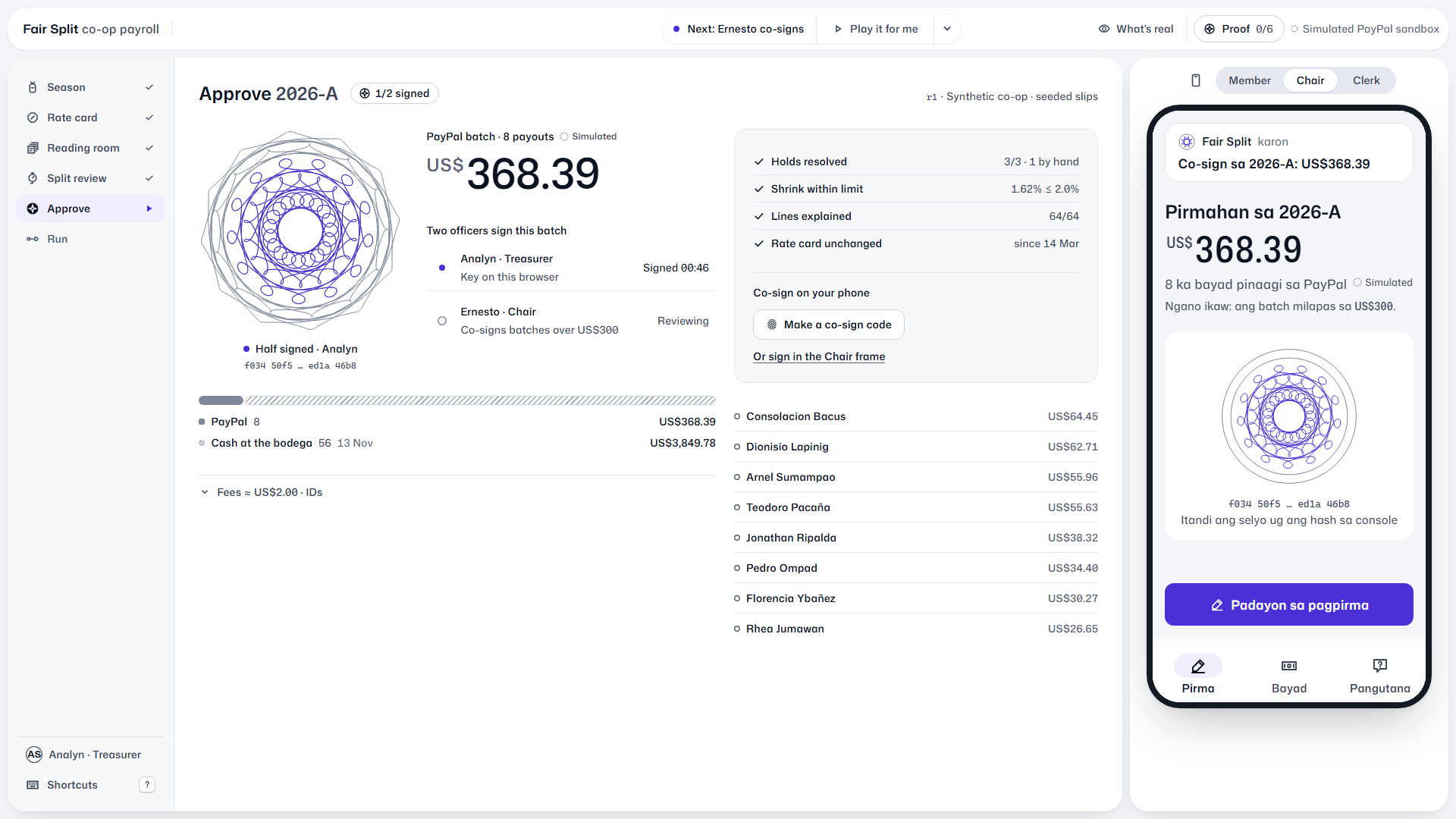
- Approve. The treasurer and the Chair each sign one batch hash with an Ed25519 key; any batch over US$300 needs the Chair. Arm a one-cent change to one payout before key 2: once both keys sign, the Payouts tool re-hashes the batch, refuses the changed payout and voids both approvals.
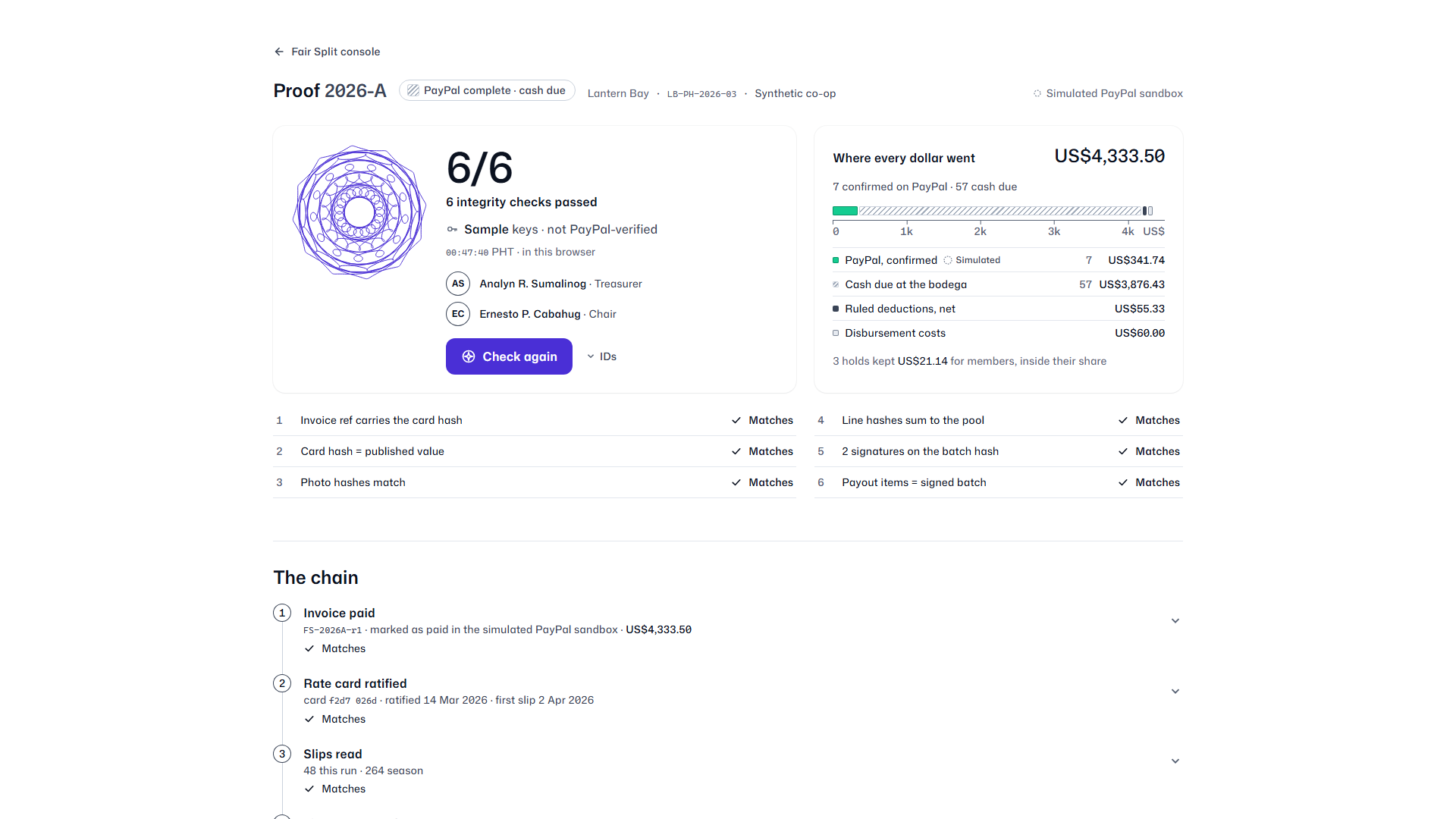
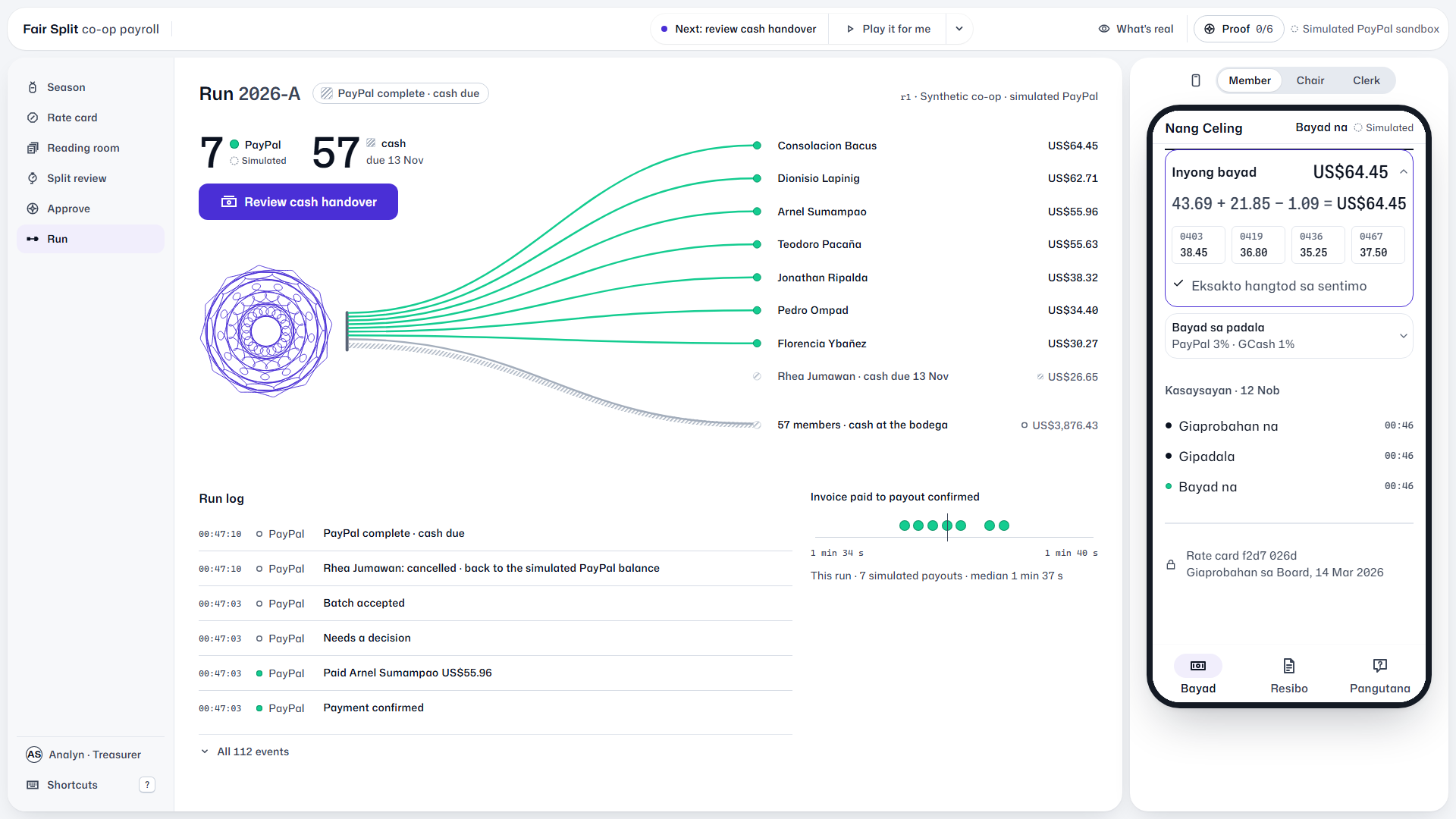
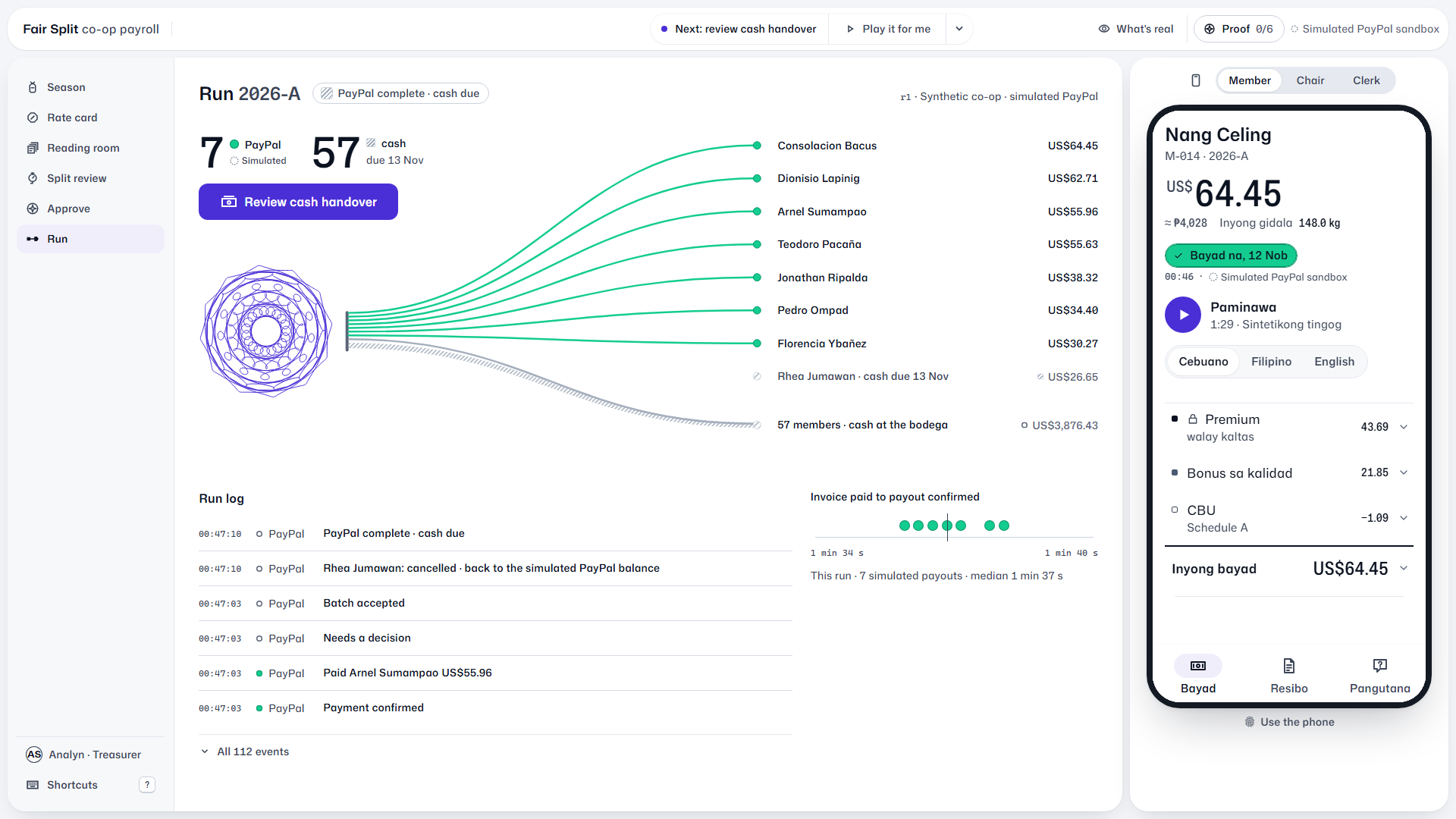
- Pay. Our typed Payouts tool posts 8 items (US$368.39) to the simulated PayPal sandbox. Status checks and the simulator's signed webhooks confirm each item. Rhea has no PayPal account, so her item parks UNCLAIMED and is cancelled, and she is paid in cash. End state: 7 of 64 members paid through the simulated PayPal sandbox (US$341.74) and 57 in cash (US$3,876.43), on the same kind of statement. The holds returned US$21.14 to the members it belonged to: US$17.94 by counting the duplicate slip once and US$3.20 by returning the unruled fine.
- Explain and prove. A member's statement explains her number down to her slips, in Cebuano, Filipino or English, from hand-written templates (the model writes no statement). Nang Celing's line: premium US$43.69, quality bonus US$21.85, CBU US$1.09, net US$64.45. Sentences with a verified Gemini TTS clip can be heard; the rest use the phone's own voice, labelled. Lantern Bay opens Proof and re-checks the rate card hash, both signatures, every line and the ledger's hash chain in its own browser.
How we built it
- One origin. A TypeScript monorepo on Node 24. fs-api (Hono, Postgres through Drizzle, server-sent events) serves the treasurer's console and Judge stage (Vite, React, TanStack Router, AG Grid Community 36.2.0), the Expo app's web export at /app, and the public Proof page.
- Code decides money.
packages/domaincomputes every line in integer cents (largest-remainder pool shares) and a policy lattice compares the whole invoice body with the engine's quote before any PayPal call. The model never writes a number into a line, invoice, payout or statement. - Effects through an outbox. Every PayPal call is enqueued in the same Postgres transaction as the state change that asks for it. Every event lands in a hash-chained ledger with Ed25519-signed checkpoints, which Proof verifies.
- PayPal. Invoicing v2 runs through
@paypal/agent-toolkit1.11.0 (create, send, AUTO_CANCEL rule, record payment, GET). The toolkit has no Payouts tool, so we wrote a typed one, built on PR #107's schemas, withPayPal-Request-Ididempotency and re-hash checks. Webhooks are verified offline (CRC32 of the raw body plus RSA-SHA256 against the signing certificate), deduplicated by transmission id, and stored with their delivery evidence. - The simulator.
packages/paypal-simimplements the REST subset we use (OAuth, Invoicing v2, Payouts v1, Webhooks v1) and validates every request and response against PayPal's published OpenAPI specs. It runs inside fs-api's process and intercepts the toolkit's HTTP calls, so the client code is unchanged; its resource IDs carry SIM and its debug IDs start with sim-. - AI. One ClaudeGateway is the only Anthropic SDK import in product code (two schema spikes aside). It keys a replay cache on sha256 of the image, variant, prompt version, schema version, model and effort, enforces per-lane spend caps and a kill switch, and sends any stop other than end_turn to a person.
- Tests. 6,362 unit, property (fast-check) and embedded-Postgres tests across 23 packages at the 1 Nov merge of main (8fc978c), a booted smoke of 85 checks over every route and IC-01 command, and a Playwright suite of 33 tests in 8 spec files for the judge loop and the phone co-sign.
- Who wrote it. Claude Code agents wrote, reviewed and merged the code under an automated review-and-verify protocol, and OpenAI's Codex CLI built some work packages from written briefs; the user approved every outward step.
Challenges we ran into
- No PayPal accounts. The developer, in India, reports being unable to create the US PayPal accounts the plan assumed, so there are no sandbox REST credentials; we built a strict simulator and kept PayPal's own client code. The integration is untested against PayPal's own sandbox, and we say so on every PayPal value.
- The toolkit's own HTTP client. The Agent Toolkit sends its calls through its own axios instance, so a simulator in a separate service could not catch them. The simulator runs in fs-api's process and intercepts node:http, node:https and fetch.
- Signed webhooks from a simulator. PayPal's verifier rightly refuses a certificate that is not PayPal's, so the simulator signs with its own certificate authority, which is trusted only in simulator mode.
- Honest copy. A lint (E-19) reads this text, the README, the film script and every UI catalog, and fails when 'sandbox', or 'live' next to PayPal, appears without 'simulated', on claims we cannot back, and on any money or kilo figure the seed does not hold.
- Audio on a free tier. Each Cebuano, Filipino and English clip is transcribed back and compared with its exact sentence before it is published; a sentence without a verified clip is spoken by the phone, labelled.
Accomplishments that we're proud of
- The judge loop runs end to end with no login: fund, read, hold, two keys, pay, Proof, reset.
- A payout changed after it was signed (armed before key 2) is refused in view of the judge, and both approvals are voided.
- Proof re-verifies in the buyer's browser against published keys, for PayPal and cash lines alike; a judge run, signed with demo keys, reads Sample, never Verified.
- Rhea's unclaimed item moves to cash on the same statement, so a member without PayPal is not left out.
- R1, the only real Claude output in the repo: on 1 Nov 2026 claude-opus-5-5 (reads and zoom) and claude-haiku-5-5 (injection screen) ran live on the 10 synthetic hero slips. N = 10 scored slips: 10 of 10 rows exact against provisional, agent-checked labels, 0 unsafe auto-accepts, and the two stained 0462 fields were sent to a person. The labels are not person-reviewed, N is small, and a single read scored the same on this sample.
What we learned
- Putting the model only where paper becomes data, and code wherever money is decided, made every claim testable.
- Honest labels need machinery: provenance on every row (live, replay, simulated rail, seeded) and a lint on every public sentence.
- A simulator is only worth having if it is strict, so ours checks every request and response against PayPal's published specs.
What's next for Fair Split: audited co-op payroll on PayPal
- Run the same code against PayPal's own sandbox (
PP_MODE=sandbox); it is untested today. - Person-reviewed labels and a larger, held-out set of slips for the eval.
- Native-speaker review of the Cebuano and Filipino text, which is machine-translated today.
- A pilot co-op: there is no pilot partner yet.
- The business model: the buyer pays a per-run audit fee. The co-op stays merchant of record, and Fair Split never holds funds.
- Production onboarding, where PayPal must grant third-party permissions for Invoicing and Payouts.
How it differs
Re-scanned 4 Nov 2026, before the hackathon's project gallery was public; the README's Prior art table names the projects. Most nearby projects protect the payer or the parties to a contract. Some now give the person paid a receipt, one has two signers on one approval hash with rules ratified by signed hash, and one checks a signed proof in the visitor's own browser. None we found starts from a handwritten weigh-slip. Fair Split reads each slip twice, holds what the ratified rate card cannot justify, binds the officers to one batch hash, puts members paid in cash on the same statement as members paid through PayPal, and lets the buyer re-verify every line in its own browser.
What's real, replayed, simulated, seeded and synthetic
- Real: the presses, holds and approvals in a session; every amount, computed in integer cents; the rate card hash; Proof's checks in the browser; R1's committed Claude responses.
- Replayed: the slip reading in Judge Mode (a labelled seed stand-in). If the hour's quota of payout runs is spent, the payout steps replay an earlier simulated run, labelled as a replay.
- Simulated: every PayPal call, ID, status, webhook and fee (the simulated PayPal sandbox), the phone's push banners and the clerk's scanner.
- Seeded: the invoice-send approval, and the 54 earlier photos' manifest entries with their seeded read dates (those photos are not imaged).
- Synthetic: the co-op, its 64 members, the buyer, the 48 slips in 12 photos (A–L, composed in code from model-made hero slips and code-drawn slips), the documents and the voices.
Limits
- Fees on screen are the simulator's ($0.25 × 8 = $2.00, PayPal's published US rate). In production a Philippine co-op pays PayPal PH's fees: receiving 4.40% + US$0.30, payouts 2% capped at ₱50 each, conversion 3.0%.
- No APK is built yet; the app runs as a web export in the stage's phone frames and in a phone's browser.
- Push notifications, the clerk's offline capture, iOS and the audit agent are not part of this build.
Built With
- ag-grid
- anthropic
- claude
- claude-code
- drizzle-orm
- expo.io
- gemini-tts
- hono
- node.js
- paypal
- paypal-agent-toolkit
- paypal-payouts
- paypal-webhooks
- playwright
- postgresql
- python
- react
- react-native
- tailwindcss
- tanstack-router
- typescript
- vite
- vitest
- zod
