Inspiration:
Algorithmic fairness concerns have increased as a result of the critical sectors' quick adoption of AI and machine learning. Even though a lot of models are very accurate, they frequently reinforce or spread prejudices against underrepresented groups. Adaptability and scalability are limited by the static constraints or manual tuning required by most existing fairness solutions. In order to make AI systems more morally and practically deployable in a variety of settings, we were motivated to create a dynamic, multi-objective algorithm that strikes a balance between efficiency, accuracy, and fairness in real-time.
What it does:
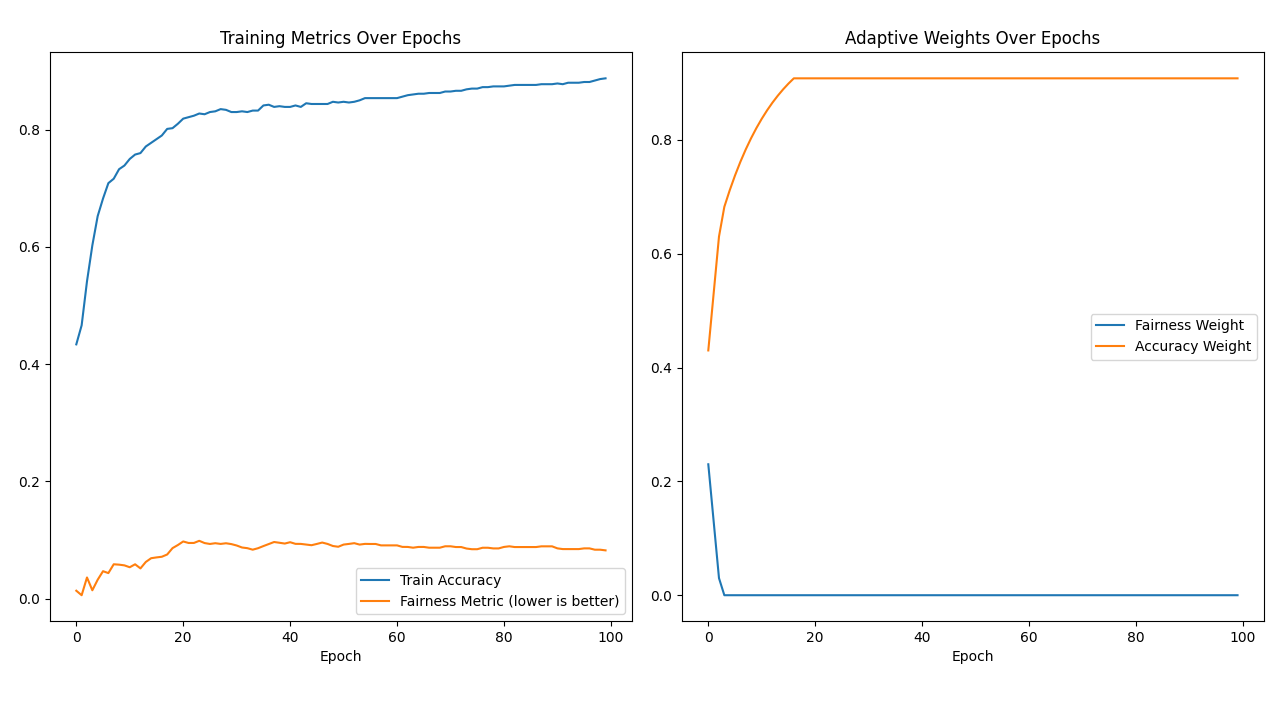
A dynamic multi-objective optimization algorithm called Fair Optimus adaptively strikes a balance between: Equal opportunity and demographic parity are examples of fairness metrics; predictive accuracy is used to sustain model performance; Computational efficiency to make deployment feasible.
It employs an adaptive weighting scheme that, under the direction of bandit-based tactics or reinforcement learning, updates the significance of each objective during training or inference. The algorithm produces interpretable models with performance characteristics that can be explained by examining the Pareto front of fairness, accuracy, and efficiency trade-offs.
Fair Optimus solves the following mathematical problems:
[ \min_{\theta} \quad \alpha(t) \cdot \text{Fairness}(\theta) + \beta(t) \cdot \text{Error}(\theta) + \gamma(t) \cdot \text{Cost}(\theta)] where (\theta) are model parameters and (\alpha(t), \beta(t), and \gamma(t)) are dynamic weights that vary over time (t).
How we built it:
-Using PyTorch and Scikit-learn, fundamental adaptive multi-objective optimization logic was created in Python. -Reinforcement learning techniques were used to implement dynamic weight update rules and fairness metrics.
- DEAP's evolutionary algorithms were used to effectively explore the Pareto front. -Matplotlib and Seaborn were used to visualize performance curves and trade-offs. -Modular code was created to make it simple to incorporate into common ML pipelines.
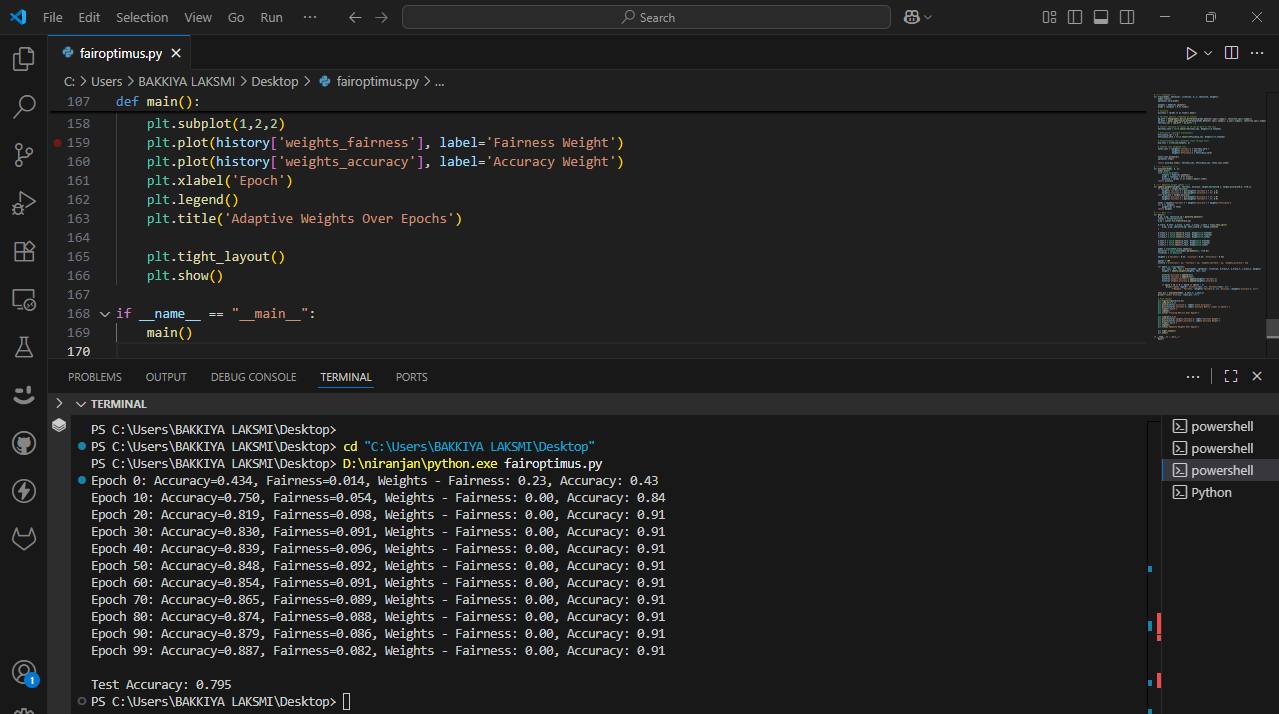
- Using Jupyter notebooks for experimentation, the entire development process was carried out in Visual Studio Code.
Challenges we ran into:
-Creating dynamic weighting systems that are stable and do not deteriorate convergence or oscillate. -Adaptive fairness checks add computational overhead, which must be balanced with overall efficiency. -Establishing suitable reward signals to direct weight updates in reinforcement learning. -Combining several, occasionally incompatible definitions of fairness. -The ability to clearly visualize and interpret high-dimensional trade-offs.
Accomplishments that we're proud of:
-A prototype algorithm that accurately maintains accuracy while dynamically adapting to fairness constraints was successfully developed. -Better trade-offs were shown on benchmark datasets such as Adult and COMPAS. -Achieved a balance that performs better in terms of efficiency and fairness than baselines with static fairness constraints. -Clear visualizations that illustrate the effects of fine-tuning efficiency, accuracy, and fairness have been developed. -For reproducibility and extensibility, a completely modular, open-source codebase was created using Visual Studio Code.
What we learned:
-Adaptive and context-aware weighting is very beneficial for multi-objective fairness optimization. -Reinforcement learning is a useful tool for guiding dynamic balance in ethical AI goals. -Algorithmic innovation can help navigate the difficult trade-offs between efficiency, accuracy, and fairness. -The development of such systems necessitates interdisciplinary knowledge spanning AI ethics, optimization and software engineering. -Transparent visualization is essential for conveying fairness implications to stakeholders.
What's next for Fair Optimus:
-Extending support for multi-group fairness scenarios and increasingly intricate fairness metrics. -Real-time fairness adaptation in streaming data contexts through the integration of online learning.
- Implementing Fair Optimus as a plug-and-play library for well-known machine learning frameworks. -Working together with subject-matter specialists to customize solutions for critical applications such as finance and healthcare. -To encourage broader adoption and additional innovation, we plan to publish our research findings and make the entire project open-source.


Log in or sign up for Devpost to join the conversation.