Inspiration
What it does
How we built it
Challenges we ran into
Accomplishments that we're proud of## Inspiration
Architectural design research is still surprisingly manual.
After generating or selecting a promising facade image, architects often have to translate what they see into dozens of separate searches: similar precedents, material systems, construction details, manufacturer information, performance data, and evidence that the design can actually be built.
The difficult part is not simply finding information. It is deciding what needs to be researched in the first place.
FAIR started from a simple question:
What if architects could search with the design itself, instead of repeatedly translating a design into keywords?
What it does
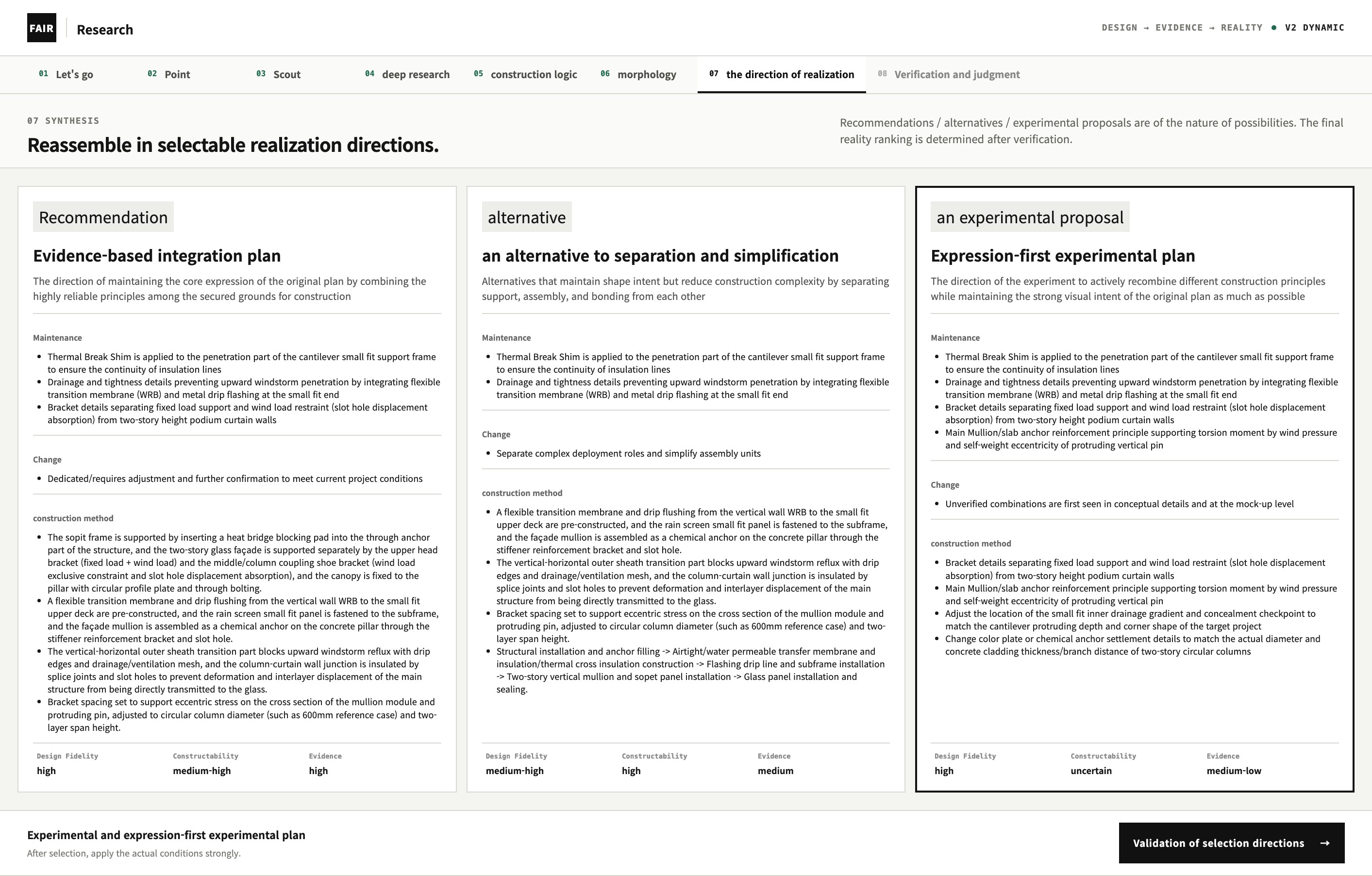
FAIR — Facade Research Agent turns a design image and a short project context into an autonomous research process.
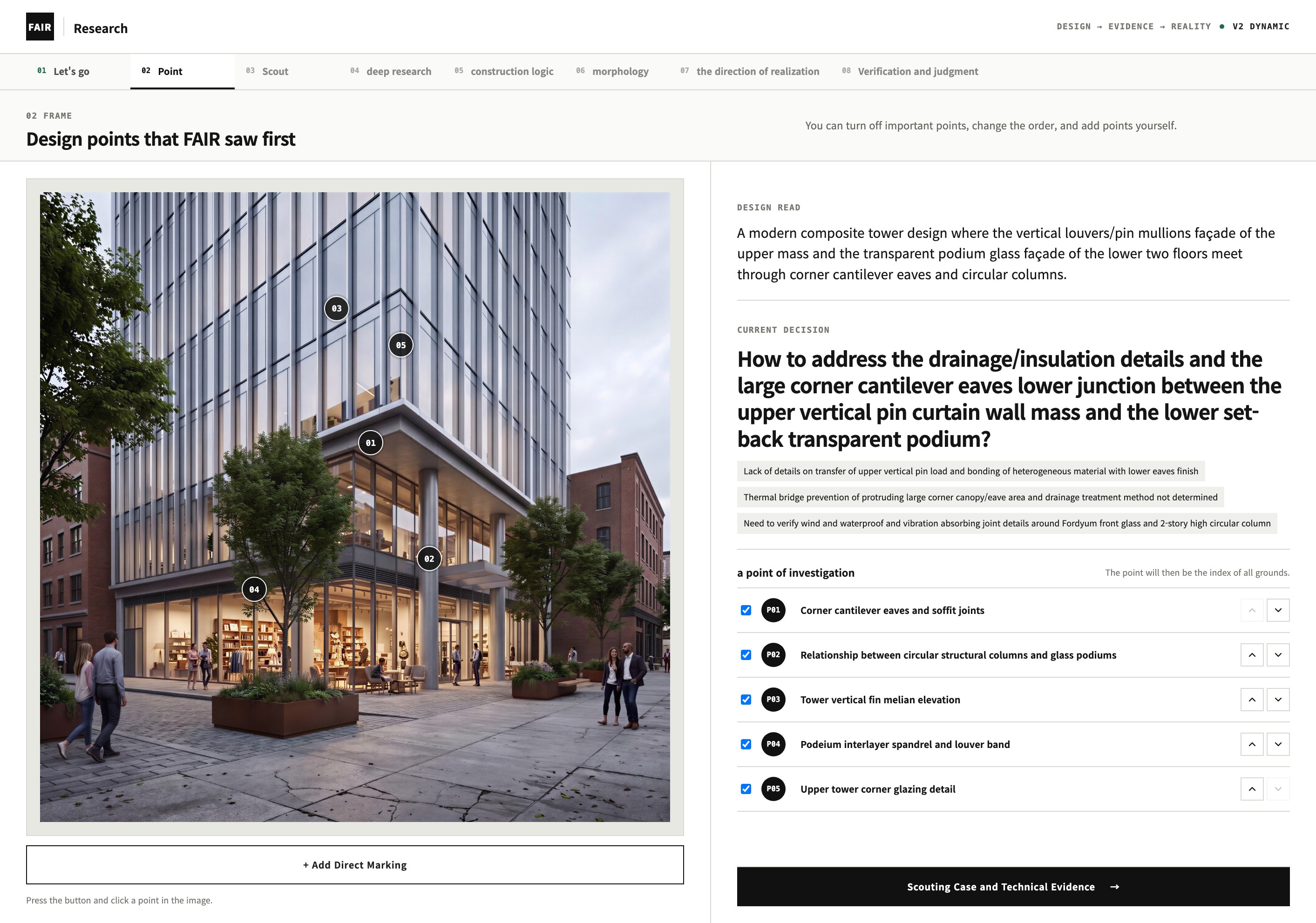
Instead of asking the user to choose every research category manually, FAIR first analyzes the image and identifies its key design intentions, such as:
- deep horizontal frames
- recessed glazing
- stone / glass contrast
- facade modularity
- planted terraces
- material transitions
It then decides what evidence is needed to develop those design moves further.
For example, a facade with deep stone frames may trigger research into:
- built precedents with comparable proportions
- feasible material systems
- facade and curtain-wall connection details
- relevant performance information
- manufacturer or technical references
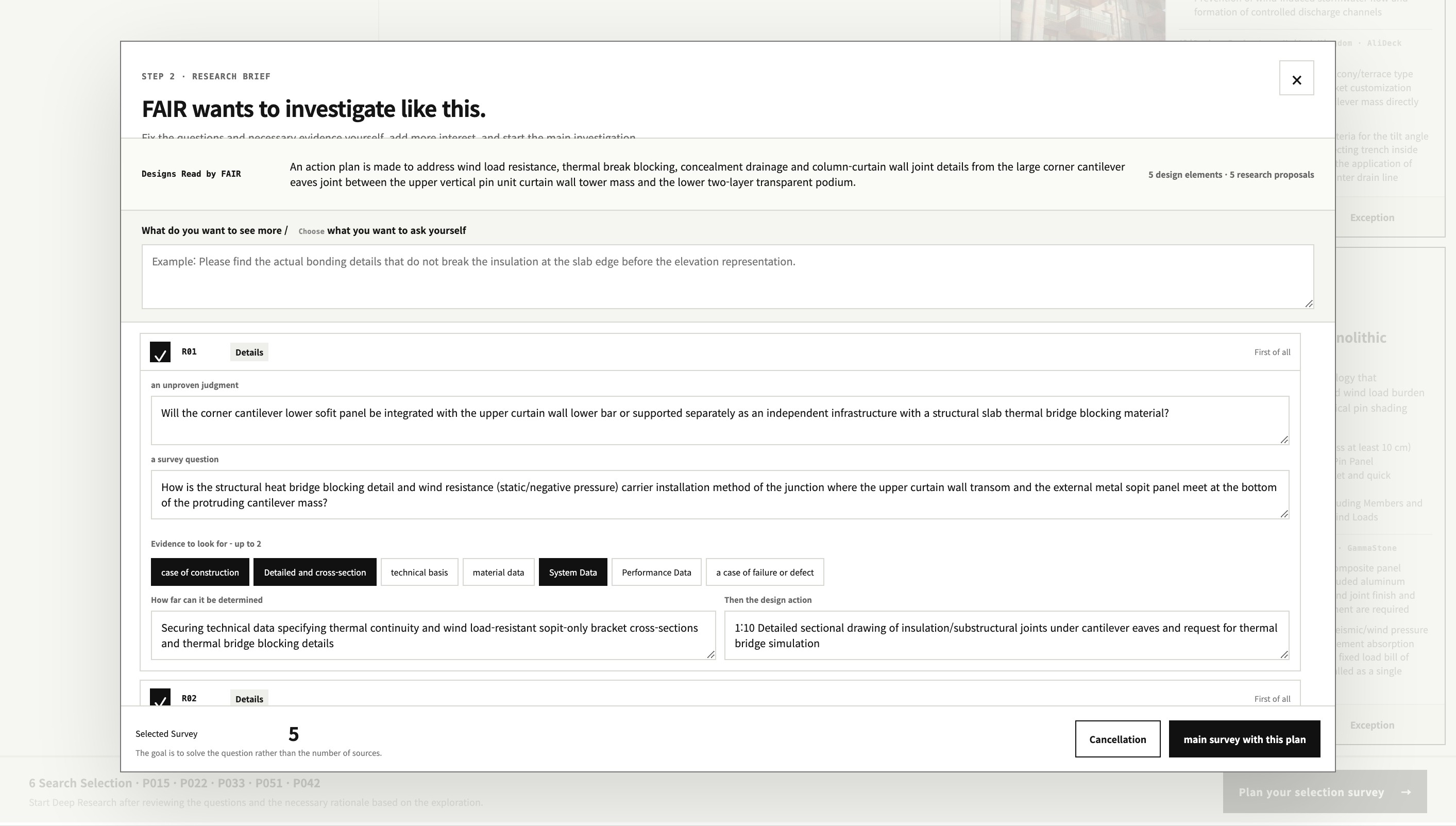
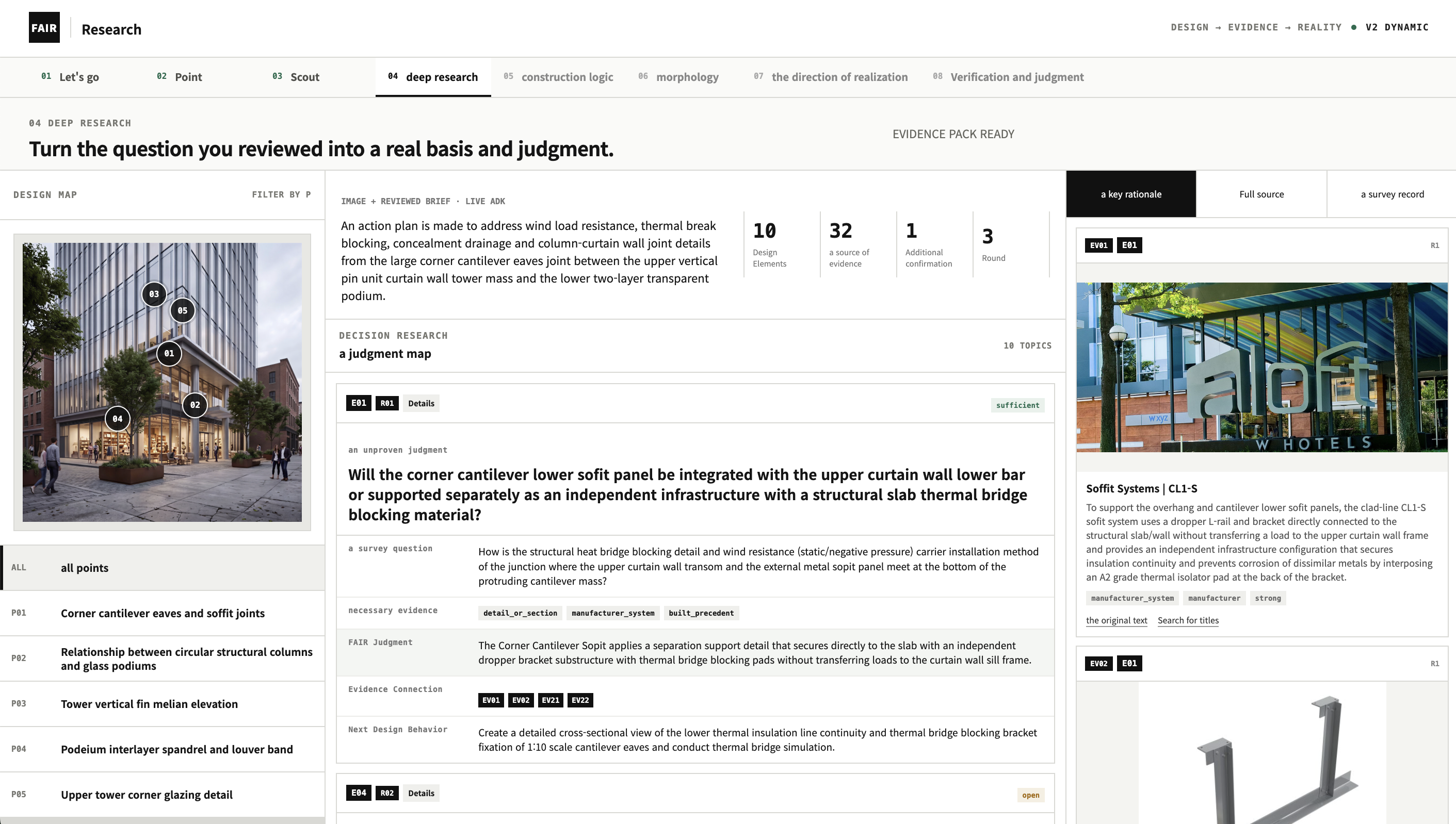
FAIR creates a research plan, gathers evidence, evaluates which design questions are sufficiently supported, and identifies remaining evidence gaps.
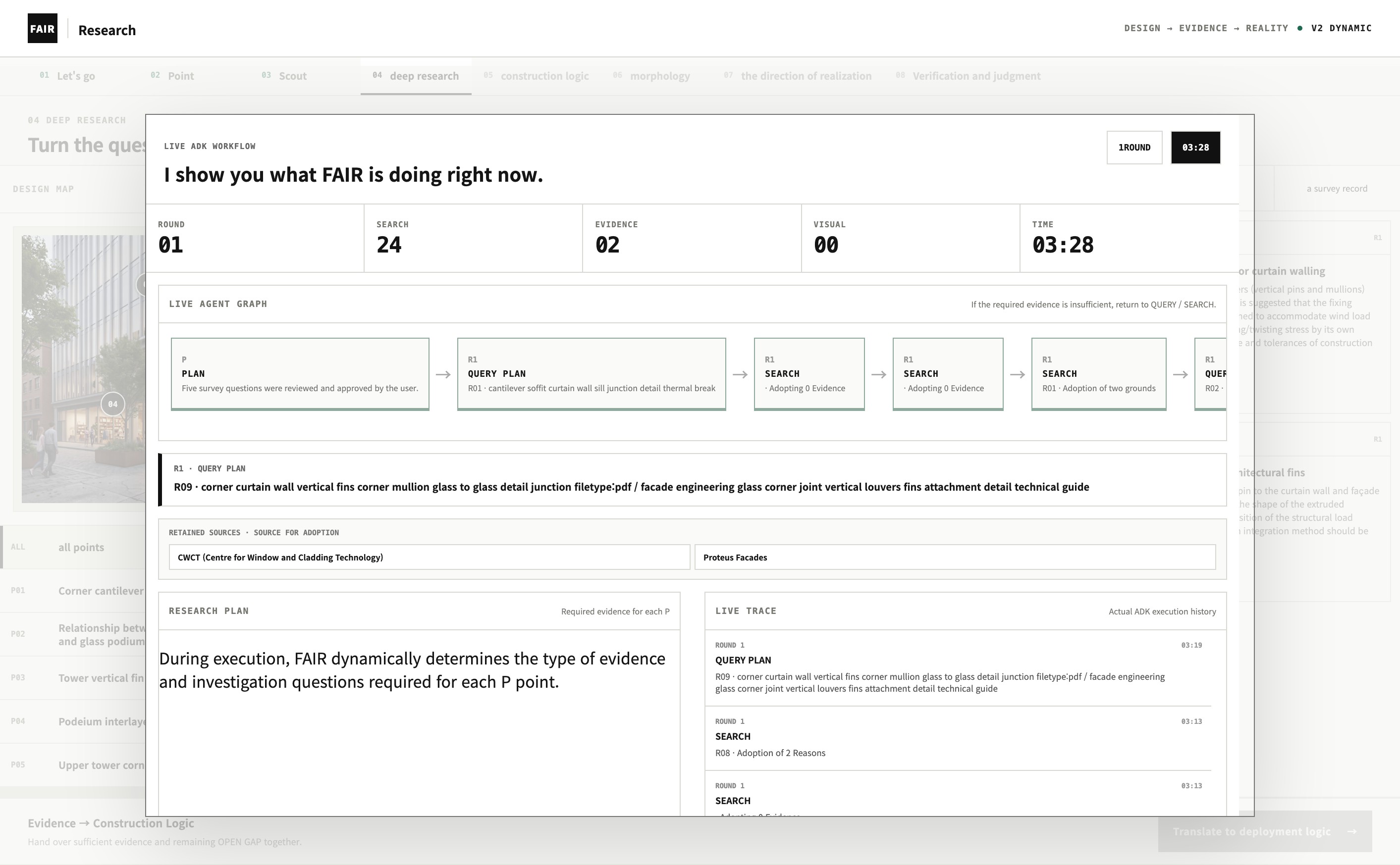
If an important gap remains, the agent can continue researching that specific topic rather than repeating the entire search.
The goal is not to generate more search results.
The goal is to create evidence-backed design intelligence.
How we built it
FAIR is being developed as an independent agent service so that it can later connect to existing architectural design tools without depending on a specific interface or database.
The core workflow is:
Design Image + Project Context
→ Design Intent
→ Research Plan
→ Evidence
→ Evidence Gap Evaluation
→ Targeted Re-Research
Google's Agent Development Kit (ADK) provides the orchestration layer.
Gemini handles multimodal interpretation of architectural images and project context, while deterministic schemas keep the agent output structured and reusable.
The system separates:
- what is directly observed in the image
- what is inferred
- what requires external evidence
- what remains unresolved
Research objects are given persistent IDs so that design elements, research questions, evidence and future FAIR database records can remain connected.
The agent is intentionally separated from deterministic architectural calculations. In the future, existing FAIR tools such as morphology analysis, performance calculation, material databases and design-generation systems can be exposed to the agent as tools rather than being rebuilt inside the LLM.
Why an agent?
A conventional research pipeline follows a predetermined sequence.
FAIR instead decides what should happen next based on the current design and the evidence already available.
This allows the system to:
- skip irrelevant research
- reuse existing evidence
- select the appropriate research tools
- identify missing evidence
- selectively research unresolved questions
- eventually monitor new information and determine whether it affects an existing project
This agent layer also creates a path toward continuous architectural monitoring: new material, technical or precedent information can be evaluated against active designs instead of simply being stored in a database.
Challenges
One of the main challenges was deciding what should remain deterministic and what should be delegated to an agent.
Architectural calculations, verified technical values and database operations should not become probabilistic simply because an LLM is available.
We therefore treat ADK as an orchestration and reasoning layer, while evidence, calculations and external tools remain independently verifiable.
Another challenge is preventing autonomous research from becoming uncontrolled search. FAIR uses explicit research states, evidence gaps and hard execution limits so that the agent has a clear reason to continue — and a clear reason to stop.
What we learned
The biggest lesson was that a useful architectural AI system does not necessarily need more data.
It needs a way to connect data to decisions.
FAIR is evolving from a passive architectural knowledge base into an active research partner that can decide what information matters for a specific design.
Don't search with keywords. Search with your design.
What we learned
What's next for FAIR — Facade Research Agent
Built With
- fastapi
- gemini3.7flash
- googleadk
- googlecloudrun
- googlesearch
- multimodalai
- pydantic
- python


Log in or sign up for Devpost to join the conversation.