-
-
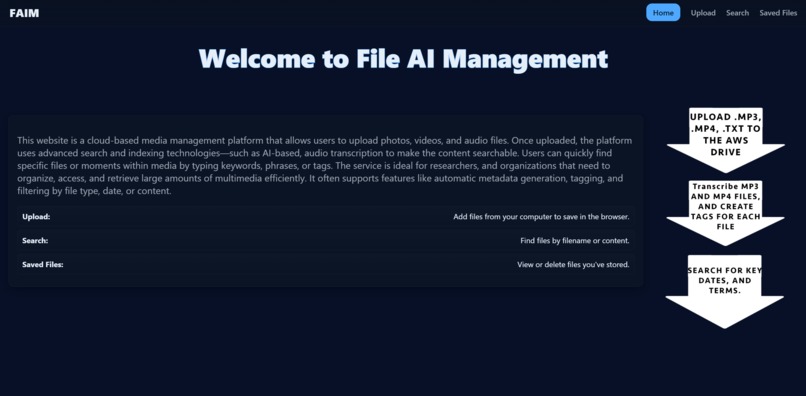
Home Page
-
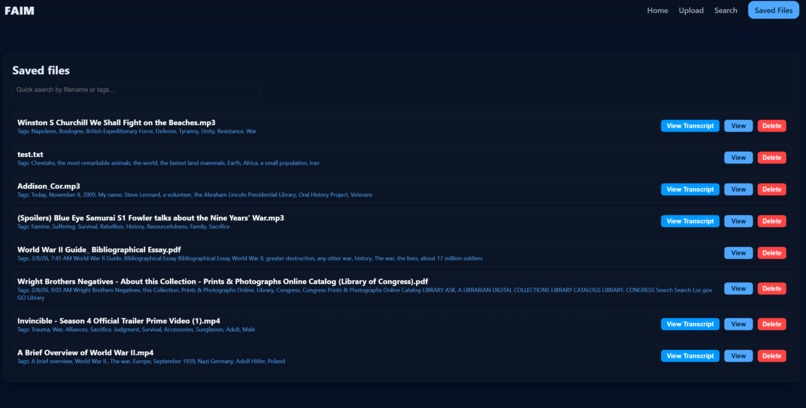
Saved Files Page
-
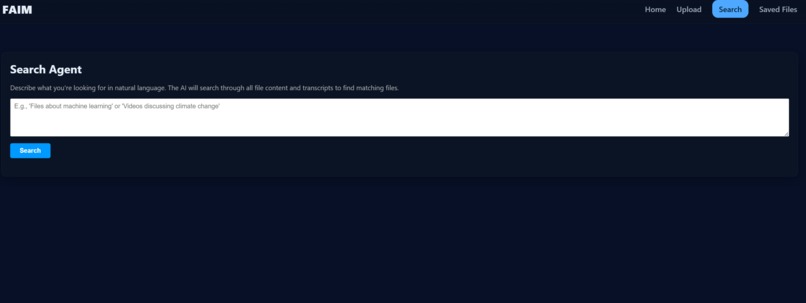
File Prompt Search
-

Upload Page


Inspiration
A deep desire to learn AWS drove us to do something linking AWS frontend hosting with AWS cloud storage.
What it does
The FAIM provides a website and cloud storage in which most common file types can be uploaded into the storage. Upon doing so, FAIM uses a variety of AI agents (depending on file type) to convert data into easily-usable information via transcripts and tags. Once uploaded and processed, it can be accessed either directly or thematically through the use of a built-in AI chatbot.
How we built it
For hosting, we used the trifecta of AWS. AWS Amplify for frontend web hosting, AWS EC2 for backend API management, and AWS S3 for cross-device cloud storage. Once the infrastructure was set up, we created a split in which uploaded information is processed according to file type, and then re-consolidated as easy text forms for the AI chatbot. Utilized Featherless AI and API and AWS for API keys regarding their respective agents.
Challenges we ran into
The BIGGEST challenge by far was trying to understand how frontend, backend, and storage all fit together online. None of us had dealt with all aspects of web creation before, and subsequently, it took us around 10 hours of asking around, prompting AI, and using our combined sleep-deprived braincells to figure it out.
Accomplishments that we're proud of
Being able to set up a full-stack application for the first time, in a competitive manner.
What we learned
AWS Frontend Hosting (Amplify), AWS EC2 Server Provisioning, AWS S3 Over-The-Cloud Resource Allocation. Coordination between multiple AWS and non-AWS services, including but not limited to Featherless API, Prompt Engineering.
What's next for FAIM - File AI Management
Encryption, scaling popularity with group sharing, more precise tagging algorithms, directory customizability (account creation, folder management, etc).
Built With
- 3s
- amazon-dynamodb
- amazon-web-services
- amplify
- ec2
- fastapi
- featherless
- qwen
- rekognition
- textract
- venv


Log in or sign up for Devpost to join the conversation.