Inspiration
I've watched incident-response playbooks fail in the same way twice: the symptoms look familiar, so someone (or an agent) reaches for the fix that looked right last time — even when that fix already failed, or only worked under a different database driver, region, or config. Vector search and "memory agents" make this worse if similarity is treated as safety.
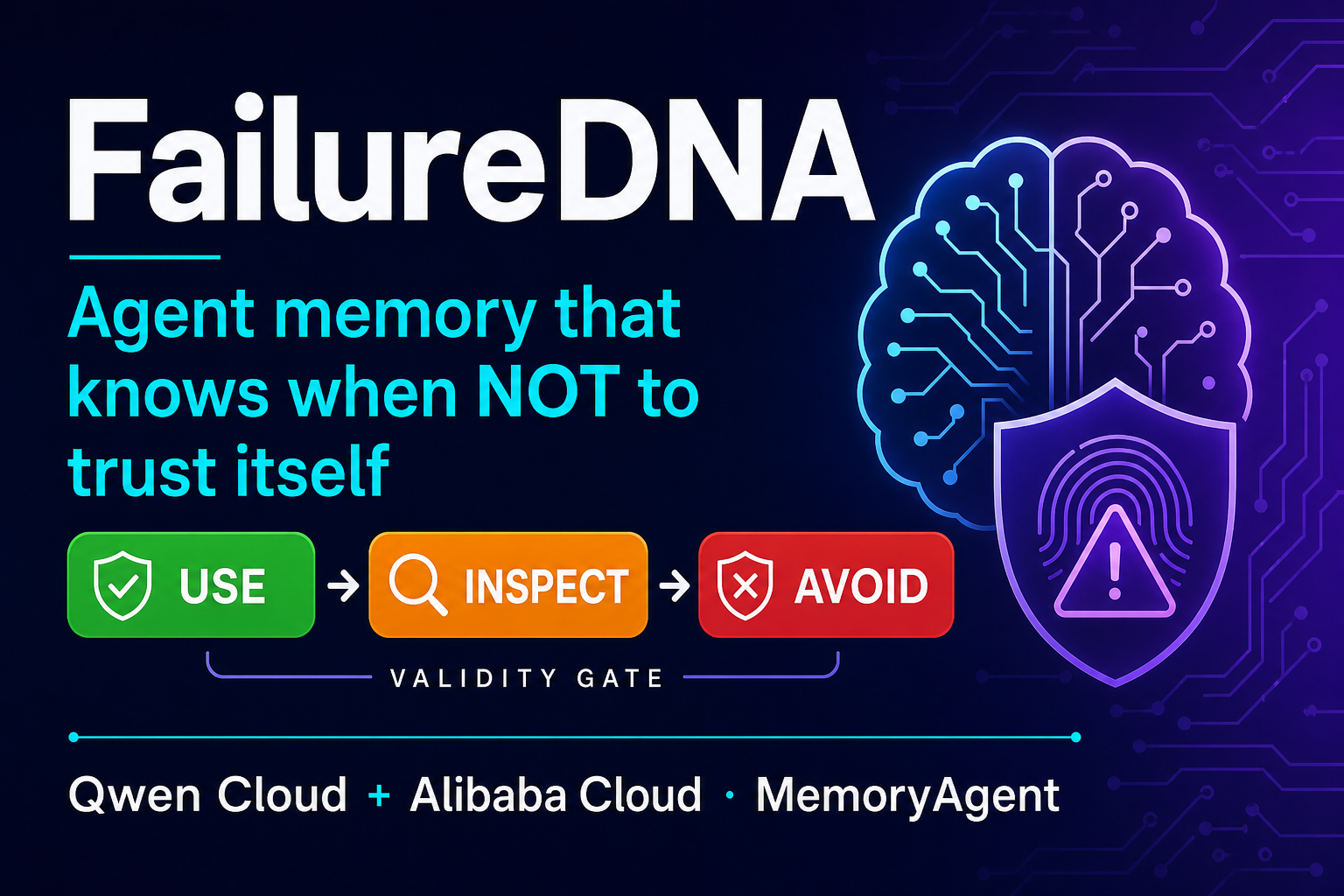
I built FailureDNA for Track 1: MemoryAgent because I wanted memory that doesn't just recall — it qualifies experience before an LLM acts. The question isn't "what happened before?" but "should we trust that memory now?"
What it does
FailureDNA is a persistent experience-memory layer for incident-response agents.
Each resolved incident becomes an episode: symptoms, environment fingerprint (driver, topology, config hash), action taken, and real outcome. On the next incident, the system:
- Retrieves candidates with hybrid semantic + keyword search (pgvector + symptom overlap)
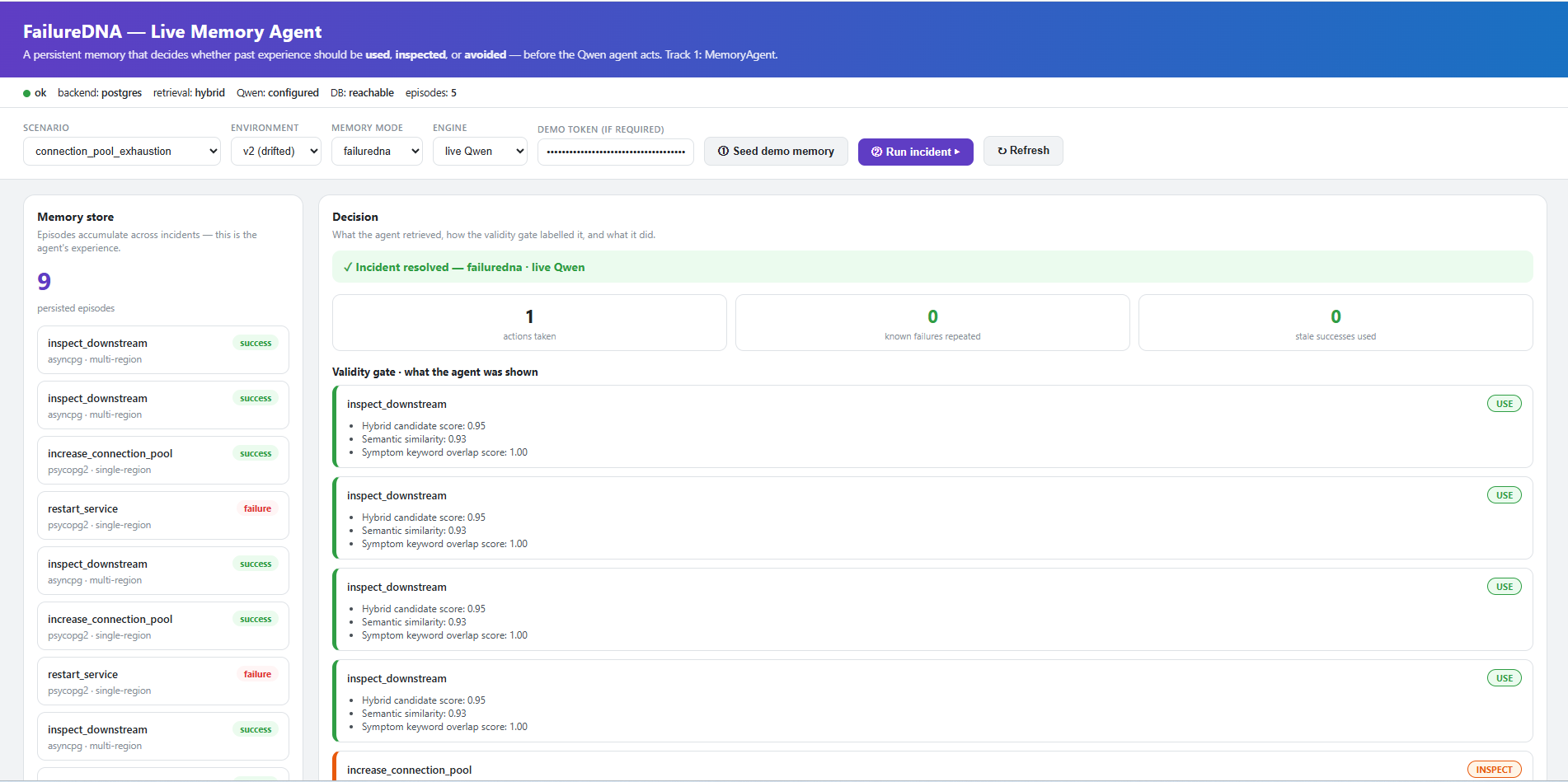
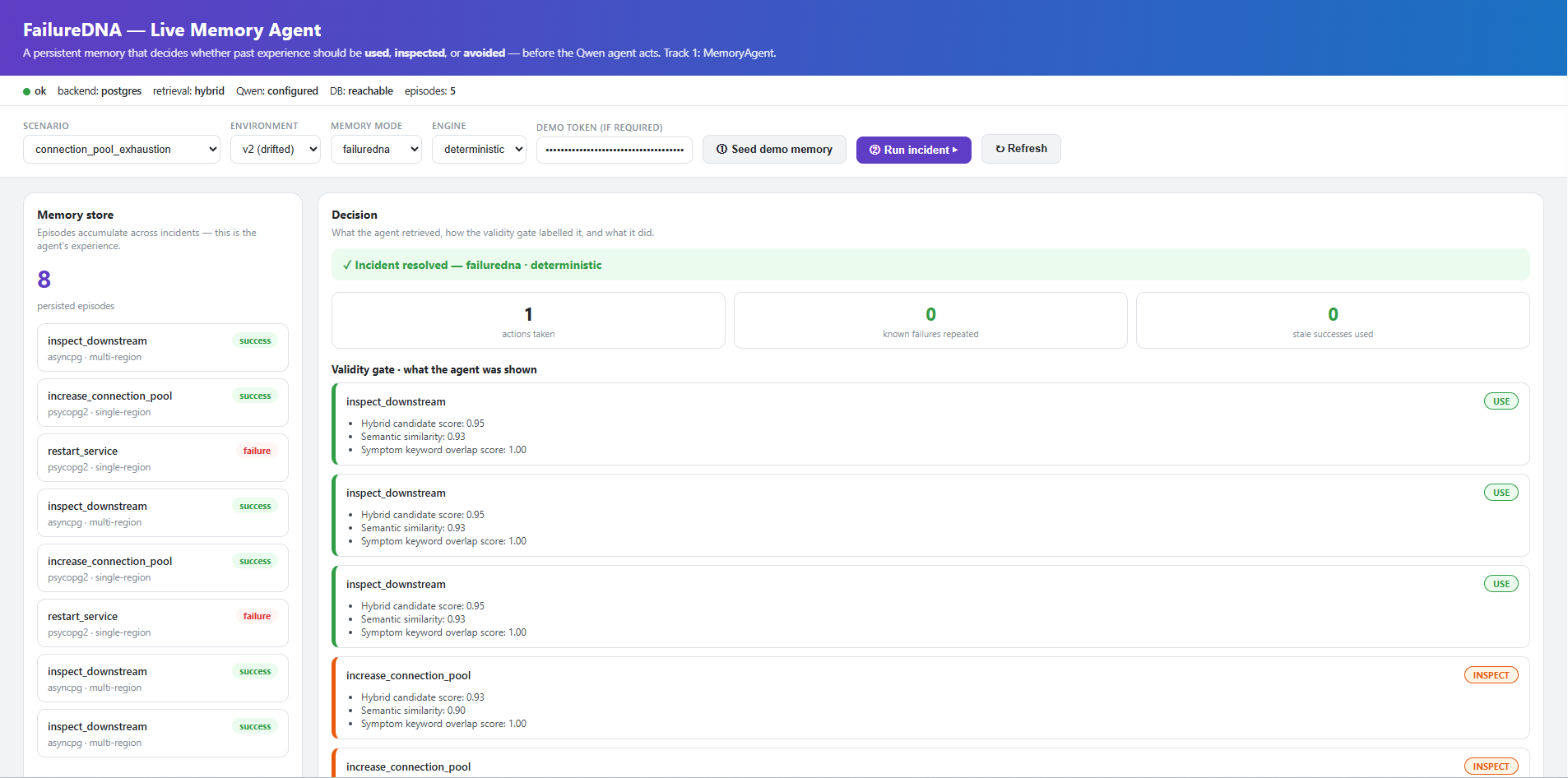
- Labels each memory use, inspect, or avoid using deterministic rules — failed actions are never offered again; stale successes are flagged when the environment drifted
- Hands bounded context to Qwen, which picks one allowlisted action as validated JSON
- Persists the new outcome back to memory
You can compare three modes side by side: no memory, naive (similarity only), and failuredna. In the live demo, a known-bad restart_service is blocked while a still-relevant inspect_downstream is chosen — with zero repeated failures.
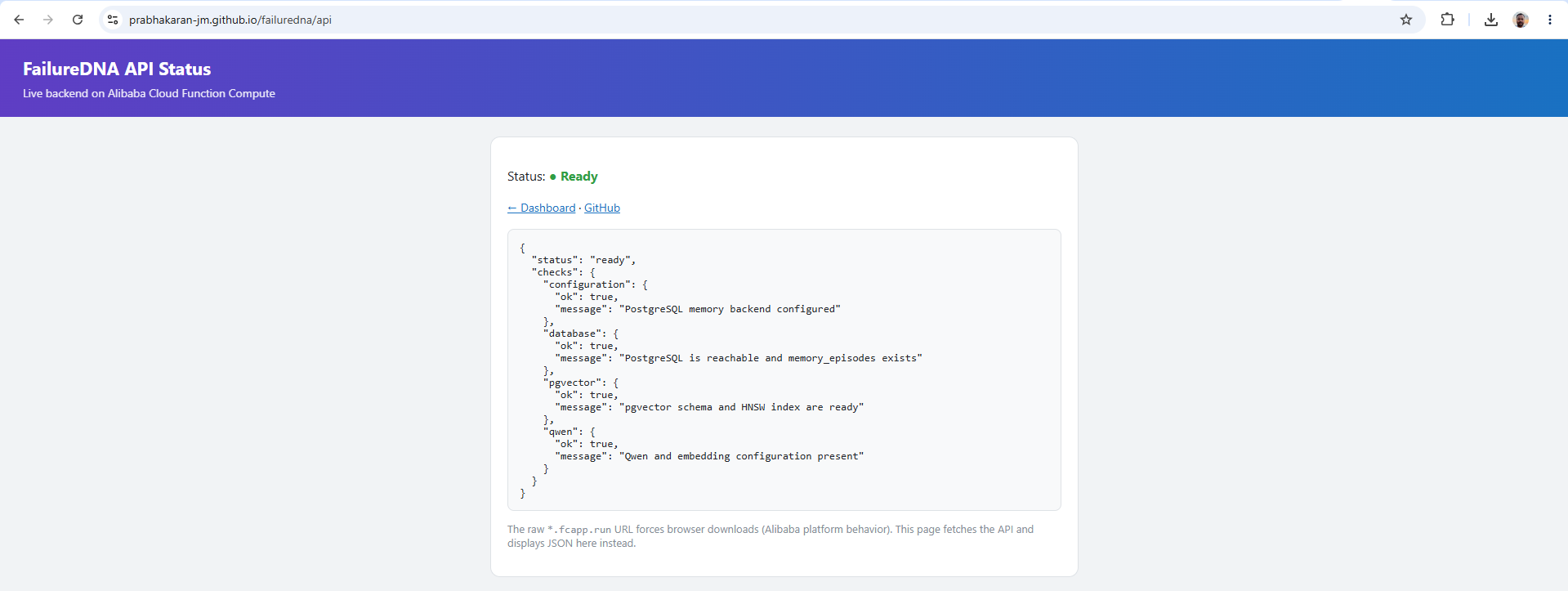
Try it: Live dashboard · API health
How I built it
As a solo developer, I built the full stack end to end:
- Backend: FastAPI on Alibaba Cloud Function Compute (custom Docker container, port 9000)
- Memory: ApsaraDB RDS PostgreSQL + pgvector (HNSW index), Alembic migrations, hybrid retrieval with Qwen
text-embedding-v3 - Reasoning: Qwen chat completions (DashScope, OpenAI-compatible) with strict JSON validation, single retry, and bounded timeouts
- Safety boundary: Qwen selects actions; validity and outcomes stay deterministic — the model never decides whether a memory is safe or what happened in the simulator
- Frontend: GitHub Pages dashboard (
docs/) talking to the FC API cross-origin - Quality: Reproducible benchmark harness (5 scenarios, fairness controls, shortcut baselines), 199+ tests, deployment smoke scripts
Architecture: retrieve → fuse scores → validity gate → Qwen decision → validate → execute → persist. See the architecture diagram and deployment guide.
Challenges I ran into
Production on Alibaba FC was harder than the app logic. The default *.fcapp.run domain forces browsers to download HTML instead of rendering /ui — so I hosted the dashboard on GitHub Pages and kept the API on FC.
Cross-origin POST was blocked for days. Browsers send an OPTIONS preflight for X-Demo-Token + JSON. The FC gateway injects Access-Control-* headers, but the app still had to return 200 on OPTIONS — my early fixes gated on an env var that was empty at runtime, so preflight kept returning 405. The fix: unconditional OPTIONS 200, zero duplicate CORS headers from the app.
Docker image deploys failed with platform of image is unknown/unknown. BuildKit was attaching provenance attestations FC rejects. I had to use buildx build --provenance=false --sbom=false and verify manifests with imagetools inspect before each deploy.
Solo scope: memory store abstraction, pgvector pipeline, Qwen client, benchmark fairness, deployment docs, and a judge-friendly live UI — all one person, one repo.
Accomplishments that I'm proud of
- Shipped a working live demo end to end: GitHub Pages → FC → RDS pgvector → Qwen, with Seed and Run working in the browser
- Designed a clear split: similarity finds candidates; deterministic rules decide trust — not "let the LLM figure out if memory is safe"
- Avoid enforcement removes known-bad actions from the candidate set before Qwen sees them — provable, not prompt-based
- Built a fair benchmark with evaluator-only labels, isolated stores per mode, and shortcut baselines so wins aren't from one lucky action
- Documented a real Alibaba Cloud path (ACR Personal Edition, VPC + RDS TLS, FC custom container) that others can follow
- Went from "Failed to fetch" on demo day to a dashboard that shows the validity gate live
What I learned
- Memory agents need a validity layer. Embeddings surface relevance; they don't prove a fix still applies after environment drift.
- Platform behavior matters as much as application code. FC gateway CORS, attachment headers, and OCI manifest formats all affected the demo — none of that showed up in local
curltests. - Keep LLMs in a narrow lane. Qwen is strong at choosing among bounded options; deterministic gates handle safety and auditability.
- Deploy early, probe with the browser. OPTIONS preflight and
imagetools inspectwould have saved hours if I'd checked them before assuming the API was "fine" from GET/healthalone. - Solo hackathons reward boring engineering: migrations, health probes, smoke tests, and docs are what make a demo survive contact with judges.
What's next for FailureDNA
- Custom domain on FC (e.g.
cloudaimldevops.com) for a cleaner demo URL and optional same-origin/ui - More incident scenarios beyond the simulator — webhooks from PagerDuty/Opsgenie, real runbook actions behind a tool boundary
- Memory lifecycle: expiry, invalidation, and supersession when a newer episode contradicts an old success
- Multi-tenant memory with scoped episodes per service/team
- Observability: export validity-gate decisions and Qwen choices as structured traces for post-incident review
- Open-source polish: Helm/Serverless Devs templates, one-command deploy, and a public benchmark leaderboard
Testing for judges
Live dashboard: https://prabhakaran-jm.github.io/failuredna/
API health: https://prabhakaran-jm.github.io/failuredna/api.html
- Open the dashboard and paste the demo token into Demo token (if required)
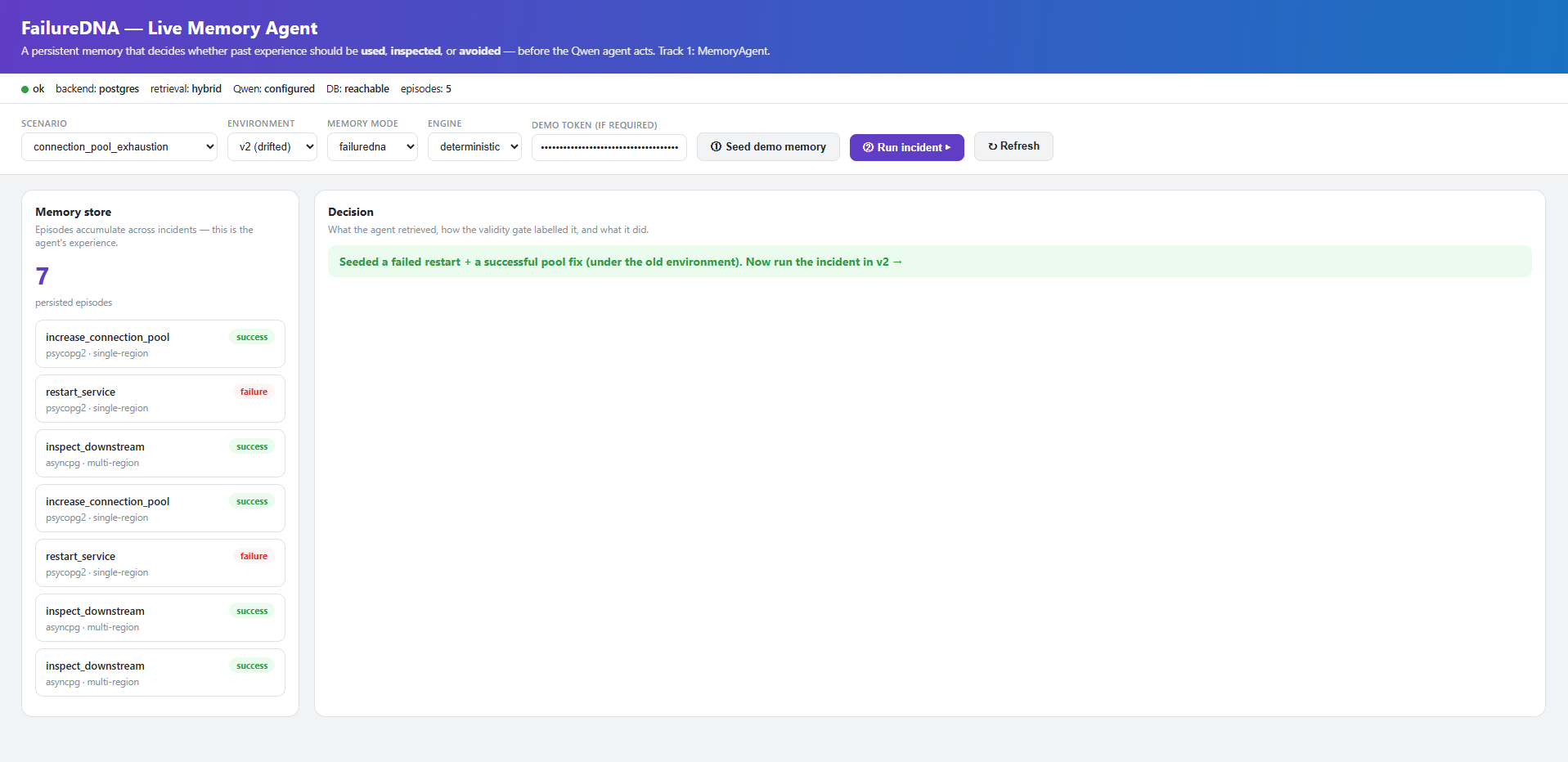
- Click Seed demo memory (once)
- Run incident — Memory mode: failuredna, Engine: deterministic
- Switch Engine to live Qwen and run again
Demo token: Shared privately with the hackathon organizers for judging.
If you are a judge and do not have the token, contact the organizers or the project submitter.
Built With
- alembic
- alibaba-cloud-acr
- alibaba-cloud-function-compute
- apsaradb-rds
- docker
- fastapi
- github
- html/javascript
- openai-compatible-api
- pgvector
- postgresql
- pydantic
- pytest
- python
- qwen-(dashscope)
- qwen-text-embedding-v3
- sqlalchemy
- uvicorn


Log in or sign up for Devpost to join the conversation.