-
-
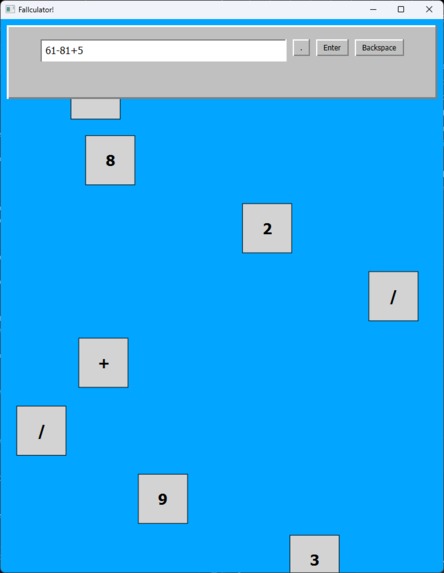
User Interface in action
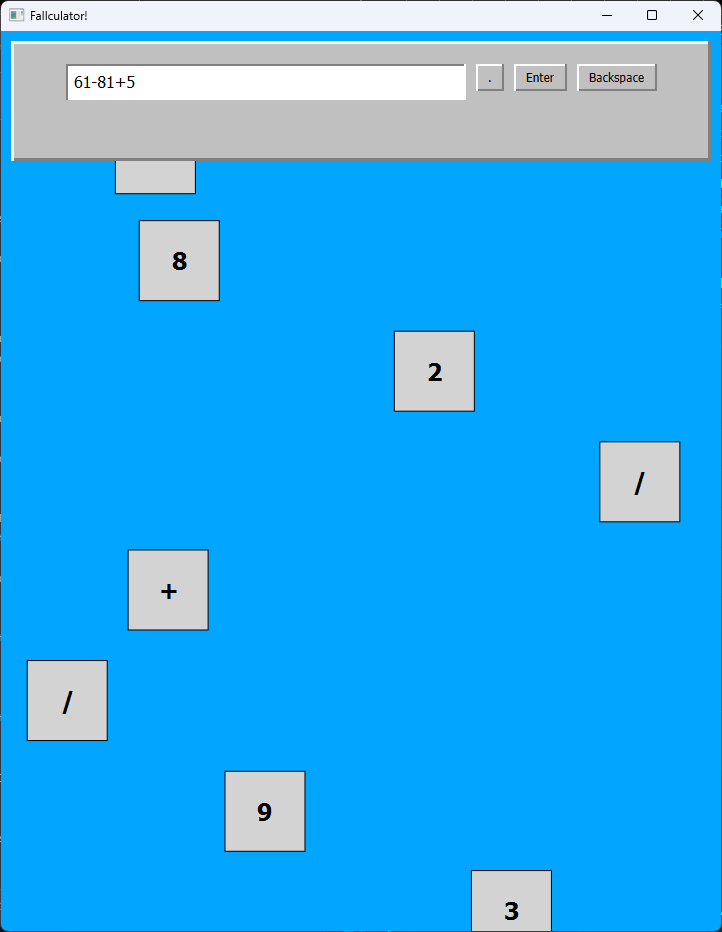
Inspiration
I recently came across a hackathon in which the prompt was to make the absolute worst volume scale user experience and I've been looking for a different medium through which to do something like that. What better than a calculator? The Windows 95-style design isn’t just for nostalgia. It’s slow, clunky, and a little unsettling — the perfect aesthetic for something that looks reliable right before it betrays you.
What it does
It's more about what it doesn't do. This calculator randomly drops numbers and operators (+, -, *, /) with which the user must make their calculations. However, it's designed to actively thwart the user by randomly disappearing tiles, disabling their function, and even speeding them up occasionally.
How I built it
Built with Java, JavaFX, and CSS.
Challenges I ran into
One of the biggest challenges for me was setting up JavaFX in the beginning. I attempted to make the project runnable completely within the Github codespace by dowloading the entire JavaFX SDK into the codespace; that was a mistake and a waste of time. After scrapping that, I just went back to my local IDE and put in the work to learn how to commit to Github from there.
Accomplishments that I'm proud of
Finally using Git properly was a huge milestone for me. I have been afraid of it for a while and absolutely mauled my way through it in a couple previous hackathons, but I took the time to figure it out and it worked in my favor. Also, I am really proud of the logic in the calculator, which was done without any external libraries. Developing the algorithm went from a flowchart on paper to a fully functioning calculator base surprisingly well.
What I learned
Github. Github. and also Github. Additionally, I learned the value of working iteratively and scaling ideas; this allowed me to completely finish a hackathon project for the first time.
What's next for FaIlculator
Mobile and web compatibility and secondary game mode


Log in or sign up for Devpost to join the conversation.