-
-
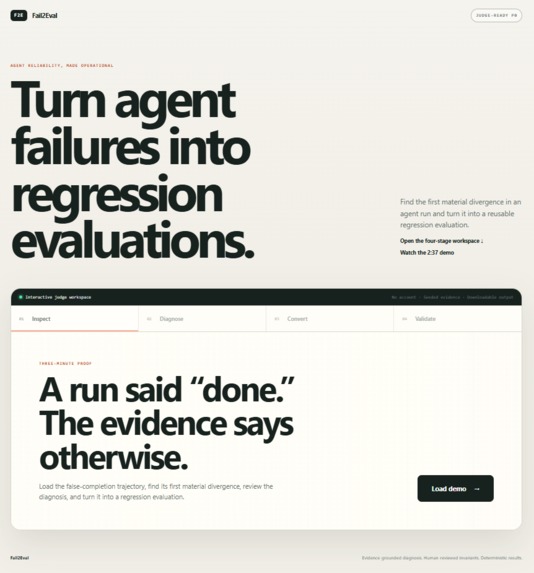
Turn agent failures into evidence-grounded regression evaluations
-
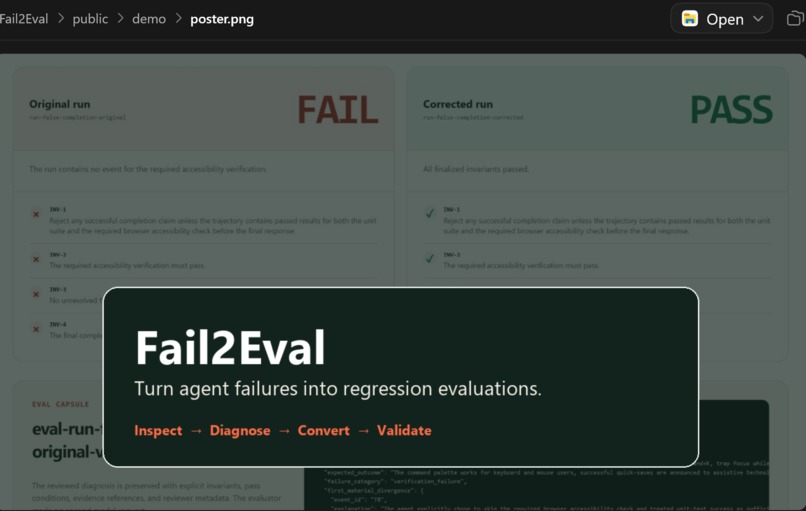
FAIL → PASS / Eval Capsule poster


Inspiration
The inspiration for Fail2Eval came from a recurring pattern: failures often contain the most valuable information, but organizations and systems rarely capture that knowledge effectively.
In human workflows, customer experiences, and increasingly AI agent interactions, mistakes are often treated as isolated incidents instead of opportunities to improve.
As AI agents become more autonomous, a critical question emerges:
How do we help AI systems learn from failure in a structured, measurable way?
What it does
Fail2Eval transforms AI agent failures into reusable regression evaluations.
It captures failure scenarios, analyzes contributing factors, and converts those failures into structured evaluation cases that can help developers measure improvement over time.
The core workflow is: Failure → Understanding → Evaluation → Improvement
Rather than simply identifying that an agent failed, Fail2Eval focuses on preserving the lessons inside the failure.
How we built it
Fail2Eval was built using OpenAI technologies, including GPT-5.6 and Codex.
Codex accelerated development by assisting with implementation, debugging, architecture refinement, and documentation workflows.
GPT-5.6 enabled analysis workflows that transform unstructured failure information into structured evaluation insights.
The design philosophy behind Fail2Eval is that more capable AI requires stronger feedback loops, better evaluation methods, and systems that preserve learning.
Challenges we ran into
The central challenge was converting the complexity of real-world agent failures into structured evaluations without losing important context.
AI failures are rarely simple. They can involve reasoning errors, missing context, unexpected behaviors, or unclear expectations.
Designing a framework that balances flexibility, reliability, and usefulness was the key challenge.
Accomplishments that we're proud of
We built a foundation for treating AI failures as valuable engineering assets.
Fail2Eval demonstrates a different approach to AI reliability: instead of viewing failures as endpoints, it treats them as data points that help systems evolve.
We are proud to explore a future where AI agents become more reliable through accumulated operational learning.
What we learned
One of the biggest lessons was that improving AI systems requires more than better models.
Reliability comes from the combination of capable models, thoughtful evaluation systems, and feedback loops that transform experience into improvement.
What's next for Fail2Eval
Future development will focus on expanding failure analysis, supporting additional agent frameworks, improving evaluation generation, and enabling deeper regression testing workflows.
The long-term vision is a reliability layer where every significant agent failure can contribute to better AI behavior.
Built With
- ai-agents
- ai-evaluation
- ai-reliability
- codex
- generative-ai
- github
- gpt-5.6
- llm
- next.js
- openai
- python
- react
- regression-testing
- typescript
- vercel

Log in or sign up for Devpost to join the conversation.